TL;DR:
- Adults in Singapore are increasingly learning Mandarin for career, social, and cultural reasons.
- Effective adult courses focus on practical communication, real-world scenarios, and consistent practice.
- With dedicated effort, adults can achieve fluency and professional proficiency regardless of age.
Mandarin is not just for school children or heritage speakers. In Singapore’s fast-moving, multilingual business environment, working professionals and expatriates are signing up for Mandarin classes in growing numbers, and for good reason. Many adults assume they’ve missed their window, that language learning belongs to childhood. That assumption is wrong. With the right structure, the right environment, and a clear purpose, adults often learn faster and retain more than they expect. This guide breaks down why Mandarin matters for adults in Singapore, what adult-focused courses actually look like, and how you can build real, lasting fluency at any stage of your career.
Table of Contents
- Why adults are learning Mandarin in Singapore
- What is ‘Mandarin for adults’? Key features and challenges
- How adults succeed: Effective learning strategies and environments
- Business and cultural nuances: Mandarin for professional success
- Our perspective: Why adult learners have an edge
- Ready to start your Mandarin journey?
- Frequently asked questions
Key Takeaways
| Point | Details |
|---|---|
| Mandarin is accessible | Adult learners in Singapore can confidently learn Mandarin with structured support and practical application. |
| Benchmarks matter | HSK and other proficiency tests provide clear goals for adult learners aiming for work or daily life. |
| Daily practice is key | Short, consistent sessions are proven to be more effective for Mandarin retention than intensive cramming. |
| Professional nuance | Business Mandarin requires etiquette and vocabulary specific to Singapore’s unique context. |
Why adults are learning Mandarin in Singapore
Singapore is home to one of the world’s most dynamic multilingual communities. Mandarin sits alongside English, Malay, and Tamil as an official language, and it carries enormous weight in both professional and social settings. For adults navigating this environment, Mandarin is vital for professional opportunities and social integration alike.
The motivations vary widely. Some adults are chasing a promotion that requires Mandarin fluency. Others are expatriates trying to connect more genuinely with colleagues, neighbors, or their children’s school community. Many are business professionals who work with Chinese-speaking clients or partners across the region and want to stop relying entirely on translators.
Here are the most common reasons adults in Singapore start learning Mandarin:
- Career advancement: Roles in finance, trade, logistics, and government increasingly list Mandarin as a preferred or required skill.
- Social inclusion: Being able to hold a conversation in Mandarin opens doors in Singapore’s Chinese-speaking community.
- Family motivation: Parents want to support their children’s Mandarin education and stay involved in their learning.
- Business relationships: Understanding Mandarin for business means reading the room, not just the contract.
- Personal enrichment: Access to Chinese literature, film, and culture becomes far richer when you speak the language.
The most common fear? “Am I too old to learn Mandarin?” The short answer is no. Mandarin aptitude research shows that adult learners bring cognitive strengths that children lack, including stronger pattern recognition, a larger existing vocabulary base, and greater self-awareness about how they learn best.
Adult Mandarin programs in Singapore are built differently from children’s classes. They move faster through grammar concepts, use professional and real-world scenarios, and assume learners can handle abstract explanation. Class sizes tend to be smaller, feedback is more direct, and the content is immediately applicable. That’s a significant advantage.
Statistic callout: Singapore’s Mandarin-speaking workforce is expanding across sectors. Adults who add functional Mandarin to their skill set report stronger client relationships and broader internal opportunities within multinational companies operating across Asia.
With the growing importance established, let’s break down exactly what Mandarin for adults really means and how it differs from children’s programs.
What is ‘Mandarin for adults’? Key features and challenges
Adult Mandarin courses are structured around practical outcomes. Whether you choose group classes, private tuition, or online sessions, the goal is the same: real communication, not just textbook exercises.
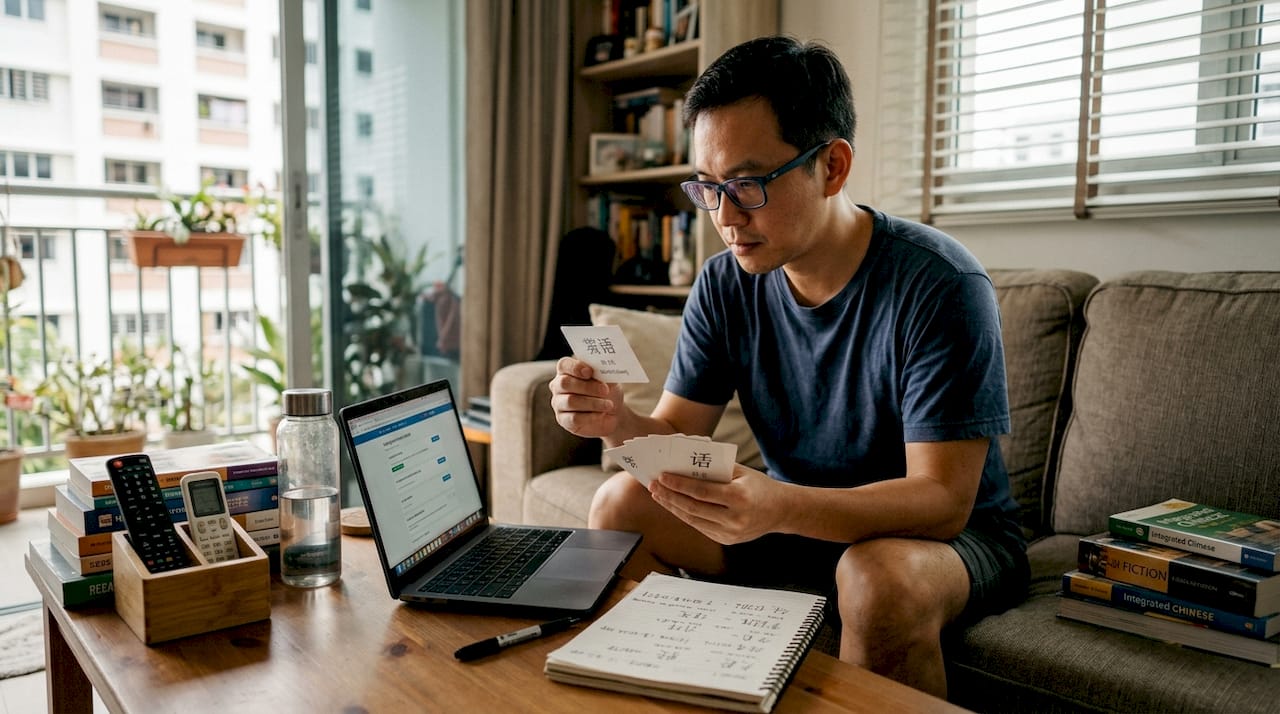
The most widely recognized proficiency standard is the HSK (Hanyu Shuiping Kaoshi), a six-level scale developed in China. Understanding HSK explained helps you set realistic goals. HSK1 and HSK2 cover basic survival Mandarin. HSK4 and above signal professional-level ability. HSK is the global proficiency standard for Mandarin, but business-level communication demands additional etiquette and vocabulary training beyond what the test covers.
Here’s how adult course formats compare:
| Format | Best for | Pace | Cost range |
|---|---|---|---|
| Group classes (3-6 students) | Social learners, structured progress | Moderate | Lower |
| Private tuition | Fast-track or job-specific needs | Fast | Higher |
| Online Zoom classes | Busy schedules, remote learners | Flexible | Moderate |
| Corporate programs | Teams, industry-specific vocabulary | Customized | Varies |
When choosing your Mandarin level, a placement test is essential. Many adults overestimate or underestimate their starting point, and the wrong level wastes time and money.
The biggest challenges adults face include:
- Tones: Mandarin has four tones plus a neutral tone. Mispronouncing a tone changes the meaning entirely.
- Character memorization: Written Mandarin uses thousands of characters. Adults without prior exposure to Singaporean Mandarin varieties often find this the steepest curve.
- Motivation dips: Progress can feel slow between HSK levels, especially at intermediate stages.
HSK pass rates globally sit at around 90% for HSK1 and HSK2, but drop to roughly 60% for HSK4 through HSK6. Small class sizes directly benefit attention and retention, which is why quality schools cap group sizes deliberately.
Pro Tip: Before enrolling, ask any school what their average class size is and how they handle learners who fall behind. A school that can answer both questions clearly is one worth trusting.
Now that we’ve seen why adults pursue Mandarin and the hurdles they face, let’s examine how to actually build momentum through proven learning strategies.
How adults succeed: Effective learning strategies and environments
The biggest mistake adult learners make is treating Mandarin like a project to complete rather than a skill to build. Skills require repetition, not just exposure. Here’s what actually works.
- Practice daily, not intensively. Consistent daily practice of 15 to 45 minutes outperforms a three-hour weekend session every time. Spaced repetition locks vocabulary into long-term memory.
- Speak from day one. Waiting until you feel ready to speak is the fastest route to staying silent forever. Use what you know, even imperfectly.
- Join a conversational group. Singapore has active Mandarin language exchange communities. Real conversations with native speakers accelerate tonal accuracy faster than any app.
- Use digital tools strategically. Apps like Pleco for character lookup and Anki for flashcard review are excellent supplements. They’re not replacements for structured instruction.
- Schedule post-course refreshers. Post-course Mandarin maintenance is one of the most overlooked steps. Many learners plateau after completing a course and lose ground quickly without a maintenance plan.
“The learners who make the most progress are not always the most naturally gifted. They’re the most consistent.”
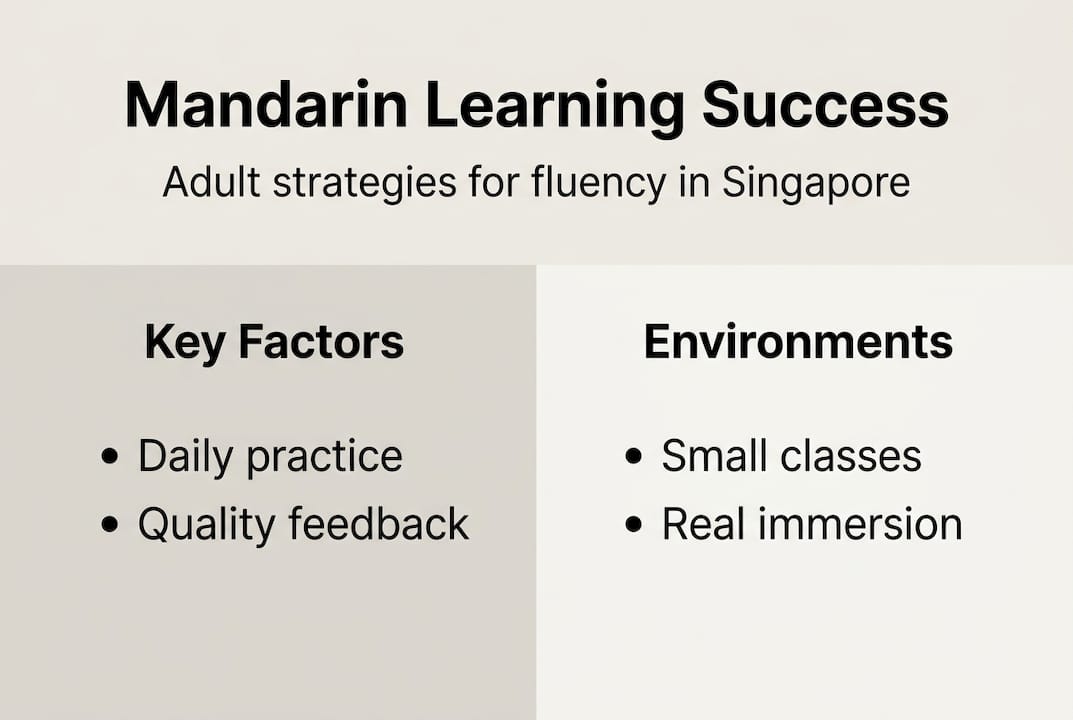
The factors in Mandarin learning that matter most include frequency of practice, quality of feedback, and exposure to authentic language outside the classroom. Singapore’s environment actually helps here. You can practice ordering food in Mandarin, reading street signs in Chinese characters, or chatting with a colleague, all within a single day.
Families can even learn Mandarin together, which creates a shared motivation and built-in accountability.
Pro Tip: Set a micro-goal each week, not just a course-level goal. For example, aim to use three new words in a real conversation by Friday. Small wins compound fast.
With the fundamentals clear, let’s look at what it takes to bring Mandarin into a professional setting.
Business and cultural nuances: Mandarin for professional success
Conversational Mandarin gets you into the room. Business Mandarin keeps you there. The gap between the two is wider than most people expect.
In Chinese business culture, guanxi (关系) refers to the network of relationships and mutual trust that underpins professional dealings. Speaking Mandarin, even imperfectly, signals respect and genuine effort. It changes how you’re perceived at the table. Cultural etiquette and guanxi matter deeply in business contexts, and placement tests are often required to determine the right entry point for professional-level learning.
Here’s how HSK levels map to professional use cases in Singapore:
| HSK level | Ability | Professional relevance |
|---|---|---|
| HSK 1-2 | Basic greetings, simple phrases | Social icebreakers only |
| HSK 3 | Simple conversations, everyday topics | Entry-level client interaction |
| HSK 4 | Fluent discussion on familiar topics | Minimum for most Mandarin job requirements |
| HSK 5-6 | Complex topics, nuanced expression | Senior roles, negotiations, presentations |
For most job postings in Singapore and China that list Mandarin as a requirement, HSK4 is the floor. University admissions in China typically require HSK4 or HSK5.
Key skills that business-specific Mandarin courses develop include:
- Industry vocabulary: Finance, law, logistics, and tech each have their own Mandarin lexicon.
- Formal written communication: Emails and reports in Chinese follow specific conventions.
- Meeting etiquette: Knowing when to speak, how to address senior colleagues, and how to handle disagreement respectfully.
- Presentation skills: Structuring a pitch or proposal in Mandarin for a Chinese-speaking audience.
Understanding Chinese business etiquette is not optional for professionals who want to build lasting relationships in this region. Language and culture are inseparable at this level.
Non-Chinese background adults face an added phonetic challenge. Without prior exposure to tonal languages, building accurate pronunciation takes longer. But it is absolutely achievable with targeted practice and the right instructor feedback.
Our perspective: Why adult learners have an edge
After years of helping adults learn Mandarin in Singapore, we’ve noticed something that surprises most new students: adults often outperform their own expectations, and frequently outperform younger learners in structured environments.
Why? Adults bring something children cannot: purpose. When you’re learning Mandarin to close a deal, connect with a client, or support your child’s education, every lesson has stakes. That focus accelerates retention in ways that passive childhood exposure simply does not.
The conventional wisdom is that children learn languages effortlessly and adults struggle. In our experience, that’s only half true. Children absorb accent and tone more naturally. But adults absorb grammar logic, vocabulary connections, and cultural context far faster. They ask better questions. They practice more deliberately.
Singapore also gives adult learners a unique advantage: the city itself is an immersion environment. Mandarin is everywhere, from hawker center conversations to boardroom negotiations. Adults who commit to optimizing Mandarin learning in this environment don’t just learn a language. They build a professional and personal asset that compounds over time.
Don’t let the myth of the “too-late” learner hold you back. The best time to start was years ago. The second best time is now.
Ready to start your Mandarin journey?
If you’ve been thinking about learning Mandarin as an adult in Singapore, the clearest next step is finding a course built for exactly where you are right now.
At Linda Mandarin, we’ve designed Mandarin courses for adults that meet learners at every level, from complete beginners to professionals targeting advanced fluency. Whether you’re exploring business Mandarin programs for career growth or simply want to communicate more confidently in daily life, we have a format that fits your schedule and goals. Start with a placement assessment to find your level, then choose your learning path with guidance from our experienced instructors. Success in Mandarin is not about age or background. It’s about finding the right structure and showing up consistently.
Frequently asked questions
Is it possible for adults to learn Mandarin fluently?
Yes, adults can reach fluency with structured courses, regular practice, and real-life immersion. Daily practice of even 15 to 45 minutes produces measurable progress over months.
What Mandarin proficiency level is required for business in Singapore?
Most employers require at least HSK4, which enables basic professional conversations and reading. HSK4 pass rates globally are around 60%, reflecting its genuine difficulty and value.
How long does it take for an adult to become conversational in Mandarin?
With consistent effort, most adults reach conversational ability in 12 to 18 months. Consistent daily practice is the single biggest factor in how quickly you get there.
Do I need a Chinese background to learn Mandarin as an adult?
No background is required. Prior exposure can ease some aspects like character recognition, but cultural background is not a prerequisite for success at any level.
What’s the difference between HSK and TOCFL Mandarin tests?
HSK uses simplified characters and is recognized across China and internationally. TOCFL uses traditional characters and is the standard in Taiwan. Both are valid credentials depending on your professional or academic goals.