TL;DR:
- Many adults fail to learn Mandarin not because of discipline issues but due to ineffective teaching methods.
- Matching instruction approaches to individual goals and learner profiles significantly improves language acquisition outcomes.
Not every adult who wants to speak Mandarin fails because they lack discipline. Many fail because they were taught with the wrong method. With mandarin teaching methods explained clearly, you can match your learning approach to your actual goals, whether that means holding a business conversation in Shanghai or navigating daily life in Singapore. The method matters as much as the hours you put in, and understanding your options before you commit is one of the most practical decisions you can make as an adult learner.
Table of Contents
- Key takeaways
- Mandarin teaching methods explained: the main approaches
- Task-based learning and why it outperforms generic practice
- AI tools in modern Mandarin teaching
- Aligning methods with proficiency frameworks
- My take on picking the right method
- Start learning Mandarin the right way with Linda Mandarin
- FAQ
Key takeaways
| Point | Details |
|---|---|
| No single method fits all | Matching the teaching approach to your learning goals and background drives better results than picking the most popular method. |
| Task-based learning reduces errors | Translation continuation tasks measurably improve output quality by training learners to reuse target language structures. |
| AI tools have clear limits | AI is best used for pronunciation drills and vocabulary practice, not as a replacement for proficiency-aligned human instruction. |
| Proficiency frameworks guide progress | Understanding ACTFL communication modes helps you choose methods that build measurable, testable language skills. |
| Combining methods works best | Mixing communicative, technology-supported, and culturally-grounded approaches produces more well-rounded Mandarin ability. |
Mandarin teaching methods explained: the main approaches
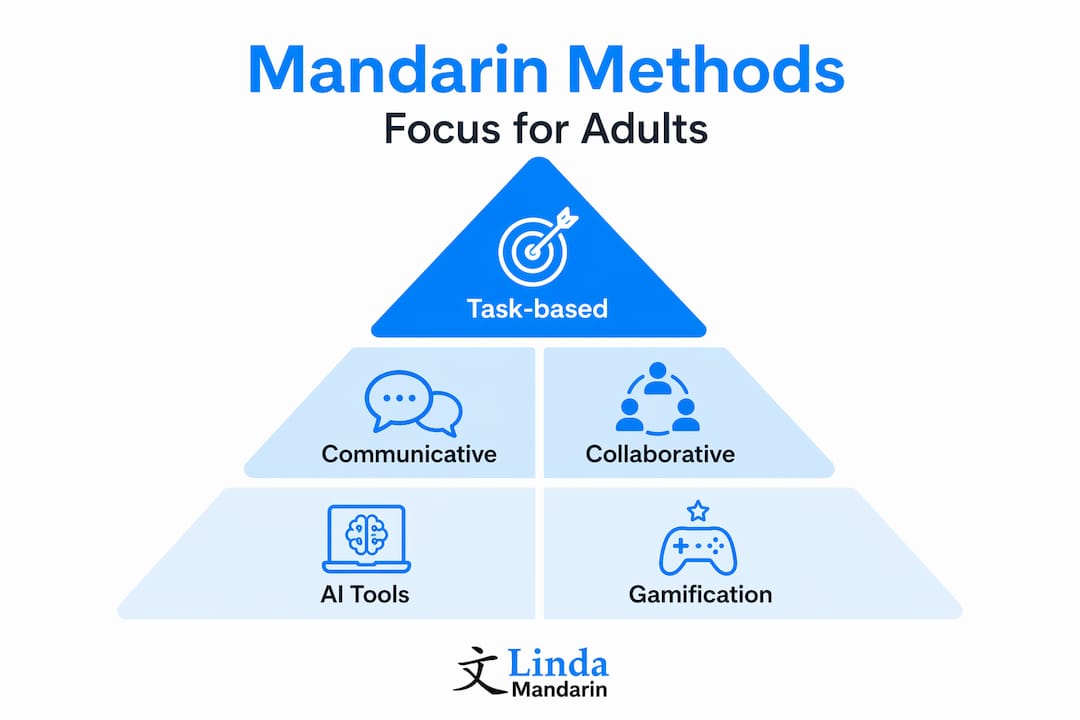
Research identifies five main Mandarin teaching approaches: gamification, digital technology, communicative language teaching, collaborative learning, and cultural integration. Each one targets different skills, suits different learners, and produces different outcomes. Understanding them gives you the ability to ask the right questions when evaluating a course or self-study program.
Here is what each approach actually means in practice:
- Gamification uses points, badges, leaderboards, and reward loops to sustain motivation. Gamified language learning works well for early-stage learners who need repeated exposure to vocabulary and tones without burning out. Apps that reward streaks and correct pronunciations are built on this model.
- Digital technology covers any learning supported by software, AI, audio tools, or video platforms. This is the broadest category and includes everything from online courses to speech recognition software.
- Communicative language teaching (CLT) focuses entirely on real conversation. Learners practice speaking in realistic scenarios rather than drilling grammar rules in isolation. The goal is functional fluency, not grammatical perfection.
- Collaborative learning puts learners together to complete tasks, discuss topics, or solve problems in Mandarin. Social interaction in language practice accelerates spoken fluency because learners must negotiate meaning in real time rather than rehearsing scripted exchanges.
- Cultural integration embeds Chinese customs, social norms, and contextual knowledge into lessons. For business learners especially, this is non-negotiable. You cannot conduct a meeting in Mandarin effectively without understanding the cultural expectations behind the words.
The key thing to understand is that method effectiveness depends heavily on matching the approach to both the learner’s characteristics and the teacher’s readiness to deliver it. A gamification-heavy approach may keep a beginner motivated, but it will not build the professional register that a business Mandarin learner needs. Know what you are optimizing for.
Pro Tip: Before selecting a Mandarin course or study plan, write down your primary goal in one sentence. “I want to hold a business meeting in Mandarin” points toward communicative and cultural methods. “I want to pass a proficiency test” points toward structured, assessment-aligned approaches.
Task-based learning and why it outperforms generic practice
Of all the Mandarin language teaching techniques available to adult learners, task-based learning may be the most underappreciated. The reason it works is not complicated. It forces you to produce language, not just recognize it.
One of the most rigorously studied formats is the translation continuation task. Here is how it works:
- Present a source sentence or short passage in the learner’s first language, then provide the beginning of a Mandarin translation.
- Require the learner to complete the translation using specific grammatical structures or vocabulary forms they have recently studied.
- Repeat the target forms across multiple tasks in different contexts, making the learner reuse the same structures intentionally.
- Review output with feedback focused on accuracy and natural usage, not just whether the meaning was conveyed.
The results are significant. Learners using this method produce higher quality translations and make measurably fewer errors compared to learners using generic practice. More specifically, the conscious reuse of target language forms during structured tasks improves language retention far more than passive exposure or unguided conversation practice.
What makes this approach genuinely different is the “continuation” element. The learner is not given a blank page. They are given a starting point that nudges them toward a specific form, and they must complete the thought accurately. This mirrors how real language use works. You do not construct sentences from scratch every time. You build on patterns you have already internalized.
For adult learners in business or professional settings, task-based learning is ideal because tasks can be designed around realistic workplace scenarios. Negotiating prices, summarizing reports, or making introductions can all be structured as continuation tasks with targeted vocabulary and grammar.

Pro Tip: When practicing with task-based methods on your own, try rewriting the same email or scenario three times using slightly different vocabulary each time. This forces structured reuse and builds flexibility in your Mandarin output.
AI tools in modern Mandarin teaching
AI has changed what adult Mandarin learners can do outside of class. Tools like ChatGPT, HelloChinese, and Duolingo offer adaptive, real-time feedback on pronunciation, vocabulary recall, and short conversational exchanges. For adult learners with irregular schedules, this kind of on-demand practice is genuinely useful.
Where these tools deliver real value:
- Tonal accuracy drills: AI speech recognition can flag when your second tone sounds like a fourth, which is immediate feedback that would otherwise require a teacher present.
- Character recognition practice: Spaced repetition algorithms in apps like Pleco or HelloChinese are proven to accelerate character retention.
- Vocabulary building at scale: AI tools can generate personalized example sentences using the words you are currently learning.
- Low-stakes conversation practice: Chatting with an AI in Mandarin removes the social pressure of speaking with a native speaker, which is useful when you need volume of practice.
The limitations, however, are real. AI alignment with standardized exam criteria and cultural-pragmatic nuance remains limited. An AI will tell you whether your pronunciation is close to standard Mandarin, but it cannot tell you whether your phrasing would come across as rude, overly formal, or culturally misaligned in a business meeting. That gap matters enormously for professional learners.
The practical takeaway is that AI tools perform best as supplements to human instruction. Use them for the high-repetition, low-context work: drilling characters, rehearsing vocabulary, and getting pronunciation corrections. Rely on an experienced teacher for everything that requires cultural judgment, register awareness, and proficiency progression. If you are learning Mandarin for business communication, skipping the human instruction layer is a mistake you will notice the moment you walk into a real meeting.
Aligning methods with proficiency frameworks
Choosing how to learn Mandarin without a proficiency framework is like training for a race without knowing the distance. You might work hard, but you will not know whether you are preparing for the right thing.
The ACTFL Proficiency Guidelines are the most widely used framework for assessing foreign language ability in the United States. They cover listening, speaking, reading, and writing across levels from Novice to Distinguished. More usefully for adult learners, ACTFL defines three communication modes: interpersonal (two-way conversation), interpretive (listening and reading for comprehension), and presentational (producing formal speech or writing).
The table below shows how each major teaching method maps to these communication modes:
| Teaching Method | Primary Communication Mode | Best Suited For |
|---|---|---|
| Communicative language teaching | Interpersonal | Conversational fluency and real-time exchange |
| Task-based learning | Presentational | Structured output, written and spoken production |
| Cultural integration | Interpretive and interpersonal | Reading context, social and business norms |
| Gamification | Interpretive | Vocabulary, tones, character recognition |
| AI-supported practice | Interpretive and presentational | Pronunciation drills, self-paced review |
The AP Chinese Language and Culture program, which assesses all three ACTFL modes in a structured exam, is a useful benchmark even for adult learners not taking the test. Its framework of integrating language and cultural knowledge reflects what real professional proficiency actually looks like.
For adults aiming at conversational or business fluency, the most productive strategy is to choose methods that actively develop interpersonal and presentational skills while using interpretive tools (apps, AI) for vocabulary and comprehension support. Explore Mandarin course levels that are explicitly organized around measurable proficiency targets so you can track your progress rather than guessing at it. You can also find practical Mandarin learning resources that support each stage of development.
My take on picking the right method
I have seen adult learners spend six months with a single app and wonder why they cannot hold a five-minute conversation. I have also seen professionals take group classes that taught them nothing relevant to their actual work context. Both situations share the same root cause: the method was chosen without a clear learner profile in mind.
Here is what I have come to believe after observing and working with adult Mandarin learners across different backgrounds. The label of the method matters far less than how well it fits the person using it. Tailoring approaches to learner profiles is not a nice-to-have. It is the single biggest driver of whether someone makes real progress or plateaus.
I also think most learners underestimate how much teacher readiness shapes outcomes. A communicative method delivered by a teacher who defaults to grammar lectures is not actually communicative teaching. You have to probe whether the instructor actually practices the method they describe.
My practical advice is this: mix methods deliberately. Use AI for your daily tonal and vocabulary drills. Use a human instructor for structured conversation practice and cultural coaching. Apply task-based techniques when you need to strengthen output accuracy. The factors that shape your Mandarin progress are multiple, and no single method addresses all of them. The best learners I have seen treat method selection as an ongoing calibration, not a one-time decision.
— Paul
Start learning Mandarin the right way with Linda Mandarin
If this breakdown of teaching methods has made one thing clear, it is that how you learn matters as much as how long you study. Linda Mandarin, based at 10 Anson Road, Level 22, International Plaza, Singapore 079903 right above Tanjong Pagar MRT, has been training adult learners since 2003 with structured, proficiency-aligned programs that combine communicative teaching, cultural context, and expert human instruction.
Whether you want faster conversational results through the intensive Mandarin course or need to build professional-grade Mandarin through corporate training, Linda Mandarin has a program designed for your specific goal. Prefer to learn remotely? The online Mandarin course delivers the same quality instruction over Zoom, on your schedule. Browse the full adult programs and find the course level that matches where you are today.
FAQ
What are the main Mandarin teaching methods for adults?
The five most researched approaches are gamification, digital technology, communicative language teaching, collaborative learning, and cultural integration. Each targets different skill areas and suits different learner goals and contexts.
How do I choose the best method for teaching Mandarin to beginners?
Start with communicative and gamification-based methods to build motivation and basic spoken patterns, then layer in task-based and cultural methods as proficiency grows. The goal is to match the method to both the learner’s current level and their end goal.
Can AI tools replace a human Mandarin teacher?
No. AI tools are effective for tonal drills and vocabulary practice, but they lack the cultural awareness and proficiency alignment that human instruction provides. Use AI to supplement, not replace, guided lessons.
What is task-based learning in Mandarin teaching?
Task-based learning requires learners to complete meaningful language tasks, such as translation continuation exercises, using specific target structures. Research shows it reduces errors and improves output quality more effectively than generic practice.
How does the ACTFL framework help with learning Mandarin?
ACTFL proficiency guidelines define listening, speaking, reading, and writing levels along with three communication modes. They give learners a measurable benchmark to track progress and help identify which teaching methods will build the skills they need most.