TL;DR:
- A structured, step-by-step HSK preparation plan helps learners move from unfamiliarity to exam confidence efficiently. Focusing on targeted vocabulary limits and realistic practice conditions ensures steady progress and stamina buildup. Prioritizing mental and physical readiness on exam day maximizes performance and reduces anxiety.
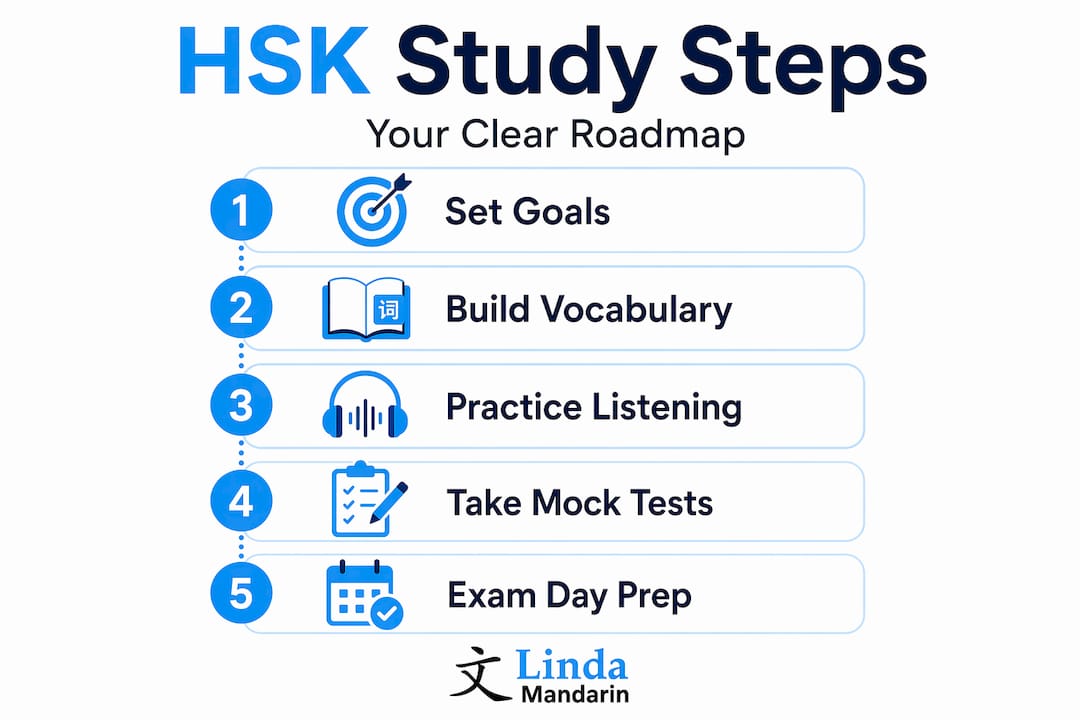
Feeling lost when you first look at HSK exam requirements is more common than you might think. The vocabulary lists are long, the test sections feel unfamiliar, and it’s hard to know where to put your energy first. A clear, step by step HSK preparation plan changes that. Instead of studying hard in the wrong direction, you study smart with a structure that moves you from zero knowledge of the exam format to genuine test-day confidence. This guide covers every phase: understanding the exam, building vocabulary, developing skills, practicing under pressure, and showing up ready.
Table of Contents
- Key takeaways
- Understanding the HSK exam before you start
- Step 1: Build your vocabulary and grammar base
- Step 2: Develop your listening, reading, and writing skills
- Step 3: Use mock tests to build stamina and readiness
- Step 4: Prepare mentally and physically for exam day
- My honest take on what actually moves the needle
- Take your preparation further with structured guidance
- FAQ
Key takeaways
| Point | Details |
|---|---|
| Know your target level first | Choose the right HSK level based on your current proficiency before spending a single hour studying. |
| Cap daily new vocabulary | Limit new words to 10-15 per day to prevent burnout and keep spaced repetition manageable. |
| Simulate real test conditions | Complete 3-5 timed, full-length practice exams without pausing or using a dictionary. |
| Stop new learning 48 hours out | Shift to light review and rest in the final two days before the exam to sharpen mental focus. |
| Mental preparation matters | Managing anxiety and exam logistics is just as important as language knowledge on test day. |
Understanding the HSK exam before you start
Before you study a single character, you need to understand exactly what you’re preparing for. The HSK (Hanyu Shuiping Kaoshi) is China’s standardized Mandarin proficiency test, and the exam’s structure and levels have evolved significantly with the HSK 3.0 update. Picking the wrong level to target wastes months of preparation.
Here’s a practical breakdown of what each level demands:
- HSK 1 and 2: Survival Mandarin. Basic greetings, numbers, and simple sentences. Roughly 150-300 vocabulary words total.
- HSK 3: Everyday conversations. You can handle common social and professional situations with around 600 words.
- HSK 4: Intermediate fluency. HSK 4 requires mastering 1,200 cumulative words and 50+ grammar patterns, with a passing score of 180 out of 300.
- HSK 5 and 6: Advanced proficiency. These levels test academic and professional Chinese at near-native depth.
The exam itself covers three core sections: listening, reading, and writing. Listening tests your ability to understand spoken Mandarin at natural speed. Reading tests vocabulary recognition and comprehension. Writing tests your ability to produce correct sentences and characters. The total test time runs between 90 and 150 minutes depending on the level, so physical stamina is part of the equation too.
Before you begin studying, gather these materials:
- The official HSK vocabulary list for your target level
- A grammar outline covering the key patterns for that level
- Two or three official practice test booklets or digital versions
- A spaced repetition app such as Anki or a similar flashcard system
Set realistic expectations from the start. HSK 1 preparation takes about 30 days of 30 to 60 minutes daily, while HSK 4 typically requires three to six months at 60 to 90 minutes per day. Write those numbers down before you commit to a test date.
Step 1: Build your vocabulary and grammar base
Vocabulary is the foundation that everything else rests on. You cannot develop listening comprehension, reading speed, or writing accuracy without solid word knowledge. This is where most candidates either gain a serious advantage or fall behind.
The most effective method is spaced repetition, which shows you words at increasing intervals based on how well you recall them. But the technique only works when you control the input volume. Limiting new vocabulary to 10-15 words daily prevents the review backlog from overwhelming you. When you add too many new words at once, the system buries you in reviews within two weeks and studying stops feeling productive.
Here is what an efficient daily vocabulary session looks like:
- Review due flashcards first, before adding anything new. This takes priority.
- Add 10 to 15 new words only after your reviews are complete.
- Learn each new word in a full sentence, not in isolation. Context sticks far better than raw translation.
- Pair vocabulary study with grammar in the same session. When you encounter a new sentence structure, write two or three original examples using words you already know.
Grammar does not need to be learned from a separate textbook. Pull grammar patterns directly from the sample sentences in your vocabulary study. When you notice a sentence uses 虽然…但是 (suīrán…dànshì), practice that pattern with five different vocabulary words. You reinforce both at once.
Pro Tip: Set a fixed time each day for vocabulary review, even 20 minutes in the morning before work. Consistency across 90 days outperforms intensive weekend sessions that leave you forgetting everything by Thursday.
The role of HSK in Mandarin learning is not just certification. It gives you a structured word list that tells you exactly what matters at each proficiency level, which removes all the guesswork from vocabulary decisions.
Step 2: Develop your listening, reading, and writing skills
Once your vocabulary base is growing, you need to develop the specific skills each test section demands. This is where preparation moves from memorization to performance.
-
Listening: The listening section plays audio only once, at near-natural conversational speed. Daily practice with podcasts and HSK-level audio materials is non-negotiable. Use the shadowing technique: listen to a short audio clip, pause, and repeat exactly what you heard, matching the rhythm and tone. This trains your ear faster than passive listening. On the actual exam, read the questions before the audio plays. You know what information to hunt for, which dramatically improves your accuracy.
-
Reading: Reading speed is the challenge here, not comprehension in isolation. Practice skimming for the main idea first, then scanning for specific details. Time yourself on practice passages. If you spend more than 90 seconds on a single reading question, you need more timed practice sessions. Reading real-world Chinese content, such as news headlines, short social media posts, or subtitled videos, builds contextual reading instinct faster than textbook passages alone.
-
Writing: The writing section is where candidates lose easy points by overthinking. Focus on standard sentence templates and character legibility rather than literary expression. A clean, correctly structured sentence earns full marks. A creative but grammatically tangled one does not. Practice sentence reordering exercises daily. These appear directly on the HSK test and train you to recognize correct grammar patterns quickly. For picture description tasks at higher levels, prepare three to four sentence templates in advance and adapt them to whatever image appears.
-
Real-world integration: The HSK 3.0 update shifted emphasis toward practical communication and critical thinking over rote memorization. Use your skills in real contexts. Watch a Chinese TV drama with Chinese subtitles. Order food at a restaurant using Mandarin. These aren’t just fun additions to your study routine. They accelerate fluency in ways that textbooks cannot replicate.
Step 3: Use mock tests to build stamina and readiness
There is a significant gap between knowing Mandarin and performing well under timed exam pressure. Mock tests close that gap.
The target is 3 to 5 full-length, timed practice exams completed before your test date. The rules are strict: no pausing the audio, no dictionary use, and no breaks beyond what the real exam allows. Simulate it completely.
| Mock test timing | What to focus on |
|---|---|
| First practice test | Identify which sections feel rushed or difficult without worrying about the score |
| Second and third tests | Track time allocation and work on the weakest section identified in test one |
| Fourth and fifth tests | Build full-exam stamina and refine your pacing for each section |
After each mock test, spend at least 30 minutes reviewing every wrong answer. Do not just note what was wrong. Understand why it was wrong. Was it a vocabulary gap? A grammar misread? A listening speed issue? That analysis tells you exactly where to focus your study in the days that follow.

The exam can run up to 150 minutes, and mental fatigue is real. Candidates who have never sat through a full-length timed practice exam often hit a wall around the 90-minute mark. Your mock tests build the mental endurance to stay sharp all the way through.
Pro Tip: Allocate time by section before you start each mock test. For HSK 4, plan roughly 30 minutes for listening, 45 minutes for reading, and 25 minutes for writing. Having a mental schedule prevents you from over-investing in early questions.
Check out these proven HSK exam tips to sharpen your test strategy even further between practice sessions.
Step 4: Prepare mentally and physically for exam day
The final phase of how to prepare for the HSK test is the one most candidates skip entirely. You can have excellent Mandarin skills and still underperform because of poor sleep, exam anxiety, or a logistical mistake on the morning of the test.
Here is what to do in the final week and on exam day itself:
- 48 hours before: Stop learning new material entirely. Avoid new vocabulary or grammar in the final two days. Light review of familiar content is fine, but your brain needs consolidation time, not new input.
- The night before: Get a full night of sleep. Eat a stable, familiar meal. Lay out your documents and identification so there is no morning scramble.
- Exam morning: Arrive at least 30 to 45 minutes early with your original government-issued ID. Late arrivals are denied entry with no exceptions.
- During the test: If a question stumps you, mark it and move on. Do not allow one difficult item to eat minutes you need elsewhere. Fill in every answer before time is called, even if you are guessing.
Managing anxiety is a skill, not a personality trait.
“Moderate nervousness can enhance focus if not magnified by comparing yourself to others or fearing failure.” (Source)
That nervousness you feel walking into the exam room is not a warning signal. It’s your brain preparing to perform. Accept it, breathe through it, and start the test.
My honest take on what actually moves the needle
I’ve worked with adult Mandarin learners long enough to spot the real dividing line between those who pass and those who retake. It almost never comes down to raw intelligence or natural language talent. It comes down to the decision to study consistently versus cramming.
I’ve seen professionals with extremely busy schedules pass HSK 4 by studying 45 minutes a day for four months. I’ve also seen people who took 10-day intensive cramming sessions and walked out frustrated with borderline scores. The difference isn’t effort. It’s distribution of effort over time.
The other thing I want to be direct about: many adults underestimate how much practical communication skills accelerate exam performance. The HSK 3.0 emphasis on real-world application means that learners who speak and listen in natural contexts are building exactly what the exam now tests. Textbook study alone puts you at a disadvantage compared to someone who supplements with real conversation.
Treat preparation as a long game. Each week of consistent study compounds. And on the day you sit that test, months of small daily decisions will show up in how clearly you understand the listening section, how quickly you move through reading, and how calmly you write your answers.
— Paul
Take your preparation further with structured guidance
If you want to move through these steps with expert support rather than on your own, Linda Mandarin offers structured courses built specifically for adult learners preparing for the HSK exam.

Located at 10 Anson Road, Level 22, International Plaza, right above Tanjong Pagar MRT in Singapore, Linda Mandarin has been training working professionals in Mandarin since 2003. The school’s syllabus is aligned with international HSK standards, and classes are available as group sessions, private lessons, or online Zoom courses, so your schedule does not have to be the reason you delay. Explore the HSK preparation course to find a program matched to your target level, or browse the full range of course levels to find the right starting point for where you are today.
FAQ
How long does it take to prepare for the HSK exam?
Preparation time depends on the level you are targeting. HSK 1 typically requires about 30 days of daily study, while HSK 4 needs three to six months at 60 to 90 minutes per day.
How many new words should I learn each day for HSK?
Cap new vocabulary at 10 to 15 words daily. Exceeding that limit creates an unmanageable review backlog that leads to burnout and inconsistent retention.
How do I prepare for the HSK listening section?
Practice daily with HSK-level audio and use shadowing to train your ear. On the test, read the questions before the audio plays so you know exactly what information to listen for.
Should I study right up to exam day?
No. Stop learning new material at least 48 hours before the exam. Light review of familiar content is fine, but rest and consolidation in the final two days improve test-day performance more than last-minute input.
How many practice tests should I complete before the real exam?
Complete three to five full-length, timed practice exams under realistic conditions, with no pausing and no dictionary. Review every wrong answer afterward to identify specific weaknesses.