TL;DR:
- Accurately assessing Mandarin proficiency requires evaluating all four skills—speaking, listening, reading, and writing—beyond simple vocabulary tests. Standardized exams like the HSK and HSKK measure different competencies and are ideal for certification or admissions, while placement exams focus on real-world ability. Self-assessment frameworks, such as ACTFL guidelines, help learners track genuine progress by examining practical language use in authentic situations.
Knowing your actual Mandarin level is harder than it sounds. Most people either overestimate themselves because they can hold a basic conversation, or underestimate themselves because they stumble on formal vocabulary. Knowing how to assess Mandarin proficiency accurately means going beyond a vocabulary quiz or grammar test. The formal term for this is Mandarin language assessment, and it covers four distinct skills: speaking, listening, reading, and writing. Whether you are an expat in Singapore, a professional preparing for a job application, or an adult learner mapping your progress, choosing the right assessment method changes everything.
Key takeaways
| Point | Details |
|---|---|
| Use the right test for your goal | Certification tests and placement exams measure different competencies, so match the method to your purpose. |
| All four skills matter | A complete Mandarin language assessment covers speaking, listening, reading, and writing, not just grammar. |
| Self-assessment has a framework | The ACTFL guidelines offer a structured way to evaluate your real-world communication ability independently. |
| Placement exams differ from certificates | Many institutions require their own placement exams and do not accept standardized test scores as substitutes. |
| Honest performance beats test prep | Demonstrating your natural ability gives more useful results than rehearsing test-specific formats. |
How to assess Mandarin proficiency with standardized tests
The most recognized starting point for assessing Chinese language ability is the HSK, which stands for Hànyǔ Shuǐpíng Kǎoshì. It is the official Chinese proficiency test used in Mainland China, and it was revised in 2021 to expand from six levels to nine, giving learners a much more granular view of their progress.
The standard HSK covers reading, writing, and listening. Speaking is assessed through a separate test called the HSKK (Hànyǔ Shuǐpíng Kǒuyǔ Kǎoshì). The HSKK measures speaking fluency across beginner, intermediate, and advanced levels, evaluating pronunciation, intonation, sentence construction, and how naturally you respond to prompts. If you want a well-rounded picture of your Mandarin proficiency, you typically need to take both.
Other standardized options include the TOCFL, which is the Test of Chinese as a Foreign Language administered in Taiwan, and the Business Chinese Test (BCT), designed specifically for workplace communication contexts.
Pro Tip: If your goal is university admission, a scholarship application, or a job offer that requests formal proof of Mandarin ability, the HSK is usually the most widely recognized option. Read up on the latest HSK format changes before registering, since the 2021 update significantly restructured the level descriptors.
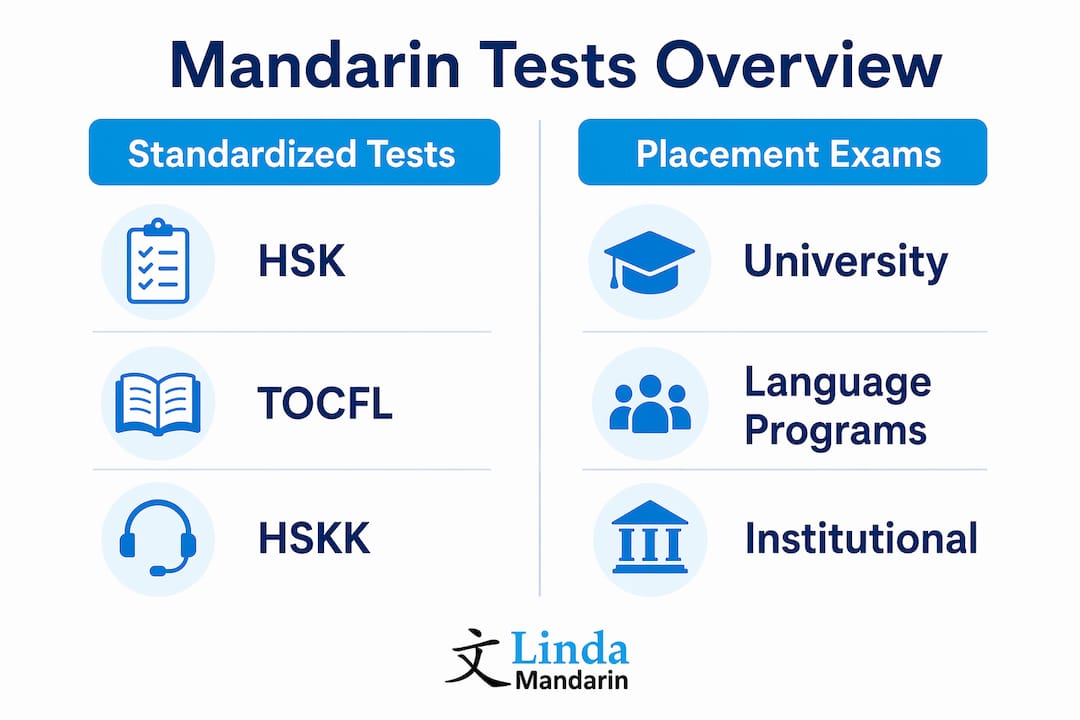
Here is a quick comparison of the main standardized Mandarin tests:
| Test | Administered by | Skills tested | Best for |
|---|---|---|---|
| HSK | Hanban / CIBPA | Reading, writing, listening | Certification, admissions, scholarships |
| HSKK | Hanban / CIBPA | Speaking only | Oral proficiency validation |
| TOCFL | LTTC (Taiwan) | All four skills | Taiwan-based academic admissions |
| BCT | Hanban | Business reading, listening | Professional and corporate settings |
One limitation of standardized tests is that strong test scores do not always reflect how well you actually communicate in real life. The HSK, in particular, rewards test-specific preparation. Someone who has drilled past papers for three months can score higher than a person who speaks fluent Mandarin but has never seen the format. This is exactly why many institutions build their own evaluation systems.
Placement and proficiency exams used by institutions
If you are applying to a university language program or enrolling in a structured course, you will likely encounter a placement exam rather than a certification test. These serve a very different function.
The University of Pennsylvania’s Chinese program is a well-documented example. Their 2025 placement exam includes both a written component and an oral interview, designed to evaluate all four skills together. No sample questions are distributed beforehand, because the test is meant to reflect your current natural ability, not your ability to prepare for a specific format.
That last point matters more than most people realize. Many institutions do not accept HSK certificates in place of their own placement exams, because the two instruments measure different things. A standardized test tells you what a learner knows. A placement exam tells an institution what a learner can do right now, under real conditions.
Here is what a typical institutional placement exam covers:
- Reading comprehension. Short passages with questions testing understanding of vocabulary in context, not isolated definitions.
- Listening comprehension. Audio recordings of natural speech, sometimes with background noise or regional accents to simulate real conditions.
- Written response. A short composition prompt that assesses grammar, coherence, and vocabulary range simultaneously.
- Oral interview. A conversation with a proctor that moves from simple questions to open-ended topics, designed to reveal how far your speaking ability actually extends.
Pro Tip: Do not try to memorize phrases or practice scripted answers before a placement interview. Institutions design these oral components to move past rehearsed responses quickly. Your best preparation is genuine Mandarin conversation practice in the weeks beforehand.
The practical takeaway here is that if you know you will face a placement exam, your goal is not to study for the exam. Your goal is to improve your actual Mandarin. That is a fundamentally different mindset from exam cramming, and it tends to produce better long-term results.
Self-assessing your Mandarin using real-world frameworks
Not every adult learner needs a formal exam. If you are tracking your own progress, preparing to enroll in a course, or just trying to understand where your gaps are, self-assessment frameworks give you a structured way to evaluate Mandarin skills without sitting a test.
The most credible framework for this comes from ACTFL, the American Council on the Teaching of Foreign Languages. ACTFL’s Proficiency Guidelines define proficiency as the ability to accomplish communication goals in spontaneous, unrehearsed situations. The evaluation criteria are captured in the acronym FACT: Functions, Accuracy, Context, and Text type. Each criterion asks you to examine not what you have memorized, but what you can actually do with the language under real conditions.
For self-assessment in practice, consider breaking your evaluation into the four skill domains:
- Speaking. Record yourself reading a short Mandarin paragraph aloud to check pronunciation and tones. Then record yourself answering three unexpected questions in Mandarin without preparation. Finally, try summarizing a short news story or article in Mandarin for at least two minutes. These three tasks mirror the structure that formal oral exams use to measure pronunciation, accuracy under pressure, and discourse control.
- Listening. Watch a five-minute segment of a Mandarin news broadcast or podcast without subtitles. Track what percentage of the content you genuinely understand versus what you reconstruct from context.
- Reading. Pick a Mandarin newspaper article on an unfamiliar topic. Time how long it takes to read one page, and note how many characters you need to look up.
- Writing. Write a short email or description in Mandarin without using translation tools. Review it for logic, grammar, and whether you can express exactly what you intended.
Pro Tip: Use the Mandarin learning resources available to adult learners to find listening and reading materials calibrated to different proficiency levels. Trying content that is slightly above your comfort zone is the fastest way to identify genuine gaps.
The ACTFL approach shifts the question from “how many words do I know?” to “what can I do with this language?” That reframe is genuinely useful, especially for adult learners who have studied Mandarin for years but still feel uncertain about their level.
Choosing the right assessment method for your goal
The criteria for Mandarin proficiency assessment change depending on what you actually need the result for. Here is a practical comparison:
| Assessment type | Best for | Skill coverage | Recognized by |
|---|---|---|---|
| HSK / HSKK | Certification, job applications, scholarships | Reading, writing, listening, speaking (separate) | Employers, universities globally |
| TOCFL / BCT | Taiwan admissions, business roles | All four skills or business-specific | Select institutions and employers |
| Institutional placement exam | Course enrollment, academic programs | All four skills, including oral interview | Specific institutions only |
| ACTFL-based self-assessment | Personal tracking, course preparation | All four skills | Informal use, coaching context |
A few principles help cut through the noise when choosing:
- If you need a certificate an employer or university will accept, sit a standardized test. For most adults in Singapore, that means the HSK preparation route is the most practical path.
- If you are enrolling in a structured Mandarin program, check whether they run their own placement exam. Bringing an HSK certificate may not be enough.
- If your goal is personal growth or career readiness rather than a formal credential, ACTFL-style self-assessment gives you the most honest picture of your real-world communication ability.
One persistent myth worth addressing: you cannot reliably convert scores between frameworks. An HSK 4 does not map cleanly onto a B2 in the Common European Framework of Reference for Languages (CEFR), even though some rough equivalencies are published. The tests measure different competencies in different ways. Treat each result on its own terms.
Practical steps to prepare and interpret your assessment
Whether you are heading toward a formal test or conducting a personal audit, the preparation process follows a similar logic.
- Define your goal first. Are you seeking certification, course placement, or personal clarity? The answer shapes every subsequent decision about which Mandarin proficiency evaluation methods to use.
- Audit all four skills honestly. Use the self-assessment approach above to identify which skill areas are strongest and which need work before you sit any formal evaluation.
- Choose your assessment format. For certification, register for the relevant standardized test and review HSK preparation steps to understand the format. For placement, focus on authentic practice rather than format drilling.
- Practice spontaneous communication. The Mandarin Upper Intermediate B2 level assesses advanced grammar, writing, speaking fluency, and cultural knowledge in realistic scenarios, which is a useful benchmark for what professional-level assessment actually demands.
- Interpret results with context. A score tells you where you are on a specific scale. It does not tell you whether you can handle a business meeting in Mandarin or follow a fast-paced podcast. Use results as one data point, not the whole picture.
Pro Tip: The single best preparation for any Mandarin assessment is extended conversation practice with a qualified instructor who can give you real-time feedback. Rote memorization of vocabulary lists rarely closes the gaps that assessment reveals.
My take on getting Mandarin assessment right
I have worked with adult Mandarin learners long enough to see a recurring pattern. People obsess over test scores and level numbers, then feel stuck because a number does not tell them what to do next. In my experience, the most useful thing any learner can do before choosing an assessment method is ask one honest question: “What do I actually need to do in Mandarin?”
If the answer is “use it in business meetings,” then a formal certification is only useful if a specific employer requires it. What you really need is to be assessed on your ability to hold a real conversation under pressure, which means a placement exam or an ACTFL-style evaluation is far more informative than an HSK score.
The adult learners who make the fastest progress are not the ones who prepare hardest for tests. They are the ones who use assessment results as a diagnostic rather than an endpoint. They find out they struggle with listening comprehension in noise, or that their tone accuracy drops when they are tired, and they work specifically on those things.
I have also seen learners avoid assessment entirely because they are afraid of the result. That is the most costly mistake of all. You cannot fix what you will not measure. Get an honest assessment, treat it as information rather than judgment, and use it to direct your learning toward practical Mandarin communication.
— Paul
Start your Mandarin journey with Linda Mandarin
Linda Mandarin has been helping adult learners in Singapore build real Mandarin proficiency since 2003. Whether you are starting from zero, preparing for a formal proficiency test, or developing the business Mandarin skills your career demands, the school offers structured courses designed for practical communication. Browse adult Mandarin course levels from beginner conversational through to advanced business Mandarin, or explore the dedicated HSK preparation program if certification is your goal. For companies, corporate Mandarin training delivers customized programs tailored to your team’s specific communication needs. Classes are available in group, private, and online Zoom formats, and the school is located right above Tanjong Pagar MRT at 10 Anson Road, Level 22, International Plaza, Singapore 079903. Contact Linda Mandarin to arrange a personal placement assessment and find out exactly where you stand.
FAQ
What is the best Mandarin proficiency test for adults?
The HSK is the most widely recognized standardized Mandarin test globally, covering reading, writing, and listening across nine levels since 2021. For speaking, the HSKK is taken alongside it as a separate oral component.
How do placement exams differ from HSK certification?
Placement exams assess all four language skills in real-time, including an oral interview, to determine your course level. Standardized certificates like HSK measure specific competencies and are often not accepted as substitutes by universities or language schools.
Can I assess my Mandarin level without taking a formal test?
Yes. The ACTFL Proficiency Guidelines offer a structured self-assessment framework based on what you can do in spontaneous, unrehearsed Mandarin communication across speaking, listening, reading, and writing.
How do I judge my Mandarin speaking level accurately?
A reliable approach separates three tasks: reading aloud to check pronunciation and tones, answering unexpected questions to measure accuracy under pressure, and giving a short oral retelling to assess discourse control and fluency.
How often should I reassess my Mandarin proficiency?
Most adult learners benefit from a formal or structured self-assessment every three to six months. This frequency is enough to track genuine progress without creating the anxiety that comes from testing too often before skills have time to develop.