TL;DR:
- Interactive Mandarin learning emphasizes active speaking, listening, and real-time feedback rather than passive memorization. It fosters faster retention and practical communication skills through structured input, output, and correction cycles using tools like live tutors and digital apps. Building an immersive environment with daily practice and feedback accelerates fluency, even outside China, through online connections and real-world interactions.
Interactive Mandarin learning is a method where you actively engage with the language through speaking, listening, real-time feedback, and practical problem-solving rather than passively memorizing vocabulary lists. This approach, formally known as communicative language teaching, treats Mandarin as a living tool from day one. Programs built on this model use structured cycles of input, output, interaction, and feedback loops to build skills you can actually use in a conversation. Tools like ChineseSkill, Yoyo Chinese, and live instruction from native tutors all fall under this framework. The result is faster retention and real communication ability, not just test scores.
How does interactive mandarin learning differ from traditional methods?

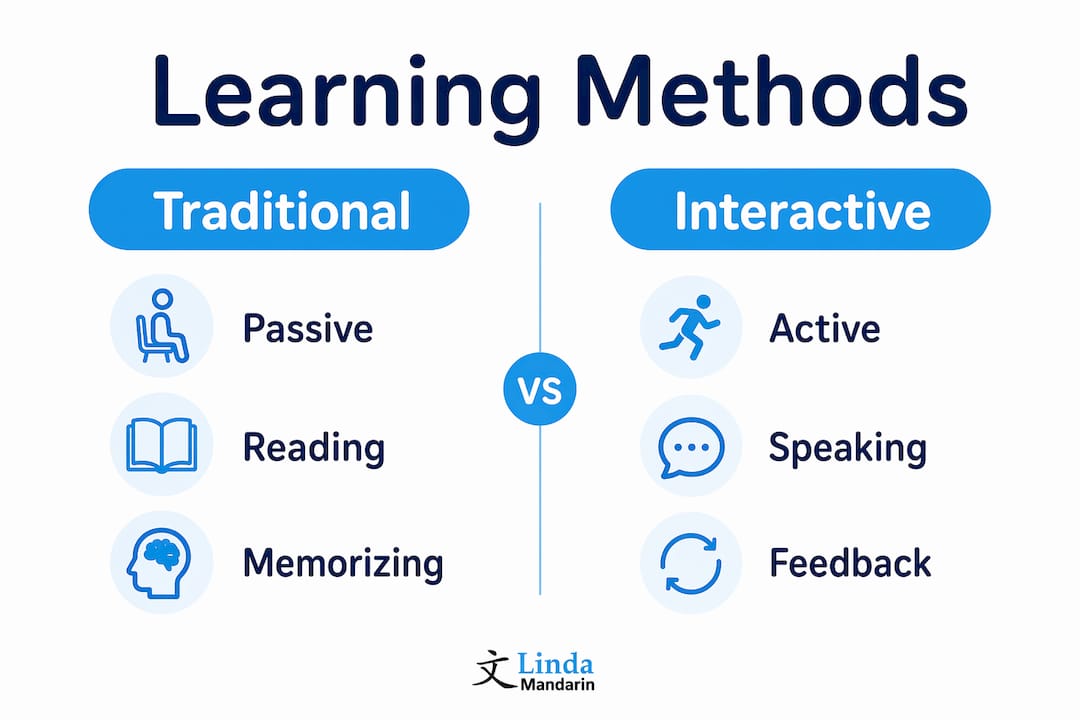
Traditional Mandarin instruction centers on passive absorption. You read a textbook, memorize tones, copy characters, and hope the grammar sticks. Interactive Mandarin learning flips that model entirely. You produce language, receive corrections, and immediately apply what you learned in a new context.
The difference in outcomes is significant. Isolated memorization of vocabulary and grammar is less effective than embedding those elements in dialogues and problem-solving tasks. That means a learner who practices ordering food in Mandarin retains the vocabulary far longer than one who writes the same words in a notebook twenty times.
One common misconception is that “immersion” automatically means interaction. It does not. Without deliberate structure, learners can spend months in a Chinese-speaking city and still default to English for every meaningful exchange. True interactive learning requires you to produce output and receive specific, immediate corrections.
Here is a direct comparison of the two approaches:
| Factor | Traditional Learning | Interactive Learning |
|---|---|---|
| Primary activity | Reading and memorizing | Speaking, listening, and responding |
| Feedback timing | Delayed (tests, homework) | Immediate (real-time correction) |
| Language context | Isolated drills | Real-life dialogues and scenarios |
| Retention rate | Lower over time | Higher through active recall |
| Practical output | Limited | Strong from early stages |
Pro Tip: If you finish a lesson and cannot use a single new phrase in a real sentence, the lesson was passive. Rebuild it around a short role-play or a live conversation task.
What are the most effective interactive techniques for mandarin?
The most effective interactive techniques combine structured output with immediate correction. No single app or method covers everything, so the strongest learners blend several approaches.
Role-playing and scenario drills are the foundation. You practice a specific situation, such as negotiating in a business meeting or asking for directions, and a tutor or partner corrects your tones and word order in real time. Interactive strategies like drills and role-playing are highly effective but depend on a supportive environment and a teacher who actively facilitates challenge alongside encouragement.
Digital tools add volume and consistency between live sessions. The most useful options for adult learners include:
- ChineseSkill uses game mechanics to reinforce tones and sentence structure through short daily sessions.
- Yoyo Chinese combines video explanations with structured speaking exercises, making it strong for Mandarin for beginners who need grammar clarity.
- Duolingo provides gamified repetition, though it works best as a supplement rather than a primary method.
- iTalki connects you with native Mandarin tutors for one-on-one conversation practice, which no app fully replicates.
AI-driven personalization is changing how apps function. Mobile platforms using AI now adapt to individual learner behavior rather than delivering the same content to everyone. These systems predict where you will struggle and adjust lesson difficulty accordingly. That level of personalization was previously only available through private tutors.
The most effective setup combines all three layers. Use an app like ChineseSkill for daily tone practice, attend live sessions with a native tutor for real conversation, and use platforms like iTalki for additional speaking time. You can explore effective ways to learn Mandarin that combine these layers into a practical weekly routine.
Pro Tip: Treat your app sessions as warm-ups, not workouts. The real learning happens when you speak to a person who can correct your tones and give you a confused look when your sentence does not make sense.
How do you build an immersive, feedback-rich learning environment?
Building an environment that forces you to use Mandarin is the single biggest accelerator for adult learners. The goal is to eliminate the option of retreating into English when things get difficult.
Follow these four steps to structure your environment effectively:
- Schedule daily speaking time with a native speaker. This does not require living in China. Platforms like iTalki and language exchange apps connect you with Mandarin speakers globally. Even 20 minutes of daily conversation practice outperforms two hours of solo study.
- Set up an input-output-feedback cycle for every new topic. First, consume input by listening to a podcast or watching a short video in Mandarin. Then produce output by summarizing what you heard in Mandarin. Finally, get feedback from a tutor or language partner on what you said.
- Use practical moments as practice opportunities. Ordinary moments like buying lunch become language practice when you commit to using Mandarin for the transaction. In Singapore, this is entirely possible at hawker centers and markets where Mandarin is widely spoken.
- Join online Mandarin communities. Groups on Reddit, Discord, and dedicated platforms like HelloTalk give you written and spoken practice with real people. Posting a short voice message in Mandarin and asking for corrections is a low-pressure way to build output habits.
The key principle behind all four steps is the same. Structured immersion with repeated contact pushes you beyond your comfort zone into meaningful interaction. Passive exposure, such as watching Chinese dramas without engaging, builds familiarity but not fluency. You can also compare online versus face-to-face Mandarin learning to decide which environment suits your schedule and learning style.
How do you measure progress and stay motivated?
Motivation in Mandarin learning drops when progress feels invisible. The solution is to make progress measurable and tie your milestones to real communication wins rather than abstract scores.
Here is how to track and sustain momentum:
- Record yourself speaking every two weeks. Compare recordings from month one to month three. Tone accuracy, sentence length, and fluency all improve visibly when you listen back. This is more motivating than any progress bar in an app.
- Use conversation milestones as benchmarks. Define specific goals: hold a five-minute conversation about your job, order a full meal without switching to English, or complete a phone call in Mandarin. These milestones reflect real ability.
- Leverage immediate feedback as a motivator. Feedback-correction loops accelerate learning beyond passive content consumption. When a tutor corrects your tone in real time and you immediately use the corrected version correctly, the win is instant and memorable.
- Balance challenge with achievability. Interactive learning increases engagement through active participation and regular measurable progress. Tasks that are too easy produce boredom; tasks that are too hard produce avoidance. The right level is one where you succeed about 70% of the time and need to push for the rest.
Understanding Mandarin teaching methods for adults helps you identify which feedback structures work best for your learning style and set realistic timelines.
Key takeaways
Interactive Mandarin learning works because structured input-output-feedback cycles build practical communication skills that passive memorization cannot replicate.
| Point | Details |
|---|---|
| Core definition | Interactive learning requires active speaking, listening, and real-time feedback, not passive study. |
| Immersion is not enough | Living in a Chinese environment without structured practice keeps most learners in an English-speaking bubble. |
| Best tool combination | Pair daily app practice with live native tutor sessions for the strongest retention outcomes. |
| Feedback drives motivation | Immediate corrections create instant wins that sustain engagement over the long term. |
| Measure real communication | Track progress through conversation milestones, not just app scores or vocabulary counts. |
Why most adults learn mandarin the hard way first
I have watched hundreds of adult learners start with the same approach: buy a textbook, download Duolingo, and study alone for three months. Then they try to speak to someone and freeze completely. The vocabulary is there. The tones are not. The confidence is nowhere.
The problem is not effort. It is structure. Most self-study programs give you input without requiring output. You recognize words but cannot produce them under pressure. That gap only closes through live interaction with someone who will correct you in the moment.
What I have found actually works is starting with a native tutor from week one, even before you feel “ready.” The discomfort of early mistakes is exactly what accelerates retention. Native tutors provide real-time guidance and an emotional connection to the language that no app can replicate. Apps are excellent for reinforcing what you learned in a live session. They are poor substitutes for the session itself.
The other mistake I see constantly is treating gamification as interaction. Earning points in an app feels productive. But genuine interactive learning requires producing output and receiving immediate correction. Points do not correct your tones. A person does.
If you are serious about Mandarin for professional or personal use, invest in structured live instruction early. Use technology to fill the gaps between sessions, not to replace them.
— Paul
Start learning mandarin interactively at linda mandarin
Linda Mandarin has delivered structured, interactive Mandarin courses for adults in Singapore since 2003. Every course, from beginner conversational Mandarin to advanced business Mandarin, is built around the input-output-feedback model described in this article. Certified native instructors fluent in English guide you through real-life scenarios, correct your tones in real time, and adapt lessons to your pace and goals.

Classes are available as group sessions, private lessons, and live online Zoom classes, all based at 10 Anson Road, Level 22, International Plaza, right above Tanjong Pagar MRT. Whether you want to build conversational confidence or develop skills for the boardroom, explore the full range of adult Mandarin course levels or find out how corporate Mandarin training can support your team’s professional communication goals.
FAQ
What is interactive mandarin learning?
Interactive Mandarin learning is a method where learners actively speak, listen, and receive real-time feedback rather than passively memorizing content. It uses structured input-output-feedback cycles to build practical communication skills.
Is interactive learning better than traditional mandarin study?
Interactive learning produces stronger retention and practical speaking ability because it embeds language in real contexts rather than isolating vocabulary and grammar in drills. Traditional methods work best as a supplement, not a primary approach.
Which apps support interactive mandarin learning for beginners?
ChineseSkill, Yoyo Chinese, and Duolingo all offer structured interactive exercises for Mandarin for beginners. For genuine conversation practice, iTalki connects you with native tutors for live, corrected speaking sessions.
How long does it take to see results with interactive methods?
Most adult learners notice measurable improvement in spoken Mandarin within 8–12 weeks of consistent interactive practice, including live tutor sessions and daily output exercises. Progress depends on session frequency and the quality of feedback received.
Do i need to live in china to learn mandarin interactively?
No. Structured immersion can be built anywhere through online tutors, language exchange partners, and daily practice in Mandarin-speaking communities. Singapore, for example, offers extensive daily opportunities to practice Mandarin in real-world settings.