TL;DR:
- English acts as a temporary scaffold in Mandarin learning, facilitating early understanding and cognitive transfer.
- Overreliance on English leads to translation errors, syntactic interference, and slower acquisition of authentic Mandarin skills.
The role of English in Mandarin instruction is to serve as a supportive cognitive tool that accelerates early learning while being deliberately reduced as proficiency grows. English-speaking adults bring real linguistic advantages to Mandarin study, but those same advantages create predictable traps. Research shows that 82% of Mandarin learners rely on their mother tongue for outlining and revising, which produces morphological, lexical, and syntactic errors at measurable rates. Understanding how English helps and where it hurts is the foundation of any effective bilingual teaching strategy.
How does English influence Mandarin learning outcomes?
English shapes Mandarin acquisition in two directions at once. The bidirectional relationship between Chinese and English means cognitive skills built in one language actively support the other. A learner who reads well in English transfers reading comprehension strategies directly into Mandarin study. That transfer works in reverse too: Mandarin tonal training sharpens phonological awareness that feeds back into English listening skills.
The risks run equally deep. When learners default to English during Mandarin practice, they produce three distinct error types. Morphological errors account for 31.1% of mistakes, lexical errors for 24.89%, and syntactic errors for 23.89%. These numbers reflect a specific failure mode: learners construct sentences in English first, then swap in Mandarin words, producing grammatically broken output.
The differences between English and Mandarin make direct translation especially damaging. English relies on verb tenses, plural markers, and articles. Mandarin uses none of them. A learner who mentally translates “I have been studying” into Mandarin will produce an unnatural sentence every time.
Phonology adds another layer. Backward transfer from English pitch patterns can selectively enhance Mandarin tone perception. English rising-falling intonation trains the ear to detect pitch movement, which gives some learners a head start on distinguishing Mandarin tones 2 and 4. This is one area where English background genuinely helps rather than hinders.
Pro Tip: Build direct mental connections between a Mandarin word and its real-world concept. Picture a cup when you learn 杯子 (bēi zi), not the English word “cup.” This trains your brain to think in Mandarin from the start.
What teaching methods effectively integrate English in Mandarin instruction?
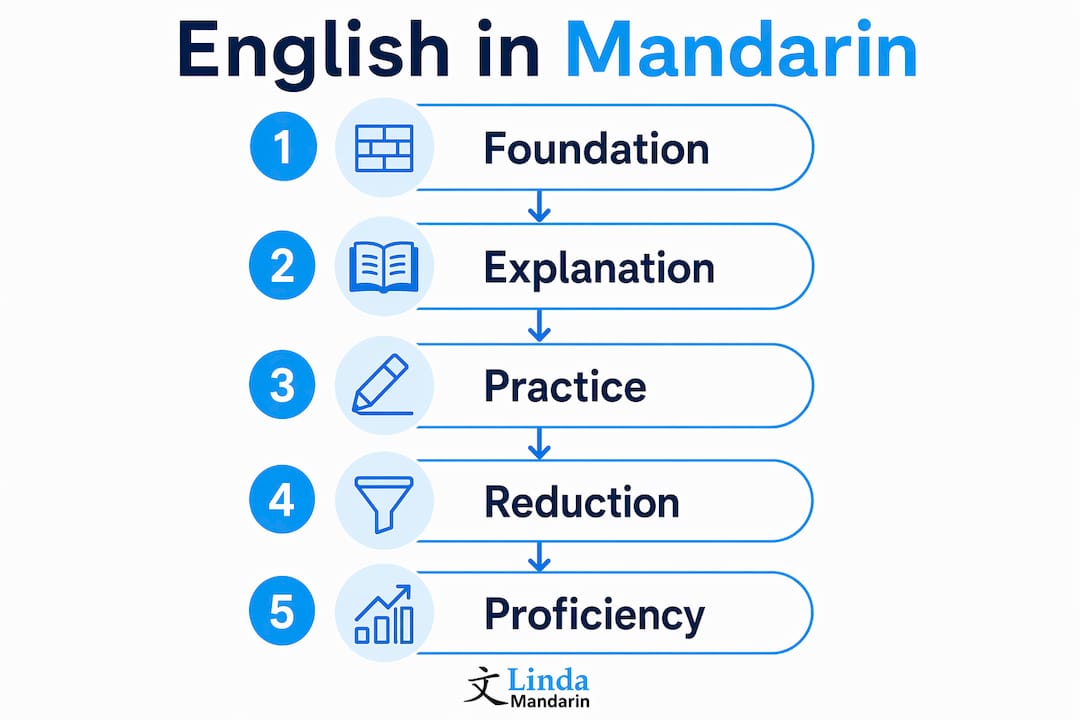
Effective bilingual education in Mandarin does not mean equal time for both languages. It means using English at the right moment, then stepping back. Interdisciplinary integration of English and Mandarin teaching methods produced an average 4.2-point increase in examination scores across 48 school-year observations between 2021 and 2023. That result came from coordinating grammar concepts, vocabulary building, and reading strategies across both languages rather than teaching them in isolation.

Cambridge researchers advocate a phased approach to English usage in language classes. Phased English teaching focuses first on broad phonetic awareness, then shifts to targeted intelligibility features. The goal is clear, adaptable communication rather than a native-like accent. This principle applies directly to Mandarin instruction: start with English scaffolding to explain tone categories, then remove that scaffolding as learners internalize the sounds.
The table below compares four common teaching approaches and their practical characteristics.
| Teaching method | English role | Best for | Key limitation |
|---|---|---|---|
| Full immersion | None | Advanced learners | Overwhelming for beginners |
| Structured bilingual | Explanatory only | Beginner to intermediate | Requires disciplined fade-out |
| Interdisciplinary integration | Conceptual bridge | Academic and professional learners | Needs coordinated curriculum |
| Translation-based | Primary medium | Absolute beginners only | Creates long-term dependency |
The structured bilingual model works best for most adult learners in Singapore. English explains the concept once, clearly. Then the instructor moves all practice into Mandarin. The translation safety net gets pulled away gradually, not all at once. Mandarin teaching methods that follow this progression produce faster speaking confidence than full immersion alone.
What challenges arise from English usage in Mandarin language instruction?
Overusing English during Mandarin instruction is the most common and most damaging mistake in bilingual classrooms. The problem is not that English appears. The problem is that it stays too long.
-
Translation dependency. Learners who hear English explanations for every new concept stop processing Mandarin directly. They wait for the English version. Over time, Mandarin becomes a code they decode into English rather than a language they inhabit.
-
Instruction time imbalance. Some immersion programs do not maintain a 50/50 Mandarin-English split. Mandarin instruction ranged from 42–48% in observed programs, with subjects like math removed from Mandarin delivery entirely. That reduction directly cuts the hours learners spend processing Mandarin in real contexts.
-
Syntactic interference. English sentence structure (subject-verb-object with tense markers) conflicts with Mandarin structure at every level. Learners who think in English before speaking Mandarin produce sentences that sound translated because they are translated.
-
Pronunciation anchoring. English phonemes anchor in the mouth before Mandarin sounds are established. Adult learners often substitute the closest English sound for an unfamiliar Mandarin initial or final, producing errors that calcify quickly without correction.
-
Curriculum conflict. When English and Mandarin are taught by separate instructors with no coordination, learners receive contradictory advice about grammar, pronunciation, and learning strategy. The importance of English in Chinese instruction is maximized only when both languages are taught within a shared pedagogical framework.
The solution to each of these challenges is the same: set a clear timeline for reducing English use, communicate that timeline to learners, and hold to it.
How can adult learners and educators apply English strategically in Mandarin learning?
Adult learners have one major advantage over children: they can consciously manage their own language use. That metacognitive ability is the key to using English well without letting it take over.
- Use English to understand, not to practice. Read the English explanation of a grammar point once. Then close it and practice the pattern entirely in Mandarin. Returning to English during practice resets the learning clock.
- Label concepts in Mandarin immediately. When you encounter a new idea in English, find the Mandarin term before you move on. Building direct concept-language connections without English translation is the fastest path to authentic Mandarin thinking.
- Set Mandarin-only windows. Dedicate 20-minute blocks to speaking or writing exclusively in Mandarin. Mistakes made in these windows are more valuable than perfect English-assisted sentences.
- Ask instructors to fade English progressively. A good instructor uses English heavily in week one and minimally by week eight. If your class still relies on English translation by the intermediate level, the pacing is off.
- Use Mandarin for business contexts early. Adult learners studying Mandarin for business communication accelerate fastest when they attach Mandarin vocabulary to real professional situations rather than abstract grammar drills.
For educators, the core principle is the same one Cambridge researchers identified: teach for intelligibility, not perfection. An adult learner who can negotiate a deal in Mandarin with minor tonal errors has achieved more than one who can recite tones correctly but cannot hold a conversation.
Pro Tip: When you catch yourself mentally translating from English before speaking Mandarin, pause and try to recall the Mandarin word directly from a memory or image. That extra second of effort builds the neural pathway that makes Mandarin thinking automatic.
Key takeaways
English serves Mandarin instruction best as a temporary scaffold, not a permanent crutch. Its value lies in accelerating early comprehension and leveraging bilingual cognitive transfer, while its risk lies in creating translation dependency that slows authentic Mandarin acquisition.
| Point | Details |
|---|---|
| English causes predictable errors | Mother tongue reliance produces morphological, lexical, and syntactic mistakes at measurable rates. |
| Bidirectional transfer is real | Cognitive skills built in English and Mandarin reinforce each other when instruction is coordinated. |
| Phased reduction is the method | English should explain concepts early, then be deliberately removed as Mandarin practice takes over. |
| Immersion ratios matter | Programs that drop below a balanced Mandarin instruction share produce weaker Mandarin outcomes. |
| Adults can self-manage | Adult learners who consciously limit English use during practice sessions progress faster than those who do not. |
What I’ve learned about English as a tool, not a crutch
The biggest mistake I see adult learners make is treating Mandarin like a puzzle to be solved in English. They hear a new phrase, immediately reach for the English equivalent, and feel satisfied once they find it. That satisfaction is the problem. The moment you have the English word, your brain files the Mandarin under “English synonym” and stops building a direct connection.
The thinking-in-Mandarin shift does not happen automatically. It requires instructors who are willing to hold the line on Mandarin-only practice even when learners push back. It requires learners who trust the discomfort of not knowing the English equivalent. And it requires a curriculum that treats English as a tool with a planned expiration date inside the classroom.
What I find encouraging is that adult learners who commit to this approach often outperform younger learners in professional contexts. They bring discipline, real-world motivation, and the ability to consciously apply what they know about how they learn. That metacognitive edge, when pointed in the right direction, makes the bilingual advantage concrete and fast.
— Paul
Adult Mandarin programs that put this into practice
Linda Mandarin has been teaching adult learners in Singapore since 2003. Its instructors are certified native Mandarin speakers who are also fluent in English, which means they know exactly when to use English and when to step away from it.

The school’s adult Mandarin course levels run from beginner conversational Mandarin through advanced business Mandarin, with group classes, private sessions, and online Zoom formats available. Corporate training programs are built around real professional scenarios, so learners attach Mandarin directly to the contexts where they will use it. Classes are held at 10 Anson Road, Level 22, International Plaza, Singapore 079903, right above Tanjong Pagar MRT, with online options for learners who prefer remote study.
FAQ
What is the role of English in Mandarin instruction?
English serves as a temporary explanatory tool in Mandarin instruction. It helps beginners understand grammar concepts and vocabulary quickly, but effective teaching phases it out as learners build direct Mandarin thinking skills.
Does English help or hurt Mandarin learning?
English does both, depending on how it is used. Bilingual cognitive transfer strengthens overall language ability, but mother tongue reliance causes morphological, lexical, and syntactic errors when learners translate rather than think directly in Mandarin.
What is the best teaching method for bilingual Mandarin instruction?
The structured bilingual method works best for most adult learners. English explains concepts early, then instruction shifts fully to Mandarin practice, with English removed progressively as proficiency increases.
How can adult learners reduce their dependence on English in Mandarin class?
Set Mandarin-only practice windows, build direct concept-to-Mandarin connections without translating, and ask instructors to reduce English explanations as you advance through intermediate levels.
Does learning English help with Mandarin tones?
English pitch patterns can selectively enhance Mandarin tone perception through backward transfer. Rising-falling intonation in English trains the ear to detect pitch movement, which gives some learners an advantage in distinguishing specific Mandarin tones.