TL;DR:
- Chinese business emails emphasize respectful language, hierarchy, and relationship maintenance over directness. They follow a five-part structure and require careful use of formal phrases and pronouns to protect face and foster trust. Building proficiency involves understanding cultural nuances, practicing aloud, and applying formal etiquette for better professional relationships.
Writing Chinese emails is a process of combining clear structure with respectful language that aligns with Chinese business etiquette. Unlike Western email conventions, which reward directness, professional Mandarin correspondence prioritizes hierarchy, harmony, and relationship maintenance above all else. Get the format wrong and your message lands. Get the tone wrong and the relationship suffers. This guide covers how to write Chinese emails correctly, from subject line to sign-off, with the cultural knowledge to back every choice you make.
How to write Chinese emails: the five-part structure
Chinese business emails follow a five-part structure: a formal greeting with an appropriate title, an introduction or statement of purpose, the main details, a polite closing, and a full signature. Each part carries weight. Skipping or shortening any section signals carelessness to a Chinese reader.

1. Subject line
The subject line sets the tone before the email is even opened. Keep it under 20 characters, use Chinese characters, and make it specific. A subject like “Meeting Request: Project Alpha Discussion on March 15” works. A subject like “Question” or “Following Up” does not. Vague subjects reduce open rates and signal a lack of preparation.
2. Greeting
The greeting is the most visible signal of respect. Use the formal salutation structure: the recipient’s title followed by their surname. “尊敬的王总” (Respected Director Wang) is the standard opening for a senior contact. Never open with a casual “Hi” or the recipient’s first name alone in a formal business context.
3. Introduction and purpose
State your purpose in the first one or two sentences of the body. Reference any prior communication if relevant. This gives the reader immediate context and shows you value their time.
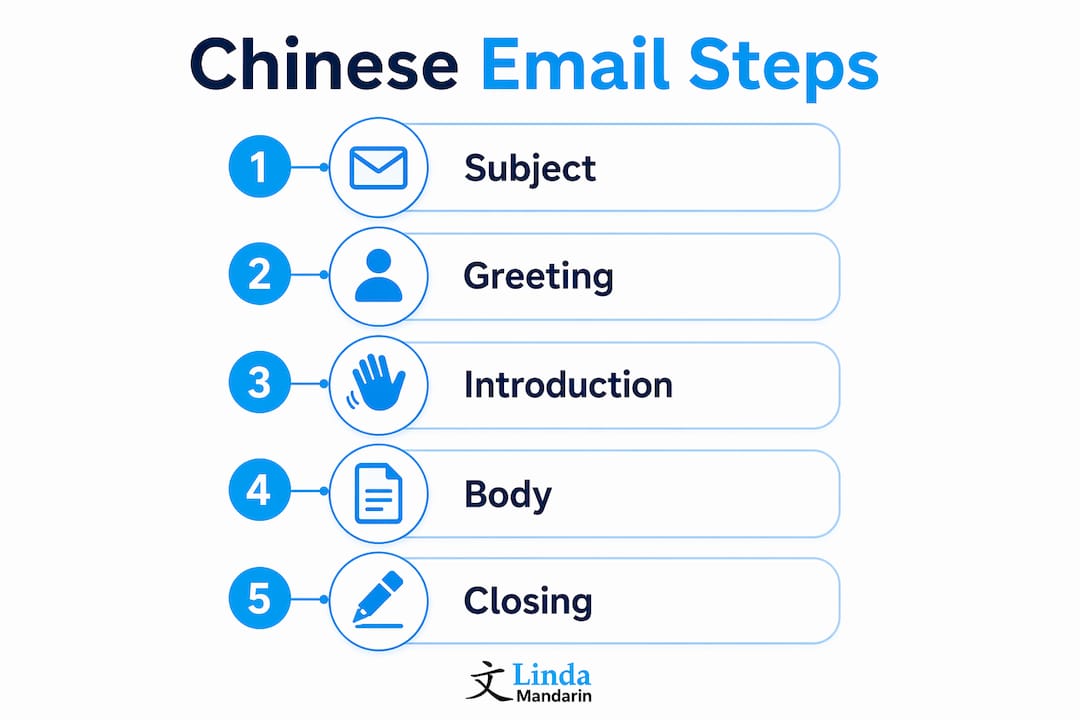
4. Main body
Keep paragraphs to about three lines each. Short paragraphs improve readability and make the email easier to scan. Organize your points logically and use softening language throughout. Avoid bullet-point lists in formal Chinese emails unless the context is clearly transactional.
5. Closing and signature
End with a formal closing phrase. Sign-off phrases such as “顺颂商祺” convey respect and goodwill and are standard in business correspondence. Your signature must include your full name, position, company name, and contact details.
| Email part | Purpose |
|---|---|
| Subject line | Specific, under 20 characters, in Chinese characters |
| Greeting | Formal title plus surname, never casual |
| Introduction | State purpose immediately, reference prior contact |
| Main body | Short paragraphs, polite and indirect language |
| Closing and signature | Formal phrase, full contact details |
Pro Tip: Draft your subject line last. Once you have written the full email, you will have a clearer sense of the single most important point, which makes for a stronger, more specific subject.
How to apply Chinese email etiquette and culturally appropriate language
Western email etiquette focuses on directness, while Chinese communication prioritizes hierarchy and harmony. The relationship maintained through language is often more important than the content itself. This is the single biggest adjustment most professionals need to make when writing emails in Chinese.
The concept of “face” (mianzi) governs how criticism, disagreement, and requests are expressed. Direct criticism in a written email creates a permanent record of embarrassment. Maintaining face means choosing indirect, diplomatic phrasing at every turn.
Key etiquette principles to apply:
- Use “您” (nin) instead of “你” (ni) when addressing anyone senior or unfamiliar. Improper pronoun use is one of the most common and damaging mistakes in professional Chinese email.
- Avoid direct imperatives. Replace “Send me the report by Friday” with “Could you kindly share the report when convenient?”
- Never criticize a person’s work directly. Frame feedback as a shared problem to solve together.
- Limit CC and BCC usage. Copying multiple people on a sensitive exchange risks public embarrassment and damages face for everyone involved.
- Match your level of formality to the recipient’s seniority. The more senior the reader, the more formal your language must be.
“The ‘what’ of the email message is often secondary to the ‘relationship’ maintained through language.” — Chinese business communication principle
Pro Tip: Before sending, read your email aloud and ask: does any sentence sound like a command or a complaint? If yes, rewrite it as a question or a collaborative suggestion.
Understanding Chinese business culture and etiquette at a deeper level will make these adjustments feel natural rather than forced.
Which common Chinese email phrases optimize professional communication?
The right vocabulary separates a competent email from a truly professional one. Chinese business correspondence relies on a set of established phrases that signal respect, politeness, and cultural fluency. Learning these phrases is one of the fastest ways to improve your writing.
Formal salutations
- 尊敬的… (Zūnjìng de…) — “Respected [Title and Name],” used for senior contacts
- 您好 (Nín hǎo) — “Hello” in the formal register, appropriate for most professional emails
- 您好,[Name]总 — A slightly warmer formal opener for contacts you know well
Polite request phrases
- 请问 (Qǐng wèn) — “May I ask,” used to introduce a question politely
- 能否帮忙 (Néng fǒu bāngmáng) — “Would you be able to help,” a soft request form
- 麻烦您 (Máfan nín) — “Sorry to trouble you,” used before making a request
- 烦请 (Fán qǐng) — “Please kindly,” a formal way to make a direct request without sounding demanding
Soft disagreement and negotiation phrases
- 我们可以再商量一下 (Wǒmen kěyǐ zài shāngliang yīxià) — “We can discuss it further,” a face-saving way to push back
- 需要进一步考虑 (Xūyào jìnyībù kǎolǜ) — “This requires further consideration,” used to delay or redirect without refusing outright
Expressing thanks and closing remarks
- 感谢您的支持 (Gǎnxiè nín de zhīchí) — “Thank you for your support”
- 期待您的回复 (Qīdài nín de huífù) — “Looking forward to your reply”
- 顺颂商祺 (Shùn sòng shāng qí) — A formal closing phrase meaning “Wishing you business success”
Mastering these phrases gives your emails a natural, professional tone that native readers will recognize immediately. For a broader vocabulary foundation, the business Mandarin terminology guide covers the full range of professional language you will need.
What are the best practices and common mistakes in Chinese email writing?
Most errors in professional Chinese email writing come from applying Western habits to a Mandarin context. The fixes are straightforward once you know what to watch for.
Common mistakes to avoid:
- Using “你” (ni) instead of “您” (nin) when addressing a superior or new contact. This reads as disrespectful and undermines your credibility immediately.
- Opening with a casual greeting like “Hey” or “Hi [First Name]” in a formal email. Always use the full formal salutation structure.
- Overusing urgent language. Phrases like “ASAP” or “urgent” in every email lose their impact and can feel aggressive in a Chinese professional context.
- Sending complex or sensitive discussions entirely by email. Chinese professional emails function as formal documents; large or nuanced discussions are better handled in a scheduled meeting.
- Using red font or excessive color formatting. Avoid overusing colors such as red, which can imply error or warning and undermine the professional tone of your message.
- Hitting “Reply All” carelessly. Digital habits like Reply All can cause unintended embarrassment in Chinese workplaces by exposing private exchanges to a wider audience.
Best practices that set you apart:
- Proofread for tone, not just grammar. A grammatically correct email can still offend if the register is wrong.
- Keep every paragraph to three lines or fewer. Dense text signals disorganization.
- Use softening modal phrases in at least two or three places per email to maintain a polite, collaborative tone.
- Review your closing phrase. A generic “Best regards” translated literally into Chinese reads as informal. Use established formal closings like “顺颂商祺” instead.
Pro Tip: Keep a personal template file with your most-used opening, request, and closing phrases. Paste and adapt them for each email rather than writing from scratch. This saves time and keeps your tone consistent.
For more on effective business communication in Mandarin, the principles that apply to email extend directly into meetings, presentations, and negotiations.
Key takeaways
Composing professional Chinese emails requires a five-part formal structure, consistent use of respectful language, and a clear understanding of face and hierarchy in every phrase you choose.
| Point | Details |
|---|---|
| Follow the five-part structure | Every professional Chinese email needs a greeting, purpose, body, closing, and full signature. |
| Use “您” not “你” | The formal pronoun is mandatory when addressing seniors or unfamiliar contacts. |
| Protect face at every step | Avoid direct criticism and limit CC usage to prevent public embarrassment. |
| Keep subject lines specific | Under 20 characters, in Chinese characters, with a clear topic reference. |
| Use established closing phrases | Formal sign-offs like “顺颂商祺” signal cultural fluency and respect. |
What I’ve learned from years of watching professionals get Chinese email wrong
Most professionals who struggle with writing emails in Chinese are not making vocabulary errors. They are making relationship errors. They write emails that are technically correct but culturally tone-deaf, and they cannot figure out why responses are slow or cold.
The biggest shift I have seen work is this: stop thinking of email as a tool for transmitting information and start thinking of it as a tool for maintaining a relationship. Every sentence is a small signal about how much you respect the reader. The greeting, the pronoun choice, the closing phrase, all of it adds up to a picture of who you are as a professional.
Patience matters more than speed in Chinese digital correspondence. Sending a follow-up email the next day because you have not heard back is a Western reflex that reads as pressure in a Chinese context. Give it time. A well-written, respectful email will get a response.
The professionals I have seen improve fastest are the ones who practice phrasing out loud before they write. They read their draft aloud, catch anything that sounds blunt or demanding, and rewrite it. That habit alone eliminates most of the common mistakes. Pair that with genuine curiosity about Chinese business etiquette and you will write emails that open doors rather than close them.
— Paul
Build your Chinese email skills with structured training
Writing professional Mandarin emails is a skill that improves fastest with structured practice and expert feedback. Reading guides helps, but applying the language in real business contexts is what builds lasting confidence.

Linda Mandarin, Singapore’s established Mandarin language school located above Tanjong Pagar MRT, offers business Chinese writing courses and corporate Mandarin training designed specifically for working adults. Courses cover professional email writing, formal correspondence, and the cultural knowledge that makes your Mandarin communication credible. Group classes, private sessions, and online Zoom options are all available to fit your schedule.
FAQ
What is the correct format for a professional Chinese email?
A professional Chinese email follows five parts: a formal greeting with title and surname, a clear statement of purpose, the main body with polite language, a formal closing phrase, and a full signature with contact details.
Which pronoun should I use when writing emails in Chinese?
Always use “您” (nin) instead of “你” (ni) in professional Chinese emails. Using the informal pronoun with a superior or unfamiliar contact is a significant etiquette error.
How long should a Chinese business email subject line be?
Keep the subject line under 20 characters and write it in Chinese characters. Use a specific topic reference rather than vague terms like “Question” or “Update.”
How do I express disagreement politely in a Chinese email?
Use indirect phrases such as “我们可以再商量一下” (we can discuss it further) or “需要进一步考虑” (this requires further consideration) to push back without causing offense or damaging face.
Should I handle complex negotiations entirely by email in Chinese business culture?
No. Chinese professional emails serve as formal documentation. Complex or sensitive discussions are better handled in a scheduled meeting, with email used to confirm details and maintain a written record.