TL;DR:
- Progressive Mandarin learning combines comprehensible input and chunk-based practice to build fluency steadily. It uses content slightly above the learner’s current level, emphasizing daily engagement and active speaking to enhance language acquisition and cognitive skills.
Progressive Mandarin learning is a structured method where adults advance by consistently engaging with Mandarin content they mostly understand, then actively practicing language chunks to build real fluency. The approach draws on the i+1 comprehensible input principle, which means your study material stays just one step above your current level. Effective progress requires 30–60 minutes of daily input at the right difficulty. Mandarin’s tonal system, character structure, and grammar make this graduated exposure especially powerful for adult learners with professional communication goals.
What is progressive Mandarin learning and how does it work?
Progressive Mandarin learning is defined as a method that pairs comprehensible input with chunk-based speaking practice to produce steady, measurable fluency gains. The term “structured Mandarin learning” is the recognized industry phrase for this approach. Both terms describe the same core idea: you move forward by building on what you already know, not by memorizing grammar rules in isolation.

The foundation is the i+1 input hypothesis. You engage with content where you understand roughly 70–80% of the material, leaving 20–30% inferable from context. That gap is where acquisition happens. When the gap is too large, you stop learning. When it is too small, you stop growing.
Volume of right-level input consistently outperforms years of grammar drilling. Listening and reading at the correct level act as a form of spaced repetition, expanding vocabulary naturally and rapidly. This is why structured Mandarin learning programs prioritize curated content over textbook exercises.
Linda Mandarin’s syllabus reflects this principle directly. Courses are sequenced so each level builds on the previous one, keeping learners in the productive i+1 zone throughout their study.
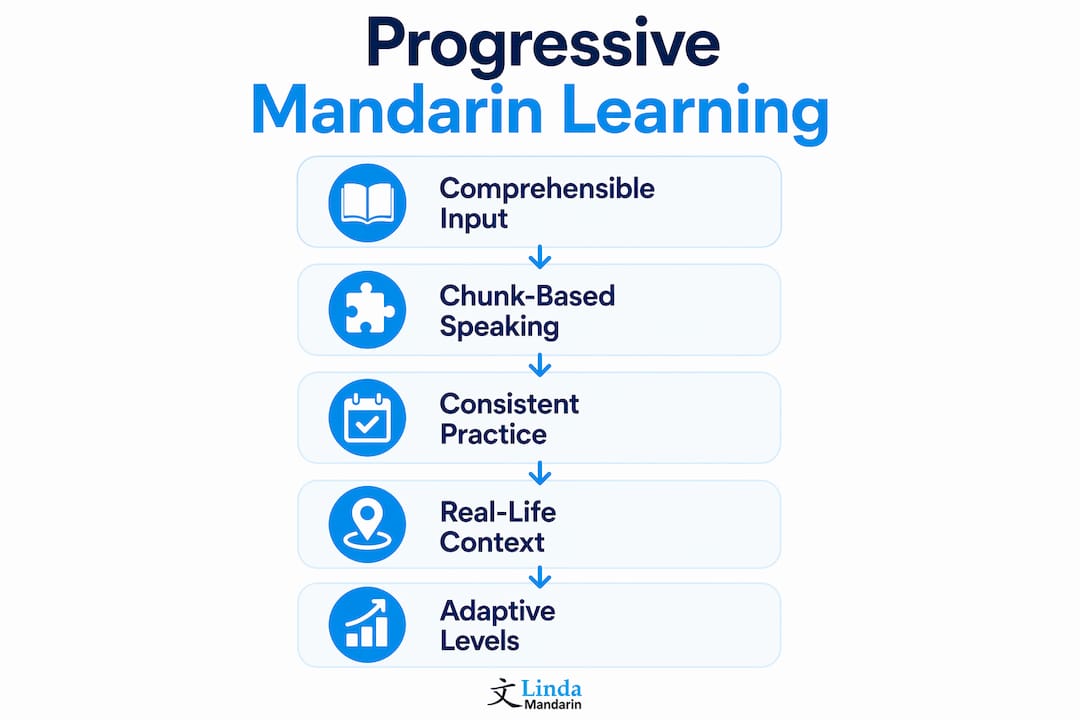
How does the i+1 comprehensible input method drive progressive Mandarin learning?
The i+1 method works because the brain acquires language through meaningful exposure, not through conscious memorization. When you understand most of what you hear or read, your brain fills in the gaps using context, tone, and prior knowledge. That process is acquisition, and it is faster and more durable than rote study.
Three factors determine whether your input is working:
- Comprehension level: Aim for 70–80% understanding. Below that, the content is too hard to be useful. Above 90%, you are not being challenged enough to grow.
- Daily time commitment: 30–60 minutes of focused input per day produces consistent progress for adult learners. Shorter sessions are fine for maintenance but not for advancement.
- Content selection: Choose material that genuinely interests you. Podcasts, short videos, graded readers, and news summaries all work. The subject matter matters less than your engagement with it.
The affective filter is a critical variable most learners overlook. Anxiety and boredom block acquisition even when the input level is correct. Low stress and high engagement keep the filter down and let input reach the part of the brain where language is stored. This is why forcing yourself through dry textbooks often produces frustration instead of fluency.
Pro Tip: Pick one topic you genuinely care about, such as business news, cooking, or travel, and find Mandarin content on that topic. Your comprehension will improve faster because background knowledge compensates for vocabulary gaps.
Why is chunk-based learning essential in mastering spoken Mandarin progressively?
Chunk-based learning, also called the lexical approach, treats language as a collection of pre-built phrases rather than individual words assembled by grammar rules. Speaking with pre-fabricated chunks turns passive understanding into real communication far faster than word-by-word construction.
Mandarin is particularly well suited to this method. Word order carries more meaning in Mandarin than inflections do. There are no verb conjugations, no gendered nouns, and no plural suffixes to memorize. A learner who masters a set of high-frequency sentence patterns can communicate meaningfully within weeks. The grammar is embedded in the chunks themselves.
Here is how to build a chunk-based practice system:
- Collect chunks in context. When you encounter a useful phrase in a podcast or conversation, write it down with the full sentence around it. Never record a word in isolation.
- Learn the chunk as a unit. Practice saying the whole phrase until it comes out automatically. Do not analyze the grammar until after you can produce the chunk fluently.
- Reinforce with spaced repetition. Use a flashcard system like Anki to review chunks at increasing intervals. Review the full phrase, not individual characters.
- Use the chunk in real conversation. Find a language partner or join a class where you can deploy new chunks within 24–48 hours of learning them. Delayed use causes rapid forgetting.
- Get feedback immediately. Correction at the chunk level is more useful than correction at the word level. A native speaker who adjusts your phrasing teaches you the natural pattern.
Reducing speaking anxiety through chunk learning makes Mandarin feel manageable and encourages early spoken practice. Adults who try to construct sentences word by word freeze under pressure. Adults who recall a practiced chunk speak with confidence.
Pro Tip: Record yourself using five new chunks in a short monologue each week. Listening back reveals pronunciation issues and forces you to produce language without a prompt, which is exactly the condition you face in real conversations.
What cognitive benefits does the progressive Mandarin learning approach offer adults?
Learning Mandarin progressively does more than teach a language. Mandarin study improves executive function, multitasking, mental flexibility, and memory by requiring the brain to simultaneously process tones, characters, and grammar. This is not a side effect. It is a direct result of the brain’s workload during Mandarin acquisition.
“Mandarin acts as a cognitive workout, enhancing mental discipline and decision-making under pressure.” The tonal system alone forces the auditory cortex to make distinctions it never needed to make in English, building new neural pathways in the process.
The progressive approach maximizes these benefits because it keeps learners in a state of productive challenge. Passive exposure to content that is too easy produces no cognitive growth. Structured, enjoyable exposure at the i+1 level keeps the brain engaged and building. You can read more about Mandarin’s effect on brainpower and the specific mental skills it develops.
| Cognitive skill | How Mandarin develops it |
|---|---|
| Executive function | Managing tones, characters, and syntax simultaneously trains focused attention |
| Mental flexibility | Switching between tonal and written systems builds cognitive switching speed |
| Working memory | Retaining character sequences and sentence patterns expands short-term capacity |
| Decision-making | Processing ambiguous tonal input under time pressure sharpens rapid judgment |
These gains are most pronounced in adult learners who engage consistently over months, not in those who study intensively for a few weeks and stop. Progressive methods, by design, support that kind of sustained engagement.
How to implement progressive Mandarin learning in your daily routine effectively?
A practical daily routine for structured Mandarin learning balances input and output in roughly equal measure. Input builds your internal model of the language. Output forces you to use it, exposing gaps you did not know existed.
Start with these daily habits:
- 30–60 minutes of input. Split this between listening and reading. A 20-minute podcast during your commute and a 20-minute graded reader before bed covers the minimum effectively.
- Diglot weaving for character recognition. Diglot weaving embeds Mandarin characters in native-language text, giving beginners a low-pressure way to build reading skills. Character recognition improves 4–8 weeks faster than jumping straight into full immersion reading.
- Active output practice. Speak or write in Mandarin for at least 10–15 minutes daily. This does not require a conversation partner. Narrate your day, describe what you see, or write a short summary of what you listened to.
The production gap is the most common reason adult learners plateau. Lack of prompt-less production stalls progress even when input hours are high. You must practice speaking without being asked a question first. That is the condition of real conversation.
Pro Tip: Use the “shadowing” technique during your listening sessions. Play a short Mandarin audio clip, pause it, and repeat what you heard at the same speed and intonation. This trains both pronunciation and listening simultaneously.
The table below shows how to balance your weekly study time across the four core skills:
| Skill | Recommended weekly time | Best format |
|---|---|---|
| Listening | 3–4 hours | Podcasts, short video clips, graded audio |
| Reading | 2–3 hours | Graded readers, bilingual texts, news summaries |
| Speaking | 1–2 hours | Language exchange, class practice, self-recording |
| Writing | 1 hour | Character practice, short journal entries, text summaries |
Choosing meaningful and authentic materials keeps motivation high across all four skills. Content connected to your professional goals, such as business news or industry podcasts in Mandarin, doubles as career development and language practice.
Key takeaways
Progressive Mandarin learning works because it pairs comprehensible input at the i+1 level with chunk-based speaking practice and consistent daily output to produce lasting fluency.
| Point | Details |
|---|---|
| i+1 input is the core engine | Engage with content you understand 70–80% of the time to stay in the acquisition zone. |
| Chunk-based speaking reduces anxiety | Learn and practice pre-built phrases to speak confidently without freezing mid-sentence. |
| Daily input time matters | 30–60 minutes of right-level input each day produces faster gains than occasional long sessions. |
| The production gap stalls progress | Active, prompt-less speaking and writing practice is required to convert passive knowledge into real fluency. |
| Cognitive benefits are real and measurable | Mandarin study builds executive function, memory, and mental flexibility through its unique tonal and character demands. |
Why I think most adults underestimate what progressive learning can do
Adults tend to approach Mandarin with the same mindset they used in school language classes: memorize vocabulary lists, study grammar charts, pass a test. That approach produces test scores. It does not produce conversation.
What I have observed consistently is that the affective filter is the real obstacle, not the language itself. Adults who feel embarrassed about making mistakes stop producing output. They consume input endlessly and wonder why they cannot speak. The lexical approach breaks that cycle because it gives you something concrete to say. You are not constructing a sentence from scratch. You are recalling a pattern you have already practiced. That shift from construction to recall is the difference between freezing and speaking.
The cognitive benefits are also underestimated. Most adults frame Mandarin as a professional tool, which it is. But the mental discipline built through tonal processing and character recognition carries over into focus, memory, and decision-making at work. Learning Mandarin progressively is not just a language investment. It is a cognitive one.
My honest advice: start output earlier than feels comfortable. Most learners wait until they feel “ready.” That moment rarely arrives through input alone. Speak with your first ten chunks. Record yourself. Get feedback. The discomfort is the learning.
— Paul
Linda Mandarin’s adult courses for progressive Mandarin learning
Linda Mandarin has been teaching adult learners in Singapore since 2003, and its course structure is built around the same progressive principles covered in this article. Courses run from beginner conversational Mandarin through advanced business Mandarin, with each level designed to keep learners in the productive i+1 zone.

Whether you prefer in-person classes at the school’s location above Tanjong Pagar MRT, live online Zoom sessions, or a corporate Mandarin training program for your team, Linda Mandarin offers a format that fits your schedule. Certified native instructors fluent in English deliver every lesson. You can review the full range of adult Mandarin course levels and find the right starting point for your goals.
FAQ
What is the i+1 method in Mandarin learning?
The i+1 method means studying content where you understand roughly 70–80% of the material, leaving the remaining 20–30% inferable from context. That gap is where language acquisition occurs most efficiently.
How long should I study Mandarin each day?
30–60 minutes of focused, right-level input per day produces consistent progress for adult learners. Splitting that time between listening and reading delivers the best results.
What is the production gap in Mandarin learning?
The production gap occurs when learners accumulate passive vocabulary through input but cannot use it in spontaneous speech. Closing it requires regular prompt-less speaking and writing practice, not more listening.
How does chunk-based learning reduce speaking anxiety?
Chunk-based learning gives you pre-practiced phrases to recall under pressure instead of constructing sentences word by word. That recall process is faster and less stressful, which makes early spoken practice feel achievable.
What is diglot weaving and how does it help with Mandarin characters?
Diglot weaving embeds Mandarin characters inside native-language sentences, giving beginners a low-pressure way to build character recognition. Learners who use this method typically develop reading skills 4–8 weeks faster than those who jump straight into full Mandarin text.