TL;DR:
- Mandarin tones are vital pitch patterns that determine the meaning of every spoken word in the language. Mastering the four primary tones and neutral tone through structured practice enhances clarity, confidence, and natural speech in learning Mandarin.
Mandarin tones are the pitch patterns that determine the meaning of every spoken word in the language. This guide to Mandarin tones covers all four primary tones plus the neutral tone, giving you a clear system for understanding and producing each one correctly. Tones are not optional decoration in Mandarin. They are the core of the language. Get them wrong and you change the word entirely. Get them right and your speech becomes clear, natural, and confident. Whether you are learning for conversation, travel, or business, mastering the Mandarin tone system is the single most important step you can take as a learner.
What are the four Mandarin tones and the neutral tone?
Mandarin has four primary lexical tones plus a fifth neutral tone, and each one carries a distinct pitch contour that changes word meaning fundamentally. This is the core fact every learner must accept early. The same syllable spoken in four different tones produces four completely different words.
The classic example is the syllable “ma.” Spoken in the first tone, it means “mother.” In the second tone, it means “hemp.” In the third tone, it means “horse.” In the fourth tone, it means “scold.” The neutral tone version appears in sentence-final particles and carries no fixed meaning on its own. One syllable, five possibilities. That is the power and the challenge of the Mandarin tone system explained through a single example.
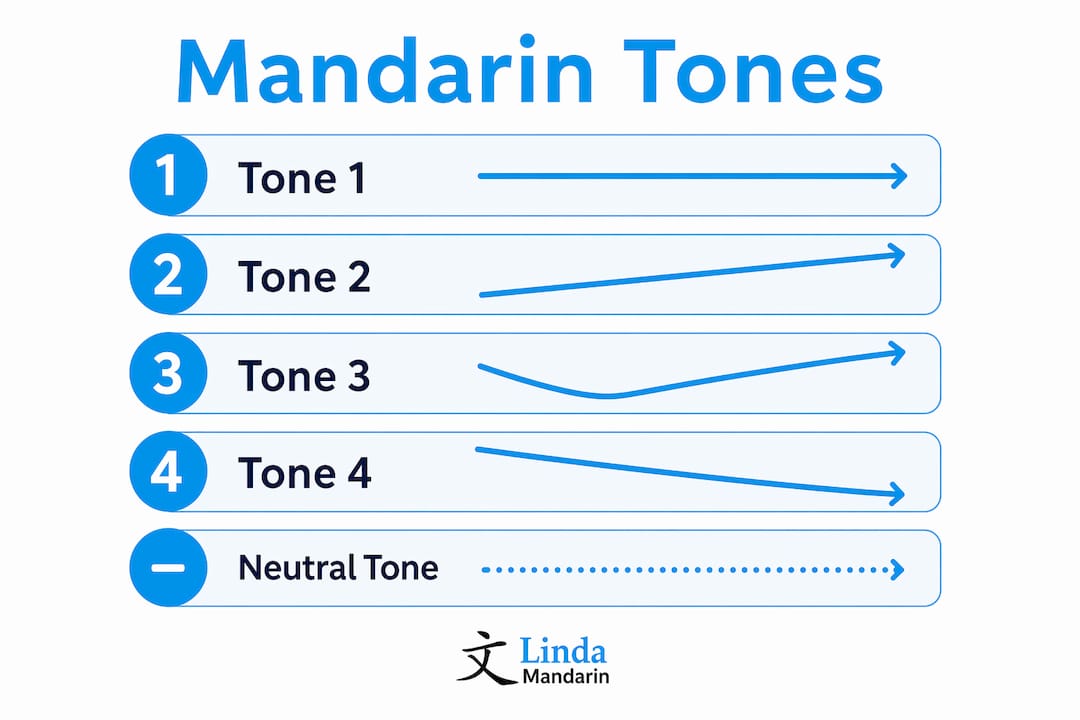
Here is a breakdown of each tone’s pitch shape:
- First tone (Tone 1): High and level. Your pitch stays flat at the top of your range, like holding a musical note. The Pinyin mark is a flat line: ā.
- Second tone (Tone 2): Rising. Your pitch climbs from mid to high, like the end of an English question. The Pinyin mark is an upward accent: á.
- Third tone (Tone 3): Dipping. Your pitch falls low and then rises again, tracing a valley shape. In fast speech, you often only produce the low dip. The Pinyin mark curves down then up: ǎ.
- Fourth tone (Tone 4): Falling sharply. Your pitch drops from high to low in one quick, emphatic movement, like a firm command. The Pinyin mark is a downward accent: à.
- Neutral tone (Tone 5): Light and unstressed. No defined pitch contour. It appears on grammatical particles and certain syllables in compound words.
| Tone | Pitch Shape | Pinyin Mark | “Ma” Meaning |
|---|---|---|---|
| Tone 1 | High and level | ā | Mother |
| Tone 2 | Rising | á | Hemp |
| Tone 3 | Dipping low then rising | ǎ | Horse |
| Tone 4 | Sharp falling | à | Scold |
| Neutral | Light, unstressed | a | Particle |
The pitch contour is what you must train your ear and voice to recognize. Pitch height varies by speaker, but the shape of each tone stays consistent.
How do you accurately hear and pronounce Mandarin tones?
Pinyin is the essential tool for beginners learning to connect tone pitch to physical vocal action. Pinyin is the standardized Romanization system for Mandarin, and its tone marks give you a visual map of exactly what your voice should do. Before you attempt to speak, read the Pinyin mark and let it guide your pitch movement.

The most effective practice method for beginners is listening and exaggerating pitch contours alongside native audio. Exaggeration matters because your ear needs to learn to detect differences that feel dramatic at first. Once you can hear and produce the exaggerated versions, natural speech becomes much easier to manage.
Follow this structured practice sequence:
- Isolate each tone. Practice Tone 1 alone with a single syllable like “ma” until your pitch stays flat and high without dipping. Then do the same for each of the other tones in sequence.
- Practice tone pairs. Combine two tones in sequence, such as Tone 1 followed by Tone 4, or Tone 2 followed by Tone 3. Tone pairs train your voice to shift pitch quickly between syllables.
- Advance to tone patterns in sentences. Once tone pairs feel natural, practice short phrases and sentences where you track the tone of every syllable.
- Record yourself and compare. Record your voice, then play it back next to a native speaker audio example. The gap between the two tells you exactly where to adjust.
- Use technology for feedback. Speech recognition tools and language learning apps that flag tone errors give you immediate, objective feedback that a mirror cannot.
Pro Tip: Focus on the shape of the pitch movement, not the exact pitch level. A high voice and a low voice can both produce correct Mandarin tones as long as the contour is right. This takes pressure off learners who worry about hitting a specific note.
Daily practice of 15–20 minutes on tone drills produces faster results than occasional long sessions. Consistency builds the muscle memory your voice needs. You can find a solid set of Mandarin pronunciation resources to support your daily routine.
What are the most common tone mistakes English speakers make?
English speakers face specific, predictable challenges with Mandarin tone pronunciation. Knowing these pitfalls in advance lets you address them before they become habits.
- Confusing Tone 1 and Tone 4. Both tones start at a high pitch, which makes them easy to mix up. Tone 1 stays flat and sustained. Tone 4 drops sharply and quickly. Imagine Tone 1 as a locked horizontal line and Tone 4 as a hammer striking downward. That mental image keeps them separate.
- Mistaking the rise in Tone 2 and Tone 3. Both tones involve upward pitch movement at some point. Tone 2 rises from mid to high. Tone 3 dips low first, then rises. The key difference is where the pitch starts. Tone 2 never dips. Tone 3 always does.
- Letting Tone 1 slip downward. English speakers naturally let their pitch fall at the end of statements. Tone 1 requires you to fight that instinct and hold the pitch level all the way through the syllable.
- Ignoring tone sandhi. Tone sandhi causes tone changes in fast, natural speech. The most common example: two consecutive Tone 3 syllables cause the first one to shift to a Tone 2 rising tone. Learners who only practice tones in isolation get caught off guard when this happens in real conversation.
- Dropping tones under pressure. When learners focus on vocabulary or grammar, tone accuracy often drops. This is normal, but it is a sign that tones have not yet become automatic.
Pro Tip: When you notice your tones slipping in conversation, slow down rather than speeding up. Speed hides errors. Slowing down forces you to produce each tone deliberately, which rebuilds accuracy faster.
The differences between English and Mandarin go beyond vocabulary. Pitch carries meaning in Mandarin in a way it simply does not in English, and that shift in thinking takes time.
How do you practice Mandarin tones in real conversations?
Managing tone contrast in fluent speech is the real challenge for learners, not producing tones in isolation. Moving from drills to actual conversation requires a different set of strategies.
- Use role-play dialogues. Practice scripted conversations where you know the vocabulary in advance. This lets you focus mental attention on tone accuracy rather than word retrieval.
- Shadow native speakers. Listen to a native speaker sentence, then repeat it immediately while trying to match the pitch pattern exactly. Shadowing trains your ear and voice simultaneously.
- Practice tone-minimal pairs in context. Take two words that differ only by tone, such as “mǎi” (buy) and “mài” (sell), and use both in a sentence. Context reinforces the meaning difference and locks the tone in memory.
- Get feedback from a native speaker. Self-monitoring has limits. A native speaker catches errors your own ear misses. Regular feedback sessions accelerate progress significantly.
- Monitor your tones during emotional speech. Tones carry emotional weight in Mandarin. A sharp Tone 4 can sound abrupt. A gentle Tone 2 can soften a question. Paying attention to this layer adds naturalness to your speech.
“Tones are the gatekeeper to Mandarin pronunciation. Master them and the rest of the language becomes significantly more accessible. Learners who invest in tone accuracy early find that vocabulary and grammar stick faster because they are building on a solid phonetic foundation.”
A structured, stepwise approach moving from isolated tones to tone pairs to full sentences and then to live conversation produces the most reliable results. Each stage builds on the previous one. Skipping ahead creates gaps that show up later as persistent errors.
Tones also shift meaning in ways that go beyond the dictionary. The same phrase spoken with different tones can sound polite or rude, confident or uncertain. That emotional layer is worth practicing deliberately, not just as an afterthought. For practical tips on building this skill, the Chinese tones tips page at Linda Mandarin covers common learner challenges in depth.
Key Takeaways
Mastering Mandarin tones requires learning the pitch contour of all five tones, practicing them in a structured sequence from isolation to conversation, and correcting the specific errors English speakers make most often.
| Point | Details |
|---|---|
| Five tones, not four | Mandarin has four primary tones plus a neutral tone, each changing word meaning completely. |
| Contour over pitch level | Train the shape of each tone’s movement, not the exact pitch height, to stay flexible across speakers. |
| Tone sandhi is real | Two consecutive Tone 3 syllables shift the first to Tone 2 in natural speech. Learn this early. |
| Structured practice works | Move from isolated tones to tone pairs to sentences to live conversation for lasting accuracy. |
| Feedback accelerates progress | Recording yourself and working with native speakers catches errors self-study misses. |
What I’ve learned from watching learners crack the tone code
Tone anxiety is the most underrated obstacle in Mandarin learning. I have watched adult learners freeze mid-sentence because they second-guessed a tone. That hesitation does more damage than the wrong tone would have. Native speakers are remarkably good at understanding context, and a slightly off tone in a clear sentence rarely causes a breakdown in communication.
The real breakthrough for most learners comes when they stop thinking of tones as a separate skill and start hearing them as part of the word itself. “Mā” is not “ma plus a flat tone.” It is simply the word for “mother.” Once that shift happens, tone production becomes instinctive rather than calculated.
Patience is not a soft skill here. It is a technical requirement. Tone accuracy in conversation takes longer to develop than tone accuracy in drills. That gap is normal. The learners who push through it consistently are the ones who end up sounding natural. Focus on the pitch contour, practice every day, and trust that the ear catches up to the voice eventually.
— Paul
Linda Mandarin’s adult courses for tone mastery
Tone accuracy is built in a structured learning environment with expert feedback, and that is exactly what Linda Mandarin delivers for adult learners in Singapore.

Linda Mandarin has been training adult professionals in Mandarin since 2003, with courses that cover pronunciation and tonal accuracy from the first lesson. The school’s Mandarin course details page outlines programs for every level, from beginner conversational Mandarin to advanced business communication. Online Zoom classes give you the same structured instruction with the flexibility to learn from anywhere. Corporate training programs focus specifically on clear tonal communication for professional settings. Linda Mandarin’s certified native instructors, all fluent in English, correct tone errors in real time so bad habits never take root. The school is located at 10 Anson Road, Level 22, International Plaza, Singapore 079903, right above Tanjong Pagar MRT.
FAQ
What are the four tones of Mandarin?
Mandarin’s four tones are: Tone 1 (high and level), Tone 2 (rising), Tone 3 (dipping low then rising), and Tone 4 (sharp falling). Each tone gives the same syllable a completely different meaning.
Why do Mandarin tones matter so much?
Tones carry lexical meaning in Mandarin, not just emotion. Saying a word with the wrong tone produces a different word entirely, which makes tone accuracy central to being understood.
What is tone sandhi in Mandarin?
Tone sandhi is the automatic change that happens when certain tones appear next to each other in speech. The most common rule is that two consecutive Tone 3 syllables cause the first to shift to Tone 2.
How long does it take to master Mandarin tones?
Most adult learners develop reliable tone accuracy in controlled speech within a few months of consistent daily practice. Tone accuracy in fast, natural conversation takes longer and improves steadily with exposure and feedback.
What is the best way to practice Mandarin tones daily?
The most effective daily practice combines listening to native audio, repeating with exaggerated pitch contours, and recording yourself for comparison. Short, focused sessions of 15–20 minutes outperform occasional longer study blocks.