TL;DR:
- The HSK is an internationally recognized standardized Mandarin proficiency test used by universities, employers, and governments. It provides a structured learning roadmap and measurable proof of language skills for academic and professional advancement. Preparing effectively involves selecting the appropriate level, practicing all skills, and using official resources to achieve long-term language proficiency.
The HSK, or Hanyu Shuiping Kaoshi, is the official standardized Mandarin Chinese proficiency test recognized by universities, employers, and government agencies in 160+ countries worldwide. Understanding why HSK is important goes far beyond passing a single exam. It shapes how you study, what doors open for you academically and professionally, and how seriously others take your Mandarin skills. Whether you are preparing for your first exam or weighing the value of certification, the HSK delivers measurable, internationally accepted proof of your ability.
Why HSK is important for structured Mandarin learning
The 9-level HSK 3.0 framework gives learners a clear progression from absolute beginner to near-native proficiency. Each level builds on the last, covering vocabulary, grammar, and all four core skills: listening, speaking, reading, and writing. That structure prevents the common trap of casual learners who improve conversational fluency but neglect reading or writing entirely.
The HSK syllabus works as a learning roadmap even for learners who never sit the exam. Many adults use the official vocabulary lists and topic frameworks to guide their self-study without registering for a test date. The mandatory engagement across all four skills prevents the plateauing that happens when learners focus only on what feels comfortable.
External deadlines and standardized evaluation also support consistent study habits. A test date on the calendar creates urgency that informal study rarely generates. That motivational pressure is one of the most underrated benefits of the HSK system.
The benefits of milestone-based learning through HSK include:
- Clear short-term goals that break a long language learning process into manageable stages
- Balanced skill development across listening, speaking, reading, and writing at every level
- External accountability through official exam dates and standardized scoring
- Measurable proof of progress that you can show to universities, employers, or yourself
- A structured vocabulary syllabus that prevents random, unfocused study
Pro Tip: Even if you are not planning to sit the exam immediately, download the official HSK vocabulary list for your target level and use it as your weekly study guide. The structure alone accelerates progress.
What HSK levels do universities require?
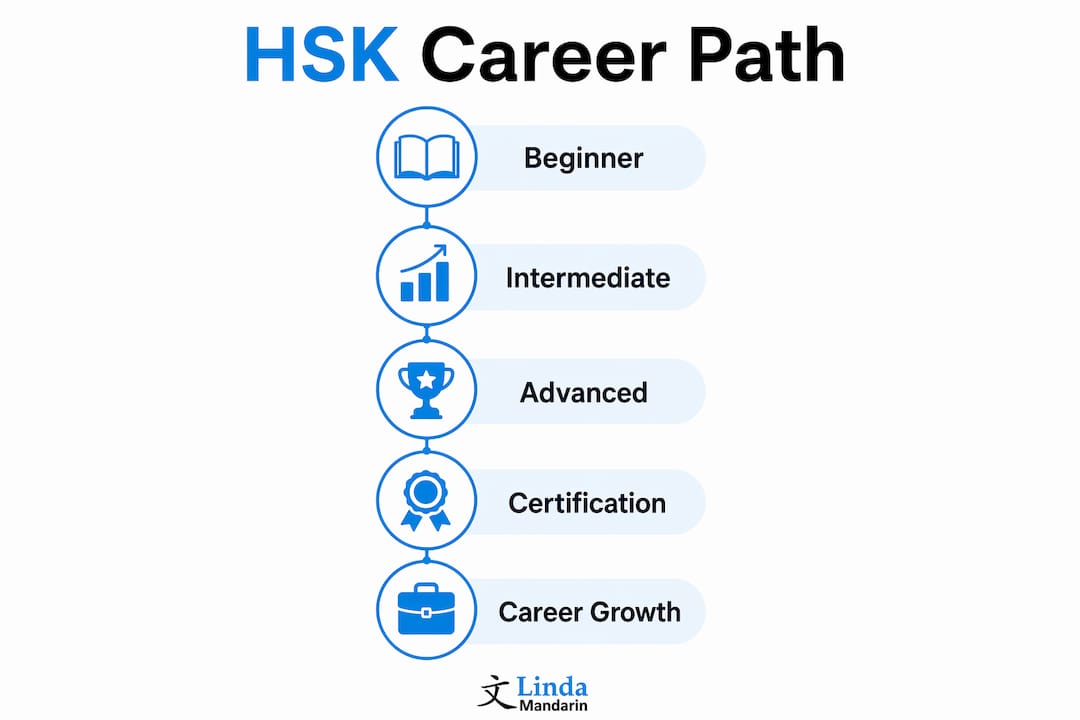
HSK 4 is the standard threshold for undergraduate admission at Chinese universities, meaning you can handle academic content independently at that level. Graduate programs typically require HSK 5 or above, where you can read complex texts and participate in academic discussions without support. These are not suggestions. Most Chinese universities list them as hard requirements on their admissions pages.
Many Chinese government scholarship programs also require HSK certification as part of the application. The certificate signals that you are prepared for instruction in Mandarin, not just conversational interaction. Scholarship committees use it to filter candidates who are genuinely ready for the academic workload.
One common misconception is that passing HSK 4 means you are fully ready for university life in China. The HSK certificate is a baseline, not a guarantee of fluency. Demonstrated use of Mandarin in real academic contexts matters just as much as the score itself.
HSK scores are valid for two years for admissions and scholarship applications, though the certificate itself does not technically expire. That two-year window means you should time your exam strategically, ideally within 18 months of your intended application date.
| Academic program type | Typical HSK level required | Notes |
|---|---|---|
| Undergraduate degree (Chinese-taught) | HSK 4 | Standard minimum for most programs |
| Graduate degree (Chinese-taught) | HSK 5 | Required for independent academic reading |
| Chinese government scholarships | HSK 4–5 | Varies by scholarship type and institution |
| Language or exchange programs | HSK 3–4 | Lower threshold; check individual program rules |
Pro Tip: Apply for your exam date at least three months before your university application deadline. Processing and score release take time, and you want a buffer to retake if needed.
How does HSK certification help your career?
HSK certification gives employers a verifiable measure of your Mandarin ability when you have no portfolio of Chinese-language work to show. Major companies value HSK 4 and 5 for roles that involve direct interaction with Chinese-speaking clients or partners. Even HSK 3 signals serious commitment to the language, which stands out in competitive hiring.

In China specifically, HSK certification can improve work permit and visa approvals by contributing to a points-based assessment system. Holding a recognized language certificate strengthens your application in ways that self-reported fluency cannot. Exam costs typically range from $60 to $100 depending on the level and test center, making it one of the more affordable professional credentials available.
Multinational corporations in finance, logistics, technology, and trade regularly list Mandarin proficiency as a preferred or required qualification. An HSK certificate translates that proficiency into a number that HR teams can evaluate without guesswork. The role of Chinese language in business success continues to grow as China remains a dominant force in global trade.
The career benefits of HSK certification include:
- Credibility with employers who cannot assess Mandarin ability through an interview alone
- Points contribution toward work permits and visa applications in China
- Competitive differentiation in roles requiring Chinese language interaction
- Proof of commitment that separates serious learners from casual ones
- A recognized credential that appears on resumes and LinkedIn profiles with clear meaning
One critical nuance: HSK is a credential, not a substitute for professional fluency. Workplace-level Mandarin skill requires thousands of hours of active use beyond what any exam measures. The certificate opens the door. Real-world practice keeps you in the room.
How to prepare for HSK effectively
Selecting the right level before you register is the single most important preparation decision. Testing too low wastes money and time. Testing too high without adequate preparation damages confidence. Use the HSK levels guide to match your current vocabulary and grammar knowledge to the correct level before booking.
Effective HSK preparation follows a structured sequence:
- Audit your current level by taking a free diagnostic test or reviewing the official vocabulary list for your target level.
- Study the official syllabus using materials published by Hanban, the body that administers the HSK, rather than relying on general Mandarin textbooks alone.
- Practice all four skills equally. Listening and speaking drills should receive as much time as reading and writing exercises.
- Take timed mock exams at least four weeks before your test date to build exam stamina and identify weak areas.
- Review errors systematically. Every wrong answer on a practice test points to a specific vocabulary gap or grammar rule to address.
- Simulate real exam conditions by practicing in a quiet room with no dictionary access and strict time limits.
Achieving professional-level Mandarin proficiency requires 2,200–3,800 hours of study beyond simply passing HSK tests. That figure puts the exam in perspective. HSK measures where you are on a long journey, not where the journey ends.
Pro Tip: Use the HSK preparation guide to build a week-by-week study plan. Consistent daily practice of 45–60 minutes outperforms weekend cramming sessions every time.
Key Takeaways
The HSK is the most reliable international standard for documenting Mandarin proficiency, and its value extends well beyond the exam room into academic admissions, career advancement, and structured daily learning.
| Point | Details |
|---|---|
| Global recognition | HSK is accepted by universities, employers, and government agencies in 160+ countries. |
| Academic threshold | HSK 4 is required for undergraduate study; HSK 5 is required for most graduate programs in China. |
| Career credential | HSK 4–5 satisfies employer verification needs, especially when no Chinese-language work portfolio exists. |
| Score validity | HSK scores are valid for two years for admissions and scholarship applications. |
| Learning roadmap | The 9-level HSK syllabus structures balanced skill development even for learners not sitting the exam. |
HSK is a tool, not a finish line
I have worked with adult Mandarin learners long enough to see a clear pattern. The ones who treat HSK as a finish line plateau quickly after passing. The ones who treat it as a documentation tool keep improving.
The exam measures a real and meaningful slice of your ability. Passing HSK 5 genuinely means you can read a Chinese newspaper and follow a business meeting. But I have seen HSK 5 holders struggle in actual workplace settings because they studied for the test, not for the language. The certificate and the skill are not the same thing.
What the HSK does exceptionally well is give you a reason to study consistently and a framework that forces you to develop all four skills. Most self-directed learners avoid writing because it is hard. The HSK makes avoiding it impossible. That accountability is worth more than the certificate itself in the long run.
My advice: use the HSK exam benefits as your motivation to build real habits, and treat the certificate as evidence of those habits. The educational certificate value in professional contexts is real, but only when the skills behind it are equally real.
— Paul
Mandarin courses aligned with HSK at Linda Mandarin
Linda Mandarin has been training adult Mandarin learners in Singapore since 2003, with a curriculum aligned to international HSK standards from the ground up.
Whether you are preparing for your first HSK exam or building business Mandarin for professional use, Linda Mandarin offers group classes, private lessons, and online Zoom sessions designed for working adults. Corporate training programs are also available for teams. The school is located at 10 Anson Road, Level 22, International Plaza, right above Tanjong Pagar MRT. Browse the full range of Mandarin course levels to find the program that fits your current level and goals.
FAQ
What is the HSK exam?
The HSK, or Hanyu Shuiping Kaoshi, is the official standardized Mandarin Chinese proficiency test. It is recognized by universities, employers, and government agencies in over 160 countries.
What HSK level do I need for university in China?
HSK 4 is the standard minimum for undergraduate programs taught in Mandarin. Graduate programs typically require HSK 5 or higher.
How long are HSK scores valid?
HSK scores are valid for two years for university admissions and scholarship applications. The physical certificate itself does not technically expire.
Does HSK certification help with employment?
Yes. Employers use HSK 4 and 5 as verifiable proof of Mandarin ability, particularly for roles involving Chinese-speaking clients or partners. Even HSK 3 demonstrates serious commitment to the language.
How many hours does it take to reach HSK proficiency?
Reaching professional-level Mandarin fluency requires 2,200–3,800 hours of study beyond passing HSK tests. The exam measures progress along that path, not the end point of it.