TL;DR:
- Academic Mandarin is a formal, rhetorically distinct register used in research, legal, and official communication in China. Its mastery signals authority and credibility in academic and regulatory contexts, but practical application often requires deliberate, task-based practice. Combining structured instruction with real-world reading and writing helps learners develop the cultural and structural nuances essential for effective communication.
Academic Mandarin is the specialized, formal variant of Mandarin Chinese used in scholarly, legal, and professional communication across China. It differs sharply from conversational or everyday Mandarin in tone, structure, and rhetorical convention. For students, educators, and professionals engaging with Chinese universities, government agencies, or research institutions, mastering this register is not optional. It determines whether your work is taken seriously. This guide explains what academic Mandarin entails, how it works, where it applies, and how to learn it effectively.

What is academic Mandarin and why does it matter?
Academic Mandarin is defined as a highly formalized, rhetorically distinct style used in research papers, legal documents, policy analyses, and official reports within China. The standard industry term for this register is “Mandarin scholarly prose,” though “academic Mandarin” and “academic Chinese language” are widely used by educators and learners. Both terms refer to the same formal written register.
This style is not simply “correct” Mandarin. It carries specific structural expectations, vocabulary choices, and rhetorical moves that signal authority and respect within Chinese academic and official circles. Failing to meet these conventions does more than produce awkward writing. Misalignment with scholarly prose conventions can reduce the perceived academic rigor of your work and undermine credibility in Sino-foreign research collaborations.

The domains where academic Mandarin applies include universities, government agencies, research institutions, and legal bodies. Professionals submitting reports to Chinese regulatory authorities, scholars publishing in Chinese journals, and educators designing Chinese-language curricula all need this register. Linda Mandarin, a Mandarin language school in Singapore operating since 2003, recognizes this need and structures its adult programs to address both formal and practical communication goals.
What are the key linguistic and rhetorical features of academic Mandarin?
Mandarin scholarly prose is built on several defining characteristics that set it apart from other registers. Understanding these features is the first step toward producing credible academic writing in Chinese.
Objective tone and formal register. Academic Mandarin avoids first-person assertions and emotional language. Writers use impersonal constructions and passive-equivalent structures to present findings as objective facts rather than personal opinions. This contrasts with Western academic writing, which often encourages a clear authorial voice.
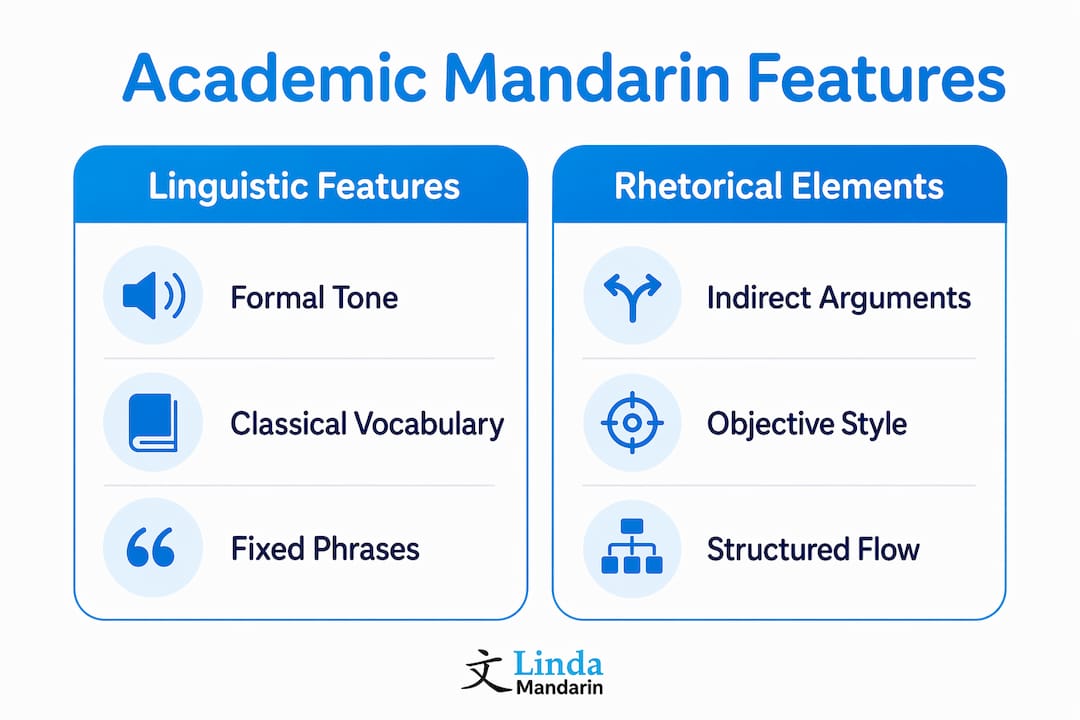
Indirect argumentation. Mandarin scholarly prose uses indirect argumentation and fixed phrases that signal deference to authority. Rather than stating a claim bluntly, writers build context, cite precedent, and frame conclusions carefully. This formality acts as a gatekeeper for academic and regulatory acceptance in China.
Fixed formal phrases and classical elements. Academic Mandarin draws on classical Chinese vocabulary and set expressions, particularly in legal, political, and humanities writing. These phrases signal that the writer understands the tradition and respects its conventions. Using colloquial substitutes, even accurate ones, marks a writer as an outsider.
Topic-prominent sentence structure. Standard Chinese is analytic with topic-prominent organization and subject-verb-object word order, but academic Mandarin adds layers of formal connectors, subordinate clauses, and hedging language that rarely appear in everyday speech.
Key rhetorical features to recognize:
- Formal connectors replacing casual transitions
- Nominalization of verbs to create abstract noun phrases
- Extensive use of four-character classical idioms in certain fields
- Avoidance of contractions, slang, and colloquial particles
- Precise citation of authoritative sources and official documents
Pro Tip: When writing in academic Mandarin, read published papers in your target field before drafting. Notice the fixed opening phrases, the way arguments are sequenced, and the vocabulary clusters that recur. Imitation of structure is not plagiarism in this context. It is expected.
How is academic Mandarin applied in educational and professional settings?
Academic Mandarin appears wherever formal Chinese communication is required. The practical applications are broader than most learners expect.
-
Submitting reports to Chinese institutions. Professionals working with Chinese government agencies or universities must submit documents that meet scholarly prose standards. A report written in conversational Mandarin, even a fluent one, signals a lack of professional preparation.
-
Academic publishing. Scholars contributing to Chinese journals or collaborative research projects need to match the rhetorical conventions of Mandarin academic writing. Reviewers notice structural misalignment immediately.
-
Legal and policy analysis. Legal professionals and policy analysts working across Chinese jurisdictions use a specialized subset of academic Mandarin that incorporates formal legal terminology and classical phrasing.
-
Corporate presentations and negotiations. Professionals in senior roles at Chinese firms or in Sino-foreign joint ventures use formal Mandarin registers in written communications, board presentations, and regulatory filings.
The gap between classroom learning and real-world application is well documented. Current graduates show gaps in applying academic Mandarin to negotiation and presentation in practical business scenarios. Academic curricula tend to overemphasize theoretical knowledge at the expense of task-based, practical learning. This means a learner can write a grammatically correct formal essay but struggle to adapt that register to a live business presentation or a policy briefing.
Closing this gap requires deliberate practice in authentic contexts. Linda Mandarin’s business communication programs address this directly by pairing formal language instruction with real-world communication tasks.
Pro Tip: Practice writing short formal summaries of news articles from Chinese state media outlets. This builds familiarity with the vocabulary, sentence patterns, and rhetorical moves used in official Chinese communication, without the pressure of a full academic paper.
What methods and tools support learning academic Mandarin?
Effective instruction in Mandarin scholarly prose combines diagnostic assessment, structured pedagogy, and technology. No single method works in isolation.
Diagnostic assessment
Academic Mandarin proficiency is measured via specialized diagnostic assessments covering STEM, Humanities, and Business domains. Baseline tests with approximately 25 questions can be completed in 20 minutes and provide CEFR-aligned estimates alongside vocabulary analysis. Longer domain-specific assessments run up to 90 minutes. These tools help educators identify where a learner’s formal vocabulary and structural knowledge fall short before instruction begins.
Project-Based Learning and Task-Based Language Teaching
Project-Based Learning (PBL) and Task-Based Language Teaching (TBLT) help bridge the gap between theoretical academic Mandarin knowledge and practical business communication. PBL asks learners to produce real outputs, such as a policy brief or a research proposal, using formal Mandarin. TBLT structures learning around authentic tasks rather than grammar drills. Both approaches, when paired with adult teaching methods designed for professional learners, produce measurably better outcomes than lecture-based instruction alone.
Generative AI as a learning scaffold
Generative AI in academic Mandarin writing is effective when combined with teacher mediation and process-oriented assessment. AI tools can generate model sentences, flag register mismatches, and suggest formal vocabulary alternatives. The critical condition is teacher oversight. Without human mediation, AI-generated Mandarin can drift toward colloquial or generic phrasing that fails academic standards. The role of technology in Mandarin learning continues to expand, but it supplements rather than replaces structured instruction.
Recommended tools and approaches for learners:
- Domain-specific vocabulary trainers with native audio
- AI writing assistants used under instructor guidance
- Corpus tools that display authentic academic Mandarin in context
- Structured feedback cycles on formal writing drafts
- Micro-credentials that certify practical communication competence alongside formal study
How does academic Mandarin differ from other Mandarin variants?
Understanding the differences between Mandarin registers is critical for choosing the right learning path. The three main variants are academic Mandarin, business Mandarin, and conversational Mandarin.
Standard Chinese includes additional classical and formal elements in its academic register that distinguish it sharply from colloquial speech. The table below summarizes the key distinctions.
| Feature | Academic Mandarin | Business Mandarin | Conversational Mandarin |
|---|---|---|---|
| Formality level | Very high | Moderate to high | Low to moderate |
| Argumentation style | Indirect, structured | Direct, pragmatic | Flexible, informal |
| Vocabulary | Classical, technical, fixed phrases | Professional, industry-specific | Everyday, colloquial |
| Sentence structure | Complex, nominalized | Clear, functional | Simple, flexible |
| Primary use | Research, legal, policy documents | Meetings, reports, negotiations | Daily interaction, social settings |
| Learning priority | Scholars, researchers, officials | Professionals, executives | Travelers, beginners |
The most common mistake learners make is assuming that strong business Mandarin automatically transfers to academic contexts. It does not. Business Mandarin prioritizes clarity and efficiency. Academic Mandarin prioritizes structural convention and rhetorical deference. A professional who excels at Mandarin negotiations may still produce writing that reads as informal or structurally weak in a Chinese academic journal.
Key Takeaways
Academic Mandarin is a distinct formal register that requires deliberate study of rhetorical conventions, classical vocabulary, and structural framing beyond standard Mandarin proficiency.
| Point | Details |
|---|---|
| Academic Mandarin defined | A formalized, rhetorically distinct style used in research, legal, and official communication in China. |
| Rhetorical conventions matter | Indirect argumentation and fixed formal phrases signal authority and determine regulatory acceptance. |
| Application gaps are real | Graduates often lack the practical skills to apply academic Mandarin in negotiations and presentations. |
| Effective learning methods | PBL, TBLT, and AI-assisted instruction with teacher mediation produce the strongest outcomes. |
| Register differences are significant | Academic Mandarin differs from business and conversational Mandarin in formality, vocabulary, and structure. |
Why academic Mandarin rewards patience more than most learners expect
Most learners underestimate how culturally embedded academic Mandarin really is. You can memorize vocabulary lists and pass grammar tests and still produce writing that a Chinese academic reviewer immediately recognizes as foreign. The tell is not vocabulary. It is the absence of the right rhetorical moves in the right sequence.
What I have found, working with adult learners over many years, is that the breakthrough comes when learners stop trying to translate their thinking into Mandarin and start reading enough authentic scholarly prose that the structure becomes intuitive. That takes time. It also takes exposure to real documents, not just textbook examples.
The integration of AI tools into instruction is genuinely useful, but only when a skilled teacher is in the loop. AI can model formal sentences. It cannot teach you why a particular phrase signals deference in one context and arrogance in another. That judgment comes from cultural understanding, and cultural understanding comes from sustained engagement with the language in real contexts.
My advice: combine formal study with regular reading of Chinese academic and official publications. Write short formal summaries. Get feedback from a native-speaking instructor who understands both the language and the professional context you are preparing for. The learners who progress fastest are not the ones who study hardest in isolation. They are the ones who put their formal writing in front of real readers early and often.
— Paul
Mandarin courses for adult learners at Linda Mandarin
Linda Mandarin has trained adult professionals and scholars in Singapore since 2003, with programs spanning conversational, business, and formal Mandarin communication.

Whether you are preparing for academic collaboration with Chinese institutions or building the formal written skills your career demands, Linda Mandarin offers structured courses in group, private, and online Zoom formats. The school’s certified native-speaking instructors tailor instruction to professional and academic goals. Explore the full range of adult Mandarin courses or learn more about corporate Mandarin training designed for teams and organizations. Classes are held at 10 Anson Road, Level 22, International Plaza, Singapore 079903, right above Tanjong Pagar MRT, with online options available.
FAQ
What is academic Mandarin in simple terms?
Academic Mandarin is the formal, structured register of Mandarin Chinese used in research papers, legal documents, and official reports in China. It differs from everyday Mandarin in vocabulary, sentence structure, and rhetorical conventions.
How long does it take to learn academic Mandarin?
The timeline depends on your existing Mandarin level and the domain you are targeting. Diagnostic assessments covering STEM, Humanities, and Business domains help establish a baseline and guide a realistic study plan.
Is academic Mandarin the same as business Mandarin?
No. Business Mandarin prioritizes direct, pragmatic communication for professional settings. Academic Mandarin uses indirect argumentation, classical vocabulary, and formal structural conventions required for scholarly and regulatory contexts.
Can AI tools help with learning academic Mandarin?
Generative AI is effective as a learning scaffold when combined with teacher mediation and process-oriented assessment. Without instructor oversight, AI-generated Mandarin can drift toward informal or generic phrasing that fails academic standards.
Why do graduates struggle with academic Mandarin in practice?
Documented competence gaps exist between theoretical academic Mandarin curricula and the practical language skills required for professional negotiation and formal presentations. Project-Based Learning and Task-Based Language Teaching are the most effective methods for closing this gap.