TL;DR:
- Mastering guanxi, face, and hierarchy is essential for successful Mandarin business meetings. Proper preparation, indirect communication, and respectful follow-up build trust and relationships over time. Cultural awareness and patience are more important than language fluency in establishing long-term partnerships.
Mandarin meeting etiquette is the set of formal and cultural protocols that govern professional meetings in Mandarin-speaking business settings. For professionals and expatriates entering Chinese business environments, these protocols go far beyond polite behavior. They reflect deep cultural values around hierarchy, face, and relationship building that directly affect whether deals move forward or stall. This guide covers the core principles, practical preparation steps, in-meeting communication strategies, and post-meeting follow-up practices you need to conduct meetings in Mandarin-speaking contexts with confidence and cultural respect.
What are the essential cultural principles in a Mandarin meeting etiquette guide?
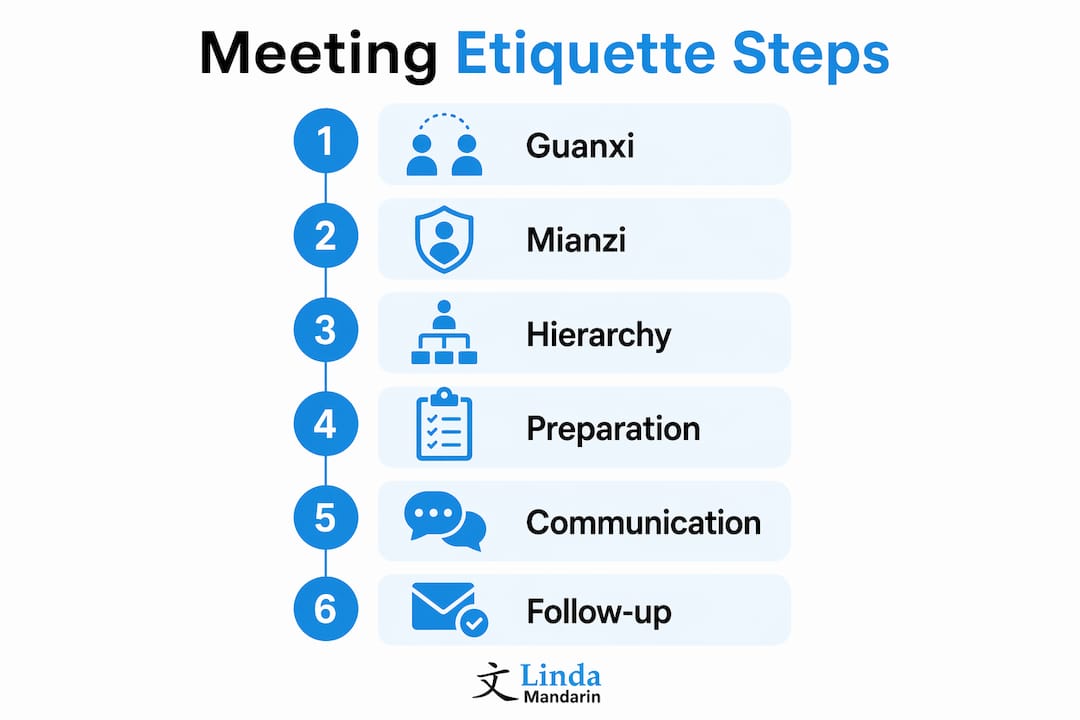
Three concepts define Chinese business culture: guanxi, mianzi, and hierarchy. Understanding all three is the foundation of any serious Chinese meeting etiquette practice.
Guanxi refers to the network of relationships and mutual obligations that underpin business in Mandarin-speaking environments. Building guanxi takes priority over immediate deal-making. Rushing straight to the agenda signals impatience and a lack of long-term commitment. Professionals who invest time in social rapport before discussing business consistently build stronger, more durable partnerships.

Mianzi, or “face,” governs how people protect their own dignity and the dignity of others in public settings. Causing someone to lose face, whether by criticizing them openly, contradicting them in front of peers, or dismissing their ideas bluntly, is one of the most damaging moves you can make in a Mandarin business context. Communication stays indirect precisely to preserve face on all sides.
Hierarchy shapes every element of the meeting, from who enters the room first to who speaks first and where everyone sits. Senior members sit centrally and are addressed before junior colleagues. Ignoring this order, even unintentionally, can cause offense and undermine trust before the meeting has properly begun.
Key principles to keep in mind:
- Prioritize relationship building over transactional speed.
- Protect everyone’s face by avoiding direct confrontation or public criticism.
- Defer to seniority in seating, greetings, and speaking order.
- Expect indirect communication and read between the lines.
- Value group harmony over individual opinion.
Pro Tip: Read the room before you speak. If the most senior person in the room has not yet offered an opinion, hold yours. Speaking before the hierarchy has been established reads as presumptuous, not confident.
How to prepare for a Mandarin business meeting
Preparation is where most expatriates either earn or lose credibility before they say a single word. The steps below apply whether you are meeting partners in Singapore, Shanghai, or Taipei.
- Research your counterparts’ titles and roles. Knowing who holds seniority lets you greet the right person first and address them correctly. Use formal titles such as “Director Wang” or “Manager Li” rather than first names.
- Prepare bilingual business cards. Cards should display your name and title in both English and Mandarin. Present and receive cards with both hands, Chinese side facing the recipient, and study the card briefly before setting it down respectfully.
- Learn key Mandarin greetings. Even basic phrases signal cultural awareness. Polite expressions like “Nín hǎo” (formal hello) and “Xièxiè” (thank you) create immediate goodwill. You do not need fluency to make a strong first impression.
- Arrive on time or slightly early. Being late, even by five minutes, signals disrespect and unprofessionalism. Arriving a few minutes early shows you value the relationship.
- Prepare your meeting materials in both languages. Agendas, proposals, and presentations with Mandarin translations demonstrate professionalism and make it easier for all participants to follow.
| Preparation item | Why it matters |
|---|---|
| Bilingual business cards | Shows respect for language and culture from the first exchange |
| Research on seniority | Lets you address the right people in the correct order |
| Key Mandarin phrases | Signals cultural effort and builds immediate rapport |
| Punctual arrival | Communicates respect for your counterpart’s time |
| Bilingual materials | Reduces misunderstanding and demonstrates thoroughness |
What are the best communication strategies during Mandarin meetings?
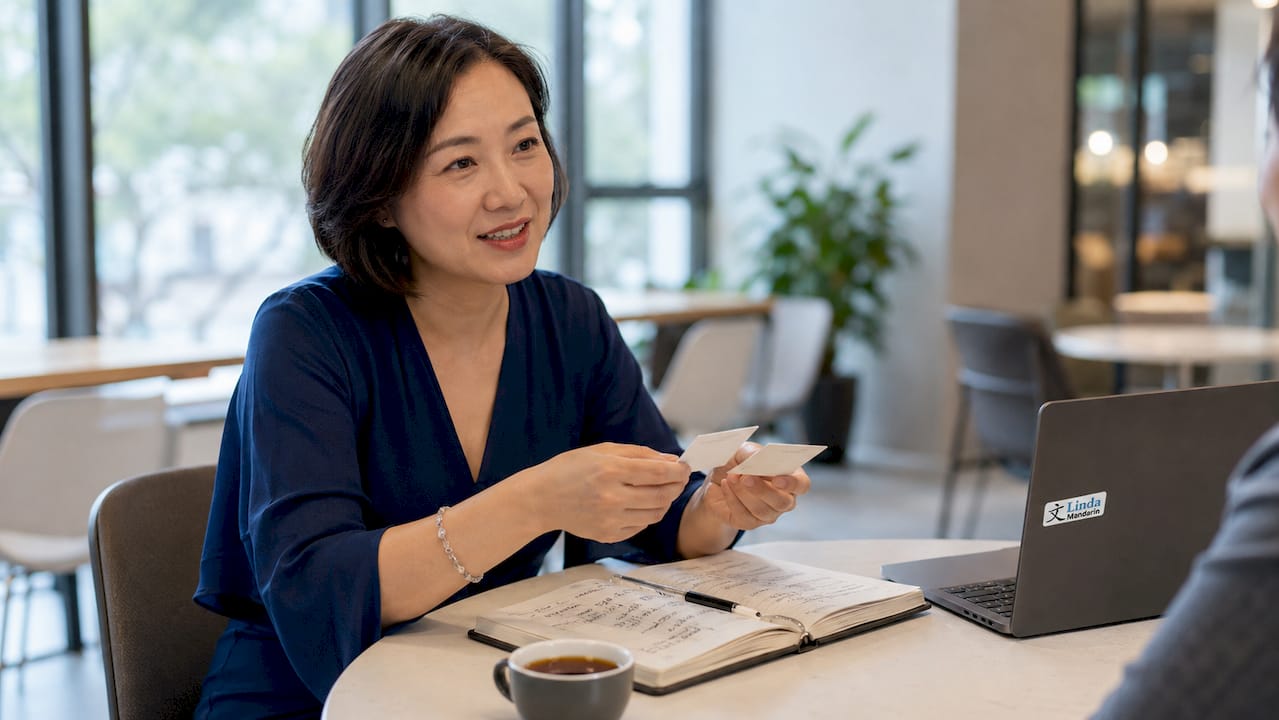
The opening minutes of a Mandarin business meeting are rarely about business. Small talk about travel, food, or the city you are visiting is standard practice. This is not wasted time. Informal conversation before business demonstrates respect and signals that you are interested in the relationship, not just the transaction.
Once the meeting moves to substantive topics, address the most senior person first. Use their formal title every time, not just on first introduction. Switching to first names without an explicit invitation to do so reads as overly familiar and can undermine the respect you have worked to establish.
Disagreement requires careful handling. Blunt confrontation is considered rude in Chinese business culture. Phrases like “we will need to consider this further” or “this may require additional discussion” often signal polite rejection or hesitation. Recognizing these phrases prevents you from misreading a soft “no” as an open door.
Silence is not a problem to fix. Pauses during meetings indicate thoughtful consideration and respect for others’ opinions. Rushing to fill every silence with words reads as anxious or disrespectful. Let pauses breathe.
Additional communication practices that matter:
- Receive and present business cards with both hands and a slight nod.
- Never write on a business card or shove it into a pocket.
- Avoid pointing with a single finger; use an open hand instead.
- Keep your tone measured and calm, even when discussing contentious points.
- Confirm understanding by summarizing key points at the end of the meeting.
Pro Tip: If you are working with an interpreter, speak in short, complete sentences. Pause after each point to allow accurate translation. Long, complex sentences are the fastest way to introduce miscommunication into a high-stakes meeting.
For professionals building their Mandarin business communication skills, learning to recognize indirect language patterns is as important as vocabulary.
How to conduct follow-ups and build relationships after Mandarin meetings
The meeting itself is only one part of the relationship-building process. What you do in the 48 hours after a meeting often determines whether guanxi deepens or fades.
- Send a bilingual follow-up message promptly. Polite thank-you messages that summarize outcomes and next steps in both English and Mandarin reinforce goodwill and demonstrate professionalism. Send this within 24 hours of the meeting.
- Use the right communication channel. WeChat is the dominant platform for ongoing business communication in mainland China. Email suits formal documentation and international contacts. Use both appropriately rather than defaulting to one.
- Understand gift-giving protocol. Gifts should be offered with both hands and may be politely declined once or twice before acceptance. Recipients typically do not open gifts in front of the giver. Avoid clocks, shoes, or anything in sets of four, as these carry negative cultural associations.
- Participate respectfully in business meals. Meals are an extension of the meeting. Wait for the host to sit first, and follow their lead on ordering and toasting. If alcohol is served and you prefer not to drink, saying “Wǒ yǐ chá dài jiǔ” (I’ll use tea instead of alcohol) is a fully accepted and gracious alternative.
- Be patient with decision timelines. Decision-making in Chinese business culture tends to be deliberate and consensus-driven. A delayed response is not a rejection. Consistent, respectful follow-up over weeks or months is standard practice.
| Follow-up action | Recommended approach |
|---|---|
| Thank-you message | Bilingual, sent within 24 hours, summarizing key outcomes |
| Ongoing communication | WeChat for relationship maintenance; email for formal records |
| Gift giving | Both hands, expect polite refusals, never open in front of giver |
| Business meals | Follow host’s lead; use tea as a respectful alternative to alcohol |
| Decision timelines | Expect deliberation; maintain patient, consistent contact |
Professionals who want to strengthen these skills through structured learning can explore Chinese business etiquette programs that combine language and cultural training.
Key Takeaways
Successful Mandarin business meetings require mastering guanxi, mianzi, and hierarchy before focusing on language fluency alone.
| Point | Details |
|---|---|
| Cultural principles first | Guanxi, mianzi, and hierarchy shape every aspect of Mandarin business meetings. |
| Prepare thoroughly | Bilingual cards, key phrases, and punctual arrival signal respect before you speak. |
| Communicate indirectly | Recognize soft refusals and let silences stand without rushing to fill them. |
| Follow up in both languages | A bilingual thank-you message within 24 hours reinforces trust and professionalism. |
| Build relationships over time | Guanxi deepens through consistent, patient engagement, not single-meeting deals. |
What working in Mandarin business environments actually taught me
Most professionals walk into their first Mandarin business meeting focused on language. They memorize greetings, practice pronunciation, and worry about getting the tones right. That preparation helps. But the bigger gap is almost always cultural, not linguistic.
The moment that shifted my perspective was watching a well-prepared Western executive lose the room entirely, not because his Mandarin was poor, but because he challenged the senior partner’s proposal directly in front of the group. The language was fine. The cultural read was not. No amount of vocabulary fixes that.
What actually builds trust in these environments is patience and consistency. Showing up on time, remembering names and titles, sending a thoughtful follow-up, and showing genuine interest in the relationship over multiple interactions, these behaviors compound. A single impressive meeting rarely closes a deal. Six months of respectful, reliable engagement often does.
The other thing worth saying plainly: learning even a modest amount of Mandarin changes how you are perceived. You do not need fluency. You need enough to greet someone properly, thank them sincerely, and raise a toast. That effort communicates something no translator can convey. It says you took the relationship seriously enough to try.
Modern Mandarin business culture is also evolving. Younger professionals in Singapore, Hong Kong, and major Chinese cities are more comfortable with direct communication than previous generations. But the core values, face, hierarchy, and relationship before transaction, remain deeply embedded. Adapt to the individual, but never assume the cultural baseline has disappeared.
— Paul
Build your confidence with Linda Mandarin’s business courses
Knowing the rules of Chinese meeting etiquette is one thing. Applying them fluently under pressure is another.
Linda Mandarin has been training adult professionals and corporate teams in Singapore since 2003. The school’s corporate Mandarin training programs cover both language skills and cultural communication, giving professionals the practical tools to conduct meetings, build relationships, and navigate business conversations with confidence. Courses run as group classes, private sessions, and live online Zoom lessons, so you can fit structured learning around a demanding schedule. Linda Mandarin is located at 10 Anson Road, Level 22, International Plaza, Singapore 079903, right above Tanjong Pagar MRT. Explore the full range of adult Mandarin courses and find the format that fits your goals.
FAQ
What is Mandarin meeting etiquette?
Mandarin meeting etiquette is the set of cultural and communication protocols that govern professional meetings in Mandarin-speaking business environments. It covers hierarchy, face, relationship building, greetings, and indirect communication styles.
Why is punctuality so important in Chinese business meetings?
Arriving late, even by five minutes, signals disrespect and unprofessionalism in Chinese business culture. Arriving on time or slightly early shows you value the relationship and your counterpart’s time.
How should I exchange business cards in a Mandarin business meeting?
Present and receive business cards with both hands, Chinese side facing the recipient. Study the card briefly before setting it down respectfully, and never write on it or put it away carelessly.
What does “we will consider it further” mean in a Chinese meeting?
This phrase often signals polite rejection or hesitation rather than genuine openness. Indirect language preserves face and harmony, so learning to read these cues is a core part of Mandarin business communication.
How do I decline alcohol respectfully during a business toast?
Saying “Wǒ yǐ chá dài jiǔ” (I’ll use tea instead of alcohol) is a fully accepted and gracious way to participate in a business toast without drinking alcohol.