TL;DR:
- Pronunciation is essential in Mandarin because tones determine word meanings and are structurally integrated. Learners often struggle with tonal differentiation, connected speech, and unfamiliar sounds, which hinder comprehension. Regular active practice with feedback improves pronunciation accuracy and listening skills, forming a crucial foundation for language mastery.
Pronunciation in Mandarin is the single most critical skill for clear communication because Mandarin is a tonal language where pitch determines meaning. The role of pronunciation in Mandarin goes far beyond accent. A wrong tone does not just sound foreign. It produces a completely different word. This makes correct pronunciation in Mandarin a prerequisite for being understood, not just a refinement. Whether you are a beginner building your first vocabulary or a professional preparing for business conversations, tonal accuracy shapes every exchange. This guide explains how tones work, where learners struggle most, and how to build pronunciation skills that actually stick.
How does the role of pronunciation in Mandarin affect meaning?
Mandarin phonetics and meaning are inseparable. Mandarin uses four primary tones plus a neutral tone, and each one carries a distinct pitch contour that changes the meaning of a syllable entirely. This is not the same as English intonation, which signals emotion or question structure. In Mandarin, tones function structurally as fixed lexical components, the same way letters do in English spelling.
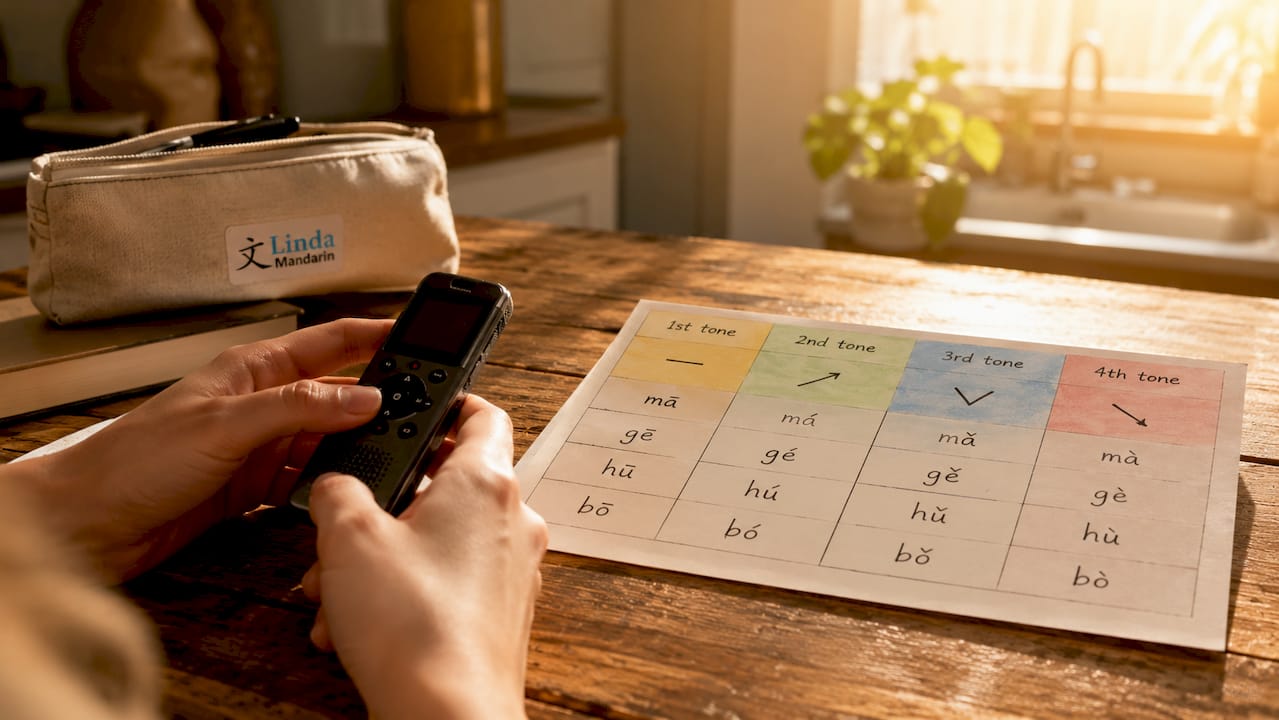
The classic example is the syllable “ma.” Spoken with a high, flat pitch (first tone), it means “mother.” A rising pitch (second tone) means “hemp.” A dipping pitch that falls then rises (third tone) means “horse.” A sharp falling pitch (fourth tone) means “to scold.” These are four completely different words. Getting the tone wrong does not create an accent. It creates a different word entirely, which causes intelligibility failure for the listener.

The neutral tone adds another layer. It is not a mistake or a skipped tone. The neutral tone is a specific phonological feature that appears in grammatical particles and compound word suffixes. Its pitch depends on the syllable before it, and it is always short, light, and unstressed. Learners who treat it as optional or as a tone error will misread grammar patterns and sound unnatural in connected speech.
Tone sandhi is another real-world factor. When two third-tone syllables appear together, the first one shifts to a second tone in natural speech. This means the tones you practice in isolation do not always match what you hear in fluent conversation. Understanding these shifts is part of what it means to develop genuine Mandarin phonetics skills.
- First tone: High and flat, held steady (e.g., “mā” = mother)
- Second tone: Rising, like asking a question in English (e.g., “má” = hemp)
- Third tone: Falls then rises, the longest tone (e.g., “mǎ” = horse)
- Fourth tone: Sharp and falling, like a firm command (e.g., “mà” = to scold)
- Neutral tone: Short, light, and context-dependent (e.g., “ma” as a sentence particle)
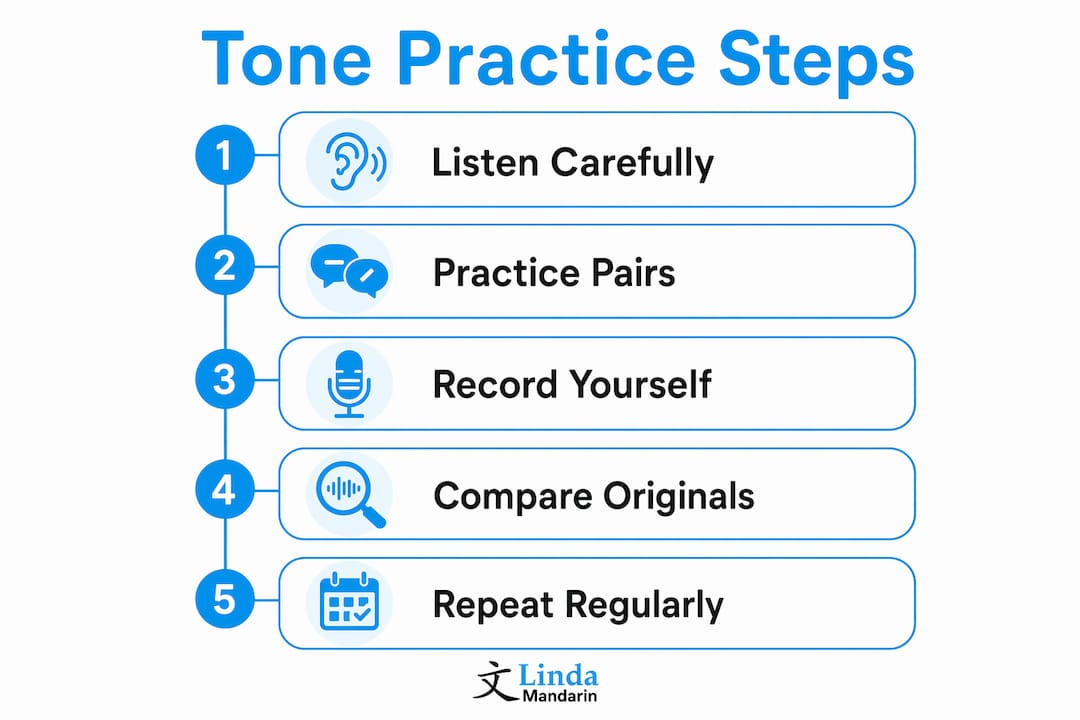
Pro Tip: Practice tone pairs, not single tones. Drilling “first tone + fourth tone” combinations trains your ear for real speech patterns faster than repeating isolated tones.
What are the biggest challenges of Mandarin pronunciation?
The challenges of Mandarin pronunciation fall into three categories: tonal confusion, connected speech, and unfamiliar sounds. Most learners can identify tones when they hear them in isolation. The real difficulty comes when tones appear in full sentences at natural speed.
Mastering tonal contrasts in connected speech is the primary challenge for learners at every level. When words flow together, pitch contours overlap and shift. A learner who can produce all four tones cleanly in a drill will often flatten them in conversation. This is not a memory problem. It is a processing problem. The brain is managing vocabulary, grammar, and pitch simultaneously, and pitch loses priority under pressure.
Specific consonant and vowel sounds also trip up learners whose native language lacks equivalents. The “x,” “q,” and “zh” initials in Mandarin do not exist in English. The vowel sounds in “lü” and “nü” require lip rounding that English speakers rarely practice. These gaps create pronunciation errors that persist long after learners feel confident about tones.
- Tonal flattening in sentences: Learners revert to monotone delivery when focusing on vocabulary or grammar.
- Neutral tone misuse: Treating the neutral tone as optional leads to grammatically awkward speech.
- Third-tone sandhi errors: Failing to shift the first of two consecutive third tones to a second tone sounds unnatural.
- Unfamiliar initials: Sounds like “zh,” “ch,” “sh,” and “r” require tongue positions English speakers have never practiced.
- Vowel precision: Mandarin finals like “ü,” “ian,” and “uan” require exact mouth shaping that differs from English vowels.
Pro Tip: Record yourself reading a short Mandarin paragraph, then compare it to a native speaker recording of the same text. The gaps you hear will tell you exactly where to focus your practice.
The impact of these errors extends beyond embarrassment. Mispronounced tones force listeners to work harder to decode meaning. Tonal accuracy enables effective lexical disambiguation, meaning correct tones help listeners identify words quickly and accurately. When tones are wrong, listeners must rely on context to guess the intended word, which slows comprehension and increases the chance of misunderstanding.
How does pronunciation affect Mandarin listening comprehension?
Pronunciation skills and listening comprehension are directly connected, and the link runs in both directions. Learners who produce tones accurately also recognize them faster when listening. This is because the brain uses the same phonological representations for both speaking and hearing.
Pinyin transcription skills have immediate and delayed positive effects on Mandarin listening comprehension. A longitudinal study of 120 non-native speakers over five months found direct and lagged benefits from Pinyin practice. This means that building your Pinyin foundation pays off not just now but months later as your listening ability continues to improve.
“Sound-to-Pinyin transcription skills yield immediate listening comprehension benefits, while character-to-Pinyin transcription improvements take a full semester to show gains.”
— Research finding from a five-month longitudinal study on Mandarin listening comprehension
The table below shows how different pronunciation skills connect to specific comprehension outcomes.
| Pronunciation skill | Comprehension outcome |
|---|---|
| Sound-to-Pinyin transcription | Immediate gains in listening accuracy |
| Character-to-Pinyin transcription | Delayed gains appearing after one semester |
| Tonal contrast recognition | Faster word identification in natural speech |
| Correct tone production | Stronger phonological memory for new vocabulary |
| Connected speech practice | Improved comprehension of fluent native speakers |
Vocabulary retention also depends on pronunciation. When you learn a new word with the correct tone, your brain stores the sound and the meaning together. If you learn the word with the wrong tone, you create a false phonological memory that interferes with both recall and recognition. Accurate pronunciation aids memory by connecting sounds to characters in a way that sticks. This is why pronunciation errors early in learning are worth correcting immediately rather than leaving for later.
What are the most effective strategies for improving Mandarin pronunciation?
Targeted practice beats general exposure when it comes to Mandarin phonetics. Listening to Mandarin podcasts or TV shows builds familiarity, but it does not correct specific tone errors. The strategies below address the actual mechanisms behind pronunciation improvement.
- Use voice-based AI tools for real-time feedback. A May 2026 study of 31 university students showed statistically significant improvement in tone accuracy and overall comprehensibility after consistent practice with voice-based AI tools. These tools give immediate feedback that a textbook cannot provide.
- Drill tonal contrast pairs, not isolated tones. Practicing “first tone versus second tone” on the same syllable trains the ear to hear the difference under real conditions. Isolated tone drills do not build this discrimination skill.
- Practice tones in full phrases, not single words. Natural speech requires managing pitch across multiple syllables. Phrase-level practice prepares you for real conversation in a way that word-level drills do not.
- Build your Pinyin foundation systematically. Pinyin is the phonetic transcription system for Mandarin. Strong Pinyin skills promote listening comprehension both immediately and over time. Treat Pinyin as a core skill, not a beginner crutch.
- Seek correction from native speakers or certified instructors. Self-assessment has limits. A qualified instructor hears errors that learners cannot detect in their own speech. Regular feedback sessions accelerate progress faster than solo practice alone.
- Use a complete pronunciation guide as a reference. Having a structured resource for tone rules and tonal contrasts gives you a reliable framework to return to when you hit a plateau.
The most common mistake learners make is spending too much time on passive listening and not enough time on active production. You cannot improve pronunciation by listening alone. You must speak, get feedback, and adjust. That cycle, repeated consistently, is what produces lasting improvement.
Key Takeaways
Correct pronunciation in Mandarin is the foundation of all communication because tones carry meaning, not just accent.
| Point | Details |
|---|---|
| Tones determine meaning | The same syllable spoken with different tones produces entirely different words in Mandarin. |
| Neutral tone is grammatical | The neutral tone is a real phonological feature, not an error, and signals grammatical structure. |
| Pinyin builds listening skills | Systematic Pinyin practice produces both immediate and long-term gains in listening comprehension. |
| Connected speech is the real test | Tonal accuracy in isolated drills does not guarantee accuracy in natural, flowing conversation. |
| Active production beats passive listening | Pronunciation improves through speaking with feedback, not through listening exposure alone. |
Why pronunciation is the gatekeeper most learners underestimate
I have worked with adult Mandarin learners long enough to see a clear pattern. The learners who plateau fastest are almost always the ones who treated pronunciation as a phase to get through, not a skill to keep developing. They spent two weeks on tones, felt reasonably comfortable, and moved on to vocabulary and grammar. Six months later, they wonder why native speakers still struggle to understand them.
The uncomfortable truth is that tonal mastery is the gatekeeper for all subsequent listening and speaking proficiency. You cannot build a reliable vocabulary if you are storing words with incorrect tones. You cannot improve your listening if your phonological representations are off. Every other skill in Mandarin sits on top of pronunciation, which means a shaky foundation creates compounding problems.
I also see learners who believe tones are uniquely difficult or mystical. They are not. Mandarin tones are pitch movements, comparable to the way English speakers naturally rise at the end of a question. The difference is that Mandarin uses those pitch movements to distinguish words, not just emotions. Once learners internalize that framing, tones stop feeling impossible and start feeling like a learnable pattern.
My strongest advice is to integrate tone contrast practice into every study session, not just dedicated pronunciation sessions. Read a sentence aloud, check your tones, adjust, and repeat. Treat pronunciation as an ongoing skill, the same way a musician treats scales. Patience and consistency produce results that cramming never will.
— Paul
How Linda Mandarin supports adult learners with pronunciation
Adult learners who want structured, expert-guided pronunciation training have a clear option in Singapore. Linda Mandarin has delivered professional Mandarin language training since 2003, with courses designed specifically for adults and working professionals.

The school’s adult Mandarin programs cover conversational Mandarin, business Mandarin, and corporate training, all with pronunciation integrated into the curriculum from the first lesson. Classes are available as group sessions, private lessons, and online Zoom classes, giving you flexibility without sacrificing instruction quality. The teaching team consists of certified native Mandarin speakers fluent in English, which means you get accurate pronunciation modeling and clear explanations in the same session. Linda Mandarin is located at 10 Anson Road, level 22, International Plaza, Singapore 079903, right above Tanjong Pagar MRT. Explore the full course details and levels to find the right fit for your goals.
FAQ
Why does pronunciation matter more than grammar in early Mandarin?
Tonal accuracy outweighs grammar for early-stage learners because a wrong tone produces a different word, while a grammar error usually still communicates the intended meaning. Correct pronunciation lets you communicate successfully even with a limited vocabulary.
What is the neutral tone in Mandarin?
The neutral tone is a short, light, unstressed syllable that appears in grammatical particles and compound suffixes. Its pitch depends on the preceding syllable, and it is a real phonological feature, not a tone omission.
How does Pinyin practice improve listening comprehension?
Sound-to-Pinyin transcription practice produces immediate gains in listening accuracy. Character-to-Pinyin transcription improvements take longer, with measurable benefits appearing after roughly one semester of consistent practice.
What is tone sandhi in Mandarin?
Tone sandhi is a rule where two consecutive third-tone syllables cause the first one to shift to a second tone in natural speech. Learners who only practice tones in isolation often miss this shift and sound unnatural in conversation.
How can voice-based AI tools help with Mandarin pronunciation?
A 2026 study of 31 university students found statistically significant improvement in tone accuracy and comprehensibility after consistent practice with voice-based AI tools. These tools provide immediate feedback that accelerates correction of specific tone errors.