TL;DR:
- Mastering Chinese pronunciation involves learning initials, finals, and tones as separate skills to speak Mandarin clearly. Correct tone use is essential to convey meaning, and structured, consistent practice prevents fossilized errors. Native-speaking instruction enhances pronunciation skills more effectively than self-study alone.
Chinese pronunciation is the system of sounds, tones, and syllable structures that make up spoken Mandarin, and mastering it is the single most important step toward being understood. Unlike European languages, Mandarin uses pitch to change word meaning entirely. The same syllable spoken in four different tones produces four completely different words. Pinyin, the internationally recognized romanization system, gives learners a written map to these sounds. But Pinyin alone is not enough. You also need to understand initials, finals, and tones as separate building blocks before you can put them together into natural speech.
What is Chinese pronunciation and how does it work?
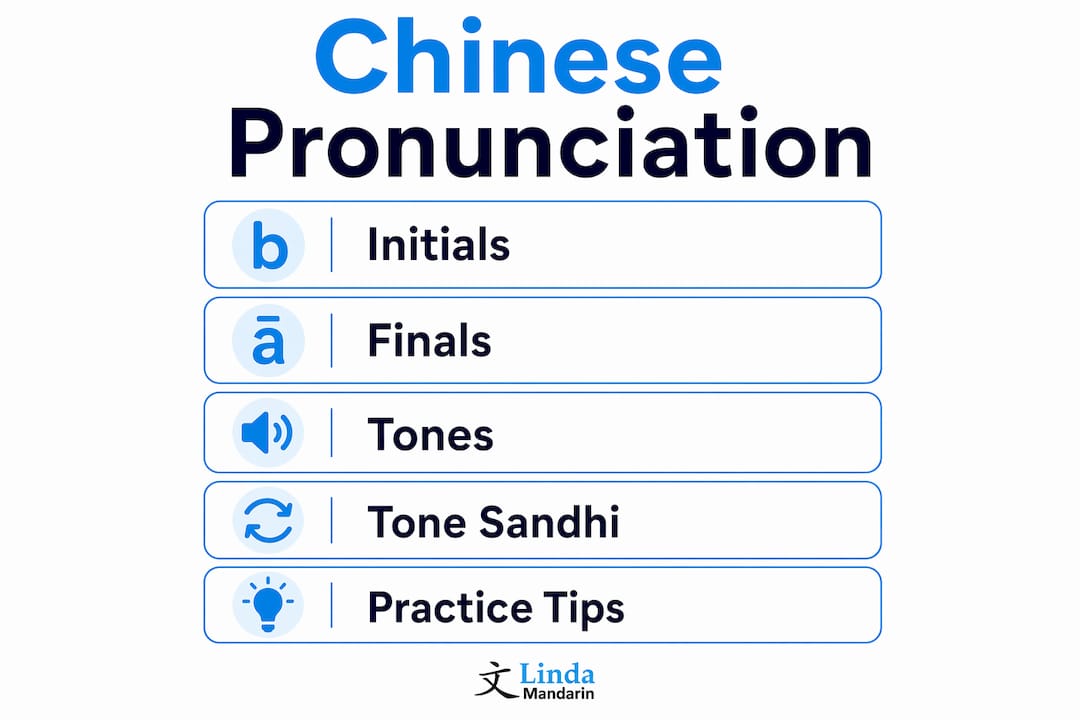
Chinese pronunciation in Mandarin is built from three core components: initials, finals, and tones. Initials are the consonant sounds that begin a syllable. Finals are the vowel sounds, or vowel plus nasal combinations, that follow. Tones are the pitch patterns placed on top of the syllable to signal meaning.
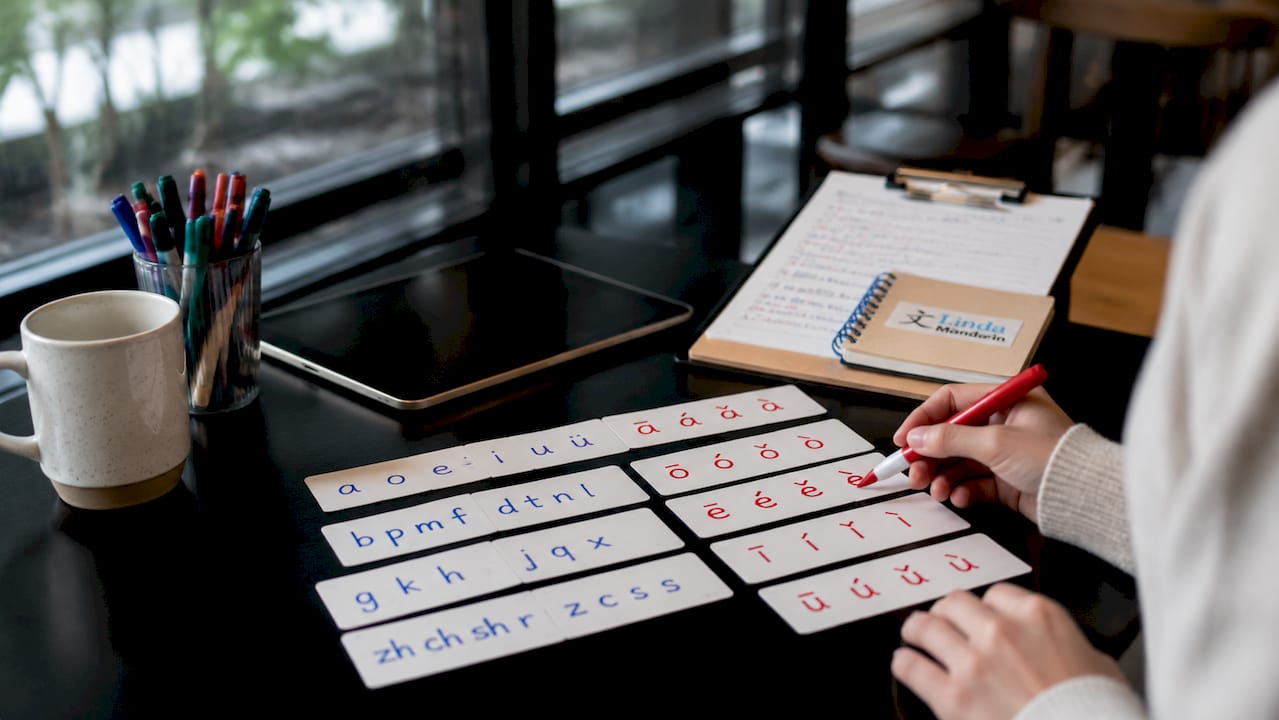
Mandarin syllables follow a consonant-vowel or consonant-vowel-nasal pattern, often written as CV or CVN. This structure is far more regular than English, which means fewer syllable shapes to learn. The challenge is not variety. The challenge is precision within each syllable.
Pinyin uses the Latin alphabet to represent these sounds, with diacritical marks above vowels to show tones. The system was standardized to help learners and non-native speakers access Mandarin sounds through familiar letters. The problem is that Pinyin letters do not always match their English equivalents. The letter “x” in Pinyin sounds nothing like the “x” in “fox.” Treating Pinyin like English phonetic spelling is the most common mistake adult learners make.
How does the Pinyin system represent Chinese sounds?
Pinyin encodes initials, finals, and tones into a single written system using 23 initials and a set of finals that cover all possible Mandarin syllables. Each syllable gets one of four tone marks, or no mark at all for the neutral tone.
Initials and finals at a glance
| Category | Examples | Notes |
|---|---|---|
| Retroflex initials | zh, ch, sh, r | Tongue curls back toward the roof of the mouth |
| Tongue-forward initials | j, q, x | Tongue presses forward, near the teeth |
| Standard initials | b, p, m, f, d, t, n, l | Closest to English equivalents |
| Simple finals | a, o, e, i, u, ü | Pure vowel sounds |
| Compound finals | ai, ei, ao, ou, an, en, ang, eng | Vowel combinations, often ending in nasals |
The retroflex group and the tongue-forward group are the two sets that cause the most trouble for English speakers. They look similar on paper but require completely different mouth positions.
The four tones plus neutral
- First tone: High and level. Hold the pitch steady at the top of your range.
- Second tone: Rising. Start mid-range and go up, like asking a question.
- Third tone: Dipping. Start mid-range, drop low, then rise slightly.
- Fourth tone: Falling. Start high and drop sharply to the bottom.
- Neutral tone: Short and unstressed. No tone mark. Common in particles and suffixes.
Pro Tip: Practice each tone on a single syllable like “ma” before combining tones across words. Isolating the pitch movement first builds muscle memory faster than jumping straight into full sentences.
Why are tones essential in Mandarin?
Mispronouncing tones leads to misunderstandings even when your vocabulary and grammar are correct. This is the defining feature of Mandarin that surprises most English speakers. In English, tone conveys emotion. In Mandarin, tone conveys meaning.
The classic example is the syllable “ma.” With a first tone, it means “mother.” With a second tone, it means “hemp.” With a third tone, it means “horse.” With a fourth tone, it means “scold.” Getting the tone wrong does not just sound foreign. It says a completely different word.
Tones also change in connected speech through a process called tone sandhi. The most common example involves two third tones in a row. When two third-tone syllables appear together, the first one shifts to a second tone. This happens automatically in natural speech, and understanding it improves both your pronunciation and your listening comprehension.
Tones are not optional features you add after learning vocabulary. They are part of the word itself. Teaching tones as secondary to vocabulary leads to persistent communication failure. Learn the tone with every new word from day one.
Pro Tip: Use a tone mastery approach that groups words by tone pattern rather than topic. Practicing “first plus fourth tone” combinations as a unit trains your ear and mouth together.
What are common Chinese pronunciation challenges for English speakers?
English speakers face specific, predictable obstacles in Mandarin pronunciation. Knowing them in advance lets you target your practice instead of guessing why something sounds wrong.
The retroflex sounds: zh, ch, sh, r
These four initials require you to curl your tongue back toward the roof of your mouth. Mandarin has 21 distinct initials including this retroflex group, and none of them have direct English equivalents. English speakers often substitute “j” for “zh” or “sh” for “x,” which produces the wrong sound entirely. The IPA symbol for “zh” is [ʈʂ], which shows the tongue tip raised and curled back. Seeing that symbol makes the physical action clearer than any Pinyin letter can.
The tongue-forward sounds: j, q, x
These three initials sit at the opposite end of the mouth from the retroflex group. Your tongue presses forward and slightly upward, close to the back of your upper teeth. The IPA symbol for “j” in Mandarin is tɕ], which is distinct from both the English “j” and the retroflex “zh.” [Confusing these two groups early in your learning creates fossilized errors that are hard to correct later.
The ü vowel
The ü sound requires you to hold your tongue in the position for “ee” while rounding your lips as if saying “oo.” Most English speakers have never made this sound before. The common mistake is substituting a plain “u,” which produces a completely different vowel. Pinyin sometimes writes ü as just “u” after j, q, x, and y, which adds to the confusion. Knowing the IPA symbol [y] for this sound gives you a precise target that Pinyin alone cannot provide.
- Retroflex sounds (zh, ch, sh, r): curl the tongue tip back
- Tongue-forward sounds (j, q, x): press the tongue forward and up
- The ü vowel: tongue forward like “ee,” lips rounded like “oo”
- Nasal finals (-n vs. -ng): -n ends with the tongue tip on the ridge behind teeth; -ng ends with the back of the tongue raised
Pro Tip: Record yourself saying minimal pairs like “ji” and “zhi” back to back. Play the recording and compare it to a native speaker. Your ear will catch errors your mouth does not notice in real time.
How to practice and improve Chinese pronunciation effectively?
Accurate pronunciation comes from deliberate, structured practice. Random repetition without feedback produces fluency in the wrong sounds. These steps build correct habits from the start.
-
Master initials and finals separately first. Drill each initial sound in isolation before pairing it with finals. This prevents you from locking in bad habits when you focus on meaning instead of mechanics.
-
Use IPA alongside Pinyin. IPA charts for Mandarin show tongue position and airflow in ways that Pinyin letters cannot. Pairing the two systems gives you both a spelling guide and a physical instruction manual.
-
Listen to native speakers daily. Exposure to natural speech trains your ear to recognize correct tones and rhythm. Mandarin is syllable-timed, meaning each syllable gets roughly equal time, unlike English where stressed syllables dominate. Your listening practice must include this rhythmic pattern.
-
Record yourself and compare. Play your recording next to a native speaker saying the same phrase. The gap between what you think you sound like and what you actually sound like is where your errors live.
-
Practice tones in context, not just in isolation. Once you can produce each tone cleanly, practice two-syllable and three-syllable combinations. Tone sandhi and natural rhythm only appear in connected speech.
-
Work with a certified native-speaking instructor. A trained teacher catches errors in real time that recordings and apps miss. Immediate correction prevents fossilized mispronunciations from forming. The Chinese pronunciation guide for adult learners at Linda Mandarin outlines how structured instruction accelerates this process.
Consistent, focused practice over weeks beats intensive cramming over a weekend. Pronunciation is a physical skill. It requires repetition across multiple sessions for the muscle memory to stick.
Key Takeaways
Mastering Chinese pronunciation requires learning initials, finals, and tones as distinct skills before combining them into natural, clear Mandarin speech.
| Point | Details |
|---|---|
| Tones carry meaning | Each of the four tones changes a word’s meaning entirely; learn the tone with every new word. |
| Pinyin is a guide, not a phonetic match | Pinyin letters do not match English sounds; use IPA charts to understand true articulation. |
| Retroflex and tongue-forward sounds differ | Zh, ch, sh require a curled tongue; j, q, x require a forward tongue. Never substitute one for the other. |
| Tone sandhi changes tones in speech | Two consecutive third tones shift the first to a second tone; learn this rule early. |
| Structured practice beats random repetition | Drill initials, finals, and tones separately, then combine them with native speaker feedback. |
Why I think most learners get pronunciation wrong from the start
Most adult learners treat Pinyin as a finished product. They see familiar Latin letters and assume the sounds match what they already know. That assumption costs months of progress.
The real issue is that Pinyin was designed as a bridge, not a destination. It maps Mandarin sounds onto a Latin alphabet for convenience, but the sounds themselves belong to a completely different phonetic system. When you read “x” in Pinyin and produce the English “x” sound, you are not approximating Mandarin. You are saying something that does not exist in the language at all.
What I have seen work consistently is pairing Pinyin with IPA from the very first lesson. Learners who understand that [tɕ] and [ʈʂ] are physically different sounds, produced in different parts of the mouth, stop confusing j and zh immediately. That single insight eliminates one of the most common fossilized errors before it forms.
The other thing I would push back on is the idea that tones get easier with time if you just keep speaking. They do not. Tones that are practiced incorrectly become harder to fix, not easier. The learners who make the fastest progress are the ones who treat every new word as a tone-plus-syllable package and refuse to separate the two. That discipline, applied consistently from week one, is what separates clear Mandarin speakers from people who are technically fluent but constantly misunderstood.
Pronunciation is not a hurdle you clear once. It is a skill you build deliberately, layer by layer, with good feedback at every stage.
— Paul
Build real pronunciation skills with Linda Mandarin
Clear Mandarin pronunciation takes more than apps and self-study. It takes structured instruction, real-time feedback, and a curriculum built around how adult learners actually acquire new sounds.

Linda Mandarin has delivered professional Mandarin training to adults and corporate professionals in Singapore since 2003. Courses range from beginner conversational Mandarin to advanced business Mandarin, with dedicated focus on tones, initials, and the specific sounds that trip up English speakers. Classes run as group sessions, private lessons, and live online Zoom sessions, so your schedule does not have to change to fit your learning. Explore the full range of adult Mandarin courses or ask about corporate Mandarin training tailored to your team’s communication goals.
FAQ
What is Chinese pronunciation made up of?
Chinese pronunciation in Mandarin consists of initials (consonants), finals (vowels and vowel combinations), and tones. These three elements combine to form every syllable in the language.
How many tones does Mandarin have?
Mandarin has four primary tones plus a neutral tone. Each tone assigns a distinct pitch pattern to a syllable, and changing the tone changes the word’s meaning entirely.
Why is Pinyin sometimes misleading for English speakers?
Pinyin uses Latin letters, but many of those letters represent sounds that differ from their English equivalents. The letter “x” in Pinyin, for example, is a tongue-forward sound with no direct English match.
What is tone sandhi in Mandarin?
Tone sandhi refers to tone changes that occur in natural connected speech. The most common example is two consecutive third-tone syllables, where the first shifts to a second tone automatically.
How can I improve my Chinese pronunciation faster?
Pair Pinyin study with IPA charts to understand exact tongue placement, record yourself speaking and compare to native speakers, and work with a certified instructor who can correct errors in real time before they become habits.