TL;DR:
- Learning Mandarin as an adult offers significant cognitive benefits, including a brain that appears up to 13 years younger. Adults can acquire grammar and vocabulary faster than children and gain practical professional advantages in global markets. Overcoming emotional barriers and focusing on communication accelerates fluency and long-term language retention.
Adult language learning advantages are measurable, research-backed, and far greater than most people expect. Learning Mandarin as an adult does not put you at a disadvantage compared to children. It gives you a different set of tools, and those tools are often more powerful. A 2026 study found that speaking multiple languages correlates with a brain that appears up to 13 years younger than that of a monolingual speaker. Adults also bring stronger reasoning, sharper memory strategies, and real-world motivation that children simply do not have yet.
What cognitive benefits do adults gain from learning Mandarin?
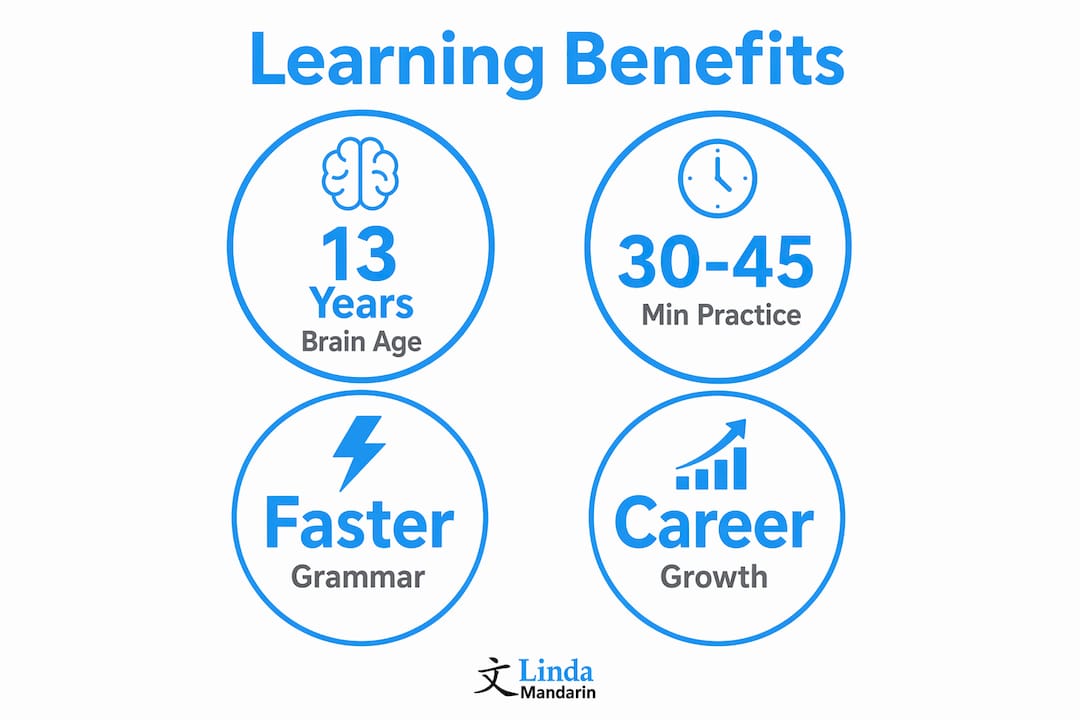
Adult language acquisition benefits start in the brain. Research published in 2026 found that bilingual brains appear six years younger than those of monolingual speakers. Trilingual speakers show a seven-year advantage, and those who speak four or more languages show a brain age up to 13 years younger. That is not a small effect. It suggests that the act of managing multiple language systems actively protects the brain over time.
Mandarin is a particularly strong candidate for this kind of cognitive workout. Its tonal system, character-based writing, and grammatical structure differ sharply from European languages. That gap forces the brain to build entirely new neural pathways rather than simply adapting existing ones. Effortful learning of Mandarin drives the brain health benefits more than passive exposure does. The harder the brain works, the greater the structural reward.
“The physiological benefits of adult language learning come primarily from active, effortful engagement with the language rather than passive exposure. High proficiency and intensity of learning are key drivers in delaying cognitive decline beyond just the number of languages spoken.”
The cognitive gains extend well beyond brain age. Language learning improves executive functions including task switching, problem-solving, working memory, and sustained concentration. Studies also show delayed dementia onset in multilingual adults compared to monolinguals. These are not abstract benefits. They show up in daily life as sharper focus at work, faster mental recovery after distraction, and better retention of new information.
Pro Tip: Consistent, focused practice sessions of 30–45 minutes produce stronger cognitive benefits than occasional marathon study blocks. Frequency beats duration when it comes to brain health.

Learning Chinese writing adds another layer of cognitive engagement. Reading and writing characters activates visual-spatial processing alongside linguistic memory, giving the brain a broader workout than phonetic scripts alone.
How do adult learners uniquely excel compared to children?
Adults are not slower language learners. They are different learners, and the difference often works in their favor. Adults possess superior cognitive skills for language acquisition, including advanced reasoning, deliberate memory strategies, and the ability to draw on first-language knowledge. Children absorb language through immersion and repetition. Adults analyze, compare, and categorize, which accelerates grammar and vocabulary acquisition significantly.
Here is where adult learners hold a clear edge over children:
- Faster vocabulary acquisition. Adults connect new Mandarin words to existing conceptual frameworks. A word like “negotiation” already has meaning. Adults just need the Mandarin label.
- Grammar mastery through analysis. Adults can study Mandarin grammar rules explicitly and apply them consciously, a skill children develop only gradually through exposure.
- Stronger grasp of idioms and cultural nuance. Life experience helps adults interpret metaphors, proverbs, and indirect communication styles that require cultural context to understand.
- Better use of explicit instruction. Adults benefit more from structured teaching because they can process explanations, ask targeted questions, and self-correct in real time.
- Metacognitive awareness. Adults know how they learn best. They can identify weak spots, adjust their study methods, and track their own progress deliberately.
Children do have one genuine advantage: pronunciation. Early exposure to tonal languages like Mandarin makes native-like accent acquisition easier. But accent is not fluency. Adults who focus on grammar and pattern analysis rather than chasing a native accent reach functional communication far faster than they expect.
Pro Tip: Use your first language as a learning tool, not a crutch. Comparing Mandarin sentence structure to English actively accelerates comprehension rather than slowing it down.
The most effective methods for adult Mandarin learners lean into these strengths. Structured instruction, spaced repetition, and explicit grammar study all align with how the adult brain processes new information.
What are the practical personal and professional advantages of adult Mandarin learning?
The advantages of adult language education extend well beyond the classroom. Mandarin proficiency creates real, tangible opportunities in both personal and professional life. Here are the most significant practical gains:
-
Career advancement in global markets. Mandarin proficiency enhances cross-cultural business interactions and negotiation effectiveness. China’s economic reach spans manufacturing, finance, technology, and trade. Professionals who speak Mandarin gain direct access to decision-makers and build trust faster in Chinese business contexts.
-
Stronger communication skills overall. Learning any second language sharpens your awareness of how language works. Adult Mandarin learners become more precise communicators in their first language too, because they develop a heightened sensitivity to word choice, tone, and structure.
-
Expanded professional network. Mandarin is spoken by over a billion people worldwide. Gaining even conversational fluency opens relationships with Chinese-speaking colleagues, clients, and partners that would otherwise require an interpreter.
-
Cultural empathy and awareness. Language carries culture. Learning Mandarin gives adults direct access to Chinese values, communication norms, and social customs. That understanding reduces misunderstandings in both business and personal relationships.
-
Confidence and personal growth. Completing a challenging cognitive task builds self-efficacy. Adults who reach conversational Mandarin consistently report increased confidence in professional settings and a stronger sense of personal accomplishment.
Mandarin communication skills developed through structured adult programs translate directly into better meetings, clearer emails, and more effective negotiations with Chinese-speaking counterparts.
What challenges do adult learners face, and how can they overcome them?
Adult learners face real barriers. Acknowledging them honestly is the first step toward getting past them. The most common challenges include:
- Pronunciation anxiety. Mandarin’s four tones are unfamiliar to most English speakers. Adults often fear saying the wrong tone and being misunderstood, which creates hesitation and slows speaking practice.
- Self-consciousness in class. Adults are accustomed to competence. Feeling like a beginner in a room full of other adults triggers discomfort that children simply do not experience in the same way.
- Time constraints. Adult learners balance work, family, and other commitments. Irregular study schedules break the consistency that language acquisition requires.
- Perfectionism. Adults tend to wait until they feel “ready” before speaking. That delay costs them the practice time that builds real fluency.
The psychological term for this hesitation is the affective filter. The affective filter is a psychological block caused by fear of speaking errors and accent. When the filter is high, learners stop taking the risks that produce growth. Lowering it requires a deliberate shift in mindset from performing correctly to communicating effectively.
Motivation is the most reliable tool for lowering that filter. Learners motivated by emotional and cultural connection outperform those driven purely by practical goals. Adults who connect Mandarin to a personal reason, whether a Chinese-speaking partner, a business relationship, or genuine cultural curiosity, practice more consistently and retain more over time.
Effective strategies for adult Mandarin learners include spaced repetition for character memorization, grammar-focused study sessions, conversation practice with native speakers, and building vocabulary systematically. Each of these methods aligns with adult cognitive strengths rather than fighting against them.
Pro Tip: Shift your goal from “speaking perfectly” to “being understood.” Native Mandarin speakers respond warmly to genuine effort. Imperfect Mandarin spoken confidently beats perfect Mandarin spoken never.
Key Takeaways
Adults who learn Mandarin gain measurable cognitive protection, faster grammar and vocabulary acquisition than children, and direct professional advantages in global markets.
| Point | Details |
|---|---|
| Brain age protection | Speaking multiple languages correlates with a brain up to 13 years younger than monolinguals. |
| Adult learning strengths | Adults acquire grammar and vocabulary faster than children through explicit analysis and memory strategies. |
| Professional value | Mandarin proficiency improves negotiation, cross-cultural communication, and career access in Chinese markets. |
| Motivation drives fluency | Emotional and cultural connection to Mandarin produces stronger persistence and long-term retention. |
| Overcome the affective filter | Shifting focus from accent perfection to clear communication accelerates real-world fluency. |
Why I think adults are actually better positioned to learn Mandarin than they realize
Most adults walk into their first Mandarin class carrying a quiet belief that they missed their window. They did not. That belief is the only real obstacle.
I have watched adult learners in structured programs move from zero Mandarin to confident business conversations in under a year. What separates the ones who succeed is not age or natural talent. It is their willingness to use what they already have. Adults bring decades of pattern recognition, life experience, and genuine motivation. Those are not small advantages. They are the exact tools Mandarin rewards.
The research on brain age and bilingualism confirms what good language teachers have observed for years. The brain does not stop growing when you stop being a child. It grows when you challenge it. Mandarin is one of the most demanding challenges available, which makes it one of the most rewarding.
My honest advice: stop waiting for the right time, the right accent, or the right level of confidence. Start with structure, find a reason that matters to you personally, and treat every mistake as data rather than failure. Adults who do that do not just learn Mandarin. They get better at learning itself.
— Paul
How Linda Mandarin supports adult Mandarin learners in Singapore
Linda Mandarin has delivered adult Mandarin training in Singapore since 2003. The school’s adult Mandarin programs cover conversational Mandarin, business Mandarin, and corporate training, all taught by certified native-speaking instructors fluent in English.
Classes run in-person at 10 Anson Road, Level 22, International Plaza, right above Tanjong Pagar MRT, and live online via Zoom for learners who need flexibility. Whether your goal is confident daily conversation or business Mandarin for professionals, Linda Mandarin structures each course around practical communication from the first lesson. Group, private, and corporate formats are all available, so you can match the format to your schedule and learning style.
FAQ
What are the main adult language learning advantages over children?
Adults acquire vocabulary and grammar faster than children through explicit analysis and deliberate memory strategies. Children hold an advantage only in pronunciation, which does not determine overall fluency.
How much younger can a multilingual brain appear?
Speaking two languages correlates with a brain approximately six years younger than a monolingual brain. Speaking four or more languages correlates with a brain up to 13 years younger.
Does learning Mandarin as an adult improve career prospects?
Mandarin proficiency directly improves cross-cultural negotiation and business communication, opening access to Chinese-speaking markets and professional networks that are otherwise difficult to reach.
What is the affective filter, and why does it matter for adult learners?
The affective filter is a psychological block caused by fear of speaking errors and accent. Lowering it by focusing on communication rather than perfection is the single most effective step adult learners can take toward fluency.
How long does it take an adult to reach conversational Mandarin?
The timeline varies by study intensity and prior language experience, but adults in structured programs with consistent practice typically reach functional conversational ability within 12 months.