TL;DR:
- Learning Mandarin boosts salaries, professional opportunities, and cognitive skills essential for complex work.
- Proficiency at HSK4 level unlocks significant career advantages without requiring native fluency, achievable in about 18-24 months.
Mandarin Chinese is the single most valuable language a professional can add to their career toolkit in 2026. The reasons why professionals study Chinese go far beyond cultural curiosity. Mandarin proficiency delivers measurable salary premiums, opens doors in finance, technology, and manufacturing, and signals to employers that you can handle complex, high-stakes work. China saw 70,392 foreign-funded enterprises established in 2025 alone, a 19.1% increase year over year. That growth creates direct demand for professionals who can communicate across the language gap.
What career advantages do professionals gain from learning Chinese?
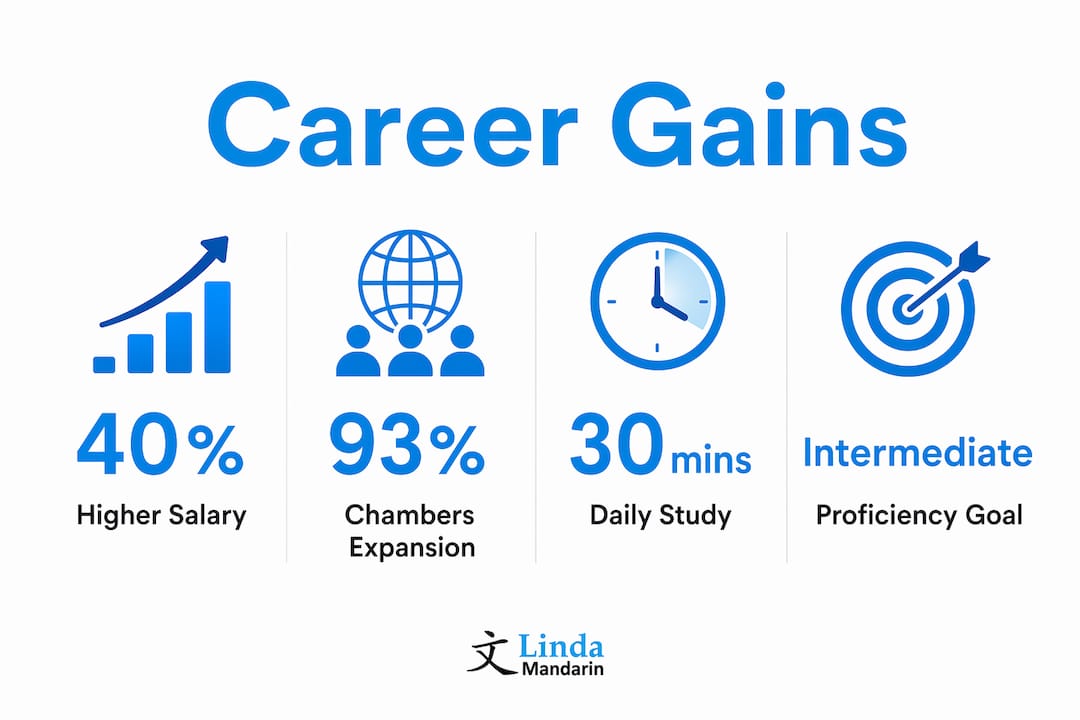
Mandarin proficiency converts directly into higher pay. Professionals with Chinese language skills earn 10–40% higher salaries than peers in similar roles without a foreign language. That range is not a rounding error. It reflects how scarce qualified bilingual talent remains across Asia and Western markets alike.

The salary premium is well documented at the certification level. A Joboko analysis of 580,000 job postings found that workers with HSK4 certification earn up to 25% more than English-only university graduates in comparable positions. That figure matters because HSK4 represents intermediate proficiency, not native fluency. Professionals do not need to master every character to see a financial return.
The sectors driving this demand are specific:
- Finance and banking: Chinese-speaking analysts and relationship managers command premium compensation at firms operating across Greater China and Southeast Asia.
- Technology: Engineering and product roles at companies with China-based supply chains or R&D centers require Mandarin for effective collaboration.
- Manufacturing and trade: Factory negotiations, quality control communication, and supplier relationships all run more smoothly with direct language access.
- International trade: Customs, logistics, and procurement professionals with Mandarin skills reduce friction and cost in cross-border deals.
Surveys indicate 60–93% of foreign chambers of commerce plan to deepen their China market presence as of early 2026. That consensus signals sustained hiring demand for Mandarin-capable professionals well into the decade. The career advantages of Chinese are not speculative. They are already priced into the job market.
Pro Tip: Target roles that list “Mandarin preferred” rather than “Mandarin required.” These positions often go unfilled for months, giving intermediate speakers a genuine competitive edge.
How does Chinese language study improve cognitive and professional skills?
Learning Mandarin engages the brain differently than learning any alphabetic language. Mandarin’s tonal system and logographic writing require the brain to process visual and auditory information simultaneously. Scientific studies confirm this activates distinct neural pathways that improve visual memory, multitasking, and decision-making under pressure.
Those cognitive gains transfer directly to the workplace. Professionals who study Mandarin report stronger working memory and better performance on tasks that require switching between complex systems. The mental discipline of memorizing thousands of characters and tracking four tones builds the same mental muscle that handles financial modeling, project management, and strategic planning.
Employers have taken notice. Mandarin proficiency signals persistence, discipline, and the ability to manage ambiguity. Hiring managers treat Mandarin study as a proxy for high cognitive flexibility. A candidate who learned Mandarin as an adult has already demonstrated they can tackle a genuinely hard problem and see it through.
The benefits compound over time. Professionals who study Mandarin for brainpower often report improvements in focus and structured thinking that show up in their non-language work. The language becomes a training ground for the kind of mental agility that leadership roles demand.
Pro Tip: Study Mandarin in short, daily sessions of 20–30 minutes rather than long weekly blocks. Consistent exposure builds tonal memory faster and mirrors the spaced repetition techniques used in professional skill development.
What proficiency level in Chinese is needed to unlock professional advantages?
Native fluency is not the goal for most professionals. The professional sweet spot is intermediate conversational proficiency, roughly equivalent to HSK4, which enables basic meetings, written correspondence, and relationship-building conversations. That level is achievable without years of full-time study.
Reaching professional-level fluency in Mandarin typically requires around 2,200 study hours. That sounds daunting until you break it down. At one hour per day, that timeline spans roughly six years. At two to three hours per day with structured instruction, professionals reach functional proficiency in 18–24 months. The key is consistent, structured practice rather than sporadic intensive effort.
Here is a practical progression for professionals:
- Months 1–3: Learn pinyin pronunciation, basic greetings, and workplace introductions. This alone changes how Chinese-speaking colleagues perceive you.
- Months 4–9: Build vocabulary around your industry. Finance professionals learn terms for contracts and reporting. Tech professionals learn product and engineering vocabulary.
- Months 10–18: Practice meeting participation, email writing, and phone conversations. This is where functional workplace use begins.
- Months 18–24: Reach HSK4 equivalent proficiency. Conduct basic negotiations, read business news, and hold informal conversations with clients.
The workplace payoff starts earlier than most professionals expect. Even basic Mandarin greetings and small talk in a client meeting shift the dynamic. Chinese-speaking counterparts respond to the effort with greater openness and trust. The language does not need to be perfect to be effective.
Pro Tip: Pair formal instruction with real-world practice from day one. Use Mandarin in one workplace interaction per week, even if it is just a greeting. Application accelerates retention faster than classroom study alone.
How does studying Chinese enhance cross-cultural understanding and business relations?
Language is the fastest path into a culture. Professionals who speak Mandarin access Chinese business communication norms directly, without relying on interpreters who may soften or reframe key messages. That direct access changes the quality of every negotiation, client meeting, and internal collaboration.
Linguistic proficiency functions as economic capital in global markets by reducing transaction costs and uncertainty in international business. A case study of professionals who studied in mainland China found that Mandarin fluency opened employment across construction, trade, technology, translation, and manufacturing sectors. The language did not just help them communicate. It gave them access to networks and opportunities that English alone could not reach.
The trust dimension is equally significant. Mandarin skills improve communication in bilingual workplaces, increase trust, and enable participation in informal conversations that shape real decisions. In many Asian business environments, the most important discussions happen outside the formal meeting room. A professional who can follow and contribute to those conversations holds a fundamentally different position than one who cannot.
Access to primary sources is another underrated benefit. Mandarin-reading professionals can review Chinese regulatory filings, market reports, and industry news without waiting for translations. That speed advantage compounds in fast-moving sectors like technology and finance.
| Business context | Impact of Mandarin proficiency |
|---|---|
| Client negotiations | Direct communication reduces misunderstanding and builds rapport faster |
| Internal team collaboration | Participation in informal discussions increases trust and inclusion |
| Market research | Access to primary Chinese-language sources ahead of translated reports |
| Supplier relationships | Direct negotiation reduces reliance on intermediaries and lowers costs |
| Regulatory compliance | Faster reading of Chinese-language filings and government communications |
The importance of studying Chinese for business professionals extends beyond vocabulary. It reshapes how counterparts perceive your commitment to the relationship and the market.
Key Takeaways
Mandarin proficiency is a measurable professional asset that delivers salary premiums, cognitive advantages, and deeper business relationships across every sector with China exposure.
| Point | Details |
|---|---|
| Salary premium is real | Professionals with Chinese skills earn 10–40% more than peers in similar roles. |
| HSK4 is the career threshold | Intermediate proficiency unlocks most professional benefits without requiring native fluency. |
| Cognitive gains transfer to work | Mandarin study improves memory, multitasking, and decision-making in non-language tasks. |
| Trust builds through language | Speaking Mandarin in client and team settings creates access and rapport that English alone cannot. |
| Market demand is growing | Over 70,000 foreign-funded enterprises entered China in 2025, sustaining strong hiring demand. |
What I have seen after years of watching professionals learn Mandarin
The professionals who gain the most from Mandarin study are rarely the ones who set out to become fluent. They are the ones who commit to consistent, practical learning with a clear professional goal in mind. I have watched finance professionals go from zero Mandarin to conducting client calls in 18 months. I have seen engineers build supplier relationships that their English-only colleagues simply could not access. The language does not need to be perfect to change your professional standing.
The mistake most professionals make is waiting until they feel “ready” to use Mandarin at work. That moment never comes if you only study in a classroom. The professionals who progress fastest treat every workplace interaction as a practice opportunity. A greeting here, a product term there, a short email in Mandarin to a colleague. Those small moments accumulate into genuine fluency faster than any textbook can deliver.
My honest advice: set a 90-day goal, not a five-year plan. Commit to reaching a level where you can introduce yourself and your role in Mandarin by the end of three months. That single achievement changes how Chinese-speaking colleagues and clients see you. From that foundation, the next 90 days build naturally. The career returns on that investment are not theoretical. They show up in your next performance review, your next job offer, and your next client meeting.
— Paul
Mandarin training built for working professionals
Professionals who are serious about adding Mandarin to their career skills need structured, practical instruction, not generic language apps.

Linda Mandarin has delivered professional Mandarin training in Singapore since 2003. The school’s corporate Mandarin training programs are built specifically for workplace communication, covering business vocabulary, meeting participation, and professional correspondence. For professionals who prefer flexible scheduling, online Zoom classes and group sessions are available alongside private instruction. All programs are taught by certified native Mandarin instructors fluent in English, and the curriculum is structured around real workplace scenarios. Linda Mandarin is located at 10 Anson Road, level 22, International Plaza, Singapore 079903, right above Tanjong Pagar MRT. Explore the full range of adult Mandarin programs and find the format that fits your schedule and career goals.
FAQ
Why do professionals study Chinese rather than other languages?
Chinese is the language of the world’s second-largest economy and the primary language of over 1.4 billion people. Mandarin proficiency delivers salary premiums of 10–40% and opens roles in finance, technology, and trade that other languages do not.
How long does it take to reach professional-level Mandarin?
Reaching functional workplace proficiency takes approximately 18–24 months of consistent study at two to three hours per day. Most professionals see meaningful career benefits at intermediate conversational level, around HSK4 equivalent, before reaching full fluency.
Does learning Chinese actually improve cognitive skills?
Yes. Mandarin’s tonal and logographic features activate distinct neural pathways that improve visual memory, multitasking, and decision-making. These cognitive gains transfer directly to non-language workplace tasks.
Is Mandarin useful for professionals who are not based in China?
Mandarin is highly useful outside China. Singapore, Malaysia, Taiwan, and many Southeast Asian business communities operate significantly in Mandarin. Multinational companies with China supply chains or investor bases also value Mandarin-capable staff regardless of location.
What level of Chinese is needed to see career benefits?
Intermediate proficiency, roughly equivalent to HSK4, is the threshold where most career benefits become accessible. That level enables basic meetings, professional emails, and relationship-building conversations without requiring native fluency.