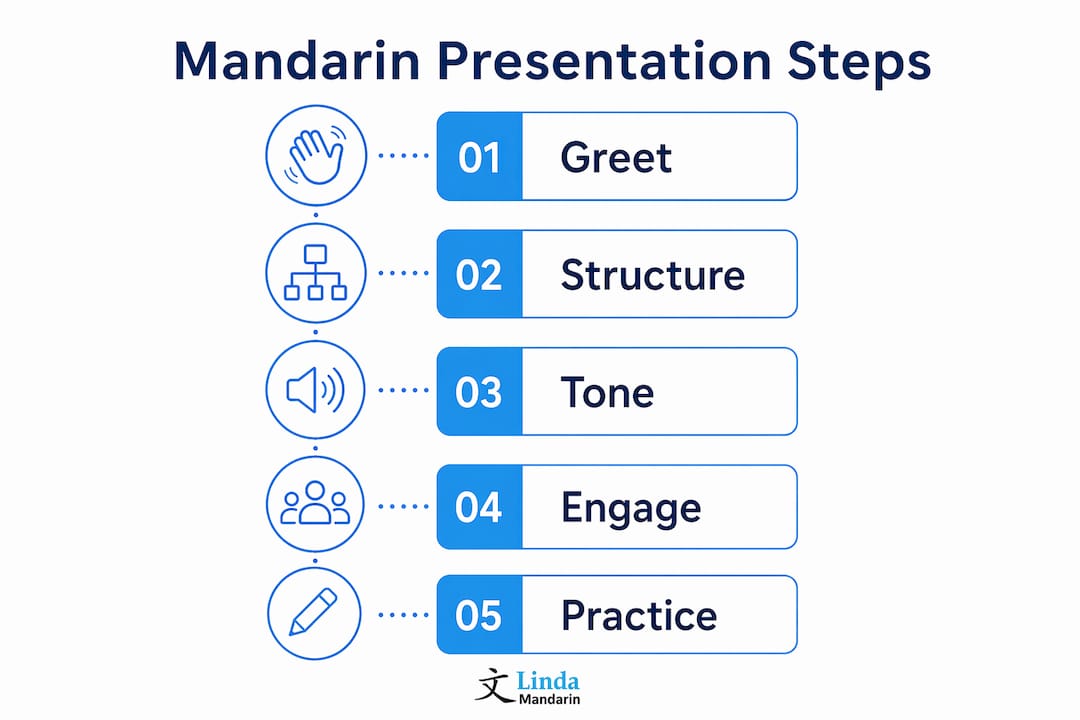
Presenting in Mandarin confidently comes down to three things: knowing the right phrases, understanding the structure, and respecting the cultural expectations of your audience. Whether you’re preparing for a business pitch, an academic talk, or a professional meeting, Mandarin for presentations explained means more than memorizing vocabulary. It means knowing when to be formal, how to transition smoothly, and how to close with the kind of polish that leaves a strong impression.
Essential Mandarin phrases every presenter needs to know
The phrases below cover the full arc of a presentation, from the first word to the final thank-you. Key phrases for presentations in Mandarin fall into five clear categories.
Opening greetings:
- 大家好 (dà jiā hǎo) — “Hello everyone” — warm and inclusive, right for most settings
- 尊敬的女士们,先生们 (zūn jìng de nǚ shì men, xiān shēng men) — “Respected ladies and gentlemen” — formal business or academic contexts
- 今天我要谈的是… (jīn tiān wǒ yào tán de shì) — “Today I will talk about…” — states your topic immediately
- 我是… (wǒ shì) — “I am…” — your self-introduction, always expected in professional settings
- 请允许我代表… (qǐng yǔn xǔ wǒ dài biǎo) — “Please allow me to represent…” — used when speaking on behalf of an organization
Transition phrases:
- 首先… (shǒu xiān) — “Firstly”
- 其次… (qí cì) — “Secondly”
- 接下来… (jiē xià lái) — “Next”
- 我们继续… (wǒ men jì xù) — “Let’s continue”
- 让我们回到… (ràng wǒ men huí dào) — “Let’s get back to…”
Giving examples and contrasting:
- 比如… (bǐ rú) — “For example”
- 举个例子… (jǔ gè lì zi) — “To give an example”
- 另一方面… (lìng yī fāng miàn) — “On the other hand”
Audience engagement:
- 大家知不知道… (dà jiā zhī bù zhī dào) — “Does everyone know…?”
- 首先,我问大家一个问题 (shǒu xiān, wǒ wèn dà jiā yī gè wèn tí) — “First, I will ask everyone a question”
- 大家有什么问题吗?(dà jiā yǒu shén me wèn tí ma?) — “Does anyone have questions?”
Closing phrases:
- 最后… (zuì hòu) — “Finally”
- 总结一下 (zǒng jié yī xià) — “To summarize”
- 谢谢大家!(xiè xiè dà jiā) — “Thank you all!”
Pair these with workplace Mandarin phrases to build a fuller professional vocabulary.
How to structure a Mandarin presentation for maximum clarity

A well-organized Mandarin presentation follows a three-part structure: opening (开场, kāi chǎng), body (正文, zhèng wén), and conclusion (结尾, jié wěi). Audiences expect this pattern, and deviating from it without reason tends to create confusion rather than interest.
Opening (开场):
- Greet the audience: 大家好,我是…
- State your topic clearly: 今天我要谈的是…
- Briefly outline what you will cover so listeners know what to expect
Body (正文):
- Sequence main points with 首先…, 其次…, 接下来…
- Support each point with examples using 比如… or 举个例子…
- Use 另一方面… when shifting to a contrasting idea or a new angle
- Keep each section focused; one main idea per block works best
Conclusion (结尾):
- Signal the wrap-up with 最后… or 总结一下
- Restate your key message in one or two sentences
- Invite questions with 大家有什么问题吗?
- Close with 谢谢大家!
The logic here mirrors good presentation structure in any language, but Mandarin audiences particularly value a clear, predictable flow. Jumping between points without signaling the shift reads as disorganized, not dynamic.
Why tone accuracy can make or break your Mandarin presentation

Mandarin is a tonal language, and incorrect tones change meanings in ways that can confuse or even embarrass a speaker. The word “mā” (妈, mother) and “mǎ” (马, horse) differ only in tone. Getting that wrong mid-sentence pulls the audience’s attention away from your content and onto your error.
Pacing matters just as much as tone. Speaking too fast collapses the tonal distinctions that listeners rely on. Slow down slightly from your natural conversational speed, especially when delivering key terms or technical vocabulary. Enunciate each syllable cleanly, and give your transitions a beat of silence before and after.
Practice the specific words that appear in your presentation, not just general Mandarin. Words like 资料 (zī liào, materials/data), 结论 (jié lùn, conclusion), and 观点 (guān diǎn, viewpoint) come up constantly in professional talks and deserve focused rehearsal. Reviewing common Mandarin mistakes before your presentation can help you catch pronunciation errors before they reach your audience.
Pro Tip: Record yourself delivering the full presentation, then play it back with the pinyin script in front of you. Mark every tone that sounds off and drill those words in isolation before running the full presentation again. Getting feedback from a native speaker on your recording accelerates improvement faster than self-review alone.
Cultural norms that shape how Mandarin presentations land
Chinese professional culture places a high value on formality, respect, and humility, and these values show up directly in how presentations are received. Chinese rhetorical style favors indirect communication and modesty over bold self-promotion, which means the way you frame your claims matters as much as the claims themselves.
Do’s:
- Open with 尊敬的… (respected…) when addressing senior figures or formal audiences
- Use titles and honorifics: 先生 (Mr.), 女士 (Ms.), 教授 (Professor)
- Speak with measured confidence rather than aggressive assertiveness
- Incorporate 成语 (chéngyǔ, Chinese idioms) where appropriate; they signal cultural literacy
- Close formally with 谢谢大家 and a slight bow if presenting in person
Don’ts:
- Avoid pointing directly at audience members with a single finger
- Don’t use overly casual language in a business or academic setting
- Avoid interrupting questions or rushing through the Q&A
- Don’t skip the formal greeting; jumping straight into content reads as disrespectful
- Avoid excessive eye contact with a single person; distribute your gaze across the room
Body language should be calm and controlled. Broad, sweeping gestures can read as aggressive in formal Chinese settings. Keep movements deliberate and minimal, and stand with a grounded, upright posture throughout.
How to keep a Mandarin-speaking audience engaged
Audience engagement in Mandarin presentations works best when you build participation into the structure from the start, not as an afterthought. Opening with a question like 大家知不知道…? immediately activates the audience mentally, even if no one answers aloud. It signals that you see them as participants, not just listeners.
Practical engagement strategies:
- Ask 大家有什么问题吗?at natural pause points, not just at the end
- Use visual aids and describe them verbally: 请看这张图 (qǐng kàn zhè zhāng tú, “please look at this chart”)
- Reference data on slides with 根据这个数据 (gēn jù zhè gè shù jù, “according to this data”)
- Maintain steady, distributed eye contact across the room
- Use facial expressions that match your content; a flat affect reads as disengaged
Managing nerves is a practical skill, not a personality trait. Slow, deliberate breathing before you begin lowers your heart rate and steadies your voice. If you lose your place, 让我们回到… buys you a natural moment to regroup without drawing attention to the pause.
Pro Tip: Use intentional pauses after key points. A two-second silence after a strong statement gives the audience time to absorb it and signals that the point deserves attention. In Mandarin presentations, silence reads as thoughtfulness, not uncertainty.
Transitioning into Q&A smoothly matters too. 现在我们进入提问环节 (xiàn zài wǒ men jìn rù tí wèn huán jié, “now we enter the Q&A session”) is a clean, professional phrase that signals the shift without awkwardness.
Where to build real Mandarin presentation skills with structured training
Phrase lists and tips get you started, but consistent improvement in Mandarin for professional speaking requires structured practice with qualified instructors who can correct you in real time.
Linda Mandarin, based at 10 Anson Road, Level 22, International Plaza, Singapore 079903 (right above Tanjong Pagar MRT), has been training adult Mandarin learners since 2003. The school’s courses are built specifically for adults and professionals, covering conversational Mandarin through to advanced business communication.
What Linda Mandarin’s programs offer:
- Corporate Mandarin training tailored to business presentation contexts
- Online Zoom classes for learners who need flexibility
- Group and private class formats to match different learning paces
- Native, certified instructors who deliver lessons in English and Mandarin
- A curriculum aligned with international language standards, covering speaking, listening, reading, and writing
- Real-life communication focus, with lessons built around practical scenarios including presentations and meetings

Adult learners who want to present confidently in Mandarin benefit most from courses that combine structured vocabulary building with live speaking practice. Linda Mandarin’s adult Mandarin programs cover both the language and the cultural context that makes the difference between a technically correct presentation and one that actually connects with a Mandarin-speaking audience.
Key Takeaways
Presenting in Mandarin effectively requires mastering core phrases, following a clear three-part structure, and respecting the cultural norms that shape how Chinese-speaking audiences receive a speaker.
| Point | Details |
|---|---|
| Start with the right greeting | Use 大家好 for informal settings and 尊敬的女士们,先生们 for formal business or academic contexts. |
| Follow the three-part structure | Organize every presentation into opening (开场), body (正文), and conclusion (结尾) for clarity. |
| Tone accuracy is non-negotiable | Incorrect tones change word meanings and reduce speaker credibility in Mandarin presentations. |
| Cultural humility builds rapport | Chinese rhetorical style favors indirect communication, modesty, and formal address throughout. |
| Structured training accelerates progress | Live practice with native instructors corrects pronunciation and cultural missteps faster than self-study. |
FAQ
How do you start a presentation in Mandarin?
Open with a greeting suited to your setting: 大家好 (dà jiā hǎo) for general audiences, or 尊敬的女士们,先生们 for formal contexts. Follow immediately with your topic statement: 今天我要谈的是…
What are the best transition phrases for presenting in Mandarin?
Use 首先 (firstly), 其次 (secondly), and 接下来 (next) to sequence your points. For contrasting ideas, 另一方面 (on the other hand) signals the shift cleanly.
How do you handle Q&A in a Mandarin presentation?
Invite questions with 大家有什么问题吗? and signal the transition with 现在我们进入提问环节. Both phrases are standard in professional Mandarin settings and signal respect for the audience.
How do Chinese speakers say “sorry” in a formal presentation context?
The standard apology is 对不起 (duì bu qǐ) for general use, or the more formal 非常抱歉 (fēi cháng bào qiàn, “I sincerely apologize”) when addressing a professional audience.
Does the 3-3-3 rule apply to Mandarin presentations?
Mandarin professional presentations follow a clear three-part structure of opening (开场), body (正文), and conclusion (结尾), with transitions and audience engagement built into each stage.