What Chinese comprehension really means for adult learners
Chinese comprehension is the active process of interpreting meaning from spoken and written Mandarin, not just recognizing individual words or characters. The Cambridge Dictionary defines comprehension (理解力) as the ability to understand language fully, distinguishing listening comprehension (听力理解) from reading comprehension (阅读理解) as two distinct but related skills.
For adult professionals, this distinction matters. You can recognize every character in a sentence and still miss what the speaker actually means. True Chinese language understanding is an active, interpretive process that bridges language features with context, intent, and cultural knowledge.
Core aspects of Chinese comprehension at a glance:
- Listening comprehension: Processing spoken Mandarin in real time, including tones, rhythm, and situational cues
- Reading comprehension: Decoding characters and extracting meaning from written text, from emails to contracts
- Pragmatic comprehension: Understanding what a speaker intends, not just what they literally say
- Cultural comprehension: Interpreting meaning shaped by Chinese social norms and business conventions
Table of Contents
- Why adult professionals find Chinese comprehension so difficult
- Proven strategies to improve your Chinese comprehension for business and conversation
- How pragmatics shapes Chinese business communication
- How Linda Mandarin supports adult learners in reaching real comprehension
- Practical exercises that build comprehension faster
- How to measure your comprehension progress accurately
- Linda Mandarin: practical Mandarin comprehension for working professionals
- Key Takeaways
- FAQ
Why adult professionals find Chinese comprehension so difficult
Most adult learners hit a wall that has nothing to do with effort. The obstacles are structural.
- Tone confusion: Mandarin has four tones plus a neutral tone. Mishearing a tone changes the word entirely, and in fast speech, tones blur together.
- Character complexity: Written Chinese uses thousands of characters with no phonetic alphabet to fall back on. Reading and listening draw on separate mental pathways.
- Word-for-word decoding: Translating mentally as you listen is the single biggest comprehension killer. By the time you’ve decoded one phrase, three more have passed.
- “Tīng bù dǒng” fatigue: Many learners try to process every word instead of tracking communicative intent. The result is cognitive overload and a sense of total listening comprehension failure.
- Spoken vs. written gap: Spoken and written Chinese are related but distinct systems. A phrase natural in conversation may look nothing like its written equivalent.
- Pragmatic blind spots: Adult learners with strong vocabulary still misread requests, refusals, or agreements because discourse pragmatics in Chinese carries heavy cultural loading.
Pro Tip: Stop trying to understand everything. Train yourself to extract the speaker’s main intent first. What do they want? What are they reacting to? That single shift reduces cognitive load faster than any vocabulary drill.
Proven strategies to improve your Chinese comprehension for business and conversation
These methods work because they match how adult brains actually acquire language, not how textbooks assume they do.
- Use comprehensible input. Select texts and audio where you already know 80–90% of the vocabulary. Struggling through material that’s too advanced slows retention, not builds it.
- Skim before you read. Scan for topic sentences and key terms first. This primes your brain to slot new information into an existing framework.
- Practice segment-based listening. Pause after short chunks of audio, reconstruct the meaning in your own words, then continue. This beats passive replay every time.
- Focus on intent, not translation. Ask “what is this person trying to accomplish?” before asking “what does each word mean?”
- Apply the three-times rule. When a new word appears in three different contexts, retain it. Chasing every unknown word in a text is the fastest route to burnout.
- Work with real business scenarios. Practice with meeting transcripts, negotiation dialogues, and professional emails. Generic textbook dialogues rarely match what you’ll actually hear in a boardroom or on a call.
- Balance active and passive exposure. Structured study builds precision; background listening to podcasts or business news builds fluency and natural rhythm.
Pro Tip: When reading, use top-down context clues first: the title, the setting, the speaker’s role. That context does half the comprehension work before you process a single character.
How pragmatics shapes Chinese business communication

Vocabulary gets you into the room. Pragmatics keeps you there.
Pragmatic competence means understanding speech acts: promises, requests, refusals, and assertions as social actions, not just sentences. In Chinese business settings, a polite “we’ll consider it” often means no. A question about your schedule may be an indirect request. Literal translation misses all of this.
- Recognize indirect speech: Chinese professional communication frequently uses indirection to preserve face on both sides.
- Learn culturally loaded expressions: phrases tied to hierarchy, reciprocity, and relationship-building (关系, guānxi) carry meaning no dictionary captures.
- Study context alongside vocabulary: who is speaking, to whom, and in what setting shapes what words actually mean.
- Practice with business Mandarin communication scenarios that include negotiation, agreement, and polite disagreement.
Professionals planning to work directly with Chinese partners or clients should also understand the practical logistics involved, including business visa requirements for travel to China, where in-person relationship-building remains central to deal-making.
How Linda Mandarin supports adult learners in reaching real comprehension
Linda Mandarin has been training adult professionals in Mandarin since 2003, with a focus on practical communication rather than academic drilling.
- Certified native instructors fluent in English deliver lessons that explain the why behind comprehension challenges, not just the what.
- Course range spans beginner conversational Mandarin through advanced business Mandarin, with corporate training programs built around real workplace scenarios.
- Flexible formats include in-person group classes, private sessions, and live online Zoom classes, designed for professionals who can’t commit to a rigid schedule.
- Evidence-based methods embed pragmatic training directly into lessons, so learners develop cultural and communicative intelligence alongside language skills.
- Practical focus across all four skills: listening, speaking, reading, and writing, with comprehension strategies woven throughout rather than treated as a separate module.
Practical exercises that build comprehension faster
The best exercises mirror real communication, not test conditions.
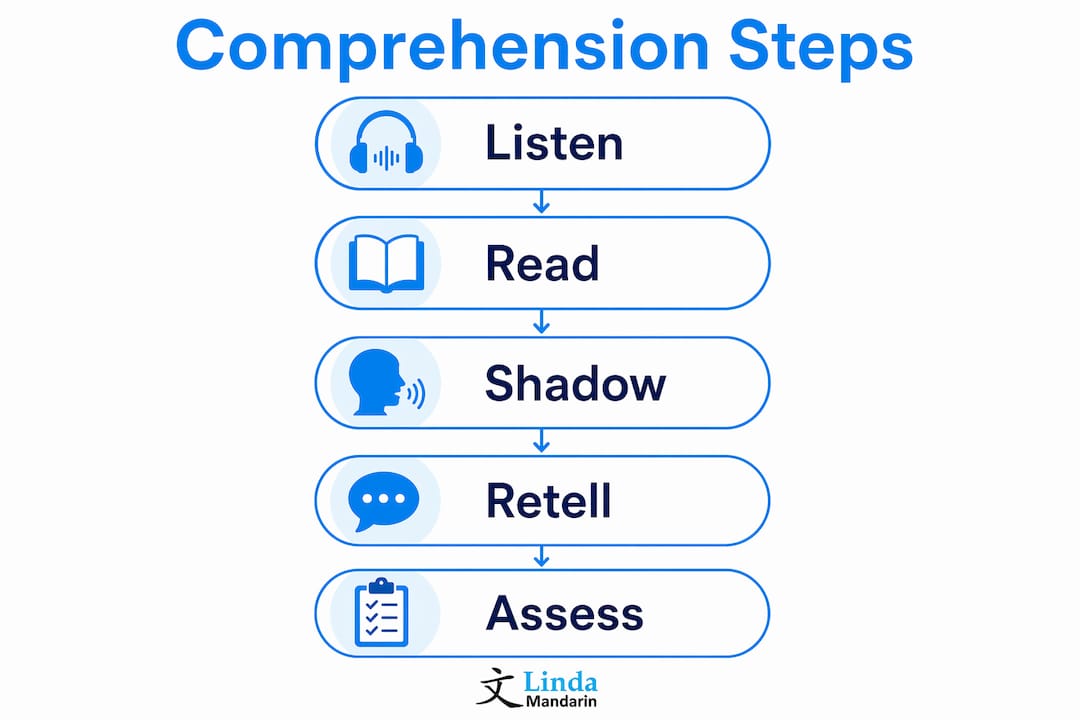
For listening: Record a short business podcast in Mandarin. Listen once without stopping. Write down the three main points. Listen again and check. This trains you to extract meaning under pressure, the exact skill you need in a live meeting.
For reading: Take a short business article in Chinese. Read the headline and first paragraph only, then predict what the rest covers. Read the full piece and compare. This builds the top-down processing habit that fluent readers use automatically.
For both: Shadow native speakers by repeating phrases immediately after hearing them. Shadowing locks in tone patterns and rhythm at a level that passive listening never reaches.
How to measure your comprehension progress accurately
Self-assessment is notoriously unreliable in language learning. Use these methods instead.
Retell tasks: After reading or listening to a passage, explain the main idea and two supporting details without looking back. If you can’t, comprehension was surface-level.
Cloze tests: Remove every seventh word from a Chinese text and try to fill the gaps. Accuracy above 60% signals solid comprehension at that level.
Timed reading checks: Track how many characters per minute you read while maintaining full understanding. Progress here is concrete and measurable.
Conversation-based feedback: A qualified instructor can identify exactly where comprehension breaks down in real time, something no app replicates. Linda Mandarin’s adult programs include structured feedback built into every session.
Linda Mandarin: practical Mandarin comprehension for working professionals

Adult professionals learning Mandarin for business don’t need more vocabulary lists. They need structured comprehension training that works in real conversations and real meetings. Linda Mandarin’s Mandarin courses for adults are built around exactly that: certified native instructors, pragmatics-integrated lessons, and flexible formats including online Zoom and corporate group training. Whether you’re preparing for client meetings, expanding into Chinese-speaking markets, or building professional relationships, the school’s programs give you the comprehension skills that actually transfer to the real world. Contact Linda Mandarin to find the right course format for your schedule and goals.
Key Takeaways
Chinese comprehension requires active interpretation of meaning, not just word recognition, and pragmatic awareness is as critical as vocabulary for professional communication.
| Point | Details |
|---|---|
| Comprehension is active | Understanding Mandarin means interpreting intent and context, not decoding words one by one. |
| Two distinct skill sets | Listening and reading comprehension draw on different mental pathways and need separate practice. |
| Pragmatics over vocabulary | Recognizing speech acts and cultural intent matters more than vocabulary size in business settings. |
| Comprehensible input works | Select texts and audio where you already know 80–90% of the vocabulary. This level supports faster retention and natural acquisition. |
| Linda Mandarin’s approach | Certified native instructors embed comprehension strategies and pragmatic training into every adult course. |
FAQ
What is Chinese comprehension, exactly?
Chinese comprehension is the ability to actively interpret meaning from spoken and written Mandarin, including tone, context, and cultural intent, not just recognize individual words or characters.
Why is listening comprehension harder than reading in Mandarin?
Spoken Mandarin moves fast, tones shift in connected speech, and there’s no pause button in a real conversation. Reading allows you to slow down and re-process; listening demands real-time meaning extraction.
How long does it take to reach functional comprehension in Mandarin?
Timeline varies by starting point and study intensity, but consistent structured practice with comprehensible input and pragmatic training accelerates progress significantly compared to vocabulary-only study.
What role does cultural knowledge play in Chinese comprehension?
Cultural knowledge is inseparable from comprehension in professional contexts. Indirect speech, face-saving expressions, and relationship-based communication all require cultural context to interpret correctly.
How does Linda Mandarin help adult learners improve comprehension?
Linda Mandarin’s certified native instructors use evidence-based methods that integrate listening, reading, and pragmatic training into practical business and conversational Mandarin courses, available in-person and via online Zoom.