TL;DR:
- Learning Chinese helps expats improve career prospects, social integration, and safety in China.
- Even basic Mandarin ability allows meaningful interactions, trust-building, and access to local opportunities.
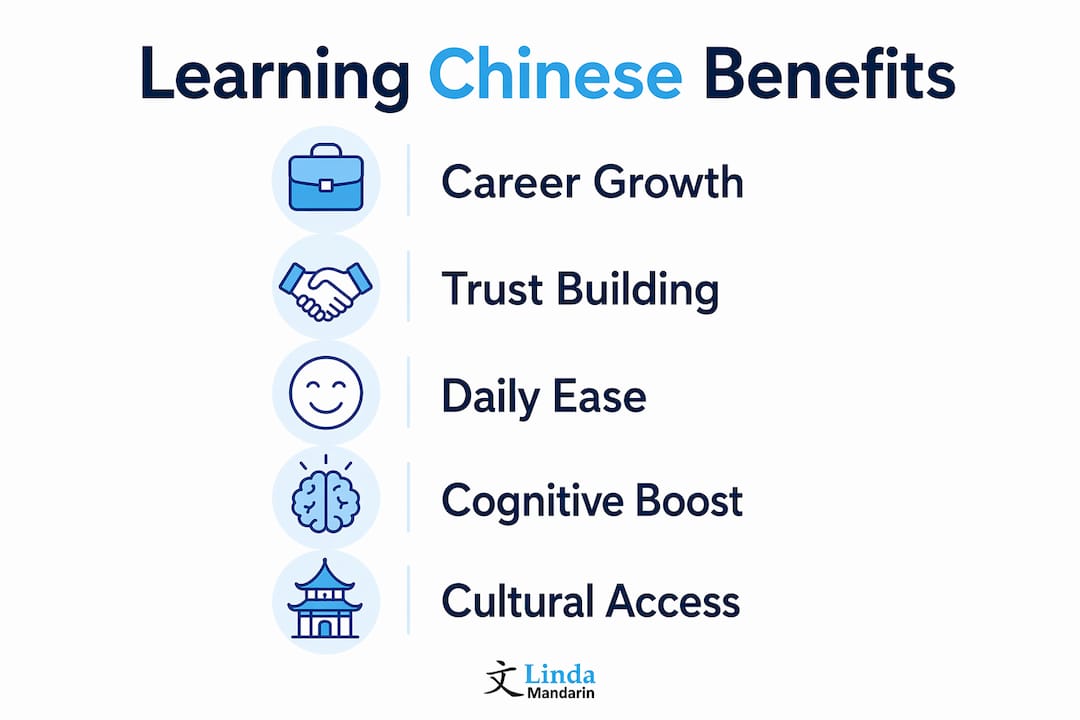
Yes, learning Chinese is worth the investment. Expats who develop even basic Mandarin proficiency report stronger career trajectories, deeper social integration, and a measurably easier daily life in China. The importance of learning Chinese for expats goes well beyond politeness; it directly affects your earning potential, your safety, and whether local colleagues actually trust you.
Here is what that looks like in practice:
- Career and hiring advantage. Mandarin competency widens the pool of roles you can compete for and removes the ceiling that stops many expats from moving into local leadership.
- Guanxi and trust. Speaking even conversational Chinese signals respect and shifts how colleagues and partners treat you, often within weeks.
- Daily convenience and safety. From hospital visits to lease negotiations, language ability prevents costly mistakes and keeps you in control of your own situation.
The trade-off is real: reaching functional proficiency takes several hundred hours of deliberate study. The payoff, for most expats, arrives well before that milestone.
Pro Tip: Start with 5–10 minutes of daily practice before you arrive in China. Practitioners consistently find that pre-arrival habits are easier to maintain than habits built from scratch once work and social demands kick in.
Table of Contents
- How does learning Chinese affect your career as an expat?
- How Chinese language skills build trust and social connection
- What practical daily-life problems does Mandarin actually solve?
- What cognitive and personal benefits come with learning Chinese?
- What myths and challenges do expats face when learning Chinese?
- How long does it take to reach useful proficiency as an expat?
- What is the most effective learning strategy for expats in China?
- What do HR leaders and researchers say about language and expat success?
- Key Takeaways
- What actually separates expats who succeed in China from those who plateau
- Further reading and authoritative sources
- FAQ
How does learning Chinese affect your career as an expat?
The career case for Mandarin is less about fluency and more about access. Expats who learn Chinese for business gain direct access to information that would otherwise pass through a local intermediary first. Without that access, you are dependent on someone else’s summary of what was said in a meeting, what a contract clause actually means, or what a client’s real objection is.

That dependency has a name in corporate China: the gatekeeping effect. When a local employee controls the flow of information between you and the rest of the organization, your influence shrinks regardless of your title. Even modest Mandarin ability, enough to follow the gist of a conversation, reduces that dynamic and rebalances the relationship.
The career benefits stack up across several dimensions:
- Hiring breadth. Roles that require client-facing communication, team leadership, or government liaison are effectively closed to non-Mandarin speakers. Language ability opens them.
- Negotiation. Following a negotiation in Chinese, even partially, lets you read tone, hesitation, and subtext that translation strips out.
- Local team leadership. Managing a Chinese team through an interpreter is slow and creates distance. Direct communication, even imperfect, builds credibility faster than any management technique.
- Business development. Relationships in China are built over meals and informal conversations, not in formal meetings. Language is the entry ticket.
HR directors who work with expatriate talent in China are direct about this: the most successful expats treat language learning as a core professional responsibility, because without it they hit a career ceiling in local leadership. The shrinking pool of expat-only roles means that local talent increasingly competes for positions that once went automatically to foreign hires. Language is now a differentiator, not a bonus.
Pro Tip: Add Mandarin study to your professional development section on your CV and mention it in performance reviews. Framing it as a business investment, not a personal hobby, signals strategic thinking to your employer and often unlocks company support for lessons.
How Chinese language skills build trust and social connection
Guanxi, the Chinese concept of relationship networks built on mutual trust and reciprocity, is not a cultural curiosity. It is the operating system of professional life in China. And language is the fastest way in.

When you speak Mandarin, even haltingly, something shifts. Colleagues who kept interactions transactional start including you in informal conversations. Clients who were polite but distant become warmer. The reason is simple: speaking someone’s language signals that you see them as worth the effort. That signal travels further in China than in most cultures, because the assumption that foreigners will not bother to learn is so widespread that any effort stands out.
The practical effects show up quickly:
- Invitations to informal dinners and social events where real decisions get made
- Colleagues sharing context and background that they would not translate for a non-speaker
- Faster resolution of workplace friction, because you can address it directly rather than through a third party
- Neighbors and service providers who treat you as a resident rather than a tourist
Research on expatriate-local employee relationships confirms that language proficiency moves relationships from distant or segregated to harmonious and trust-based. The mechanism is not just communication; it is the signal of respect that learning sends.
Speaking Mandarin in a meeting, even imperfectly, communicates something no business card or title can: that you are here to engage, not just to extract. That distinction changes how people respond to you.
What practical daily-life problems does Mandarin actually solve?
The career arguments are compelling, but the daily-life case is what most expats feel first. China’s public-facing infrastructure, from hospital registration systems to apartment lease templates to delivery app interfaces, runs almost entirely in Chinese. English-language alternatives exist in a handful of international districts in Shanghai and Beijing. Everywhere else, you are on your own.
Here is where basic Mandarin pays off immediately:
- Housing. Reading a lease, understanding a landlord’s verbal explanation of building rules, and communicating maintenance issues without a middleman.
- Healthcare. Describing symptoms to a doctor, reading a prescription label, and understanding discharge instructions. Errors here carry real consequences.
- Emergencies. Communicating with police, paramedics, or building security when something goes wrong. This is not a situation where you want to wait for a translator.
- Transit and navigation. Reading station signs, understanding platform announcements, and asking for directions in smaller cities where English signage disappears entirely.
- Transactions. Negotiating at markets, disputing a bill, and avoiding the foreigner markup that appears when vendors sense you cannot read the posted price.
Practitioners recommend targeting the 1,000 most frequent characters as an early reading goal. That core vocabulary covers administrative tasks, transit signage, shopping, and basic workplace documents without requiring full literacy. Mastering this set is a practical starting target for expats.
Pro Tip: Learn the characters for common emergency phrases and medical terms in your first month. You may never need them, but if you do, you will not have time to look them up.
What cognitive and personal benefits come with learning Chinese?
Learning Chinese does things to your brain that most other language studies do not. The tonal system, the character-based writing, and the grammatical structure that differs fundamentally from European languages all engage cognitive processes that stay dormant when you learn, say, Spanish after English.
Research on bilingualism consistently links second-language acquisition in adults to improved working memory, stronger attention control, and greater mental flexibility. These are not abstract benefits. In a demanding expat role, the ability to switch cognitive frames quickly, hold multiple interpretations of a situation simultaneously, and stay focused under ambiguity translates directly into better performance.
Beyond the cognitive angle:
- Cultural depth. Understanding Chinese gives you access to humor, idiom, and historical reference that translation cannot carry. That depth changes how you experience the country.
- Confidence. Each milestone, ordering food without pointing, following a meeting, reading a street sign, produces a measurable confidence boost that carries into professional settings.
- Retention. Expats who develop language skills report higher life satisfaction in China and are less likely to leave because of cultural and language barriers. That matters if you are building a long-term career or business in the region.
Long-term residents and business leaders in China consistently cite localized engagement, including language, as central to why they stayed and succeeded. The pattern is not coincidental.
What myths and challenges do expats face when learning Chinese?
The immersion myth
The most persistent misconception is that living in China will teach you Chinese. It will not, at least not on its own. Passive exposure, hearing Mandarin around you, does not produce active use. Successful expats deliberately seek out Chinese-only interactions, at local markets, with neighbors, in community groups, rather than defaulting to the English-speaking expat bubble that most cities offer in abundance.
Common myths vs. reality
| Myth | Reality |
|---|---|
| Living in China makes you fluent automatically | Passive immersion rarely produces active use; deliberate practice is required |
| You need perfect tones before speaking | Native speakers understand context-supported imperfect tones; speaking early beats waiting |
| Characters are too hard for adults | Mastering the most frequent characters covers most daily reading; adults learn them systematically |
| English is enough in major cities | English works in international hotels and some offices; it fails in healthcare, housing, and emergencies |
| Accent matters more than vocabulary | Vocabulary and grammar carry more communicative weight than accent at early levels |
Real obstacles to watch for
- Expat bubbles. International schools, expat bars, and English-speaking offices create comfortable environments that remove the pressure to use Chinese. Comfort is the enemy of progress.
- Fear of speaking. Tones make errors more visible than in European languages. Many expats study for months and never speak because they are waiting to be “ready.” They never get ready that way.
- Character overload. Trying to learn speaking, listening, reading, and writing simultaneously at the start overwhelms most learners. Prioritize speaking and listening first.
- Regional variation. Mandarin in Beijing sounds different from Mandarin in Chengdu or Guangzhou. Local accents are real, but standard Mandarin (Putonghua) is understood everywhere.
Avoiding common beginner mistakes early saves months of wasted effort. The biggest one is studying in isolation and never testing your Chinese in real conversations.
How long does it take to reach useful proficiency as an expat?
The honest answer: faster than most people fear, slower than immersion advocates claim. Here is what the milestones actually look like for a working adult putting in consistent effort.
A general guideline for language learning stages proceeds from survival skills with limited hours, through basic communication, to functional workplace use, and ultimately to managerial level proficiency, acknowledging that actual required hours vary widely.
These hours combine formal lessons, self-study, and active use. Classroom time alone, without daily practice, extends every milestone by a factor of two or three.
Timeline by stage:
- Months 0–3 (5–7 hours/week): Focus on pronunciation, pinyin, and the 200 most common spoken phrases. Goal: survive daily life without a translator for routine transactions.
- Months 3–9 (7–10 hours/week): Add workplace vocabulary, basic reading of common characters, and regular language-exchange sessions. Goal: follow the gist of team meetings and handle housing and healthcare independently.
- Months 9–24 (8–12 hours/week): Build toward functional workplace communication, including email reading, client calls, and leading short meetings. Goal: operate without a local intermediary for most professional tasks.
Expats on a compressed timeline should consider an intensive Mandarin program that front-loads speaking and listening hours in the first weeks. The density of early input accelerates the pattern-recognition that makes later self-study far more efficient.
What is the most effective learning strategy for expats in China?
The best strategy for a working expat is not the one that maximizes total hours. It is the one that survives contact with a full-time job and a social life.
First 12 weeks: a practical framework
- Weeks 1–4: Two to three formal lessons per week (group or private), focused on pronunciation and the 100 most common spoken phrases. Supplement with a 10-minute daily review using Anki or Pleco.
- Weeks 5–8: Add one language-exchange session per week with a local colleague or neighbor. Start using Chinese for one routine daily task: ordering coffee, buying groceries, asking for directions.
- Weeks 9–12: Introduce workplace vocabulary specific to your role. Practice one Chinese sentence per meeting, even if it is just a greeting or a confirmation. Read one short Chinese text per day (a menu, a notice, a WeChat message).
Prioritize by role:
- Customer-facing roles: Speaking and listening first. Tones, common service phrases, and the ability to handle objections in real time matter more than reading.
- Technical roles: Reading and writing move up the priority list. Being able to read specifications, contracts, and technical documents reduces errors and dependence on translation.
- Managerial roles: Listening comprehension is the highest-value skill. Following what is said in a room, even without speaking, gives you information that changes decisions.
Weekly practice template:
- 2–3 formal lessons (group class or private tuition): structured grammar and vocabulary
- 1 language-exchange session: unscripted conversation practice
- Daily micro-practice (10–15 minutes): vocabulary review, listening to a short podcast, or reading a WeChat post
- 1 real-world Chinese-only interaction: market, restaurant, or a conversation with a neighbor
Pro Tip: Tell your local colleagues you are learning Chinese and ask them to correct you. Most will be delighted to help, and the social accountability makes you practice more consistently than any app reminder.
Structured courses designed for working adults, like those offered by Linda Mandarin in both in-person and online Zoom formats, let you build this framework around your existing schedule rather than rebuilding your schedule around study.
What do HR leaders and researchers say about language and expat success?
The academic and corporate evidence on this question is consistent. Language proficiency does not just improve communication; it changes the nature of the relationship between an expat and the local team.
Research on expatriate-local employee dynamics shows that willingness and demonstrable use both matter. Willingness alone, telling colleagues you plan to learn, produces some goodwill but not trust. Actual use, even imperfect, produces trust. The mechanism is straightforward: when you speak Chinese in a meeting, you signal that you are not asking local staff to carry the communication burden for you.
The expats who succeed long-term in China are not always the most fluent. They are the ones who demonstrate, consistently, that they are trying. That effort changes how local teams share information, how clients engage, and ultimately how far the expat’s influence reaches inside the organization.
Actionable recommendations for expats and their managers:
- For expats: Start before arrival. Even A1-level Mandarin on day one signals commitment and accelerates trust-building with local colleagues.
- For HR and managers: Build language learning into the expat support package. Companies that fund lessons and create structured practice time see faster integration and lower early-departure rates.
- For both: Set language milestones alongside performance milestones. Treating Mandarin as a professional KPI, not a personal project, keeps it from being deprioritized when work gets busy.
- For corporate teams: Corporate Mandarin training tailored to your industry and team structure accelerates the timeline and ensures vocabulary is immediately applicable to real work situations.
The career growth case for Mandarin is not theoretical. Expats who invest in language skills consistently report wider professional networks, faster promotion timelines, and greater confidence in high-stakes situations.
Key Takeaways
Learning Chinese as an expat in China directly improves career prospects, daily safety, and social integration, with functional proficiency reachable after substantial deliberate study.
| Point | Details |
|---|---|
| Career ceiling is real | Expats without Mandarin hit a leadership ceiling; language ability opens local management roles. |
| Guanxi requires language | Even basic spoken Chinese shifts colleague trust from polite distance to genuine collaboration. |
| Daily life is safer with Mandarin | Healthcare, housing, and emergencies require Chinese; English fails outside international districts. |
| Immersion alone is not enough | Deliberate daily practice and Chinese-only interactions are required; passive exposure does not produce fluency. |
| Functional proficiency takes 200–400 hours | A working adult reaching B1 level can handle most daily and workplace tasks independently. |
Pro Tip: Your immediate next step: commit to 10 minutes of Mandarin practice today, before you arrive or before the week gets busy. Consistency at a small scale beats intensity that fades.
What actually separates expats who succeed in China from those who plateau
Most expats who struggle with Chinese in China are not struggling because the language is too hard. They are struggling because they optimized for comfort. The English-speaking bubble in Shanghai, Beijing, or Shenzhen is genuinely comfortable. Good restaurants, international colleagues, apps with English interfaces. You can live there for years and never need a word of Mandarin for anything that feels urgent.
The problem is that comfort and growth do not occupy the same space. The expats who build real careers and real relationships in China are the ones who deliberately made Chinese unavoidable in their daily lives. They switched their phone to Chinese. They found a local gym instead of the international one. They asked a colleague to speak to them in Mandarin during lunch, even when it was slower and more awkward than English.
The research backs this up: willingness to learn matters, but demonstrable use is what changes relationships. And the personal payoff is not just professional. There is something qualitatively different about living in a country when you can understand what people around you are actually saying. The humor, the frustration, the warmth. That access does not come from an app. It comes from showing up, imperfectly, in the language.
Further reading and authoritative sources
- Why Study Chinese? | Boston University — Academic overview of the linguistic, cultural, and professional reasons to study Mandarin, from a university language department.
- Expats Who Don’t Learn Mandarin Find it Hard to Succeed in China — Practitioner and HR commentary on retention, career ceilings, and the real cost of skipping language study.
- From dilemmatic struggle to legitimized indifference (ScienceDirect) — Peer-reviewed research on how expatriate language learning affects relationships with host-country employees.
- The best time to start learning Chinese is now (Hacking Chinese) — Practical, expat-specific guide debunking the immersion myth and outlining deliberate learning strategies.
- Learning Chinese: practical guide for expats (Expat.com) — Ground-level advice on vocabulary priorities, character targets, and realistic timelines for working adults.
- 3 Sacrifices Expats Make By Not Learning Chinese (China Culture Corner) — Direct analysis of what expats lose in control, efficiency, and career development when they skip Mandarin.
- Why learn Chinese in 2026: 12 compelling reasons (Preply) — Broad overview of career, business, and personal reasons to study Mandarin, with industry context.
- Linda Mandarin: Mandarin course details and levels — Course structure, formats (in-person and online Zoom), and level descriptions for adult learners in Singapore, with options for corporate and private training since 2003.
FAQ
Is learning Chinese actually worth it for expats?
Yes. Expats with Mandarin proficiency report stronger career outcomes, higher life satisfaction, and lower early-departure rates from China. Even basic conversational ability changes how local colleagues and clients engage with you.
How long does it take to reach useful Mandarin proficiency?
A working adult reaching functional proficiency (B1 level, enough to handle daily life and basic workplace tasks) typically needs 200–400 hours of deliberate study combining formal lessons, self-study, and real-world practice.
Is it worth learning Chinese in 2026?
Yes. The pool of expat-only roles in China continues to shrink as local talent becomes more competitive, making Mandarin a genuine differentiator for career advancement and business development in the region.
Does living in China make you fluent automatically?
No. Passive immersion alone rarely produces active fluency. Successful expats deliberately seek out Chinese-only interactions and maintain structured daily practice rather than relying on ambient exposure.
What Chinese skills should an expat prioritize first?
Speaking and listening come first for most expats, since they cover daily life and workplace communication. Reading becomes a priority once you can hold basic conversations, starting with a core set of the most frequent characters for practical daily use.