For graded fiction, HSKStory is the strongest Du Chinese alternative; for graded news, The Chairman’s Bao leads; and for free authentic reading with a built-in dictionary, Pleco is the tool most serious learners already have on their phone. The broader ecosystem of duchinese.net alternatives is large, spanning graded readers, news platforms, web-content tools, and community-built projects, so the real question is not whether a substitute exists but which one matches your level and study habit.
Quick picks at a glance:
- HSKStory — best for learners who want graded fiction aligned to the current HSK 3.0 standard, beginner through advanced
- The Chairman’s Bao — best for intermediate and advanced learners who want real-world news simplified to their level
- Pleco — best free entry point for authentic reading with tap-to-define, especially for learners who already read native content
Table of Contents
- What are the best Du Chinese alternatives in 2026?
- Profiles of every major alternative type
- Which alternative fits your reading goal?
- How do you choose the right alternative?
- Key Takeaways
- When apps are enough, and when they are not
- Linda Mandarin: structured Mandarin courses for adult learners
- Useful sources for further research
- FAQ
What are the best Du Chinese alternatives in 2026?
Prices last checked: June 2026. Confirm current in-app pricing before subscribing.
| Alternative | Best for / use case | Level system | Audio | Content type | Free tier / price | Platforms | Extra features |
|---|---|---|---|---|---|---|---|
| HSKStory | Graded fiction, HSK 3.0 alignment | HSK 3.0 | Human narration | Graded short stories | Limited free stories; paid subscription | iOS, Android, Web | Pinyin toggle, tap-to-translate, SRS export |
| The Chairman’s Bao | Graded news, current affairs | Custom (Beginner–Advanced) | TTS | Simplified news articles | Free sample articles; paid subscription | iOS, Android, Web | Vocabulary lists, comprehension questions |
| Readibu | Authentic web reading | None (reader-assisted) | None | Any web content | Free (browser extension) | Web, iOS | Tap-to-define, pinyin overlay, Pleco integration |
| Mandarin Companion | Graded readers (books) | Threshold levels (300/600/900 characters) | Downloadable human audio | Graded novellas | Free sample chapters; per-book purchase | Physical + eBook | Character count grading, cultural context |
| maayot | Daily micro-reading | Custom (Newbie–Master) | Human audio | Daily short stories | Free daily story; paid for full access | iOS, Android, Web | Sentence audio, vocabulary review |
| Pleco | Dictionary-led reading | None (self-directed) | TTS + human clips | Any text you paste or import | Free core app; paid add-ons | iOS, Android | Flashcard system, document reader, handwriting input |
| Mandarin Bean | Graded fiction, community learning | Custom graded levels | Human narration | Graded stories | Free stories available; paid subscription | Web | Pinyin toggle, vocabulary notes, community forum |
The sharpest trade-off in this table is level control vs. authenticity. Graded fiction apps (HSKStory, Mandarin Bean) keep vocabulary tightly controlled so you can read without constant lookups. Authentic-content tools (Readibu, Pleco’s document reader) expose you to real Chinese faster but demand a higher tolerance for unknown words. Neither approach is wrong; they suit different stages of the same learner.
Last checked: June 2026. In-app subscription prices change frequently. Always verify on the product’s official App Store page or website before purchasing.
Reddit threads on Du Chinese alternatives consistently flag two pain points: paywalls that lock out most content on the free tier, and a shortage of material above intermediate level. Keep both in mind when you evaluate any option below.
Profiles of every major alternative type
Graded fiction apps (HSKStory, Mandarin Bean)
These apps publish original short stories written to a controlled vocabulary ceiling. HSKStory maps directly to the current HSK 3.0 standard, which matters if you are preparing for a proficiency benchmark or want a clear progression path. Understanding how HSK levels map to real proficiency helps you pick the right starting level rather than guessing. Mandarin Bean takes a looser approach with its own graded tiers and adds a community forum where learners discuss story vocabulary.
What to check in the free tier:
- Can you access at least 5–10 stories without paying?
- Does the pinyin toggle work per-character or only as a full overlay?
- Is sentence-level audio available, or only full-story playback?
Pro Tip: Export new vocabulary from graded fiction directly into Anki using the app’s SRS export feature. Reading a word in context and then drilling it in a flashcard deck cuts memorization time compared to drilling lists alone.
Graded news platforms (The Chairman’s Bao)
The Chairman’s Bao publishes simplified news articles at multiple difficulty bands, each with comprehension questions and vocabulary lists. The content is topical, which means you pick up culturally relevant vocabulary that graded fiction often skips. Audio is TTS rather than human narration, which is a real limitation for tone practice. That said, for intermediate learners who want to move from controlled stories toward real-world reading, a graded news platform is the most direct bridge.
Key features to verify:
- Whether your target difficulty band has enough new articles each week
- Comprehension question quality (multiple choice vs. open-ended)
- Whether vocabulary lists export to a flashcard tool
Authentic web readers (Readibu)
Readibu is a browser extension and iOS app that overlays pinyin and tap-to-define on any Chinese web page. There is no curated content library; you bring your own reading material, whether that is a WeChat article, a news site, or a Chinese blog. That flexibility is the point. The tradeoff is that without level control, beginners will find authentic pages overwhelming. Readibu integrates with Pleco, so a tap on an unknown word can open a full dictionary entry.
Graded readers as physical or digital books (Mandarin Companion)
Mandarin Companion publishes novellas graded by total unique character count: roughly 300, 600, or 900 characters. Each book comes with downloadable human-recorded audio, which is rare among graded reading products and genuinely useful for tone modeling. You buy books individually rather than subscribing, so the cost structure suits learners who read slowly or want to own their material permanently. Free sample chapters are available on the Mandarin Companion website.
Pro Tip: Listen to the audio once before reading the text. Your brain primes itself for the vocabulary and tones, so the reading session that follows feels noticeably easier.
Daily micro-reading (maayot)
maayot sends one short story per day, graded from Newbie to Master, with human-recorded sentence audio. The daily cadence is the product’s real differentiator. Learners who struggle to open an app voluntarily often find that a push notification with a short, completable story is enough to maintain a daily habit. The free tier gives access to one story per day; the paid plan unlocks the full archive and vocabulary review tools.
Dictionary-led reading tools (Pleco)
Pleco is the closest thing the Mandarin-learning world has to a universal standard. The core app is free and includes a powerful dictionary, handwriting input, and a document reader that lets you paste any Chinese text and tap individual characters for definitions. Paid add-ons include human-recorded audio clips and an integrated flashcard system. For learners reading native content, Pleco’s document reader turns any copied text into an interactive reading session.
Community learning resources (Mandarin Bean forums, Chinese-Forums)
Community-built tools and forums fill a gap that commercial apps rarely address: peer discussion of specific texts, shared vocabulary lists, and honest reviews of what actually works at each level. Community-built free projects appear regularly in forum threads, and while they often lack consistent updates or advanced-level content, they are worth exploring as a supplement. Mandarin Bean’s forum is the most active community attached to a graded reading product.
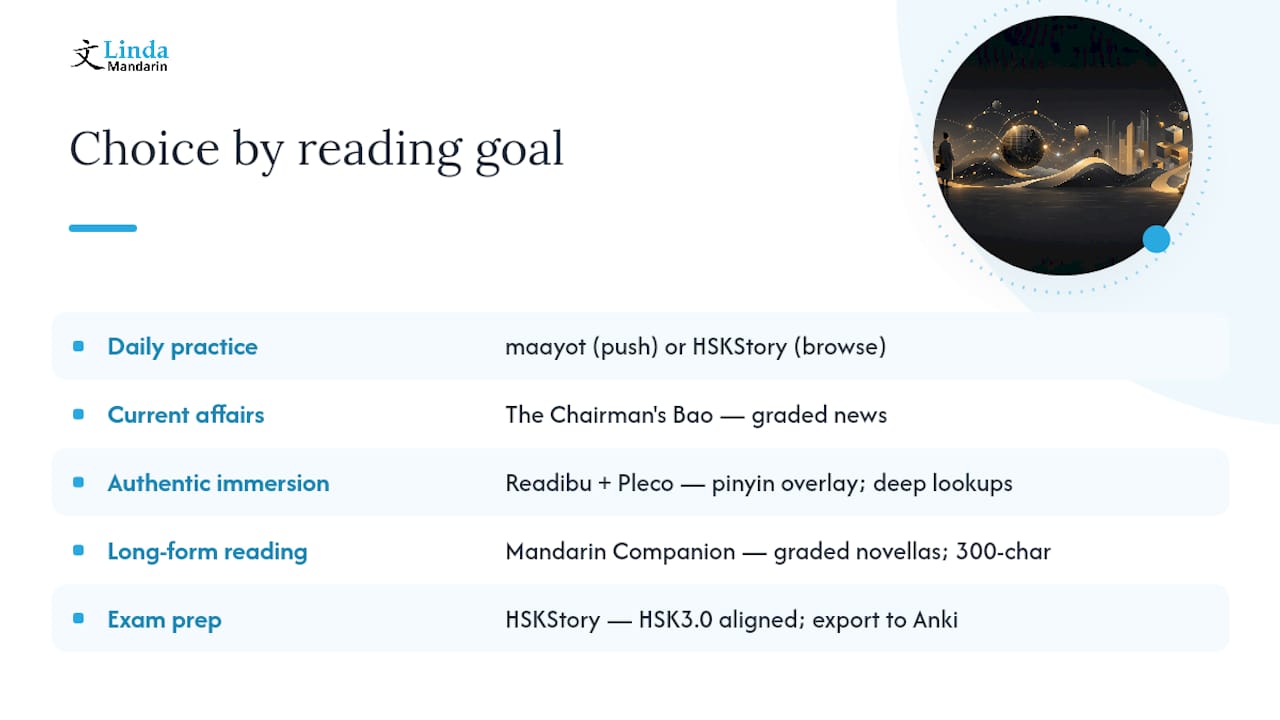
Which alternative fits your reading goal?
Your goal should drive the choice, not the other way around.
Daily 10–15 minute practice → maayot or HSKStory
Both offer short, completable reading units with audio. maayot’s push notification model suits learners who need an external prompt. HSKStory suits learners who prefer to browse a library and choose their own story. Either works at beginner through intermediate; HSKStory extends further into advanced territory with its HSK 3.0 alignment.
Current-events vocabulary, intermediate to advanced → The Chairman’s Bao
If your goal is to read Chinese news or hold conversations about current affairs, graded news beats graded fiction for vocabulary relevance. Test the free sample articles at your target level. If you can read 80% without lookups, move up one band.
Authentic immersion, upper-intermediate to advanced → Readibu + Pleco
Pick a Chinese website or WeChat public account you genuinely want to read. Use Readibu for pinyin overlay and Pleco for deep dictionary lookups. This combination costs nothing and scales to any content you find interesting.
Graded books for long-form reading → Mandarin Companion
Novellas give you the sustained narrative arc that short stories cannot. The 300-character threshold level is genuinely accessible for learners who have finished a beginner course. Download the free sample chapter first; if you can follow the plot without constant lookups, buy the book.
Exam-focused vocabulary building → HSKStory with SRS export
HSKStory’s alignment to HSK 3.0 means the vocabulary you encounter maps directly to the word lists tested in the exam. Export new words to Anki after each story. For learners who want structured exam preparation beyond self-study, instructor-led courses add the speaking and listening practice that reading apps cannot replicate.
Pro Tip: Run a 7-day free trial on two different alternatives simultaneously. After a week, check which one you actually opened more often. Habit fit matters more than feature lists.
How do you choose the right alternative?
Start with your primary goal, then filter by level, then check whether you need audio, offline access, or a specific platform. Price is rarely the deciding factor for learners who study regularly; a $10–$15 monthly subscription is negligible if you use it daily, and free tools you never open cost you more in lost progress.
A 15-minute evaluation checklist:
- Load a story or article at your current level. Can you read 70–80% without lookups?
- Tap an unknown word. Does the definition appear instantly, or do you have to navigate away?
- Play the audio. Is it human-recorded or TTS? Does it sync sentence by sentence?
- Try the dictionary integration. Can you look up a character without leaving the reading view?
- Check the export option. Can you send new vocabulary to Anki or another SRS tool?
Red flags to walk away from:
- No level mapping whatsoever (you cannot tell where to start)
- Audio only on the most basic content, paywalled everywhere else
- Essential features (pinyin toggle, tap-to-translate) locked behind a subscription with no free trial
- No offline mode for a paid subscription
- Content library that has not been updated in over a year
A simple decision flow:
- Define your session goal: vocabulary building, reading fluency, or cultural exposure?
- Test three features in the free tier: tap-to-define, audio playback, and level selector.
- Measure time-to-comprehension: how long does it take to finish one reading unit and feel satisfied? If it takes more than 30 minutes for a beginner-level story, the tool is fighting you, not helping you.
Independent comparisons note that format differences matter as much as library size: passage-based reading (Du Chinese’s model) suits some learners, while structured sentence-by-sentence repetition suits others. Neither is universally better. The Du Chinese subscription model gates most content behind a paid plan, which is a fair reason to explore alternatives, but the same paywall logic applies to most commercial apps in this category.
Key Takeaways
HSKStory is the strongest graded-fiction alternative for learners who want clear level progression; The Chairman’s Bao leads for graded news; and Pleco with Readibu covers authentic reading at no cost.
| Point | Details |
|---|---|
| Match tool to goal first | Graded fiction suits vocabulary building; graded news suits cultural fluency; authentic readers suit advanced immersion. |
| Audio type matters | Human-recorded audio (HSKStory, maayot, Mandarin Companion) trains tones better than TTS for most learners. |
| Free tiers are real tests | Run a 7-day trial on two alternatives simultaneously and track which one you actually open more often. |
| Level alignment reduces frustration | Tools mapped to HSK 3.0 (HSKStory) let you connect reading progress to an international proficiency benchmark. |
| Linda Mandarin as a next step | When self-study plateaus, Linda Mandarin’s adult courses add teacher feedback and speaking practice that no app replicates. |
When apps are enough, and when they are not
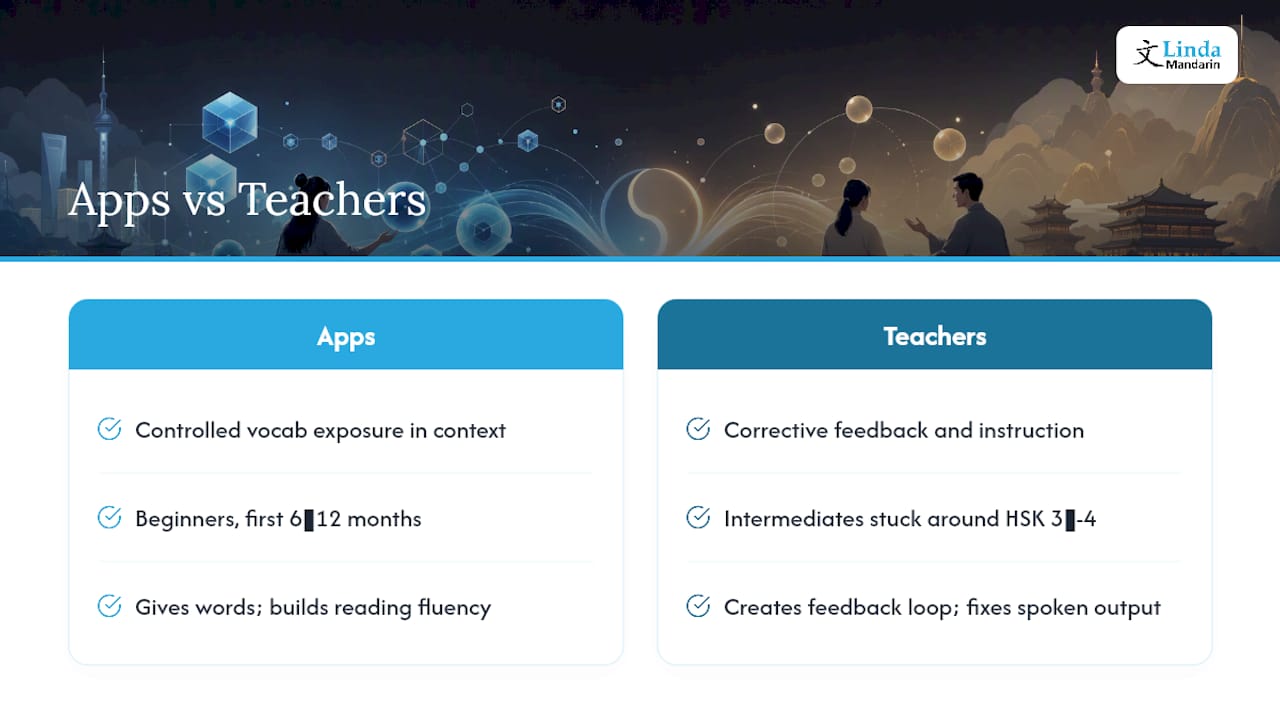
There is a version of this conversation that app developers do not want to have: reading apps are excellent at one thing, and genuinely weak at another. They are excellent at giving you controlled exposure to vocabulary in context. They are weak at correcting the way you speak, catching the tonal errors you have been repeating for months, and pushing you past the intermediate plateau that most self-learners hit around HSK 3–4.
The learners I see make the fastest progress are not the ones who found the perfect app. They are the ones who used apps to build reading fluency and then brought that vocabulary into live conversation practice with a teacher. The app gave them the words; the teacher gave them the feedback loop that made those words stick in speech.
If you are a beginner, any of the graded fiction or daily micro-reading tools above will serve you well for the first six to twelve months. If you are intermediate and feel stuck, the problem is almost never the app. It is the absence of corrective feedback on your output. That is where structured instruction, particularly courses focused on adult conversational and business Mandarin, shortens the path considerably. Linda Mandarin’s Mandarin learning resources for adults page is a good starting point for understanding what that transition looks like in practice.
Linda Mandarin: structured Mandarin courses for adult learners
Reading apps give you input. Linda Mandarin gives you the feedback loop that turns input into fluency. For adult learners and professionals who need practical conversational or business Mandarin, Linda Mandarin’s courses at 10 Anson Road, Level 22, International Plaza (right above Tanjong Pagar MRT) offer something no app can: a certified native instructor who corrects your tones in real time, tailors reading assignments to your professional context, and tracks your progress against international proficiency benchmarks.

Group classes, private lessons, and online Zoom sessions are all available, so the format fits around a working professional’s schedule. Corporate training programs are structured specifically for teams that need business Mandarin outcomes, not just vocabulary lists. If you have been cycling through apps and feel your progress has stalled, a structured adult Mandarin course is the most direct route to the conversational and professional fluency that self-study alone rarely reaches. Book a trial class or request a consultation through the Linda Mandarin website to find the right level and format for your goals.
Useful sources for further research
The sources below are starting points for your own evaluation. Prices and content libraries change; always confirm details directly on each product’s website or App Store page before subscribing.
- Top 47 Duchinese.net Alternatives & Competitors
- Alternatives to Du Chinese? : r/ChineseLanguage
- Du Chinese Immersive Chinese: Which App Is Best in 2026
- Du Chinese Review ⭐️ Learn to Read Chinese – Flexi Classes
- Manda Chinese – A free alternative to Hack Chinese, Du Chinese, and The Chairman’s Bao – Introduce Your Product Here – Chinese-Forums
- Resources You Can Use To Learn Mandarin – Linda Mandarin
- HSK Levels Explained: Your 2026 Complete Guide
Last checked: June 2026. Confirm in-app pricing directly before subscribing. Links are provided for research purposes and do not constitute endorsement of every listed product.
FAQ
Is there a free version of Du Chinese?
Du Chinese offers a limited free tier with access to a small number of beginner stories, but most of the library requires a paid subscription. Several alternatives, including maayot’s daily story and Pleco’s core app, offer more usable free access.
What is the best app for reading Chinese at an intermediate level?
The Chairman’s Bao suits intermediate learners who want graded news content, while HSKStory works well for those who prefer graded fiction with HSK 3.0 alignment. Both offer free sample content so you can test before committing.
How do Du Chinese alternatives compare on price?
Most commercial alternatives use a monthly or annual subscription model in the $10–$15 per month range, though exact pricing changes frequently. Mandarin Companion uses a per-book purchase model, and Pleco’s core app is free with optional paid add-ons. Always verify current pricing on the official product page.
Which alternative works best for business Mandarin learners?
No reading app alone covers business Mandarin comprehensively. The Chairman’s Bao’s current-affairs content gets you closest to professional vocabulary. For learners who need workplace fluency with speaking and listening practice, Linda Mandarin’s corporate Mandarin training is a more direct route than any app.
Do any Du Chinese alternatives support offline reading?
Mandarin Companion’s downloadable audio works offline, and some graded fiction apps allow offline story downloads on paid plans. Check the specific app’s offline policy before subscribing, as this feature is often restricted to premium tiers.