To pass HSK 4, follow an 8-week intensive plan at 2–4 hours per day or a 12-week balanced plan at 1.5–2 hours per day, targeting the official vocabulary target, mock-test passing scores, and regular full timed mock tests every two weeks.
Start today with these three actions:
- Download the official HSK 4 vocabulary list and load it into an SRS app (Anki or Pleco).
- Block your first full mock test in your calendar for the end of Week 2.
- Set a daily word target: a moderate daily word count helps you complete the full list in several weeks.
Key Takeaways
A structured HSK 4 study plan combining daily SRS vocabulary, timed skill drills, and mock tests every two to three weeks gives intermediate learners the clearest path to scoring 180 out of 300 and passing the exam.
| Point | Details |
|---|---|
| Choose your timeline | 8-week intensive (2–4 hours/day) or 12-week balanced (1.5–2 hours/day) based on your schedule. |
| Vocabulary target | Acquire approximately 1,200 words total; 15–20 new words per day with sentence-level SRS. |
| Mock tests are non-negotiable | Run a full timed mock test every 2–3 weeks; increase to every 4–5 days in the final two weeks. |
| Timed practice beats raw knowledge | Learners who practice under exam conditions consistently outperform those who only study vocabulary. |
| Linda Mandarin’s HSK courses | Instructor-led prep with mock tests and tutor feedback helps learners break through score plateaus. |
Table of Contents
- What does the HSK 4 exam actually test?
- What vocabulary and grammar does HSK 4 expect you to know?
- How do the 8-week and 12-week study plans compare?
- Skill-by-skill tactics for listening, reading, writing, and speaking
- How to use mock tests to manage pacing and refine your plan
- What resources should you use to prepare for HSK 4?
- How an instructor-led HSK 4 course maps to this plan
- What experienced HSK instructors actually see in the classroom
- Linda Mandarin’s HSK 4 courses give you structure when self-study stalls
- Sources
- FAQ
What does the HSK 4 exam actually test?
The HSK 4 exam covers three sections: Listening, Reading, and Writing. There is no speaking component. The full test runs around 100 minutes, including an answer-transfer period at the end.
Section breakdown:
- Listening: 45 questions across three parts (true/false statements, multiple-choice dialogues, and longer passages). Approximately 30 minutes.
- Reading: 45 questions across three parts (sentence completion, sentence ordering, and reading comprehension). Approximately 40 minutes.
- Writing: 10 questions across two parts (rearranging scrambled words into correct sentences, and writing a short passage from a picture prompt). Approximately 25 minutes.
Passing requires a set total score, with minimum section scores needed, emphasizing balanced performance. That threshold matters for your mock-test strategy: a strong reading score cannot fully compensate for a weak listening section.
HSK 4 corresponds approximately to the intermediate B2 level on the CEFR scale. The jump from HSK 3 is real: the vocabulary load nearly doubles, and the reading passages move fast enough that slow readers run out of time before they run out of knowledge.
What vocabulary and grammar does HSK 4 expect you to know?
Vocabulary target and daily pacing
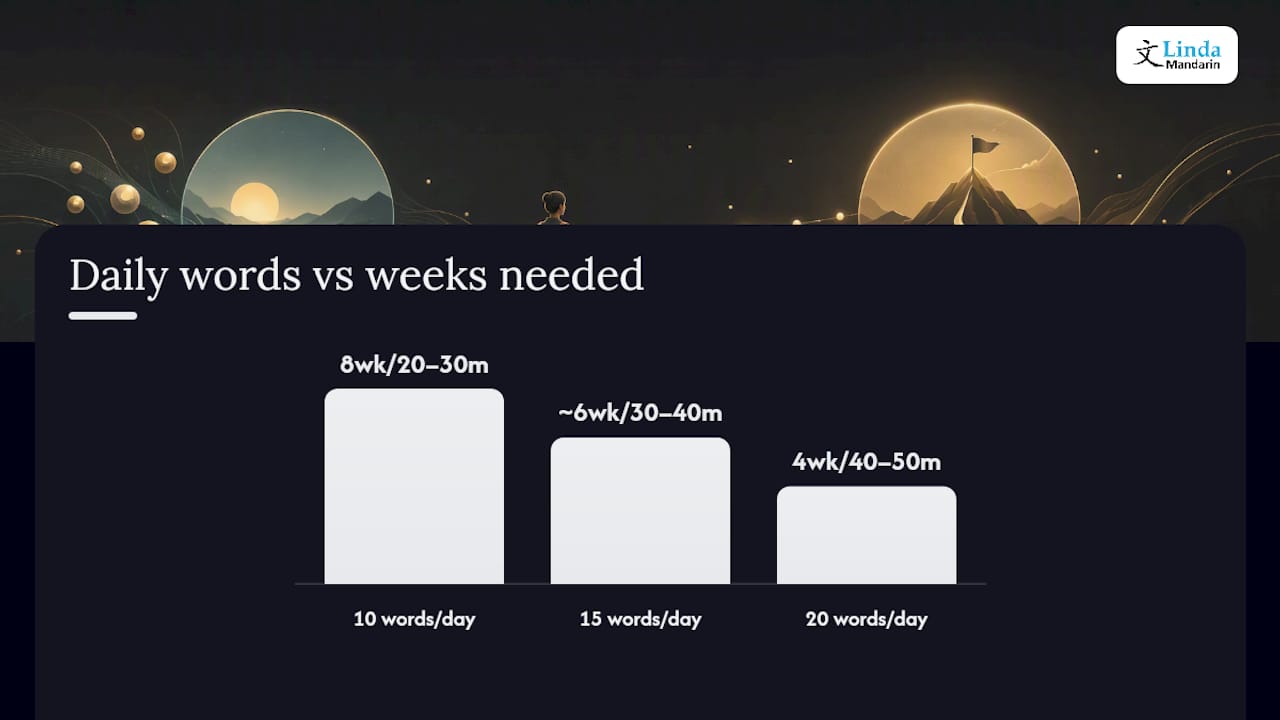
The official vocabulary target for HSK 4 covers all levels up to and including Level 4, documented in official lists. The official list is available at Chinesetest. If you already passed HSK 3, you have roughly 600 words as a base, leaving around 600 new words to acquire.
| Daily words learned | Weeks to complete 600 new words | Total daily study time (vocab only) |
|---|---|---|
| 10 words/day | 8 weeks | 20–30 minutes |
| 15 words/day | ~6 weeks | 30–40 minutes |
| 20 words/day | 4 weeks | 40–50 minutes |

Learning a moderate number of new words daily, combined with sentence-writing practice, leads to better retention than vocabulary-only study. The sentence-writing step forces you to process the word’s grammar role, not just its translation.
Grammar structures to prioritize
HSK 4 tests grammar through sentence-ordering tasks and reading comprehension, not through explicit grammar questions. These structures appear most frequently:
- 把 (bǎ) sentences: object-fronting constructions (“把书放在桌子上”)
- 被 (bèi) passive voice: “书被他拿走了”
- Complement structures: resultative (做完), directional (走进来), potential (做得到/做不到)
- Adverbial connectors: 虽然…但是, 不管…都, 只要…就, 既然…就
- Degree expressions: 越来越, 再也不, 连…都/也
- Relative clauses with 的: complex noun modification
Practice each structure by writing sentences regularly and verifying correctness with a tutor or grammar resource. Passive recognition in reading is not enough; the writing section will expose gaps.
Pro Tip: Build your SRS flashcards at the sentence level, not the word level. A card that shows “把书放在桌子上” and asks you to produce the English meaning trains grammar and vocabulary simultaneously. Single-word cards are faster to make but slower to actually use on exam day.
How do the 8-week and 12-week study plans compare?
Choose the 8-week plan if you can commit 2–4 hours daily. Choose the 12-week plan if 1.5–2 hours per day is your realistic ceiling. Both plans follow the same weekly skill rotation recommended by structured HSK preparation guides: vocabulary and SRS daily, grammar twice weekly, listening daily, writing weekly, and a mock test every two to three weeks.
Week-by-week schedule
Daily routine examples
8-week intensive (3 hours/day):
- SRS review of previous cards: 20 minutes
- New vocabulary (15–20 words) with sentence writing: 30 minutes
- Listening drill (one HSK 4 listening set, timed): 30 minutes
- Reading passage (timed, 15 minutes per set): 30 minutes
- Grammar or writing practice (alternating days): 30 minutes
- Error review and SRS card creation: 20 minutes
12-week balanced (1.5 hours/day):
- SRS review: 15 minutes
- New vocabulary (10–15 words): 20 minutes
- Listening or reading drill (alternating days): 30 minutes
- Grammar or writing (twice weekly): 25 minutes
- Error log update: 10 minutes
When a mock test reveals a weak section, reallocate 30 minutes from your strongest skill to that area for the following week. HanziFeed’s HSK study guide notes that reading speed and timed practice become the deciding factor at Level 4, so if your reading section scores lag, increase timed reading drills before adding more vocabulary work.
Skill-by-skill tactics for listening, reading, writing, and speaking
Listening
The listening section moves at a fixed pace. You cannot replay audio. The single highest-leverage tactic: use the sample playback time at the start of each part to read the answer options before the real questions begin. This primes your brain to catch the relevant detail rather than processing everything equally.
Daily listening practice should run 20–30 minutes. Use HSK 4 sample audio from the official site, or boost your Mandarin listening skills with graded podcast content at the right level. After each session, transcribe one or two sentences you found difficult and look up the vocabulary.
Reading
Timed reading is where most intermediate learners lose points. Set a hard limit of 50 seconds per question in the reading section. Scan the answer options before reading the passage, not after. For the sentence-ordering task, identify the topic sentence first, then look for logical connectors (因为, 所以, 但是) to sequence the rest.
Practice material: official HSK 4 reading sets, graded readers at HSK 4 level, and short Mandarin news snippets (People’s Daily’s simplified Chinese edition works well for vocabulary density).
Writing
Part one of the writing section asks you to reorder scrambled words into a grammatical sentence. Part two asks for a short passage of 80–100 characters based on a picture prompt. For part two, use a simple three-part structure: describe what you see, add a reaction or context sentence, and close with a brief opinion or conclusion. Examiners look for grammatical accuracy, logical flow, and appropriate vocabulary, not creative complexity.
Practice one 80–100 character prompt per week. Time yourself at 10 minutes. If you consistently finish in under 8 minutes with clean grammar, you are ready. A Mandarin reading and writing course can accelerate this if writing is your weakest section.
Speaking (not tested, but still worth your time)
HSK 4 does not test speaking, but learners who practice speaking alongside reading and writing retain vocabulary faster. Ten minutes of daily shadowing, where you repeat a sentence immediately after hearing it, trains pronunciation, rhythm, and recall simultaneously. It also makes listening comprehension easier because you internalize how sentences are constructed, not just what words mean.
Pro Tip: Build a correction workflow: after each writing or speaking session, flag every error in a dedicated notebook. At the end of the week, convert those errors into SRS cards. Tutor feedback accelerates this loop significantly, because you catch patterns you would miss reviewing your own work.
How to use mock tests to manage pacing and refine your plan
Mock tests are the most reliable tool for time-management training, and the gap between knowing the material and finishing on time is where most exam failures happen. To run every mock test under realistic conditions.
Mock test setup checklist:
- Sit at a desk, not on a couch.
- Use printed or full-screen digital test sheets, not a phone.
- Set a timer for each section: 30 minutes for listening, 40 for reading, 25 for writing.
- Score yourself immediately after using the official answer key.
- Log your section scores and total in a tracking sheet.
Time-management rules during the test:
- Never spend more than 90 seconds on a single reading question. Mark it, move on, return if time allows.
- In the writing section, draft your picture-prompt response in your head for 60 seconds before writing. Starting cold costs more time than planning does.
- In listening, if you miss a question, let it go immediately. Dwelling on a missed item causes you to miss the next one.
When to increase mock-test frequency:
- Weeks 1–3: one mock test at the end of the block, diagnostic only.
- Weeks 4–6: one mock test every two weeks, scored and analyzed.
- Final two weeks: one full mock test every four to five days, focusing on pacing and stamina.
Use HSKMock for timed, scored practice tests that replicate the real exam format. After each mock, identify your lowest-scoring section and reallocate study time accordingly for the following week.
What resources should you use to prepare for HSK 4?
Official materials (start here):
- chinesetest.cn/HSK/4: official exam structure, sample tests, and registration information.
- chinesetest.cn/syllabus: downloadable HSK 4 vocabulary list and syllabus.
Apps and tools:
- Anki: free SRS flashcard system; import the official HSK 4 deck and customize cards with example sentences.
- Pleco: dictionary and flashcard app with built-in SRS; strong for looking up words mid-study and adding them directly to a review deck.
- HSKMock: browser-based timed mock tests scored against official answer keys; use for weekly practice tests.
- HelloChinese: structured grammar and vocabulary lessons at HSK 4 level; useful for grammar review on mobile.
Textbooks:
- Hànyǔ Shuǐpíng Kǎoshì Biāozhǔn Cíhuì (Official HSK Standard Course, Level 4): the textbook series published by BLCU Press that maps directly to the exam syllabus.
- Graded readers at HSK 4 level from the Mandarin Companion or Chinese Breeze series for reading fluency practice.
Combine resources this way: use Anki or Pleco for daily SRS, official sample tests for weekly timed practice, and HSKMock for full mock exams. Textbooks fill grammar gaps; graded readers build reading speed.
How an instructor-led HSK 4 course maps to this plan
A self-study plan works well if you are disciplined about daily practice and honest about your weak areas. An instructor-led course adds three things that are genuinely hard to replicate alone: structured pacing that prevents you from over-investing in comfortable skills, targeted feedback on writing and grammar errors, and accountability that keeps the schedule from slipping.
Linda Mandarin’s HSK preparation courses follow a syllabus aligned to HSK standards, with mock tests built into the course cadence and tutor feedback on writing submissions. The course structure maps directly onto the 8- or 12-week plan above: early weeks cover vocabulary and grammar foundations, mid-course weeks focus on skill integration and timed practice, and the final weeks run full mock exams with error analysis.
What to look for when evaluating any HSK 4 course:
- Does the syllabus explicitly cover all three tested sections (listening, reading, writing)?
- How many mock tests are included, and are they scored and reviewed with the instructor?
- Are instructors native Mandarin speakers with demonstrated HSK teaching experience?
- Does the course offer flexible formats (group, private, online Zoom) to fit your schedule?
Instructor-led preparation is most valuable for learners whose mock-test scores plateau. When you have studied the vocabulary and still cannot break 160/300, the problem is almost always exam strategy and timed practice, not knowledge gaps. A structured course with regular mock tests and tutor feedback is the fastest way to close that gap.
The step-by-step HSK preparation guide on Linda Mandarin’s site shows how the course modules align to each skill area, which is useful for mapping your current self-study progress to where a course would pick up.
What experienced HSK instructors actually see in the classroom
The most common mistake intermediate learners make is treating HSK 4 as a vocabulary test. It is not. Vocabulary is the entry fee. The exam tests whether you can process Mandarin at speed, under time pressure, with no dictionary. Students who arrive with 1,200 words memorized but no timed practice regularly score below 180. Students who have 900 words but have run 10 timed mock tests often pass.
A few patterns that show up repeatedly:
- Listening scores drop because of the transfer period. Learners forget they have 10 minutes at the end to transfer answers and rush through listening, making careless errors. Know the format cold before exam day.
- Reading time runs out in part three. The comprehension passages in part three are the longest and most complex. Learners who spend too long on parts one and two arrive at part three with 8 minutes left. Practice part three first in isolation until your pace is comfortable.
- Writing part two is under-practiced. Most learners spend 90% of writing practice on sentence reordering and almost none on the picture-prompt composition. Flip that ratio in the final two weeks.
- Grammar connectors are the hidden scoring lever. Using 虽然…但是 or 不管…都 correctly in your written composition signals a level of proficiency that examiners notice. Practice them in writing, not just recognition.
Pro Tip: Keep a “mistake log” from day one. Every error from a mock test or practice exercise goes in, with the correct form and one example sentence. Review it every Sunday. Patterns in your mistake log tell you exactly where to spend the next week’s study hours.
One more thing worth saying plainly: motivation dips around Week 5 or 6 in any 8–12 week plan. That is not a sign the plan is wrong. It is a sign you are in the hard middle. The learners who pass are not the ones who felt motivated every day. They are the ones who opened Anki anyway.
Linda Mandarin’s HSK 4 courses give you structure when self-study stalls
Passing HSK 4 on a self-study plan is achievable, but most learners hit a wall somewhere between Week 4 and Week 8. Scores plateau, motivation dips, and it becomes unclear which skill to fix first. That is exactly where instructor-led preparation earns its value.

Linda Mandarin’s HSK exam preparation courses are available in group, private, and online Zoom formats, so you can fit structured learning around a full-time schedule. The syllabus covers all three tested sections, includes regular mock tests with scored feedback, and is taught by experienced native Mandarin instructors. Whether you are starting from scratch or trying to push a 160 score past the 180 passing threshold, the course gives you a clear path and someone to course-correct you when you drift. Check the course details and formats to find the option that fits your timeline and budget, then reach out to book a consultation.
Sources
Quick access to the authoritative resources referenced in this guide:
Official materials matter because the vocabulary list and sample tests on chinesetest.cn reflect the actual exam content. Third-party word lists and unofficial practice tests sometimes include words outside the tested scope or use question formats that differ from the real exam, which skews your preparation.
FAQ
How long does it take to prepare for HSK 4?
Most intermediate learners need 8–12 weeks of consistent daily study. Learners coming directly from HSK 3 with strong vocabulary retention can target the shorter end; those with a longer gap since their last formal study typically need the full 12 weeks.
Is HSK 4 hard to pass?
HSK 4 is genuinely challenging for most intermediate learners, primarily because of the time pressure rather than the vocabulary load. The passing score is 180 out of 300, with a minimum of 60 per section, and timed practice is the most reliable way to close the gap between knowing the material and finishing on time.
How should you study for HSK 4 each day?
A daily routine of SRS vocabulary review (15–20 minutes), new word acquisition with sentence writing (30 minutes), and a timed listening or reading drill (30 minutes) covers the core skills. Add grammar or writing practice twice a week and a full mock test every two to three weeks.
Is HSK 4 enough to live and work in China?
HSK 4 is roughly equivalent to CEFR B2, which supports everyday conversation, reading standard texts, and basic professional communication. It is a practical threshold for many working environments, though specialized fields or advanced academic settings typically require HSK 5 or 6.