Here are five Chinese New Year greetings you can say or text right now, each with characters, pronunciation, and a quick note on when to use it:
- 新年快乐 | Mandarin: Xīn nián kuài lè | Cantonese: San nin faai lok | “Happy New Year” — formal enough for colleagues, warm enough for friends; the most universally safe choice.
- 新年好 | Mandarin: Xīn nián hǎo | Cantonese: San nin hou | “New Year greetings” (literally “New Year good”) — casual and friendly, best for family and close friends.
- 恭喜发财 | Mandarin: Gōng xǐ fā cái | Cantonese: Gung hei faat choi | “Wishing you happiness and prosperity” — the classic Cantonese greeting, heard everywhere from Hong Kong to overseas Chinatowns.
- 年年有余 | Mandarin: Nián nián yǒu yú | Cantonese: Nin nin yau yu | “May you have abundance every year” — a warm blessing for family or close friends, often paired with another phrase.
- 万事如意 | Mandarin: Wàn shì rú yì | Cantonese: Maan si yuh yi | “May everything go as you wish” — polished and respectful, fits elders, clients, and bosses well.
These five cover most situations you will encounter. The sections below expand the full list, explain pronunciation, and show you exactly who to say what to.
Key Takeaways
The most effective approach to Chinese New Year greetings is choosing the right phrase for the right person, pronouncing it with attention to tone, and keeping your reply short and reciprocal.
| Point | Details |
|---|---|
| Match phrase to recipient | Use 新年好 casually with friends; use 祝您万事如意 formally with clients and bosses. |
| Cantonese vs. Mandarin | Lead with 恭喜发财 in Cantonese communities; use 新年快乐 as the universal safe choice. |
| Replies stay short | Mirror the greeting back or say 谢谢,也祝您新年快乐 — one reciprocal phrase is enough. |
| Tones matter most | Focus on correct tone contours for two or three high-frequency phrases rather than memorizing dozens. |
| Linda Mandarin | Adult conversational and business Mandarin programs offer live pronunciation practice and cultural coaching. |
Table of Contents
- 1. The full list of Chinese New Year greetings with pronunciation and usage
- 2. How to reply when someone wishes you a Happy New Year
- 3. Which greeting fits which recipient
- 4. Pronunciation essentials for Mandarin and Cantonese greetings
- 5. Zodiac-year greetings and how to use them
- 6. Cultural notes, etiquette, and what not to say
- 7. Where to hear and practice authentic pronunciations
- 8. Why a few well-pronounced greetings matter more than you think
- Ready to practice these greetings with a live instructor?
- Sources
- FAQ
1. The full list of Chinese New Year greetings with pronunciation and usage
The 23 Chinese New Year greetings compiled by The Woks of Life is one of the most practical reference lists available, covering characters, romanization, and usage notes. The phrases below draw on that tradition, organized from the most common to the more specific.
Core greetings
1. 新年快乐 — Xīn nián kuài lè (Mandarin) / San nin faai lok (Cantonese)
Literal: “New Year happy.” Idiomatic: “Happy New Year.” The go-to phrase for most situations. According to China Highlights, this is the more formal of the two common Mandarin greetings, appropriate with strangers, colleagues, and in professional contexts. Use it in spoken greetings, texts, and cards.
2. 新年好 — Xīn nián hǎo (Mandarin) / San nin hou (Cantonese)
Literal: “New Year good.” Idiomatic: “Happy New Year!” Warmer and more casual than 新年快乐. China Highlights notes this is the popular choice among family and close friends. Think of it as the difference between “Happy New Year!” and a cheerful “New Year!” shouted across the room.
3. 恭喜发财 — Gōng xǐ fā cái (Mandarin) / Gung hei faat choi (Cantonese)
Literal: “Congratulations and may you prosper.” Idiomatic: “Wishing you happiness and prosperity.” The signature Cantonese greeting, used widely in social and business settings across Hong Kong and overseas Chinatowns. Perfectly appropriate for almost anyone. Pair it with 新年快乐 for a fuller wish: 恭喜发财,新年快乐.
4. 年年有余 — Nián nián yǒu yú (Mandarin) / Nin nin yau yu (Cantonese)
Literal: “Year after year, may there be surplus.” A wish for ongoing abundance. The character 余 (yú) sounds like “fish” (鱼), which is why fish appears on New Year tables. Common in family gatherings and written cards.
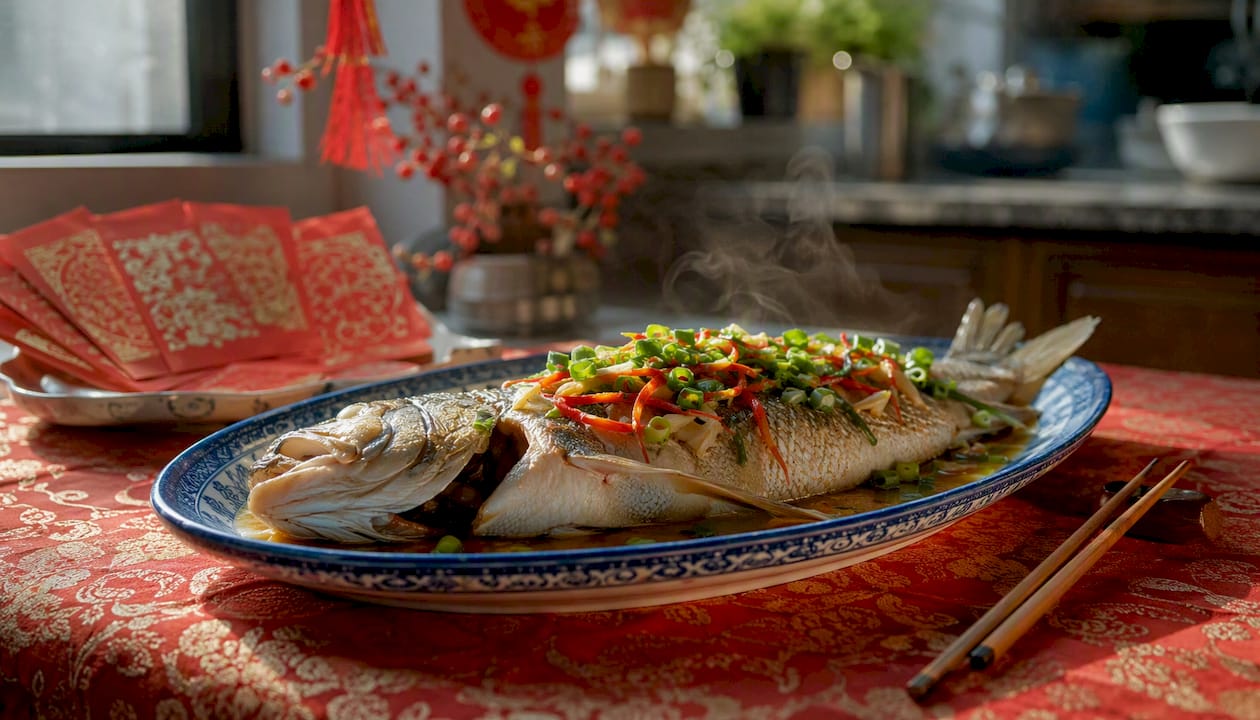
5. 万事如意 — Wàn shì rú yì (Mandarin) / Maan si yuh yi (Cantonese)
Literal: “Ten thousand things go as you wish.” A polished, respectful blessing. Suitable for elders, clients, and bosses. Often combined: 祝您万事如意,新年快乐.
6. 岁岁平安 — Suì suì píng ān (Mandarin) / Seoi seoi ping on (Cantonese)
Literal: “Year after year, peace and safety.” A heartfelt wish for health and security. Common in family messages and cards, especially for elders.
7. 身体健康 — Shēn tǐ jiàn kāng (Mandarin) / San tai gin hong (Cantonese)
Literal: “Body healthy.” Idiomatic: “Wishing you good health.” Almost always paired with another phrase. The classic combination: 祝您新年快乐,身体健康 (“Wishing you a Happy New Year and good health”) is a standard formal written greeting, as seen in full-sentence Mandarin wishes.
8. 生意兴隆 — Shēng yì xīng lóng (Mandarin) / Saang yi hing lung (Cantonese)
Literal: “Business flourishing.” A targeted wish for entrepreneurs, business owners, and clients. Avoid using this with people who are not in business — it can feel oddly transactional.
9. 工作顺利 — Gōng zuò shùn lì (Mandarin) / Gung zok seon lei (Cantonese)
Literal: “Work goes smoothly.” Ideal for colleagues and professional contacts. Specific enough to feel thoughtful, general enough to suit any industry.
10. 步步高升 — Bù bù gāo shēng (Mandarin) / Bou bou gou sing (Cantonese)
Literal: “Step by step, rise higher.” A wish for career advancement. Use this for colleagues, bosses, or anyone you know is ambitious about their career. Flattering without being sycophantic.
11. 学业有成 — Xué yè yǒu chéng (Mandarin) / Hok yip yau sing (Cantonese)
Literal: “May your studies be successful.” Best for adult learners, university students, or professionals pursuing further education. Not a general-purpose greeting.
12. 心想事成 — Xīn xiǎng shì chéng (Mandarin) / Sam soeng si sing (Cantonese)
Literal: “May your heart’s wishes come true.” A warm, personal blessing that works for close friends and family. Slightly more poetic than 万事如意.
13. 龙马精神 — Lóng mǎ jīng shén (Mandarin) / Lung maa jing san (Cantonese)
Literal: “The spirit of a dragon and horse.” Idiomatic: “Wishing you energy and vitality.” A vivid, culturally rich phrase. Especially popular for elders — it wishes them the vigor of youth.
Sample full-sentence greetings for cards and messages
These combined phrases work well in written cards, WeChat messages, and emails:
-
Formal (for clients or bosses): 祝您新年快乐,万事如意,身体健康。
Zhù nín xīn nián kuài lè, wàn shì rú yì, shēn tǐ jiàn kāng.
“Wishing you a Happy New Year, may everything go as you wish, and good health.” -
Casual (for friends or family): 新年好!祝你年年有余,心想事成!
Xīn nián hǎo! Zhù nǐ nián nián yǒu yú, xīn xiǎng shì chéng!
“Happy New Year! Wishing you abundance every year and may your wishes come true!” -
Business (for colleagues): 祝您新年快乐,工作顺利,步步高升!
Zhù nín xīn nián kuài lè, gōng zuò shùn lì, bù bù gāo shēng!
“Wishing you a Happy New Year, smooth work, and continued advancement!”
Note on 祝您 vs. 祝你: 您 (nín) is the formal/respectful “you”; 你 (nǐ) is casual. Use 祝您 for clients, bosses, and elders. Use 祝你 for friends and peers.
Regional note: 恭喜发财 is the dominant greeting in Cantonese-speaking communities (Hong Kong, Macau, Guangdong, and overseas Chinatowns in the U.S.). In Mainland China and Taiwan, Mandarin phrases like 新年快乐 and 新年好 are far more common. If you are visiting a Cantonese-speaking household, lead with 恭喜发财.
2. How to reply when someone wishes you a Happy New Year
Replies should be short, warm, and reciprocal. China Travel recommends keeping responses simple: mirror the greeting back or add a brief “thank you and the same to you.”
Common reply phrases
1. 新年快乐 — Xīn nián kuài lè / San nin faai lok
The simplest reply. Just return the greeting. Works in every context.
2. 谢谢,也祝你新年快乐 — Xièxiè, yě zhù nǐ xīn nián kuài lè
“Thank you, and wishing you a Happy New Year too.” A warm, polite response for friends and colleagues.
3. 谢谢,也祝您新年快乐 — Xièxiè, yě zhù nín xīn nián kuài lè
Same phrase with the formal 您 — use this for bosses, clients, and elders.
4. 同喜同喜 — Tóng xǐ tóng xǐ (Mandarin) / Tung hei tung hei (Cantonese)
Literally “same happiness, same happiness.” A cheerful, traditional reciprocation, especially common in Cantonese-speaking communities. Friendly and festive.
5. 恭喜恭喜 — Gōng xǐ gōng xǐ (Mandarin) / Gung hei gung hei (Cantonese)
“Congratulations, congratulations.” A classic reciprocal reply, particularly in response to 恭喜发财.
Sample dialogues
Casual exchange (friends):
A: 新年好!(Xīn nián hǎo!)
B: 新年好!祝你万事如意!(Xīn nián hǎo! Zhù nǐ wàn shì rú yì!)
A: 谢谢,你也是!(Xièxiè, nǐ yě shì!)
Formal exchange (colleague or client):
A: 祝您新年快乐,工作顺利!(Zhù nín xīn nián kuài lè, gōng zuò shùn lì!)
B: 谢谢!也祝您新年快乐,万事如意!(Xièxiè! Yě zhù nín xīn nián kuài lè, wàn shì rú yì!)
Timing note: You exchange New Year greetings the first time you see someone in the lunar new year. After that initial exchange, normal greetings like 你好 (nǐ hǎo) resume. Repeating the full New Year greeting every time you bump into the same person that day feels awkward — one exchange per person per year is the norm.
3. Which greeting fits which recipient
Choosing the right phrase is less about memorizing a rule and more about reading the relationship. Here is a quick breakdown:
Family and close friends
Use casual, warm phrases without the formal 您. The shorter forms feel more natural in relaxed settings.
- 新年好 (Xīn nián hǎo) — easy opener for anyone you know well
- 年年有余 (Nián nián yǒu yú) — a heartfelt wish, especially for parents or siblings
- 心想事成 (Xīn xiǎng shì chéng) — personal and warm for close friends
Elders and grandparents
Respect markers matter here. Use 您 and choose phrases that wish for health and longevity.
- 祝您身体健康,岁岁平安 — “Wishing you good health and peace year after year”
- 龙马精神 (Lóng mǎ jīng shén) — a vivid wish for vitality, loved by older recipients
Colleagues and professional contacts
Keep it polished but not stiff. Work-relevant phrases land well.
- 工作顺利 (Gōng zuò shùn lì) — specific and thoughtful
- 步步高升 (Bù bù gāo shēng) — appropriate for peers and those you want to compliment
Clients and bosses
Formal register, 您 throughout, and combine two or three phrases for a fuller wish.
- 祝您新年快乐,万事如意 — safe, respectful, and universally appropriate
- 生意兴隆 (Shēng yì xīng lóng) — add this for business owners and entrepreneurs
Adding 祝您 before any wish signals respect and is the right move for clients and bosses. For close friends and family, the shorter phrase without 祝您 sounds more natural, as noted in formal Mandarin greeting guides.
| Recipient | Recommended phrase | Formality |
|---|---|---|
| Close friends | 新年好 / 心想事成 | Casual |
| Family (peers) | 年年有余 / 新年快乐 | Casual |
| Elders | 身体健康 / 岁岁平安 | Respectful |
| Colleagues | 工作顺利 / 步步高升 | Semi-formal |
| Clients / bosses | 祝您万事如意 / 生意兴隆 | Formal |
4. Pronunciation essentials for Mandarin and Cantonese greetings
You do not need perfect tones to be understood and appreciated. You need good-enough tones on the two or three phrases you actually use. Here is what matters most.
Mandarin tones
Mandarin has four tones plus a neutral tone. Getting them wrong can genuinely change the meaning of a word. For New Year greetings, the most critical tones to nail are:
- 快 (kuài) — 4th tone (falling sharply). Say it like you are giving a firm command.
- 乐 (lè) — 4th tone (falling). Same sharp drop.
- 好 (hǎo) — 3rd tone (dips then rises). It sounds like a slight question before it resolves.
- 财 (cái) — 2nd tone (rising). Like asking “really?” in English.
Mispronouncing 新年好 as flat tones makes it sound robotic but still recognizable. Mispronouncing 恭喜发财 with wrong tones on 财 or 发 can make it harder to parse. Focus your practice on those two syllables.
Cantonese tones
Cantonese has six tones in everyday use, which sounds daunting. For greetings, the practical shortcut is to listen and shadow rather than memorize tone numbers. The most important contrast for learners:
- 恭 (gung) — flat, mid-level tone. Do not let it rise.
- 喜 (hei) — rising tone. Let it lift.
- 发 (faat) — short, clipped. The final -t is a stopped consonant; do not release it into a full “t” sound.
Romanization: pinyin vs. jyutping
Pinyin is the standard romanization for Mandarin. Jyutping is the recommended romanization for Cantonese, cataloged and maintained as a reference on Wikipedia’s Jyutping page. Yale romanization (an older system) still appears in older textbooks and some U.S. community resources, but jyutping is more consistent for learners starting fresh. Pick one system and stick with it — switching between jyutping and Yale mid-study creates confusion.
Practical tips
- Shadow native audio. Find a recording of a native speaker saying 恭喜发财 or 新年快乐, play it, and speak along simultaneously. Do not wait until the phrase ends. Chineasy’s audio guides are a good starting point for this.
- Record yourself. Play your recording back-to-back with the native version. The gap between the two is exactly what to fix.
- Slow to normal. Practice each phrase at half speed until the tones feel natural, then bring it up to conversational pace.
Pro Tip: Pick two or three high-frequency phrases (新年快乐, 恭喜发财, and 万事如意 are a strong set) and drill those until the tone contours feel automatic. Breadth comes later — depth on a few phrases gets you through 90% of real conversations.
5. Zodiac-year greetings and how to use them
The Chinese zodiac cycles through 12 animals, and each lunar year carries one animal’s name. Referencing the zodiac in a greeting is common and festive, but context matters.
Zodiac greeting templates
The standard template is: [Animal]年快乐 — “[Animal] Year Happy” — or [Animal]年大吉 — “Great luck in the Year of the [Animal].”
Examples using the horse (马, mǎ) as a template, drawn from zodiac greeting references:
- 马年快乐 — Mǎ nián kuài lè — “Happy Year of the Horse”
- 马年大吉 — Mǎ nián dà jí — “Great luck in the Year of the Horse”
- 马到成功 — Mǎ dào chéng gōng — “Success arrives with the horse” (an idiom wishing swift achievement)
For the current lunar year, substitute the correct animal character and apply the same template. The structure stays identical regardless of which animal the year belongs to.
Sample zodiac messages
Casual text to a friend:
祝你[Animal]年快乐,心想事成!
Zhù nǐ [Animal] nián kuài lè, xīn xiǎng shì chéng!
“Wishing you a Happy Year of the [Animal] and may your wishes come true!”
Formal written message:
祝您[Animal]年大吉,万事如意,身体健康。
Zhù nín [Animal] nián dà jí, wàn shì rú yì, shēn tǐ jiàn kāng.
“Wishing you great luck in the Year of the [Animal], may everything go as you wish, and good health.”
When to use (and when to skip) zodiac references
Zodiac greetings work well in casual messages, social media posts, and cards. In formal business correspondence, a clean 祝您新年快乐,万事如意 often reads more professional than a zodiac-specific phrase. For elderly recipients, zodiac references are generally fine and often appreciated, but avoid animal-specific idioms that could be misread as commentary on the person’s age or birth year.
6. Cultural notes, etiquette, and what not to say
Getting the greeting right is only half the picture. A few cultural missteps can undercut even the most perfectly pronounced phrase.
What to avoid saying
- Don’t wish someone a “Happy New Year” after the 15-day festival ends. The Lunar New Year period runs from New Year’s Eve through the Lantern Festival (the 15th day of the first lunar month). Greetings outside that window feel out of place.
- Avoid the number 4 (四, sì). It sounds like “death” in both Mandarin and Cantonese. Never give gifts in sets of four or reference it in a New Year message.
- Don’t say 过年好 (Guò nián hǎo) to someone who has recently lost a family member. The phrase is festive and celebratory; it is not appropriate for households in mourning.
- Avoid talking about death, illness, or bad luck. Words like 死 (sǐ, death), 病 (bìng, illness), and 穷 (qióng, poverty) are considered inauspicious during the New Year period.
- Don’t break things. If you accidentally drop or break something during a visit, say 岁岁平安 (suì suì píng ān) immediately — the word 碎 (suì, broken) sounds like 岁 (suì, year), so the phrase turns the mishap into a blessing.
Red envelope (hóngbāo / lai see) basics
Red envelopes (红包, hóngbāo in Mandarin; 利是, lai see in Cantonese) are given by married adults to unmarried people and children. The amount inside matters less than the gesture. A few practical points:
- Give and receive with both hands as a sign of respect.
- Do not open the envelope in front of the giver.
- Even amounts are preferred; odd amounts are associated with funerals.
- Digital red envelopes via WeChat Pay are now common in Chinese communities worldwide, including in U.S. cities with large Chinese-American populations.
Regional differences
In Cantonese-speaking communities (Hong Kong, Macau, and many U.S. Chinatowns in cities like San Francisco and New York), 恭喜发财 and 利是 are the expected norms. In Mandarin-speaking communities (Mainland Chinese immigrants, Taiwanese Americans), 新年快乐 and 红包 are more common. If you are unsure of your host’s background, 新年快乐 is universally understood and never wrong.
You exchange greetings the first time you see someone in the new lunar year. After that initial exchange, normal conversation resumes — you do not repeat the full New Year greeting every time you cross paths with the same person that day.
Body language adds warmth: a slight bow or a fist-and-palm salute (right fist covered by left palm) is traditional in formal or ceremonial settings. In modern everyday contexts, a warm smile and eye contact are perfectly appropriate.

7. Where to hear and practice authentic pronunciations
Reading a romanization guide is useful. Hearing a native speaker say the phrase is what actually trains your ear and mouth.
Reliable audio and practice resources
- Chineasy — short audio clips for top New Year phrases, free, mobile-friendly, and accessible from the U.S. without a VPN. Good for shadowing practice.
- Linda Mandarin’s Mandarin resources page — a curated collection of apps, audio sources, and practice worksheets for adult learners at all levels.
- Linda Mandarin’s extended greetings guide — 45 meaningful greetings with audio practice materials, useful for drilling beyond the core five phrases.
- Pleco — a free dictionary app (iOS and Android) with audio pronunciation for every character. Type any greeting and tap the speaker icon to hear a native pronunciation.
- YouTube — search “新年快乐 pronunciation” or “恭喜发财 Cantonese” for native speaker videos. The advantage over text-only resources is immediate: you hear the tone contour in real speech, not just a description of it.
Practice methods that actually work
Shadowing is the single most effective technique for tones. Play a short clip, speak along in real time, and do not pause between the model and your attempt. The goal is to sync your voice with the native speaker’s rhythm and pitch.
Spaced repetition works well for characters and meanings. Apps like Anki let you build a small deck of the ten phrases you want to use and review them in short daily sessions.
For U.S.-based learners, time zone differences with Singapore or China are not a barrier for self-study resources. Most audio tools are on-demand. Live online lessons via Zoom, however, do require scheduling across time zones, so morning slots in the U.S. (which align with evening in Singapore) tend to work well.
Tips to speak better Chinese from Linda Mandarin’s blog covers practical exercises that complement the shadowing and recording methods described here, including rhythm drills that help with the natural flow of multi-phrase greetings.
8. Why a few well-pronounced greetings matter more than you think
Most people learning Chinese New Year greetings focus on getting the characters right. The pronunciation is where the real cultural signal lives.
When a non-native speaker says 恭喜发财 with recognizable tones, the reaction from a native speaker is almost always delight. It signals effort, respect, and genuine interest in the culture. A perfectly written card with no spoken greeting carries less weight in a face-to-face setting than a slightly imperfect but warmly delivered 新年快乐.
The classroom experience at Linda Mandarin reinforces this consistently. Adult learners who arrive for conversational Mandarin lessons often underestimate how quickly a small set of phrases, practiced with correct tone contours, builds real confidence. You do not need fluency to connect. You need a handful of phrases you can deliver without hesitation.
The same principle applies to business contexts. A professional who opens a client meeting during the New Year period with a well-placed 祝您新年快乐,生意兴隆 creates a moment of warmth that a generic email cannot replicate. The phrase itself is simple. The decision to use it is what communicates cultural awareness.
Linda Mandarin’s adult programs focus precisely on this kind of practical, high-impact communication, not abstract grammar drills. The goal is phrases you can use the same week you learn them.
Ready to practice these greetings with a live instructor?
Reading about tones and romanization gets you started. Saying them out loud with immediate feedback from a native speaker is what makes them stick.

Linda Mandarin’s adult Mandarin programs cover exactly this kind of practical, conversational practice: pronunciation role-plays, cultural context, and real-time correction from experienced native instructors. Whether you want to nail your New Year greetings before a family gathering or build the business Mandarin skills to open client meetings with confidence, the school’s group classes, private lessons, and live online Zoom sessions are structured for adult learners with real-world goals.
For professionals, the corporate Mandarin training program goes further, covering business etiquette, formal greetings, and the kind of cultural fluency that matters in professional settings. Classes are available in person at 10 Anson Road, Level 22, International Plaza, Singapore 079903 (right above Tanjong Pagar MRT), and online via Zoom for learners based in the U.S. or elsewhere. Browse the adult programs and book a session to start practicing with a real instructor.
Sources
- How to Say Happy Chinese New Year in Mandarin and Cantonese
- 23 Chinese New Year Greetings (Mandarin & Cantonese)
- How to Say Happy Chinese New Year in Mandarin and Cantonese
- Top 5 Chinese New Year Greetings with Audio & Tips – Chineasy
- Chinese New Year Greetings for the Year of the Horse
- Jyutping
FAQ
How do you say “Happy Chinese New Year” in Mandarin?
The most common phrase is 新年快乐 (Xīn nián kuài lè), which is appropriate for most contexts. For close friends and family, 新年好 (Xīn nián hǎo) is the warmer, more casual option.
How do you say “Happy Chinese New Year” in Cantonese?
Say 恭喜发财 (Gung hei faat choi), which means “wishing you happiness and prosperity.” It is the standard Cantonese New Year greeting used across Hong Kong, Macau, and overseas Chinatowns.
What can you say besides “Gong xi fa cai”?
Several phrases work well as alternatives: 万事如意 (Wàn shì rú yì, “may everything go as you wish”), 年年有余 (Nián nián yǒu yú, “may you have abundance every year”), and 工作顺利 (Gōng zuò shùn lì, “wishing you smooth work”) for colleagues.
What is a good Chinese New Year message to send?
A reliable all-purpose message is: 祝您新年快乐,万事如意,身体健康 — “Wishing you a Happy New Year, may everything go as you wish, and good health.” Use 您 for formal recipients and 你 for friends.
How do you reply to a Chinese New Year greeting?
Mirror the greeting back or say 谢谢,也祝您新年快乐 (“Thank you, and wishing you a Happy New Year too”). Keep the reply short — one reciprocal phrase is the norm, not an extended exchange.