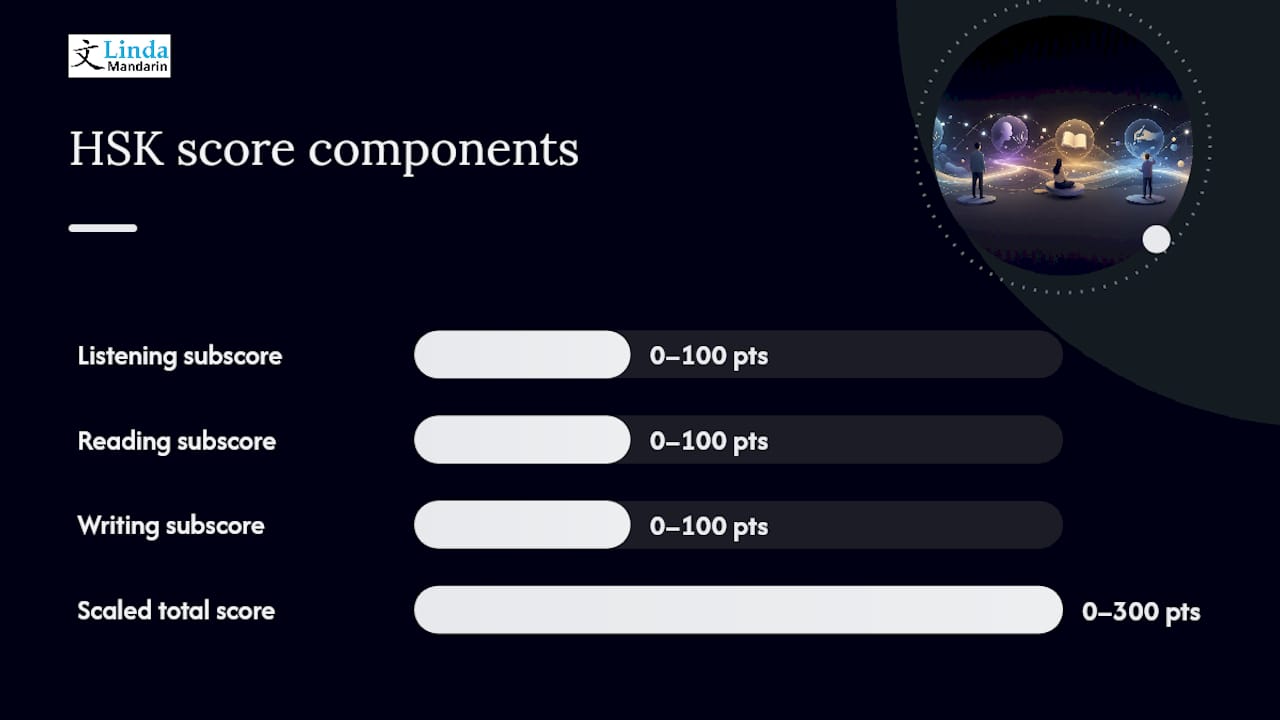
The HSK scoring system sets passing thresholds at **120 out of 200 points (60%) for HSK 1 and 2, and 180 out of 300 points (60%) for HSK 3 and 4. For HSK 5 and 6, there is no official pass cutoff since 2013 — universities and employers set their own numeric requirements at those levels. Every score report lists individual subscores on a 0–100 scale for each skill tested, plus a scaled total.
A few things worth knowing before you read further:
- HSK vs. HSKK: The written HSK tests listening, reading, and writing (at higher levels). The HSKK is a separate oral exam scored on the same 0–100 scale, with 60 commonly treated as a pass benchmark.
- Certificate validity: Many universities and employers require scores from within the past two years for admissions or visa applications. Check the receiving institution’s policy before you test.
- Score reports are not raw percentages. Raw correct answers go through equating and standardization before becoming your official subscores and total. More on that in the scoring mechanics section below.
Key Takeaways
The HSK scoring system uses a 60% pass threshold (120/200 for HSK 1–2; 180/300 for HSK 3–4), with no official cutoff at HSK 5–6 since 2013, and reports each skill on a 0–100 scale after equating and standardization.
| Point | Details |
|---|---|
| Pass thresholds by level | HSK 1–2 require 120/200; HSK 3–4 require 180/300; HSK 5–6 have no official cutoff. |
| Subscores drive strategy | Each skill (listening, reading, writing) is reported 0–100; target your lowest subscore first. |
| Scores are equated, not raw | CTI applies mean-score equating across sessions, so reported scores differ from simple correct-answer percentages. |
| Certificate validity matters | Many institutions require scores within the past two years; plan your test date around application deadlines. |
| Linda Mandarin prep | Structured courses with rubric-based writing feedback and mock testing target the subscores that move your total. |
Table of Contents
- How the HSK scoring system works: passing thresholds by level
- What each subtest measures and how subscores are built
- How raw answers become your official HSK score
- What an HSK score means in practice
- How to read your official score report and when to expect it
- How to raise your score: a prioritized study plan
- Linda Mandarin’s HSK prep courses target the subscores that matter most
- Sources
- FAQ
How the HSK scoring system works: passing thresholds by level
Chinese Testing International (CTI) administers the HSK worldwide under uniform grading criteria, meaning a score of 180 at HSK 4 carries the same weight whether you sat the exam in New York, Singapore, or Beijing. The table below shows the official structure for all six written levels.
Per-level notes:
- HSK 1–2: Two sections only (listening and reading), each reported on a 0–100 scale, totaling 200. A combined 120 clears the threshold.
- HSK 3–4: Three sections add writing to the mix. Each subscore is still 0–100; you need 180 across all three.
- HSK 5–6: The 60% floor was removed in 2013. Institutions commonly set their own cutoffs — often 180 or higher — so confirm the requirement with your target school or employer before you register.
HSKK (oral): Three levels (Beginner, Intermediate, Advanced) scored on a 0–100 scale. Per the official HSKK scoring rules, a score of 60 functions as the standard pass benchmark across all three HSKK levels. The HSKK is a standalone exam and does not combine with written HSK totals.
What each subtest measures and how subscores are built
Each subscore on your report represents one skill, capped at 100 points. The skill mix changes as levels increase, which is why the total jumps from 200 to 300 at HSK 3.
Per the China.org.cn HSK level descriptions, here is what each section covers at representative levels:
- Listening (all levels): Short dialogues, announcements, and conversations. At HSK 1–2, items are simple picture-matching and true/false. At HSK 4–6, you hear longer passages and answer multiple-choice comprehension questions.
- Reading (all levels): Sentence completion, passage comprehension, and vocabulary-in-context tasks. Complexity scales from matching characters to images (HSK 1) up to reading dense argumentative texts (HSK 6).
- Writing (HSK 3–6): Sentence reordering and character writing at HSK 3–4; paragraph writing and essay composition at HSK 5–6. Writing is the only manually scored section, which affects both processing time and score variability.
No official minimum subscore per section exists for passing. The threshold applies to the combined total only — so a weak writing score can technically be offset by strong listening and reading, as long as the total clears 180.
Pro Tip: Pull your mock test subscores and calculate the gap to 180 (or your target total). If your listening sits at 72 and reading at 68, but writing is at 35, the math tells you exactly where to spend the next four weeks. Chasing a balanced score is less efficient than closing the specific gap.
How raw answers become your official HSK score
Your reported score is not a simple tally of correct answers. The official HSK scoring explanation from chinesetest.cn describes a multi-step pipeline:
- Raw scoring: Objective items (listening and reading) are read directly from answer sheets. Each correct answer adds to a raw count.
- Equating: CTI applies mean-score equating to adjust for differences in item difficulty across test sessions. A harder session does not penalize you relative to a candidate who sat an easier one.
- Standardization: Equated scores are converted to the standardized 0–100 subscore scale using historical mean data. This step is why you cannot reconstruct your official score with simple raw-to-percent math.
- Writing scoring: Writing items are graded manually by certified examiners against a rubric, then converted to the same standardized scale before being added to your total.
- Final report: Subscores and the scaled total are released centrally after all processing is complete.
The equating step is the reason results take weeks rather than days. Because writing must be manually scored at local centers before the data feeds into central processing, the full pipeline cannot close until every exam session’s writing submissions are graded and verified.
A practical implication: Two candidates who answer the same number of questions correctly on different test dates may receive slightly different scaled scores. That is not an error — it is the equating system working as designed, adjusting for session-level difficulty variation.
What an HSK score means in practice
An HSK score carries two kinds of meaning simultaneously, and understanding both helps you present your result to the right audience.
Criterion-referenced meaning ties your score to a described ability level. The SAGE Journals academic review of HSK confirms that HSK maps to the Chinese Language Proficiency Scales (CLPS) and has correspondence to CEFR bands — HSK 4 roughly aligns with B2, HSK 5 with C1, and HSK 6 with C2. This is the reading universities use when they set admissions requirements.
Norm-referenced meaning comes from percentile data included on some score reports, derived from historical norm groups. A percentile rank tells you how your score compares to a reference population, which is more useful for competitive scholarship applications than for a binary admissions cutoff.
Common institutional uses for HSK scores:
- University admissions in China: Most programs require HSK 4 (180+) for undergraduate admission; graduate programs often require HSK 5 or a specific score above 180 at HSK 6.
- Scholarships: Chinese government scholarships typically specify HSK 4 or HSK 5 with a minimum total, sometimes with a subscore floor on writing.
- Employment: Roles requiring Mandarin proficiency in multinational firms increasingly list HSK 4 or 5 as a credential. Understanding why HSK matters for career goals can help you position your score strategically.
- Visa and residency: Some Chinese visa categories accept HSK scores as evidence of language ability; requirements vary by visa type and consulate.
Pro Tip: When an institution asks for an HSK score, ask specifically whether they require a minimum total, a minimum subscore on writing, or both. A 180 total with a 45 writing subscore may not satisfy a program that requires writing ≥ 60, even though the total clears the threshold.
How to read your official score report and when to expect it
Official results are released centrally after all scoring and equating is complete, per the HSK candidate manual. You can check your score online through the official CTI portal at chinesetest.cn using your registration credentials.
What your score report shows:
- Candidate name and registration number
- Exam date and test center
- Individual subscores (0–100 per skill)
- Scaled total score
- Pass/fail indication (for HSK 1–4)
- Percentile or norm-reference data (where included)
- Certificate ID number for third-party verification
The certificate ID is the verification token institutions use to confirm authenticity. If a university or employer requests score verification, they will typically ask for this number rather than a photocopy of the certificate.
| Score Report Field | What It Means |
|---|---|
| Subscore (e.g., Listening: 60) | Your standardized skill-level score on a 0–100 scale |
| Scaled total | Sum of all subscores; compared against the pass threshold |
| Certificate ID | Unique identifier used for official third-party verification |
| Pass/Fail indicator | Present for HSK 1–4; absent for HSK 5–6 (no official cutoff) |
| Percentile rank | Your standing relative to a historical norm group (where shown) |
Timeline: Paper certificates typically ship after the online results are published. The candidate manual notes that score reports have a validity period relevant to admissions — many institutions require scores within the past two years, so plan your test date with your application deadline in mind.
If you believe a score is incorrect, the manual outlines a formal score enquiry process through CTI. Requests must be submitted within the window specified in your test registration materials.
How to raise your score: a prioritized study plan
The most efficient path to a higher total is fixing your weakest subscore first, not studying all three sections equally. Here is how to structure the work.
Step 1: Diagnose with a mock test. Take a full timed mock exam and record each subscore. The gap between your current subscore and your target (e.g., 60 for passing, or 75 for a competitive scholarship) tells you exactly how many scaled points you need per section.
Step 2: Allocate hours by gap size. If your listening is already at 70 but writing sits at 40, the 20-point writing gap deserves roughly twice the weekly study time as maintaining your listening score. This math-backed allocation beats generic “study everything” advice.
Step 3: Follow a 6–8 week schedule with measurable weekly targets:
- Week 1–2: Baseline mock test, subscore diagnosis, and targeted vocabulary review for your weakest section.
- Week 3–4: Skill-specific drills. For listening: shadowing and dictation with graded audio. For reading: timed passage practice with vocabulary-in-context focus. For writing: rubric-guided sentence and paragraph construction.
- Week 5–6: Mixed-skill practice under timed conditions. Simulate the full exam format at least twice.
- Week 7–8: Mock exams with subscore tracking. Compare results to Week 1 baseline. If a subscore has not moved, switch the drill type rather than increasing volume.
For a more detailed week-by-week framework, the step-by-step HSK preparation guide covers scheduling and resource selection in depth.
When to retake: If a mock test shows you consistently hitting your target total with a 5–10 point buffer, you are ready. If you are within 10 points of the threshold but inconsistent, one more focused cycle before registering reduces the risk of a borderline fail.
Pro Tip: Online score calculators from sites like HSK Course (hskcourse.com), MandarinZone, and HSK Lord can estimate your scaled score from a raw correct count on mock tests. They are useful for weekly progress checks, but they cannot replicate CTI’s equating process exactly. Treat them as directional signals, not official predictions.
The part most adult learners underestimate about HSK scoring
Most candidates focus entirely on the pass threshold and ignore the subscore structure until they receive a result they did not expect. That is the wrong order of operations.
Candidates who drill vocabulary and grammar but never practice writing under timed rubric conditions consistently underperform on that subscore relative to their overall preparation level. The listening and reading subscores carry them to a pass, but the writing gap costs them points they needed for a scholarship or a specific institutional cutoff.
The removal of official pass cutoffs for HSK 5 and 6 in 2013 was a deliberate policy shift, not an oversight. It signals that at advanced levels, the exam is measuring a continuum of proficiency, not a binary pass/fail. The practical consequence is that you need to know your target institution’s specific numeric requirement before you sit the exam, not after. A 200 total at HSK 6 is a very different credential from a 270, and both are technically “no official fail.” Check the requirement first, then set your target score accordingly.

For working professionals and adult learners with limited study windows, the most realistic plan is a short, focused preparation cycle built around subscores rather than a general review. Structured feedback on writing, in particular, shortens the improvement curve faster than self-study alone.
Linda Mandarin’s HSK prep courses target the subscores that matter most
Knowing the pass threshold is one thing. Closing the gap between your current subscores and your target is where structured preparation earns its keep. Linda Mandarin’s HSK exam preparation courses are built around exactly this: identifying weak subscores through mock testing, then applying targeted instruction in listening, reading, and writing to move those numbers before exam day.

Adult learners and professionals can choose from group classes, private sessions, or live online Zoom classes, all taught by certified native Mandarin instructors fluent in English. Writing feedback is delivered against examiner-style rubrics, which is the fastest way to improve the subscore that most self-study programs leave to chance. Corporate groups can access customized training schedules aligned to their team’s proficiency levels and target exam dates.
Linda Mandarin has been training adult Mandarin learners since 2003, with courses aligned to international HSK standards from beginner through advanced. The school is located at 10 Anson Road, Level 22, International Plaza, Singapore 079903, right above Tanjong Pagar MRT. To review course levels and find the right fit for your current score and target, visit the adult Mandarin course programs page and book a consultation.
Sources
FAQ
What is the passing score for HSK 3 and HSK 4?
The threshold applies to the combined total across listening, reading, and writing — there is no official minimum per subscore.
Is HSK 5 considered fluent?
HSK 5 corresponds roughly to a C1 level on the CEFR scale, which represents advanced proficiency rather than native-level fluency. Most institutions treat HSK 5 as evidence of strong professional-level Mandarin, sufficient for graduate study or demanding workplace communication.
Is HSK 4 enough to live in China?
HSK 4 (roughly B2 on the CEFR scale) covers everyday communication, travel, and standard workplace interactions. It is sufficient for daily life in China, though professional or academic environments may expect HSK 5 or higher for more complex tasks.
What is a good HSK 3 score?
A score of 180 clears the official pass threshold.
Does HSK 1 have the hardest scoring?
HSK 1 is the entry-level exam and has the lowest vocabulary and grammar demands. HSK 6 is widely regarded as the most demanding level.