Most adult learners reach HSK 3 in 4–6 months at a moderate pace, putting in roughly 300–500 total study hours according to hour-based estimates compiled by HSKStory. That range assumes you’re starting from HSK 1–2 foundations and studying consistently, not cramming the week before the exam.
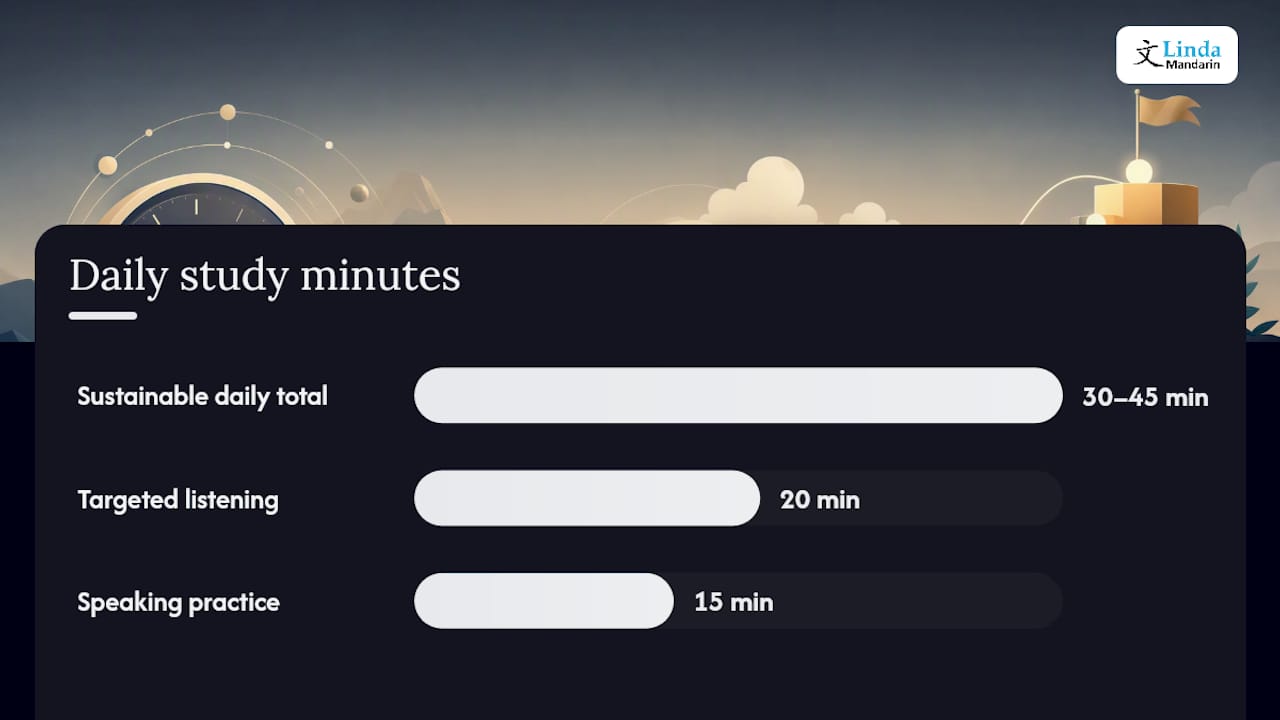
The most common scenario: 30–45 minutes of focused study per day, five to six days a week, over about five months. That’s the pace most working adults can actually sustain.
Where you land in the range depends on a few honest factors:
- Fast end (3–4 months): You already have HSK 1–2 grounding, study 1–2 hours daily, and do regular speaking practice.
- Typical (4–6 months): You’re building from scratch or HSK 1, study 30–60 minutes daily, and mix methods deliberately.
- Slow end (8–12 months): You study casually, skip speaking practice, or have long gaps between sessions.
Key Takeaways
Most adult learners reach HSK 3 in 4–6 months at a moderate pace, with roughly 300–500 total study hours and a daily commitment of 45–60 minutes of focused, mixed-method practice.
| Point | Details |
|---|---|
| Typical study hours | Most learners need 300–500 total hours; intensive study compresses this to 3–4 months. |
| Fastest single change | Add 20 minutes of daily listening with a transcript to close the most common weak section. |
| Best resource mix | Combine SRS vocabulary, graded readers, speaking practice, and weekly mock tests each week. |
| Recommended starting plan | The 6-month moderate plan (45–60 min/day) fits most working adults and includes milestone checkpoints. |
| Linda Mandarin option | HSK-aligned courses with mock tests, tutor feedback, and online Zoom delivery shorten the timeline versus unguided self-study. |
Table of Contents
- What does HSK 3 actually test?
- How long does it realistically take to reach HSK 3?
- What factors speed up or slow down your progress?
- Which study methods actually move you toward HSK 3?
- Three concrete study plans: 3-month, 6-month, and 12-month
- What does the HSK 3 exam look like on test day?
- How a structured, syllabus-aligned course shortens the timeline
- What actually surprises learners about the HSK 3 timeline
- Linda Mandarin’s HSK preparation courses for adult learners
- Sources
- FAQ
What does HSK 3 actually test?
HSK 3, as defined on the official chinesetest.cn program pages, targets learners who can handle basic daily-life communication in Chinese. The level sits between beginner interaction and functional fluency, roughly aligned with the A2–B1 boundary on the CEFR scale. You’re expected to know around 600 words and handle conversations about familiar topics: shopping, travel, work introductions, and everyday social exchanges.
The test covers three skill areas:
- Listening: Dialogues and short monologues; you identify key information and select correct responses.
- Reading: Short passages and sentence-level comprehension; you match, complete, or judge statements.
- Writing: Fill-in-the-blank and sentence ordering; character writing is limited but present.
Reaching that threshold means you can hold a basic conversation, read simple signs and messages, and write short responses. It won’t make you fluent, but it signals genuine communicative readiness for travel and basic professional interactions.
How long does it realistically take to reach HSK 3?
The honest answer is that timelines vary widely based on intensity and background, but three scenarios cover most learners:
Gochinese, intensive learners studying 2–3 hours daily can reach HSK 3 in roughly 3 months; moderate learners at 1–2 hours daily typically need several months; and casual study at 30 minutes daily can stretch to close to a year.

A quick calendar conversion: 45 minutes per day, six days a week, equals about 18 hours per month. At 300 total hours, that’s roughly 17 months. But most learners at that pace also improve their efficiency over time, so 6–8 months is a more realistic outcome. Bump to 60 minutes daily and you’re looking at 5–6 months for the same target.
The key variable isn’t just time on task. It’s what you do with that time.
What factors speed up or slow down your progress?
HanziFeed’s study-pacing analysis identifies the moderate pace of 30–45 minutes per day as the most sustainable for consistent learners, but the quality of those minutes matters as much as the quantity. Here’s what actually moves the needle:
- Prior Chinese exposure: Learners who completed HSK 1–2 formally can often reach HSK 3 in 3–4 months. Starting from zero adds 2–4 months to any timeline.
- Character vs. pinyin focus: Relying on pinyin alone slows reading comprehension significantly. Early investment in character recognition pays off at HSK 3, where the reading section tests characters directly.
- Listening practice volume: This is the most underestimated factor. Learners who skip daily listening often fail the listening section even when their vocabulary is solid.
- Speaking and production practice: Passive study (reading, watching) doesn’t build the retrieval speed the test requires. Active production, even 15 minutes of speaking per day, accelerates vocabulary retention.
- Immersion quality: Living in a Chinese-speaking environment or working with Chinese-speaking colleagues can cut months off the timeline. For learners in the U.S., deliberate immersion (Chinese media, language exchange partners) partially replicates this.
- Study consistency: Two months of daily 30-minute sessions outperforms a week of 3-hour cramming sessions. Gaps longer than a week cause measurable vocabulary decay.
- Mock test practice: Learners who take timed mock tests regularly score higher and feel less surprised by the exam format. One mock test per month in the early stages, then weekly in the final month, is a reliable pattern.
Pro Tip: Add 20 minutes of targeted listening to your daily routine before anything else. Use audio with a transcript, listen once without reading, then check the transcript for gaps. This single habit closes the listening gap faster than any other method.
Which study methods actually move you toward HSK 3?
Efficient preparation isn’t about studying more hours. It’s about using the right mix of methods so each session builds on the last.
High-impact methods, ranked by return on time invested:
- Spaced-repetition vocabulary (SRS): Apps like Anki or Pleco with HSK 3 decks let you review characters at the exact moment you’re about to forget them. Twenty minutes of SRS daily covers the 600-word vocabulary requirement in about 3 months.
- Graded readers: Short texts written at HSK 2–3 level build reading fluency without the frustration of authentic Chinese content. Read one short passage daily.
- Focused listening with transcript: Use HSK-level audio, listen actively, then read the transcript to identify what you missed. This is more effective than passive background listening.
- Targeted grammar drills: HSK 3 grammar patterns (比 comparisons, 把 sentences, resultative complements) appear repeatedly. Drilling these specifically, rather than reviewing general grammar, saves hours.
- Weekly mock tests: Timed practice under exam conditions builds speed and reveals weak sections early. Review every wrong answer before the next session.
- Speaking practice with a tutor or language partner: Two 30-minute speaking sessions per week accelerate vocabulary retrieval and build the confidence to use what you’ve studied.
A practical weekly study mix for a moderate-pace learner (roughly 5–6 hours per week):
| Activity | Time per Week | Purpose |
|---|---|---|
| SRS vocabulary review | 90 minutes | Build and retain the 600-word list |
| Listening with transcript | 60 minutes | Close the listening gap |
| Speaking practice | 60 minutes | Production fluency and retrieval speed |
| Reading (graded texts) | 45 minutes | Reading comprehension and character recognition |
| Grammar drills | 30 minutes | Target HSK 3 patterns specifically |
| Mock test or review | 45 minutes | Exam readiness and gap identification |
For a step-by-step approach to structuring your HSK preparation, including how to sequence these activities across weeks, Linda Mandarin’s preparation guide lays out a practical framework.
Three concrete study plans: 3-month, 6-month, and 12-month
Pick the plan that matches your available time, then count backward from your target exam date to set a start date.
3-month intensive plan (starting from HSK 1–2)
6-month moderate plan (most common scenario)
12-month part-time plan (busy professionals)
Adjusting your plan: If you’re ahead of a milestone by two weeks, add a mock test rather than moving to the next phase early. If you’re behind, cut grammar drills temporarily and double down on vocabulary and listening, since those two sections carry the most weight in the HSK 3 score.
What does the HSK 3 exam look like on test day?
HSKMock’s format breakdown reports the following structure for HSK 3:
- Listening: 40 questions, approximately 35 minutes
- Reading: 30 questions, approximately 30 minutes
- Writing: 10 questions, approximately 15 minutes
- Total duration: About 90 minutes, plus 5 minutes for filling in personal information
The exam is available in both computer-based and paper-based formats. Computer-based testing offers more frequent test dates and faster score reporting, which matters if you’re working toward a deadline.
Passing requires 180 out of 300 total points, with no minimum per-section score. That means a strong listening and reading performance can compensate for a weaker writing section, though neglecting writing entirely is risky.
For mock-test practice, use timed sessions that mirror the actual section lengths. After each mock, categorize your errors: vocabulary gaps, listening speed, reading comprehension, or character writing. Drilling the specific error type is far more efficient than re-studying everything. Linda Mandarin’s tips for acing the HSK test covers this targeted review approach in detail.
How a structured, syllabus-aligned course shortens the timeline
Unguided self-study works, but it carries a hidden cost: time spent figuring out what to study next. A course aligned to the HSK 3 syllabus removes that friction entirely.
The features that actually compress the timeline:
- Exact vocabulary sequencing: A syllabus-aligned course introduces the 600 HSK 3 words in a pedagogically ordered sequence, so you’re not randomly encountering words you won’t need for months.
- Regular mock tests built into the schedule: Structured courses typically include mock tests at set intervals, which means you get diagnostic feedback without having to organize it yourself.
- Tutor feedback on speaking and writing: Self-study can’t tell you when your tones are off or your sentence structure is awkward. A native instructor catches these errors before they become habits.
- Speaking-focused sessions: Most self-study plans underweight speaking. A course that prioritizes production practice closes the gap between passive knowledge and active use.
- Measurable milestones: Knowing you need to hit 300 words by week 4 and pass a mock test by week 8 keeps progress on track in a way that open-ended self-study rarely does.
To evaluate whether a course fits your timeline:
- Confirm the syllabus explicitly maps to HSK 3 vocabulary and grammar objectives.
- Check that mock tests are included, not optional add-ons.
- Ask about the ratio of speaking practice to grammar instruction.
- Verify that the delivery format (in-person, online Zoom, or hybrid) fits your schedule.
What actually surprises learners about the HSK 3 timeline
Most learners who miss their target date share one pattern: they studied vocabulary and grammar diligently but treated listening as something that would improve on its own. It doesn’t.
Listening comprehension at HSK 3 requires processing spoken Mandarin at a natural pace, with tones, connected speech, and minimal context clues. Reading a character perfectly doesn’t mean you’ll recognize it when a native speaker says it quickly. That gap is real, and it takes deliberate practice to close, not just more vocabulary cards.
The second surprise is how much production practice matters for retention. Learners who only read and listen forget vocabulary faster than those who use it in sentences, even in writing. Speaking twice a week with a tutor or language partner isn’t just about fluency. It’s the most efficient way to lock in what you’ve studied.
A few quick wins that experienced instructors consistently recommend to adult learners:
- Shadow HSK 3 audio recordings for 10 minutes daily to train your ear to the pace of natural speech.
- Write three sentences using new vocabulary before each SRS session, not after.
- Take a full mock test in week 3 of any study plan, even if you feel unprepared. The early diagnostic is worth more than the discomfort.
Pro Tip: Count backward from your exam date, not forward from today. Set the exam date first, then build the study plan to fit. Learners who register for the exam before they feel ready consistently outperform those who wait until they feel “ready.”
Linda Mandarin’s HSK preparation courses for adult learners
For adult learners who want a faster, more structured path to HSK 3, Linda Mandarin’s HSK preparation courses are built around the exact syllabus objectives, mock test cycles, and speaking-focused sessions described throughout this article.

Classes run both in-person at 10 Anson Road, Level 22, International Plaza, Singapore 079903 (right above Tanjong Pagar MRT) and via online Zoom, so working professionals can maintain a consistent study schedule without commuting. Corporate groups can also arrange tailored corporate Mandarin training aligned to business communication goals. Linda Mandarin has been training adult learners since 2003, with native Mandarin instructors who deliver lessons in English-friendly formats designed for non-heritage speakers.
To find the right course level and delivery format for your timeline, browse the course levels and options or contact Linda Mandarin directly to discuss your exam date and current level.
Sources
- How Long Does It Take to Pass Each HSK Level? (2026 Data) | HSKStory
- Gochinese
- How to Pass HSK 3: Study Plan and Resources — HanziFeed Blog
Check Chinesetest directly for current test dates, registration deadlines, and the official HSK 3 syllabus word list.
FAQ
Is it possible to reach HSK 3 in 3 months?
Yes, but only with prior HSK 1–2 grounding and 2+ hours of focused daily study. Learner reports confirm a 3–4 month lower bound is achievable with consistent effort, though most adults need 4–6 months.
Is HSK 3 hard to pass?
The listening section catches most learners off guard, so deliberate daily listening practice is the most important factor in passing.
How long does it take to complete HSK levels 1 through 3?
Starting from zero, most adult learners reach HSK 3 in 12–18 months of consistent study, or as few as 6–9 months with intensive daily practice. Each level builds directly on the previous one, so gaps in HSK 1–2 vocabulary slow progress at HSK 3.
Is HSK 3 a beginner or intermediate level?
HSK 3 sits at the upper end of beginner toward early intermediate, roughly at the A2–B1 boundary on the CEFR scale. It tests functional daily communication rather than academic or professional fluency.
How many study hours does HSK 3 require?
Most estimates place HSK 3 at 300–500 total study hours from a beginner baseline, with the lower end achievable through structured, syllabus-aligned study and regular mock testing.