Mastering business Chinese phone call phrases means you can answer with 喂 (wéi) or 你好 (nǐ hǎo), identify yourself with 我是… (wǒ shì…), state your reason with 我打电话是为了… (wǒ dǎ diànhuà shì wèile…), arrange meetings with 请问您什么时候方便 (qǐngwèn nín shénme shíhou fāngbiàn), hold or transfer with 请稍等 (qǐng shāo děng), leave a message with 可以帮我留言吗 (kěyǐ bāng wǒ liúyán ma), and close with 谢谢/再见 (xièxie / zàijiàn) — all in under two minutes.
Here is the six-stage checklist you can use right now:
- Answer: 喂 (wéi, 2nd tone) or 你好 (nǐ hǎo) — “Hello”
- Identify: 请问是哪位?(qǐngwèn shì nǎ wèi?) — “May I ask who’s calling?”
- State purpose: 我打电话是为了… (wǒ dǎ diànhuà shì wèile…) — “I’m calling about…”
- Arrange: 请问您什么时候方便?(qǐngwèn nín shénme shíhou fāngbiàn?) — “When would be convenient for you?”
- Message/hold: 可以帮我留言吗?(kěyǐ bāng wǒ liúyán ma?) — “Can you take a message?”
- Close: 谢谢,再见 (xièxie, zàijiàn) — “Thank you, goodbye”
Formality note: Use 您 (nín) for seniors, clients, and anyone you are meeting for the first time. Use 你 (nǐ) with colleagues you know well. On the phone, 喂 (wéi, rising 2nd tone) is the standard polite answer; 你好 signals a slightly more formal opening, common in corporate reception settings.
Key Takeaways
Mastering business Chinese phone call phrases means knowing the right phrase for each stage of the call, using the correct tone on 喂 (wéi, 2nd tone), and always identifying yourself before making a request.
| Point | Details |
|---|---|
| Use 喂 (wéi) with the rising 2nd tone | The falling 4th tone sounds abrupt; the rising 2nd tone signals polite readiness on a phone call. |
| Identify yourself first | State your name and company in the opening sentence to avoid repeated “请问是哪位?” exchanges. |
| Confirm all meeting details aloud | Before hanging up, say the date, time, location or meeting link, and your callback number. |
| Use 您 with seniors and new contacts | Switch to 你 only after the other person does — defaulting to 您 is always the safer choice. |
| Linda Mandarin for guided practice | Adult business Mandarin courses and corporate training in Singapore build real call fluency fast. |
Table of Contents
- Business Chinese phone call phrases: your quick cheat sheet
- How to answer and open a business call in Mandarin
- How to identify callers and introduce yourself professionally
- How to state your reason and arrange meetings on a call
- Putting callers on hold, transferring, and leaving messages
- How to handle poor connections and ask for repetition politely
- Polite closing lines that fit Singapore business conventions
- Two sample scripts you can read aloud and reuse
- Practice routines and Singapore-specific phone etiquette
- What trainers know about drilling these phrases in real workplaces
- Linda Mandarin’s adult business Mandarin courses in Singapore
- Sources
- FAQ
Business Chinese phone call phrases: your quick cheat sheet
The table below groups high-frequency Mandarin phrases by call stage. Each row gives you the Chinese, pinyin with tone marks and a literal English gloss, so you can scan the right line fast during a live call.
| Stage | Chinese | Pinyin (tones) | Literal gloss |
|---|---|---|---|
| Answering | 喂 | wéi (2nd tone) | Hello (phone) |
| 你好 / 您好 | nǐ hǎo / nín hǎo | Hello / Hello (formal) | |
| [公司名],您好 | [gōngsī míng], nín hǎo | [Company name], hello | |
| 请问哪位? | qǐngwèn nǎ wèi? | May I ask who’s calling? | |
| Asking who’s calling | 请问是哪位? | qǐngwèn shì nǎ wèi? | May I ask who this is? |
| 您哪位? | nín nǎ wèi? | Who are you? (polite) | |
| 请问您贵姓? | qǐngwèn nín guì xìng? | May I ask your surname? | |
| 请问您是哪家公司的? | qǐngwèn nín shì nǎ jiā gōngsī de? | Which company are you from? | |
| Introducing yourself | 我是[Name] | wǒ shì [Name] | I am [Name] |
| 我是[Company]的[Name] | wǒ shì [Company] de [Name] | I’m [Name] from [Company] | |
| 我是[Role] | wǒ shì [Role] | I am [Role] | |
| 我姓[Surname] | wǒ xìng [Surname] | My surname is [Surname] | |
| Stating reason | 我打电话是为了… | wǒ dǎ diànhuà shì wèile… | I’m calling about… |
| 我来电是想… | wǒ lái diàn shì xiǎng… | I’m calling because I’d like to… | |
| 关于[topic],我想… | guānyú [topic], wǒ xiǎng… | Regarding [topic], I’d like to… | |
| 请问[Name]在吗? | qǐngwèn [Name] zài ma? | Is [Name] available? | |
| Scheduling | 请问您什么时候方便? | qǐngwèn nín shénme shíhou fāngbiàn? | When would be convenient for you? |
| 明天上午十点可以吗? | míngtiān shàngwǔ shí diǎn kěyǐ ma? | Is tomorrow at 10 AM okay? | |
| 我们约[date][time]见面 | wǒmen yuē [date][time] jiànmiàn | Let’s meet on [date] at [time] | |
| 请确认一下时间 | qǐng quèrèn yīxià shíjiān | Please confirm the time | |
| Holding / transferring | 请稍等 | qǐng shāo děng | Please wait a moment |
| 请稍等一下,我帮您转接 | qǐng shāo děng yīxià, wǒ bāng nín zhuǎnjiē | One moment, I’ll transfer you | |
| 对不起,让您久等了 | duìbuqǐ, ràng nín jiǔ děng le | Sorry to keep you waiting | |
| 他/她现在不在 | tā xiànzài bú zài | He/She is not available right now | |
| Leaving messages | 可以帮我留言吗? | kěyǐ bāng wǒ liúyán ma? | Can you take a message for me? |
| 请他/她回电给我 | qǐng tā huí diàn gěi wǒ | Please ask him/her to call me back | |
| 我的电话是… | wǒ de diànhuà shì… | My number is… | |
| 我会再打来 | wǒ huì zài dǎ lái | I’ll call again | |
| Asking for repetition | 抱歉,我听不清楚 | bàoqiàn, wǒ méi tīng qīngchǔ | Sorry, I didn’t hear clearly |
| 您可以再说一遍吗? | nín kěyǐ zài shuō yī biàn ma? | Could you say that again? | |
| 可以请您慢一点说吗? | kěyǐ qǐng nín màn yīdiǎn shuō ma? | Could you speak a little slower? | |
| 请重复一遍,谢谢 | qǐng chóngfù yī biàn, xièxie | Please repeat that, thank you | |
| Closing | 谢谢您 | xièxie nín | Thank you (formal) |
| 麻烦您了 | máfan nín le | Sorry to trouble you | |
| 那就这样,再见 | nà jiù zhèyàng, zàijiàn | That’s all then, goodbye | |
| 期待与您合作 | qīdài yǔ nín hézuò | Looking forward to working with you |
Numbers and dates for scheduling: Mandarin uses a straightforward pattern. Say the year, then month (月 yuè), then day (号 hào), then time. For example: 三月十五号,上午十点半 (sān yuè shíwǔ hào, shàngwǔ shí diǎn bàn) = March 15th, 10:30 AM. Use 上午 (shàngwǔ) for AM and 下午 (xiàwǔ) for PM. Hours are stated as a number plus 点 (diǎn), and half-hours add 半 (bàn).
How to answer and open a business call in Mandarin
The first word out of your mouth sets the tone for the entire call. On a phone call, 喂 should use the rising 2nd tone (wéi) — that upward lilt signals you are present and ready. The falling 4th-tone version (wèi) sounds like you are summoning someone across a room, which reads as abrupt in a professional context.
Three opening formulas by caller type:
- Receptionist (formal): [公司名],您好!(e.g., 林达普通话,您好!) — use 您好 every time; it signals the company’s professionalism before you say another word.
- Internal colleague: 喂,我是[Name],[同事名]在吗?(wéi, wǒ shì [Name], [tóngshì míng] zài ma?) — quick, direct, no ceremony needed.
- Senior external contact: 您好,我是[Name],来自[Company]。(nín hǎo, wǒ shì [Name], láizì [Company].) — lead with 您好, then your name and company before anything else.
Pro Tip: When you are the one calling, identify yourself in the first sentence. Saying “我是[Name],来自[Company]” immediately saves the other person from asking “请问是哪位?” twice — a small gesture that busy Singapore professionals genuinely appreciate.
How to identify callers and introduce yourself professionally

The two most common identification phrases are 请问是哪位?(qǐngwèn shì nǎ wèi?) and the shorter 您哪位?(nín nǎ wèi?). Both mean “May I ask who’s calling?” The longer version is slightly more formal; use it with clients and seniors. The shorter one works fine with colleagues.
For self-introductions, keep it to one sentence:
- 我是[Name],在[Company]做[Role]。(wǒ shì [Name], zài [Company] zuò [Role].) — “I’m [Name], I work as [Role] at [Company].”
- 我姓[Surname],是[Company]的[Role]。(wǒ xìng [Surname], shì [Company] de [Role].) — slightly more formal, leading with surname.
The softeners 请问 (qǐngwèn), 麻烦您 (máfan nín), and 不好意思 (bù hǎoyìsi) all reduce the directness of a request. 请问 is the most neutral. 麻烦您 (“sorry to trouble you”) adds warmth and is common when asking a gatekeeper to connect you. 不好意思 (“excuse me / I’m sorry”) works well when you are interrupting or asking for something extra.
Here is a short sample exchange showing how these phrases connect:
Caller: 您好,我是陈明,来自ABC公司。麻烦您,请问张经理在吗?
(Nín hǎo, wǒ shì Chén Míng, láizì ABC gōngsī. Máfan nín, qǐngwèn Zhāng jīnglǐ zài ma?)
“Hello, I’m Chen Ming from ABC Company. Sorry to trouble you — is Manager Zhang available?”Receptionist: 请问您哪位?
(Qǐngwèn nín nǎ wèi?)
“May I ask who’s calling?”Caller: 我是陈明,ABC公司销售部。
(Wǒ shì Chén Míng, ABC gōngsī xiāoshòu bù.)
“I’m Chen Ming, sales department at ABC Company.”Receptionist: 好的,请稍等。
(Hǎo de, qǐng shāo děng.)
“Understood, please hold.”
How to state your reason and arrange meetings on a call
Get to the point fast. Singapore professionals are busy, and a caller who spends 30 seconds on pleasantries before stating their purpose loses goodwill. The two most useful opening templates are:
- Routine: 我打电话是为了… (wǒ dǎ diànhuà shì wèile…) — “I’m calling about…”
- Wanting action: 我来电是想… (wǒ lái diàn shì xiǎng…) — “I’m calling because I’d like to…”
- Urgent: 关于[topic],有个紧急情况想跟您说。(guānyú [topic], yǒu gè jǐnjí qíngkuàng xiǎng gēn nín shuō.) — “Regarding [topic], there’s an urgent matter I’d like to discuss.”
For scheduling, ask availability first, then propose a specific time:
- 请问您什么时候方便?(qǐngwèn nín shénme shíhou fāngbiàn?) — “When would be convenient for you?”
- 明天上午十点可以吗?(míngtiān shàngwǔ shí diǎn kěyǐ ma?) — “Is tomorrow at 10 AM okay?”
- 我们约下周三下午两点半。(wǒmen yuē xià zhōusān xiàwǔ liǎng diǎn bàn.) — “Let’s schedule next Wednesday at 2:30 PM.”
Confirmation checklist — say these out loud before hanging up:
- Date: 日期是… (rìqī shì…)
- Time: 时间是… (shíjiān shì…)
- Location or meeting link: 地点/会议链接是… (dìdiǎn / huìyì liànjiē shì…)
- Contact number: 联系电话是… (liánxì diànhuà shì…)
A full confirmation sentence sounds like: 好的,我们约好了三月十五号,上午十点,在您的办公室,我的电话是+65-XXXX-XXXX。(Hǎo de, wǒmen yuē hǎo le sān yuè shíwǔ hào, shàngwǔ shí diǎn, zài nín de bàngōngshì, wǒ de diànhuà shì +65-XXXX-XXXX.) Saying it all in one breath prevents the follow-up confusion that derails half of business meetings.
Putting callers on hold, transferring, and leaving messages
These are the moments where polite phone formulas matter most. A clumsy hold or a dropped message can undo a good first impression.
Hold and transfer phrases:
- 请稍等一下,我帮您转接。(qǐng shāo děng yīxià, wǒ bāng nín zhuǎnjiē.) — “One moment, I’ll transfer you.”
- 我这就帮您转接一下。(wǒ zhè jiù bāng nín zhuǎnjiē yīxià.) — “I’ll connect you right now.”
- 对不起,让您久等了。(duìbuqǐ, ràng nín jiǔ děng le.) — “Sorry to keep you waiting.”
- 他/她现在在开会,您方便稍后再来电吗?(tā xiànzài zài kāihuì, nín fāngbiàn shāohòu zài lái diàn ma?) — “He/She is in a meeting — would it be convenient to call back later?”
Message template to leave:
他/她不在,我可以为您留言:我是[Name],来自[Company],是关于[reason],请他/她回电:+65-XXXX-XXXX,方便的话请在[time]之前回电。
(Tā bú zài, wǒ kěyǐ wèi nín liúyán: wǒ shì [Name], láizì [Company], shì guānyú [reason], qǐng tā huí diàn: +65-XXXX-XXXX, fāngbiàn de huà qǐng zài [time] zhīqián huí diàn.)
“He/She is not in. I can take a message: I’m [Name] from [Company], calling about [reason]. Please ask him/her to call back at +65-XXXX-XXXX, ideally before [time].”
Checklist for taking a message:
- Caller’s full name (姓名 xìngmíng)
- Company name (公司名 gōngsī míng)
- Reason for call (来电原因 lái diàn yuányīn)
- Best callback number (回电号码 huí diàn hàomǎ)
- Preferred callback time (方便回电时间 fāngbiàn huí diàn shíjiān)
How to handle poor connections and ask for repetition politely
Bad audio happens. The professional response is calm and specific, not a frustrated “什么?” (shénme? — “what?”). A compact set of phrases for connection problems keeps the call on track without embarrassment.
When the line breaks up, lead with an apology, then state the problem:
- 抱歉,我听不清楚,您可以再说一遍吗?(bàoqiàn, wǒ tīng bù qīngchǔ, nín kěyǐ zài shuō yī biàn ma?) — “Sorry, I can’t hear clearly — could you say that again?”
- 信号不太好,我们稍后再联络。(xìnhào bú tài hǎo, wǒmen shāohòu zài liánluò.) — “The signal isn’t great — let’s connect again shortly.”
For callbacks and channel switches, WeChat voice or video calls are now a common alternative to traditional phone calls among Mandarin-speaking professionals. Offering one is practical, not informal:
- 我会再打给您。(wǒ huì zài dǎ gěi nín.) — “I’ll call you again.”
- 可以改用微信语音吗?(kěyǐ gǎi yòng Wēixìn yǔyīn ma?) — “Can we switch to WeChat voice?”
- 我发微信给您确认。(wǒ fā Wēixìn gěi nín quèrèn.) — “I’ll send you a WeChat message to confirm.”
Pro Tip: If you need someone to slow down, use 可以请您慢一点说吗?(kěyǐ qǐng nín màn yīdiǎn shuō ma?) — “Could you speak a little slower, please?” It is polite, direct, and native speakers hear it often enough that it causes zero awkwardness. Pair it with 请重复一遍,谢谢 (qǐng chóngfù yī biàn, xièxie) if you still need the phrase repeated.
Polite closing lines that fit Singapore business conventions
A strong close does two things: it thanks the other person and it states the next step. Leaving either out makes the call feel unfinished. Explicit confirmation of the next action is one of the most practical habits you can build on business calls.
Core closing phrases:
- 好的,谢谢您。(hǎo de, xièxie nín.) — “Alright, thank you.”
- 麻烦您了。(máfan nín le.) — “Sorry to have troubled you.” (Warm, widely used with seniors.)
- 那就这样,再见。(nà jiù zhèyàng, zàijiàn.) — “That’s all then, goodbye.”
- 期待与您合作。(qīdài yǔ nín hézuò.) — “Looking forward to working with you.” (Use at the end of a first-contact call.)
Follow-up action lines:
- 我会发确认邮件给您。(wǒ huì fā quèrèn yóujiàn gěi nín.) — “I’ll send you a confirmation email.”
- 我会通过微信发确认。(wǒ huì tōngguò Wēixìn fā quèrèn.) — “I’ll confirm via WeChat.”
Two closing sequences:
Formal (senior client):
好的,那我们约好了明天上午十点。麻烦您了,期待与您合作,再见。
(Hǎo de, nà wǒmen yuē hǎo le míngtiān shàngwǔ shí diǎn. Máfan nín le, qīdài yǔ nín hézuò, zàijiàn.)
“Alright, we’re confirmed for tomorrow at 10 AM. Sorry to trouble you — looking forward to working with you. Goodbye.”
Casual (known colleague):
好,就这样!我发微信给你确认,再见!
(Hǎo, jiù zhèyàng! Wǒ fā Wēixìn gěi nǐ quèrèn, zàijiàn!)
“Great, that’s settled! I’ll confirm on WeChat. Bye!”
Notice the pronoun shift: 您 (nín) in the formal version, 你 (nǐ) with the colleague. That single swap signals the entire register difference.
Two sample scripts you can read aloud and reuse
These scripts are annotated line by line. Read them aloud at least three times — that repetition is what moves the phrases from recognition to production. Step-by-step pronunciation practice is the fastest way to build call confidence.
Script 1: Inbound call (receptionist to caller)
| Speaker | Chinese | Pinyin | Literal gloss |
|---|---|---|---|
| Receptionist | 林达普通话,您好! | Líndá Pǔtōnghuà, nín hǎo! | Linda Mandarin, hello! |
| Caller | 您好,我是陈明,来自ABC公司。请问张经理在吗? | Nín hǎo, wǒ shì Chén Míng, láizì ABC gōngsī. Qǐngwèn Zhāng jīnglǐ zài ma? | Hello, I’m Chen Ming from ABC Company. Is Manager Zhang available? |
| Receptionist | 请问您哪位? | Qǐngwèn nín nǎ wèi? | May I ask who’s calling? |
| Caller | 我是陈明,ABC公司销售部。 | Wǒ shì Chén Míng, ABC gōngsī xiāoshòu bù. | I’m Chen Ming, sales at ABC Company. |
| Receptionist | 好的,请稍等一下,我帮您转接。 | Hǎo de, qǐng shāo děng yīxià, wǒ bāng nín zhuǎnjiē. | Understood, please hold — I’ll transfer you. |
| Receptionist | 对不起,张经理现在在开会。可以帮您留言吗? | Duìbuqǐ, Zhāng jīnglǐ xiànzài zài kāihuì. Kěyǐ bāng nín liúyán ma? | Sorry, Manager Zhang is in a meeting. Can I take a message? |
| Caller | 好的,请告诉他我是陈明,+65-XXXX-XXXX,请他回电,谢谢。 | Hǎo de, qǐng gàosu tā wǒ shì Chén Míng, +65-XXXX-XXXX, qǐng tā huí diàn, xièxie. | Sure, please tell him I’m Chen Ming, +65-XXXX-XXXX, please ask him to call back. Thank you. |
| Receptionist | 好的,我会转告他,再见。 | Hǎo de, wǒ huì zhuǎngào tā, zàijiàn. | Understood, I’ll pass the message. Goodbye. |
Pronoun note: The receptionist uses 您 throughout because the caller is an external contact. If Manager Zhang were to call back and the two knew each other well, 你 would be natural.
Script 2: Outbound call (arranging a meeting)
| Speaker | Chinese | Pinyin | Literal gloss |
|---|---|---|---|
| Caller | 您好,我是林华,来自XYZ公司。请问是李总吗? | Nín hǎo, wǒ shì Lín Huá, láizì XYZ gōngsī. Qǐngwèn shì Lǐ zǒng ma? | Hello, I’m Lin Hua from XYZ Company. Am I speaking with Director Li? |
| Li | 是的,您好。 | Shì de, nín hǎo. | Yes, hello. |
| Caller | 我打电话是为了讨论下个月的合作项目,请问您什么时候方便? | Wǒ dǎ diànhuà shì wèile tǎolùn xià gè yuè de hézuò xiàngmù, qǐngwèn nín shénme shíhou fāngbiàn? | I’m calling to discuss next month’s collaboration project. When would be convenient for you? |
| Li | 下周三下午两点可以吗? | Xià zhōusān xiàwǔ liǎng diǎn kěyǐ ma? | Is next Wednesday at 2 PM okay? |
| Caller | 好的,没问题。我们约好了下周三,下午两点,在您的办公室? | Hǎo de, méi wèntí. Wǒmen yuē hǎo le xià zhōusān, xiàwǔ liǎng diǎn, zài nín de bàngōngshì? | Great, no problem. We’re confirmed for next Wednesday at 2 PM, at your office? |
| Li | 对,就这样。 | Duì, jiù zhèyàng. | Correct, that’s settled. |
| Caller | 好的,我会发确认邮件给您。麻烦您了,期待与您合作,再见! | Hǎo de, wǒ huì fā quèrèn yóujiàn gěi nín. Máfan nín le, qīdài yǔ nín hézuò, zàijiàn! | Great, I’ll send a confirmation email. Sorry to trouble you — looking forward to working with you. Goodbye! |
Practice routines and Singapore-specific phone etiquette
Knowing the phrases is step one. Getting them out naturally under pressure is a different skill, and it takes deliberate repetition. Scripted drills and role-play exercises are the most reliable way to reduce call anxiety and build fluency on real calls.
Three drills that actually work:
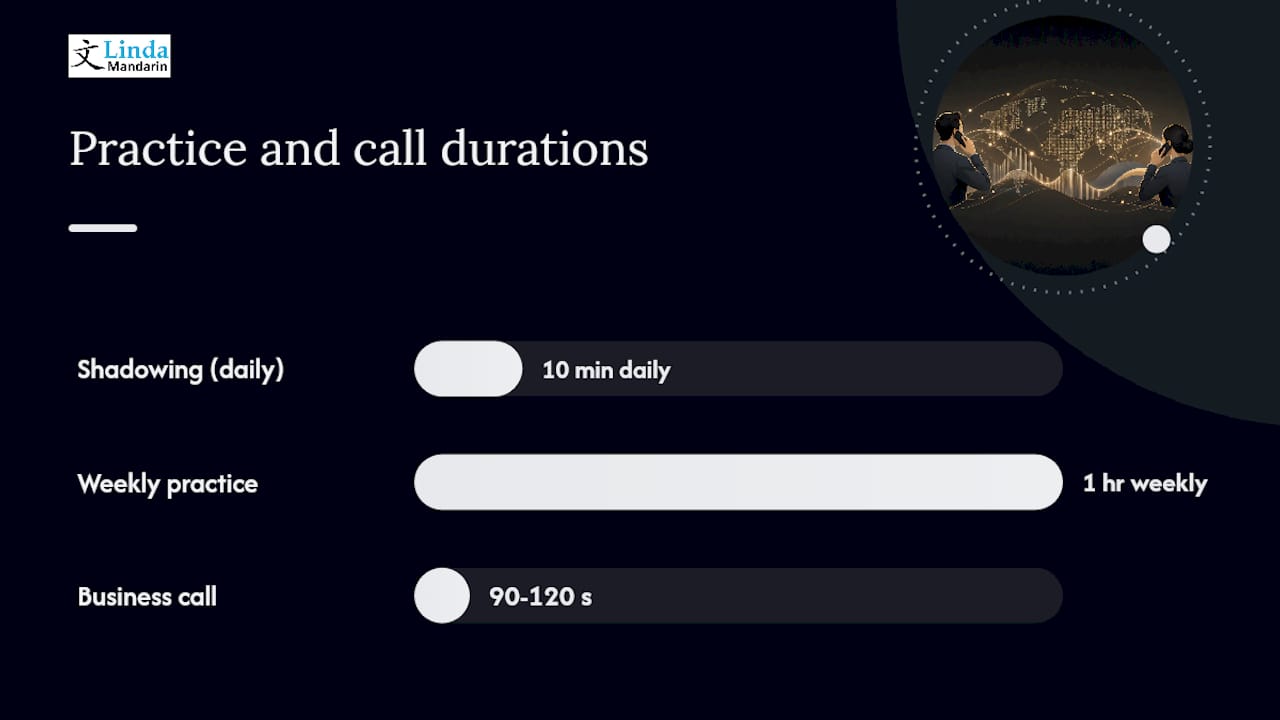
- Shadowing: Play a recorded Mandarin phone call (the sample scripts above work well) and speak each line simultaneously with the speaker. Focus on matching tone and rhythm, not just words. Ten minutes daily beats an hour once a week.
- Role-play with a partner: One person plays the receptionist, the other the caller. Swap roles after each round. Time the call — a clean business call from opening to close should take 90 seconds to two minutes.
- Record and review: Record yourself running Script 2 above. Listen back for three things: correct tones on 喂 (wéi) and 您 (nín), clear self-identification in the first sentence, and a stated next step before 再见.
Common mistakes and how to fix them:
- Overusing 你 instead of 您: Default to 您 with anyone you have not met in person. Switch to 你 only when the other person does first.
- Skipping self-identification: Many learners open with 喂 and then ask for the person they want, leaving the receiver confused. Always say your name and company before your request.
- Speaking too fast when nervous: Slow down deliberately. Native speakers will not judge you for pausing; they will judge you for being unclear.
- Forgetting to confirm details: Ending a call without repeating the time, date, and contact number is the single most common source of missed meetings.
Singapore context: Business calls in Singapore often involve code-switching between Mandarin and English, especially in mixed-language offices. If your Mandarin falters mid-call, it is perfectly acceptable to say 不好意思,我用英语说一下 (bù hǎoyìsi, wǒ yòng Yīngyǔ shuō yīxià) — “Excuse me, let me say this in English.” Most Singapore professionals will appreciate the attempt at Mandarin regardless. For time-of-day conventions, avoid calling before 9:00 AM or after 6:00 PM unless you have an established relationship. WeChat is widely used for follow-up confirmations, and offering to send a WeChat message after a call is standard practice rather than informal. Understanding Chinese business culture and etiquette alongside these phrases gives you the full picture of what Singapore professionals expect on a call.
What trainers know about drilling these phrases in real workplaces
The phrases in this guide work not because they are textbook-perfect, but because they are short enough to recall under pressure. In a classroom setting, the phrases that stick fastest are the ones learners say out loud in a timed, role-play format within the first session — not the ones they read silently and highlight.
The most common sticking point in training is the opening. Learners who have not practiced tend to pause after 喂 and wait for the other person to speak, which creates an awkward silence. Flipping that habit — opening with your name and company immediately — is the single change that most improves a learner’s first impression on a call. Two or three timed role-plays, each under two minutes, are usually enough to make that opening automatic.
For a quick self-assessment, listen to a 60-second recording of yourself running Script 1 or Script 2. If you can hear your name, your company, your reason for calling, and a stated next step before 再见, you are ready for a real call. If any of those four elements is missing or buried, that is the drill target for the next session. Business Mandarin for professionals is built around exactly this kind of practical, measurable readiness.
Linda Mandarin’s adult business Mandarin courses in Singapore
Phone fluency in Mandarin comes faster with structured practice and a native-speaking instructor who can catch your tones in real time. Linda Mandarin’s adult business Mandarin programs are built for professionals who need practical communication skills, not just vocabulary lists. Courses run in-person at 10 Anson Road, Level 22, International Plaza, right above Tanjong Pagar MRT, and online via Zoom for flexible scheduling.

For teams and companies, Linda Mandarin’s corporate Mandarin training can be customized around the exact scenarios your staff face — including phone calls, client meetings, and WeChat communication. Classes are taught by certified native Mandarin instructors fluent in English, so the gap between what you know and what you can say on a live call closes quickly. Contact Linda Mandarin to discuss a corporate program or view the adult course schedule to find the right fit for your level and goals.
Sources
The following sources were used to prepare this guide and are worth bookmarking for deeper reading:
- Interjection: 喂 (Hello on the Phone) (叹词:喂) — HSK 2 Grammar | Mandarin Temple
- Dialing in Mandarin: Top 10 Basic Chinese Phrases for Phone Calls – Chineasy
- Phone Calls in Chinese: Real Conversation Scripts | Kaiwa Blog
- How to make a phone call in Chinese
FAQ
What do Chinese people say when answering the phone?
The standard answer is 喂 (wéi), said with a rising 2nd tone. In formal or corporate settings, receptionists typically answer with the company name followed by 您好 (nín hǎo), for example 林达普通话,您好.
How do you say “phone call” in Chinese?
The standard term is 电话 (diànhuà), which covers both the device and the call itself. “To make a phone call” is 打电话 (dǎ diànhuà), and “to receive a phone call” is 接电话 (jiē diànhuà).
What are some popular Chinese phrases for business calls?
The most useful business Chinese phone call phrases include 我打电话是为了… (I’m calling about…), 请问您什么时候方便 (When would be convenient for you?), 请稍等,我帮您转接 (Please hold, I’ll transfer you), and 可以帮我留言吗 (Can you take a message?).
What are some common Mandarin phrases for asking someone to repeat themselves?
Use 您可以再说一遍吗?(nín kěyǐ zài shuō yī biàn ma?) for “Could you say that again?” or 可以请您慢一点说吗?(kěyǐ qǐng nín màn yīdiǎn shuō ma?) for “Could you speak a little slower?” Both are polite and widely understood.
How do you end a business phone call in Mandarin politely?
A standard formal close is 麻烦您了,再见 (máfan nín le, zàijiàn) — “Sorry to trouble you, goodbye.” For calls where you have arranged a next step, add 我会发确认邮件给您 (wǒ huì fā quèrèn yóujiàn gěi nín) — “I’ll send you a confirmation email” — before signing off.