Most self-learners pass HSK 5 by choosing one of three plans based on available weekly hours, then taking a timed baseline mock test before week one begins. Here is the quick-pick rule: if you have 10 or more hours per week, follow the 12-week intensive plan; 5–9 hours per week puts you on the 24-week balanced plan; 2–4 hours per week means the 9–15 month long-term plan is your realistic path. The passing score is a qualifying threshold out of the total test points, and your first task this week is a full timed mock test to find your current gap.
Plan options at a glance:
- 12-week intensive (10+ hrs/week): heavy vocabulary weeks 1–2, listening and reading speed weeks 3–6, mock-test simulation weeks 7–12
- 24-week balanced (5–9 hrs/week): vocabulary and grammar foundation weeks 1–6, skill-building weeks 7–16, consolidation and mocks weeks 17–24
- 9–15 month long-term (2–4 hrs/week): slow vocabulary accumulation months 1–4, reading and listening depth months 5–9, exam simulation months 10–15
Key Takeaways
A structured HSK 5 study plan built around a baseline mock test, the 2–3 hours-per-point scheduling rule, and weekly skill-specific targets gives you the clearest path to 180/300.
| Point | Details |
|---|---|
| Choose your plan by weekly hours | 10+ hrs/week: 12-week intensive; 5–9 hrs/week: 24-week balanced; 2–4 hrs/week: 9–15 months. |
| Start with a baseline mock test | Score yourself before week one to calculate your point gap and allocate study hours by skill. |
| Use the 2–3 hours-per-point rule | Multiply your score gap by 2–3 to estimate total study hours needed, then divide by weekly hours. |
| Match daily practice to the test | Every session should include at least one of: timed reading, listening with notes, writing, or SRS. |
| Linda Mandarin for guided prep | Structured HSK prep courses with writing feedback and timed mocks are available in-person and online via Zoom. |
Table of Contents
- What does your HSK 5 study plan actually need to cover?
- How long does it realistically take to prepare for HSK 5?
- Three copy-ready week-by-week study schedules
- What should each study session actually look like?
- What are the best resources for HSK 5 preparation?
- How should you use mock tests to drive your preparation?
- What mistakes do most HSK 5 candidates make?
- When does a guided course make more sense than self-study?
- Does speaking practice help even though HSK 5 does not test it?
- One thing most HSK 5 guides get wrong
- Linda Mandarin’s structured HSK 5 preparation
- Sources
- FAQ
What does your HSK 5 study plan actually need to cover?
HSK 5 is a three-section exam with roughly 100 questions, a total testing time of about 125 minutes, and a passing score of 180 out of 300. Every study session you plan should map directly to one of those three sections.
| Section | Questions | Approx. Time | What It Tests |
|---|---|---|---|
| Listening | ~45 | ~30 minutes | Dialogues, monologues, news-style passages |
| Reading | ~45 | ~45 minutes | Cloze, sentence matching, long-passage comprehension |
| Writing | ~10 | ~40 minutes | Sentence reordering, short compositions (~80–100 characters) |
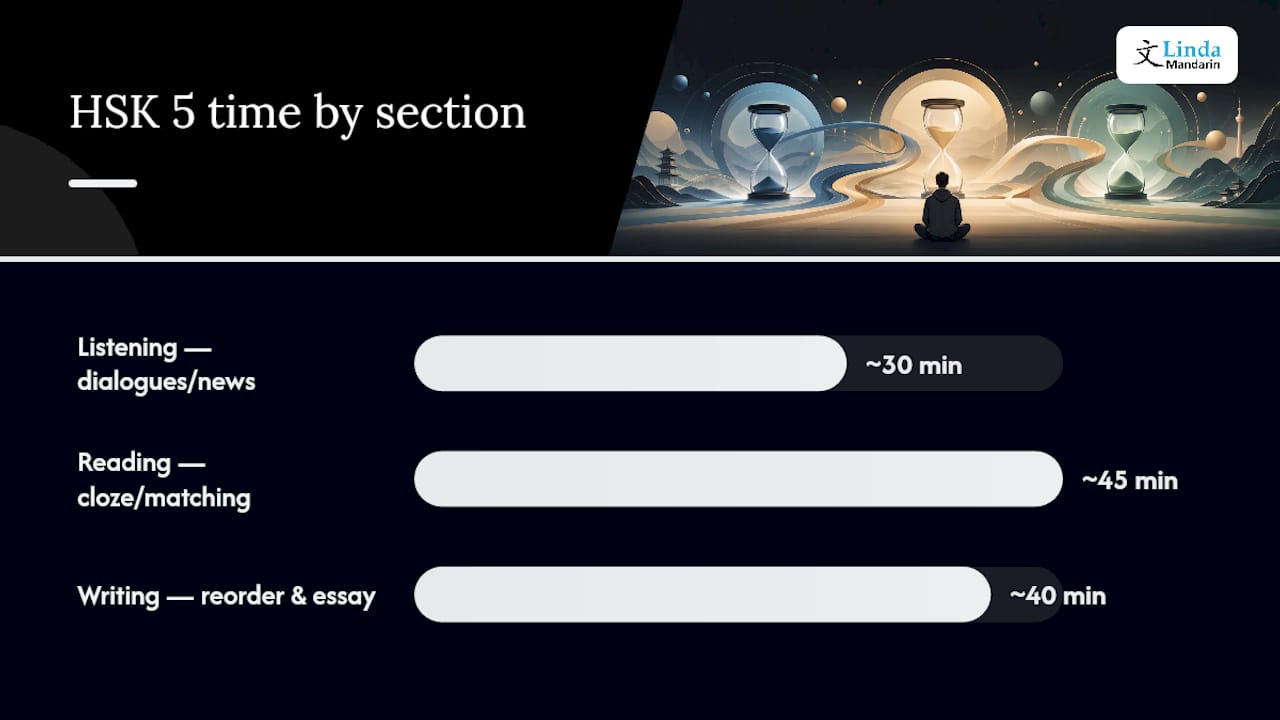
Total: ~125 minutes. Passing score: 180/300.
The vocabulary requirement sits at roughly 2,500 cumulative words across HSK levels 1–5 combined. That cumulative framing matters: you are not memorizing 2,500 new words from scratch; you are building on what you already know from earlier levels and filling the gaps. HSK 3.0 trial formats may add a speaking component for certain test administrations, but the standard format tested at most centers remains Listening, Reading, and Writing.
The writing section is where many learners lose points they should not. The writing tasks include 8 sentence-reordering items and 2 short compositions, each expecting roughly 80 characters of coherent, structured prose under time pressure. That is a skill you must practice, not just understand.
How long does it realistically take to prepare for HSK 5?
Your timeline depends on two numbers: your current mock score and your weekly study hours. A commonly cited planning heuristic is roughly 2–3 study hours per point of improvement needed. Use it as a starting estimate, then adjust after your first real mock.
Worked example: You score 130 on a baseline mock. You need 180 to pass, so your gap is 50 points. At 2.5 hours per point, that is approximately 125 hours of focused study. At 10 hours per week, that is 12–13 weeks. At 5 hours per week, it is 25 weeks. At 3 hours per week, it stretches to 40+ weeks.
Those numbers assume consistent, focused practice, not passive review. Skill-gap planning sharpens the estimate further: if your listening score is already near passing but your writing is 30 points short, allocate proportionally more hours to writing, not an even split.
Progress-check rule: Retest every 4 weeks on the intensive plan, every 6 weeks on the balanced plan, and every 8 weeks on the long-term plan. If a skill is not moving, reallocate time from your stronger section to the weak one before the next checkpoint.
Three copy-ready week-by-week study schedules
12-week intensive plan (10+ hours/week)
This plan follows a disciplined daily routine with clear weekly micro-goals: vocabulary-heavy early weeks, skill-building in the middle, and exam simulation at the end.
- Weeks 1–2: Learn 30–40 new vocabulary items daily using spaced repetition (SRS). Read one short graded passage per day. Take a mini listening quiz every other day.
- Weeks 3–4: Shift to 20 new words daily; add 30 minutes of timed reading practice. Begin listening to native-level audio (news podcasts, short lectures) for 30 minutes daily.
- Weeks 5–6: Introduce weekly writing practice: one sentence-reorder set and one short composition per week. Increase timed reading to 45 minutes daily.
- Weeks 7–8: First full mock test (week 7). Log every error by type. Reallocate study time based on results. Continue SRS for weak vocabulary.
- Weeks 9–10: Two timed reading sessions per day. Daily listening with note-taking. Two writing compositions per week with self-review against model answers.
- Weeks 11–12: Full mock test every five days. Review errors the same day. Final vocabulary sweep of your personal error log.
24-week balanced plan (5–9 hours/week)
- Weeks 1–6: Build vocabulary foundation (15–20 new words daily), light reading, and listening exposure
- Weeks 7–12: Increase reading speed drills; add one writing task per week; begin listening to authentic audio
- Weeks 13–16: First full mock test (week 13); skill rebalancing based on results
- Weeks 17–20: Intensive practice on weakest section; two writing compositions per week
- Weeks 21–24: Full mock every two weeks; daily error review; final vocabulary consolidation
9–15 month long-term plan (2–4 hours/week)
- Months 1–4: 8–10 new vocabulary items daily; one reading passage per week; listening exposure 3 times per week
- Months 5–8: Increase reading to 30 minutes daily; add writing practice every two weeks; first full mock at month 5
- Months 9–12: Monthly full mocks; targeted skill work between mocks; daily SRS maintenance
- Months 13–15 (if needed): Final consolidation, exam simulation, and error-log review
What should each study session actually look like?
The format of your session matters as much as its length. Here are four templates you can copy directly into your calendar.

30-minute session: 15 minutes SRS vocabulary review (Anki or a dedicated HSK deck), 15 minutes timed reading of one short passage.
60-minute session: 20 minutes SRS, 25 minutes timed reading or listening with notes, 15 minutes reviewing errors from the previous session.
90-minute session: 20 minutes SRS, 30 minutes timed reading, 25 minutes listening practice with comprehension questions, 15 minutes writing one sentence-reorder set.
180-minute session: 20 minutes SRS, 45 minutes timed reading (two passages), 45 minutes listening (two audio sets with notes), 30 minutes writing one full composition, 20 minutes error review.
Weekly allocation template (balanced plan, 6 hours/week):
Pro Tip: Set your SRS review session as the first thing you do each study day, before reading or listening. Vocabulary reviewed at the start of a session, when your working memory is fresh, shows stronger retention than vocabulary reviewed at the end.
What are the best resources for HSK 5 preparation?
The right resource depends on your plan type. Here is a prioritized list:
- Official HSK materials: The official HSK 5 practice workbooks and past papers from the Hanban/BLCU Press are non-negotiable. They set the exact question format and difficulty level.
- SRS decks: Anki with a pre-built HSK 5 deck (search “HSK 5 Anki deck” on AnkiWeb) handles vocabulary at scale. Learn collocations and example sentences, not isolated translations.
- Graded readers: Mandarin Companion and Chinese Breeze series bridge the gap between textbook vocabulary and native-level reading. Start here before moving to news sources.
- News and podcasts: ChinesePod (upper-intermediate and advanced levels), Mandarin Corner, and the People’s Daily app expose you to the editorial vocabulary that dominates HSK 5 reading passages. Reading 30–60 minutes daily from graded materials toward native news builds both speed and contextual vocabulary.
- Mock-test banks: HSKMock.com provides timed, full-length practice tests that replicate the current format closely. Run every mock under real conditions: no pausing, no dictionary.
- Writing feedback: A language exchange partner on HelloTalk or a tutor on iTalki can review your compositions. Short, frequent writing with quick feedback produces faster accuracy gains than writing long essays once a month.
For the 12-week plan, prioritize official materials, Anki, and HSKMock.com. For the 6-month and long-term plans, add graded readers and a regular news-reading habit early, since vocabulary depth compounds over time.
Linda Mandarin’s HSK exam preparation courses offer a structured syllabus aligned to the current test format, with instructor feedback on writing and timed mock sessions built into the schedule. That kind of guided structure is worth considering if self-directed practice is stalling your progress.
How should you use mock tests to drive your preparation?
Mock tests are diagnostic tools, not just confidence checks. The cadence: bi-weekly full mocks during the final phase of the intensive plan, monthly full mocks during the balanced plan, and one full mock every 6–8 weeks on the long-term plan. Mini-mocks (one section only, timed) work well after every 2–3 weeks of focused study on a single skill.
How to run a mock test properly:
- Set a timer for the exact section times (30 min listening, 45 min reading, 40 min writing).
- No dictionary, no pausing, no phone.
- Score immediately after finishing.
- Log every wrong answer in an error log before reviewing explanations.
Error log fields to track:
- Question number and section
- Question type (vocabulary, inference, grammar, time management)
- Root cause (unknown word, misread passage, ran out of time)
- Action item (add to SRS, practice that question type, adjust pacing)
Use the 2–3 hours-per-point heuristic to estimate how many sessions that requires, then schedule them before your next mock.
What mistakes do most HSK 5 candidates make?
Common preparation errors:
- Studying vocabulary in isolation instead of in sentence context. HSK 5 tests whether you can use words, not just recognize them.
- Skipping timed reading practice. Reading 45 questions in 45 minutes is a skill that requires deliberate speed training, not just comprehension.
- Neglecting writing structure. Many learners can write grammatically but produce compositions that lack a clear topic sentence and logical flow. The exam rewards structure.
- Treating mock tests as assessments rather than training tools. A mock you do not analyze in detail is a wasted three hours.
- Cramming vocabulary in the final week instead of consolidating. New words learned in the last seven days rarely stick under exam pressure.
Exam-day checklist:
- Valid ID (passport or national ID accepted at most centers)
- Pencils and eraser (check your test center’s specific requirements)
- Arrive 30 minutes early
- Warm up with 5 minutes of light reading in Chinese before entering the exam room
- Time allocation plan: do not spend more than 1 minute per reading question; flag and return to difficult items
One-sentence pacing rule: If you cannot answer a question in 60 seconds, mark your best guess, flag it, and move on — unanswered questions score zero, but a flagged guess can be revisited if time allows.
You can find additional HSK test-performance tips that address pacing and section-specific strategy in more detail.
When does a guided course make more sense than self-study?
Self-study works well when you have consistent daily discipline, access to quality materials, and a reliable way to get writing feedback. When any of those three break down, a structured course closes the gap faster than willpower alone.
Signs you should consider enrolling in a course:
- Your mock scores have plateaued for two consecutive checkpoints
- You are unsure whether your written compositions are grammatically and structurally correct
- You are struggling to stay consistent without external accountability
- You are preparing on a tight timeline (12 weeks or less) and cannot afford to waste study sessions on the wrong material
A focused HSK 5 prep course delivers several things self-study rarely replicates efficiently: a structured syllabus that sequences skills in the right order, instructor feedback on writing compositions, timed mock sessions with post-test analysis, and targeted correction of recurring errors rather than general review.
Linda Mandarin has been offering structured Mandarin courses for adult learners since 2003. Its HSK preparation program follows a syllabus aligned to the current exam format, with experienced native-speaking instructors who provide direct feedback on writing tasks. Classes are available in-person at 10 Anson Road, Level 22, International Plaza, Singapore 079903 (right above Tanjong Pagar MRT), and online via Zoom for learners who prefer flexible scheduling. You can review the full range of adult Mandarin programs to find the format that fits your schedule.
Does speaking practice help even though HSK 5 does not test it?
Yes, and the mechanism is practical rather than theoretical. Speaking forces you to retrieve vocabulary actively, which strengthens the same retrieval pathways that reading comprehension and writing depend on. Learners who speak regularly tend to internalize grammar patterns faster than those who only read and listen.
Specific techniques that transfer directly to HSK 5 skills:
Shadowing: Listen to a native-level audio clip, then repeat it aloud immediately, matching the speaker’s rhythm and intonation. This builds listening accuracy and trains your ear to parse fast speech, which directly improves listening section performance.
Read-aloud practice: Read a news article or graded reader passage aloud at normal speed. When you stumble on a word or phrase, that is a vocabulary gap to add to your SRS deck. This technique surfaces weak spots faster than silent reading.
Structured output: Summarize what you just read or listened to in spoken Chinese, without notes. Keep it to 60–90 seconds. This forces you to use the vocabulary and grammar structures you have been studying in a production context, which deepens retention.
Language exchange: A weekly 30-minute conversation session with a native speaker on HelloTalk or Tandem gives you real-time feedback on pronunciation and fluency. It also exposes you to natural sentence patterns that appear in HSK 5 reading passages.
Speaking practice does not need to be a separate, formal activity. Fold it into existing sessions: shadow after listening practice, read aloud before writing practice, summarize after reading. Fifteen minutes of active speaking per session adds up to meaningful fluency gains over a 12–24 week plan.
One thing most HSK 5 guides get wrong
Most guides treat the three sections as equally weighted preparation tasks. They are not. Reading is the section where most candidates lose the most points, and it is also the section most responsive to deliberate daily practice. Thirty to sixty minutes of reading every day, moving progressively from graded materials to native news and essays, compounds in a way that vocabulary drilling alone does not.
The other underrated insight: your mock-test error log is more valuable than any textbook. Every wrong answer tells you exactly what to study next. Learners who analyze their errors systematically and convert them into specific study tasks consistently outperform those who simply retake mocks hoping the score will rise.
Start with a baseline mock. Build your plan around the gap. Adjust every four to six weeks based on real data, not intuition.
Linda Mandarin’s structured HSK 5 preparation
Passing HSK 5 on a self-study plan is achievable, but the writing section and timed reading drills are genuinely harder to improve without feedback. Linda Mandarin’s HSK preparation courses are built specifically for adult learners who want a structured path to the exam, with instructor-reviewed compositions, timed mock sessions, and a syllabus that sequences vocabulary, reading, and writing in the right order.

Classes run in-person in Singapore’s central business district and online via Zoom, so your schedule does not have to change to fit the course. If you are within 12 weeks of your exam date or your mock scores have stalled, enrolling in a focused prep course is the most direct route to closing the gap. Visit the Mandarin course details page to review program options and find a schedule that fits.
Sources
- HSK Level 5 Complete Guide 2026: Format, Vocabulary and Preparation
- How to create a 12-week HSK study plan
- HSK Level 5 – Test Preparation: The Complete, Must-Read Guide
- HSK 5 Study Guide: Advanced Chinese | Hanlexon
FAQ
How long does it take to study for HSK 5?
Preparation typically ranges from 12 weeks (10+ hours/week) to 15 months (2–4 hours/week), depending on your starting level and weekly study hours. Use a baseline mock test and the 2–3 hours-per-point rule to calculate a personalized estimate.
How difficult is HSK 5?
HSK 5 is considered upper-intermediate to advanced, requiring roughly 2,500 cumulative vocabulary items and the ability to read editorial-style Chinese and write coherent short compositions under time pressure. Most learners find the timed reading section the hardest to improve quickly.
What is HSK 5 equivalent to?
HSK 5 is broadly equivalent to the B2–C1 range on the Common European Framework of Reference (CEFR), meaning you can read Chinese newspapers, follow native-speed conversations, and communicate fluently on a wide range of topics.
Is HSK 5 enough to be considered fluent?
HSK 5 demonstrates strong functional fluency: you can read, write, listen, and communicate at a level sufficient for most professional and academic contexts in Chinese. Full native-level fluency typically requires continued exposure beyond the exam, but HSK 5 is a widely recognized benchmark for advanced proficiency.