If you know roughly 1,000 words, can hold a basic conversation, and just passed or are close to passing HSK 3, you have one real decision to make: push straight into HSK 4 prep or spend a few more months solidifying what you have. Most intermediate learners should consolidate for six to eight weeks before committing to an HSK 4 exam date, because the vocabulary load doubles and the grammar shifts from simple sentences to connected paragraphs.
You are probably ready to start HSK 4 prep now if you meet most of these:
- You can recognize and use close to 1,000 words without translating in your head first.
- You already use basic connectors like 因为…所以 and 虽然…但是 in speech, not just in recognition drills.
- You can follow slow-to-moderate native audio and catch the main idea without subtitles.
- You can write two or three connected sentences about a daily topic, not just isolated phrases.
If most of that feels shaky, spend four to eight weeks on targeted HSK 3 review before opening an HSK 4 textbook. If it feels solid, start a focused three to six month HSK 4 plan right away.
Key Takeaways
Moving from HSK 3 to HSK 4 requires roughly doubling your vocabulary while shifting from recognition to active production of grammar structures like 把/被 and correlative conjunctions.
| Point | Details |
|---|---|
| Vocabulary nearly doubles | HSK 3 covers about 1,000 words; HSK 4 requires close to 2,000 for a real shot at passing. |
| Structure matters more than word count | Correlative conjunctions, complements, and 把/被 constructions drive paragraph-level writing at HSK 4. |
| Timeline runs 3 to 12 months | Pace depends on weekly hours: 10+ hours accelerates to 3–4 months, 3–4 hours stretches to a year. |
| Diagnose before you commit | A 70% score on a full mock listening test is a reliable readiness signal before booking the real exam. |
| Guided prep closes structural gaps faster | Linda Mandarin’s HSK preparation course pairs diagnostic testing with grammar clinics and full mock exams. |
Table of Contents
- HSK 3 vs HSK 4: The Core Differences at a Glance
- How Does the Exam Format Change From HSK 3 to HSK 4?
- What Do You Actually Need to Improve, Skill by Skill?
- What New Vocabulary Does HSK 4 Actually Add?
- Is HSK 4 Harder Than HSK 3? A Reality Check
- Realistic Timeline: How Long From HSK 3 to HSK 4?
- How Should You Prepare? Materials and Course Options
- Should You Sit HSK 4 Now or Consolidate HSK 3 First?
- How a Structured Course Speeds Up the HSK 3 to HSK 4 Bridge
- An Honest Note on Timing the Jump
- Ready to Move From HSK 3 to HSK 4?
- Sources
- FAQ
HSK 3 vs HSK 4: The Core Differences at a Glance
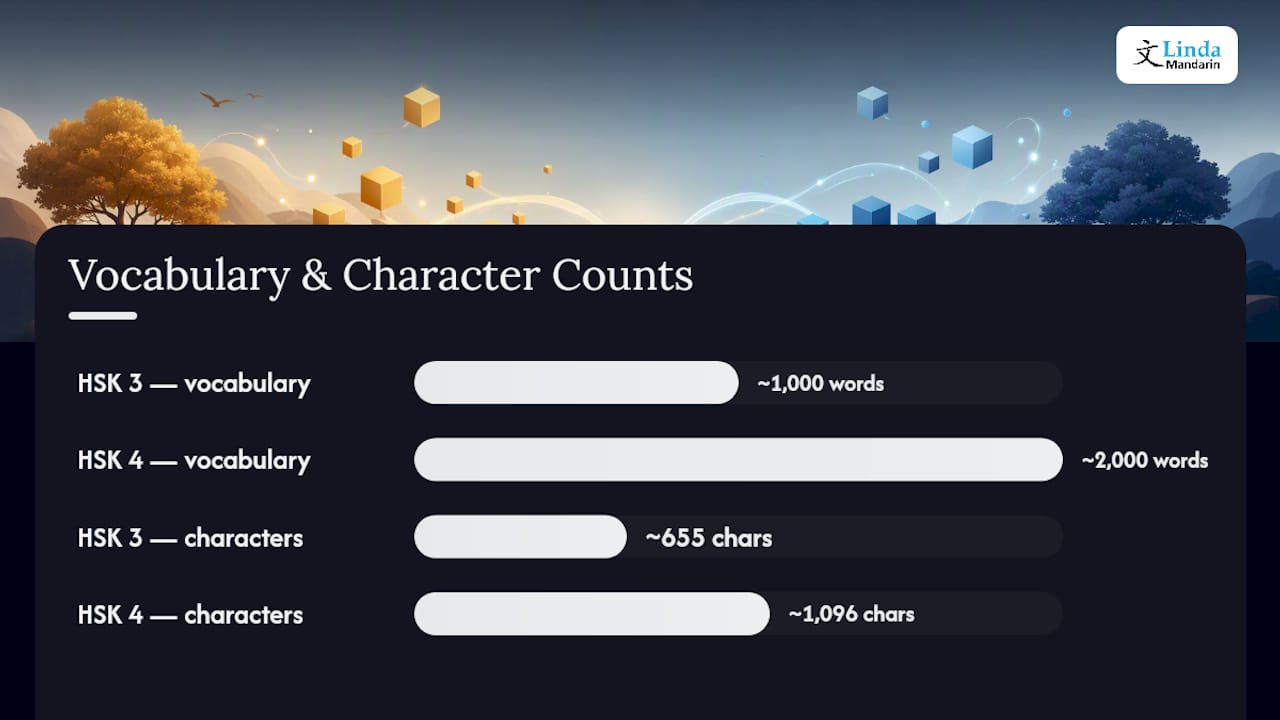
The jump between these two levels is bigger than a single number suggests. HSK 3 covers roughly 1,000 cumulative vocabulary items and 655 recognition characters. HSK 4 nearly doubles that to about 2,000 cumulative words and 1,096 recognition characters, based on figures compiled by China Study Center. On the CEFR scale, HSK 3 sits closer to A2/B1, while HSK 4 maps to roughly B1/B2.
Both levels use the same pass threshold: 180 out of 300 points. But “passing” means something different at each stage.
| Metric | HSK 3 | HSK 4 |
|---|---|---|
| Cumulative vocabulary | ~1,000 words | ~2,000 words |
| Recognition characters | ~655 | ~1,096 |
| CEFR equivalence | A2/B1 | B1/B2 |
| Passing score | 180/300 | 180/300 |
HSK 3 gets you through daily, routine interactions: ordering food, asking directions, small talk with colleagues. HSK 4 is widely treated as the practical threshold for functional independence, the point where you can handle a good chunk of university coursework or workplace conversation in Mandarin, according to Linda Mandarin’s test prep guidance.
One caveat worth flagging: vocabulary counts vary slightly across guides depending on whether they cite the older HSK 2.0 syllabus or newer revisions. The official HSK framework has moved toward a broader, nine-level structure, so always check which version a study list references before you commit to it as your target.
How Does the Exam Format Change From HSK 3 to HSK 4?
The test itself gets longer, faster, and less forgiving. Here’s what shifts structurally:
- Listening: More questions, longer dialogues, and audio that leans on inference rather than direct statement.
- Reading: Passages get longer and denser, with more implied meaning you have to infer from context.
- Writing: HSK 3 asks for word reordering and short sentences. HSK 4 requires picture-based sentence construction plus short paragraph writing.
The listening section is where a lot of learners get caught off guard. HSK 4 audio moves at a more natural pace and leans harder on inference, with less hand-holding through repetition compared to lower levels, according to analysis from Be Chinese. If you’ve gotten used to catching every word on a second pass, HSK 4 forces you to extract meaning the first time through.
What Do You Actually Need to Improve, Skill by Skill?
Each skill demands a different kind of effort as you move up, and lumping them together is how a lot of study plans go sideways.
Listening at HSK 4 asks for faster processing and stronger inference. You’re no longer just matching sounds to words. You’re guessing what a speaker means when they don’t say it directly. Daily shadowing practice (repeating audio phrase by phrase, matching rhythm and tone) closes this gap faster than passive listening ever will.

Reading passages get longer and pack in more implied context, so scanning for discourse markers like 但是, 而且, and 因此 becomes a real skill rather than a nice-to-have. Graded readers pitched slightly above your comfort level train this without overwhelming you.
Writing and speaking move from short, isolated sentences to picture-based prompts and short paragraphs. This is arguably the biggest structural leap. You need active command of complements, 把/被 constructions, and connector phrases, not just recognition of them on a multiple-choice test, per Migaku’s HSK 4 breakdown.

Pro Tip: Dictation is underrated for writing prep. Listen to a short native-speed clip, write down exactly what you hear, then compare it character by character against the transcript. It exposes gaps in both listening and character production at the same time.
What New Vocabulary Does HSK 4 Actually Add?
The extra 1,000 or so words at HSK 4 aren’t just more of the same. HSK 3 vocabulary is mostly concrete and situational: food, weather, transportation, simple emotions. HSK 4 adds abstract concepts, discourse connectors, and topic-specific terms tied to work, society, and opinion.
| Word type | HSK 3 example area | HSK 4 example area |
|---|---|---|
| Concrete/daily | Food, transport, weather | Carried forward, less emphasis |
| Abstract concepts | Rare | Attitudes, opinions, comparisons |
| Discourse connectors | Basic (但是, 因为) | Correlative pairs (虽然…但是, 不但…而且) |
| Topic-specific terms | Minimal | Work, society, environment, media |
This shift changes how you should study. Passive recognition (seeing a word and knowing its meaning) got you through HSK 3. HSK 4 tests whether you can produce these words in context, so prioritizing active vocabulary over passive flashcard recognition matters more here than at any earlier stage. Chunk new words by topic (work, opinions, society) rather than studying them alphabetically or randomly, and set your spaced repetition intervals shorter for anything you can’t yet use in a sentence unprompted.
Is HSK 4 Harder Than HSK 3? A Reality Check
Yes, and not by a small margin. The vocabulary doubles, but the harder part is structural: mastering complements, 把/被 constructions, and correlative conjunctions well enough to string them into coherent paragraphs rather than isolated sentences, according to Elon.io’s breakdown of the HSK 3 to HSK 4 transition.
Common mistakes that slow learners down:
- Memorizing word lists without ever producing the words in a sentence.
- Avoiding 把 and 被 constructions because they feel awkward, instead of drilling them until they’re automatic.
- Under-training discourse markers, so writing reads as disconnected sentences instead of a paragraph.
Most learners underestimate HSK 4 because they’re comparing word counts, not skill demands. Doubling your vocabulary matters less than learning to connect three sentences into one coherent thought. That’s the actual test.
Experts consistently warn against skipping foundational review: HSK is cumulative, and gaps from HSK 3 tend to resurface and cause failure at HSK 4, not the new material itself.
Realistic Timeline: How Long From HSK 3 to HSK 4?
Study guides generally put the transition at six to twelve months of regular study for most learners, with an accelerated three to four month path available for those studying intensively, per estimates from HanziFeed. Your pace depends on hours per week, not just calendar months.
- Accelerated (3–4 months): 10–12 hours weekly. Suited to learners with flexible schedules or those in intensive courses.
- Steady (6–9 months): 5–7 hours weekly. The most common path for working adults balancing a job.
- Conservative (9–12 months): 3–4 hours weekly. Realistic for learners fitting study around a demanding schedule.
A sample steady plan might look like this:
- Months 1–2: Consolidate HSK 3 gaps, start learning the first 300 new HSK 4 words in topic chunks.
- Months 3–4: Introduce grammar frames (把/被, complements, correlative conjunctions); daily shadowing for listening.
- Months 5–6: Shift to paragraph writing practice; weekly timed listening mock tests.
- Months 7–8: Full mock exams under timed conditions; targeted review of weak sections.
If yes to all three, you’re ready to schedule.
How Should You Prepare? Materials and Course Options
Effective HSK 4 prep leans on a mix of official material and structured production practice, not just vocabulary apps.
- Official HSK vocabulary lists and syllabus documents from Chinesetest for the exact word and grammar scope.
- Graded readers slightly above your current level to build reading stamina without frustration.
- Full-length mock test banks, timed under real exam conditions, not done casually.
- Spaced repetition apps set to prioritize production, not just recognition.
- Intensive course formats that replicate exam timing and include structured grammar clinics for complements and connector structures.
When evaluating a course or self-study plan, check that it includes diagnostic assessment before you start, dedicated writing feedback (not just answer keys), and full-length timed mocks, not just chapter quizzes.
Pro Tip: If a course only tests recognition through multiple choice, it won’t prepare you for HSK 4’s writing section. Ask specifically how much production practice (writing full sentences, speaking prompts) is built into the syllabus before enrolling.
For adult learners in Singapore who want structured, guided prep rather than self-study, Linda Mandarin’s HSK preparation course builds this production practice directly into the syllabus.
Should You Sit HSK 4 Now or Consolidate HSK 3 First?
Answer these six questions honestly:
- Do you know close to 1,800–2,000 cumulative words, including topic-specific and abstract vocabulary?
- Can you write a short paragraph (three to four connected sentences) without help?
- Can you follow native-speed audio and grasp the main idea without repeats?
- Do you use 把/被 constructions and correlative conjunctions in speech, not just recognize them?
- Have you scored 70% or higher on a full-length HSK 4 practice test?
- Do you have at least three months before any real-world deadline (job, university) tied to the exam?
5 to 6 “yes” answers: Schedule the exam and start focused mock testing weekly.
3 to 4 “yes” answers: Run a targeted two to three month prep sprint on your weak areas before booking.
0 to 2 “yes” answers: Spend more time consolidating HSK 3 vocabulary and grammar before opening HSK 4 material.
How a Structured Course Speeds Up the HSK 3 to HSK 4 Bridge
Self-study works, but the structural leap from HSK 3 to HSK 4 (paragraph writing, faster listening, correlative grammar) is exactly where guided feedback saves months. Linda Mandarin’s HSK preparation track builds in diagnostic testing, targeted grammar clinics, and full mock exams rather than leaving you to guess which gaps matter most.
| Learner need | Course support feature |
|---|---|
| Faster listening comprehension | Weekly timed listening mocks at native speed |
| Paragraph-level writing | Structured writing feedback, not just answer keys |
| Active vocabulary production | Speaking and writing drills, not recognition-only review |
| Grammar gaps (把/被, complements) | Dedicated grammar clinic sessions |
Course formats include in-person group classes, private one-on-one sessions, and online Zoom options for learners who need flexibility around work schedules.
An Honest Note on Timing the Jump
Most learners I see stall not because HSK 4 material is too hard, but because they start it before HSK 3 grammar is automatic. If 把 sentences still feel like a puzzle you have to solve rather than something you say without thinking, that gap will show up under exam pressure.
Run a real diagnostic test before you pick an exam date. It costs you an hour and saves you months of studying the wrong things.
Ready to Move From HSK 3 to HSK 4?
Linda Mandarin runs a free diagnostic assessment for adult learners, so you know exactly where your HSK 3 foundation has gaps before you commit to an HSK 4 timeline. It’s a faster way to plan than guessing from a vocabulary list alone.

Course formats are built around how adults actually study: online Zoom sessions for learners juggling work hours, small group classes for peer accountability, and private lessons for a fully customized pace. Corporate training is also available for teams preparing for Mandarin proficiency milestones tied to their roles.
Located right above Tanjong Pagar MRT at 10 Anson Road, Level 22, International Plaza, the school has run structured Mandarin training for adults since 2003. If you’re ready to close the gap between HSK 3 and HSK 4, check out the HSK preparation course details and book a diagnostic session to map your starting point.
Sources
- Chinesetest
- HSK Levels Explained: Complete Guide to All 9 Levels | China Study Center
- HSK 4 guide: complete exam preparation | Migaku
- HSK 4 syllabus: topics, tasks, and grammar | HSKStory
FAQ
Is HSK 4 Considered Fluent?
No. HSK 4 signals functional independence, meaning you can handle routine work and study conversations, but it falls short of the nuance and speed typically associated with fluency.
Is HSK 4 Impressive on a Resume or Application?
Yes, in most academic and professional contexts. HSK 4 is commonly treated as the practical minimum for university admission or workplace roles requiring conversational Mandarin.
Is HSK 3 Hard to Pass?
Not for learners who have studied consistently for several months. HSK 3 tests basic daily communication, and most learners who prepare adequately pass comfortably.
Is It Hard to Get HSK 4?
It’s a meaningful step up from HSK 3, mainly because of the shift from short sentences to paragraph-level writing and faster listening. Learners who consolidate HSK 3 grammar first, rather than rushing in, generally find the transition manageable within three to nine months.