HSKK is the official, recorded Chinese speaking test, separate from the written HSK exam, with three levels: Beginner (初级), Intermediate (中级), and Advanced (高级). Scoring runs on a 0 to 100 scale, and a score of 60 counts as a pass at every level. Results typically arrive about one month after your test date, and certificates are commonly accepted for two years by universities and employers, though you should always confirm that window with the institution requesting it. You register through the official Chinese Test Service portal or an authorized local test center.
A few things worth knowing before you book a seat:
- HSKK has no live examiner. You speak into a recording device, and raters score the audio afterward.
- The three levels are not tied one-to-one with HSK numbers. Vocabulary expectations, not test names, decide which one fits you.
- You must register for HSKK separately from HSK. Passing the written exam does not enroll you in the speaking test.
Key Takeaways
Passing HSKK at any level requires a 60 out of 100 score, timed practice under real test conditions, and registration through an official test center 4 to 6 weeks before your target date.
| Point | Details |
|---|---|
| Three levels, one pass mark | Beginner, Intermediate, and Advanced all require a score of 60 out of 100 to earn a certificate. |
| Format gets longer, not just harder | Beginner runs 17 to 20 minutes with 27 items; Advanced runs 24 to 25 minutes with just 6 items. |
| Results take about a month | Certificates are commonly valid for two years for admissions, but confirm with the receiving institution. |
| Register early for prep time | Book through the Chinese Test Service or an authorized center, allowing 4 to 6 weeks to prepare. |
| Timed mocks beat casual practice | Recording weekly mock tests under exact prep and speaking windows catches tone and pacing problems early. |
Table of Contents
- HSKK Levels and Test Format Explained
- What Does an HSKK Score Actually Mean?
- How Do I Register for the HSKK Test?
- How Should You Prepare for the HSKK Speaking Test?
- Why Structured Classes Improve HSKK Scores
- What I’d Tell Anyone Studying for HSKK
- Where to Confirm HSKK Format and Registration Details
- Sources
- FAQ
HSKK Levels and Test Format Explained
Each HSKK level has three parts, and the jump in difficulty between them is bigger than most first-time test takers expect. Here’s what actually happens in the room.
Beginner (初级) targets learners with roughly 200 spoken words in their active vocabulary, according to Confucius Institute level guidance. The test runs about 17 to 20 minutes total, including prep windows, and covers three parts across roughly 27 items:
- Listen and repeat. You hear a short sentence, then repeat it aloud. This section has the most items and rewards clean pronunciation over speed.
- Listen and answer. A short question plays, and you give a brief spoken reply, usually just a phrase or a sentence.
- Answer questions. You get two prompts and need to build a response of roughly five sentences each, drawing on daily-life topics like family, weather, or routines.
Intermediate (中级) assumes around 900 spoken words and runs about 21 to 23 minutes with 14 items total. The format shifts:
- Listen and repeat, similar to Beginner but with longer, more complex sentences.
- Picture description. You’re shown two images and describe each one within a set speaking window, which tests narrative structure as much as vocabulary.
- Answer questions. Prompts move into more abstract territory, opinions, comparisons, plans, and expect fuller, more connected answers.
Advanced (高级) targets learners near 3,000 spoken words and runs about 24 to 25 minutes with just 6 items, because each task takes far longer to complete. Task types here include listening to a short passage and retelling it, reading a passage aloud, and answering open-ended questions that require you to build and defend a position.
The prep window matters as much as the speaking window. Before most tasks, you get a short block of silent time to think, sometimes just a few seconds, sometimes closer to a minute for Advanced retell tasks. Use it badly and you’ll freeze once recording starts.
Pro Tip: Practice speaking into a phone voice memo instead of talking to yourself in your head. The moment you hear your own recorded voice, tone problems and awkward pauses become obvious in a way silent rehearsal never reveals.
What Does an HSKK Score Actually Mean?
A passing HSKK score is 60 out of 100, and that threshold holds across Beginner, Intermediate, and Advanced. There’s no sliding scale by level. The bar is fixed, and the difficulty of the test itself is what changes.
Results are usually available about one month after your test date, though the exact reporting method depends on your test center; some post scores online, others mail printed certificates. Universities, scholarship committees, and employers widely accept HSKK results as proof of spoken proficiency, and many ask for results dated within two years of the application deadline. Always check that window with the specific institution, since practices vary.
- Score 60 or above: you receive a certificate for that level.
- Score below 60: you get your numeric result, but no certificate for that sitting.
- No penalty for retaking: you can register again for the same level whenever you’re ready.
A score of 60 is the line between a certificate and a numeric result you can’t use for admissions. That’s a meaningful gap for anyone applying to a program on a deadline, which is exactly why timed practice matters more than casual conversation practice in the weeks before your test.
How Do I Register for the HSKK Test?
Booking a seat is straightforward, but the details that trip people up are almost always logistical, not academic.
- Choose HSKK, your level, and a test date. Pick a date that gives you 4 to 6 weeks of focused prep if you’re starting from scratch.
- Upload a photo and pay the fee. Public guides commonly cite ballpark figures around 200 RMB for Beginner, 400 RMB for Intermediate, and 600 RMB for Advanced, but fees and currency vary by center, so confirm the exact amount locally before you pay.
- Confirm refund and reschedule policies before you commit to a date, especially if your schedule might shift.
- On test day, bring valid ID, arrive early, and ask ahead whether the center provides recording equipment or expects you to bring your own headset. Every center has its own rules on what you can bring into the test room, so check in advance rather than assume.
How Should You Prepare for the HSKK Speaking Test?
Reading Chinese and speaking it under a timer are different skills, and HSKK tests the second one exclusively. The most useful thing you can do is stop treating prep as “study” and start treating it as rehearsal for a very specific, timed performance.
Run weekly full mock tests using the exact prep and speaking windows for your level. A stopwatch and a voice recorder are the only tools you need. For Beginner drills, focus on listen-and-repeat accuracy: play a native audio clip, repeat it, then compare your recording against the original for tone and rhythm. For the short-answer section, build two or three flexible phrase templates you can adapt to almost any daily-life prompt, so you’re not building sentences from scratch under pressure.

Intermediate picture description rewards structure over creativity. Train yourself to open with a one-line summary, add three specific details, and close with a wrap-up line, timed to fill your speaking window without running short or rambling past it.
Advanced tasks demand more from your prep window than your speaking window. Practice outlining a retell or an argument in the first 10 to 15 seconds of silent time, then speaking from that outline rather than improvising as you go.
Tone flattening under pressure, not vocabulary gaps, is the most common reason capable speakers lose marks on HSKK. Recording every practice run and listening back for pitch and pacing catches this early, before it becomes a habit that shows up on test day.
Pro Tip: Add one tutor-led mock test per week starting about three weeks before your exam date. Self-recording catches obvious errors, but a second set of ears catches the subtle tone and pacing issues you’ve stopped hearing in your own voice.
Why Structured Classes Improve HSKK Scores
Com has run Mandarin courses in Singapore since 2003, built on a syllabus aligned with international HSK standards and taught by native instructors fluent in English. That structure matters for HSKK specifically, because self-study tends to miss the exact things raters penalize most.
- Routine timed mocks catch pacing problems that silent study never reveals.
- Tone correction from a live teacher fixes the flattening that creeps in under exam pressure, something a recording app alone can’t diagnose.
- Feedback on recorded answers mirrors exactly how HSKK raters will hear you.
Small-group classes build conversational fluency for Beginner and Intermediate learners, private lessons target tone and retell work for Advanced candidates, and online Zoom sessions offer flexible mock scheduling for anyone juggling a work calendar. Match the format to how many mocks and how much correction you actually need before test day.
What I’d Tell Anyone Studying for HSKK
Record every mock, then fix one issue at a time. Chasing pronunciation, pacing, and vocabulary all at once just scatters your effort. Train tone and stamina under a real timer, not in quiet, unpressured study sessions where nothing forces you to think fast. And be patient with slow progress. Small daily speaking reps add up faster than they feel like they do in the moment.
Where to Confirm HSKK Format and Registration Details
- Chinese Test Service for official registration and test calendars
- The Overall HSKK Guide for level-by-level timing breakdowns
- Com’s HSK Test Preparation Course for structured, guided practice
Sources
- The Overall HSKK (Chinese Speaking Test) Guide
- HSKK levels (Confucius Institute)
- HSK/HSKK proficiency tests (University of Sheffield / Confucius Institute)
FAQ
Is HSKK Harder Than HSK?
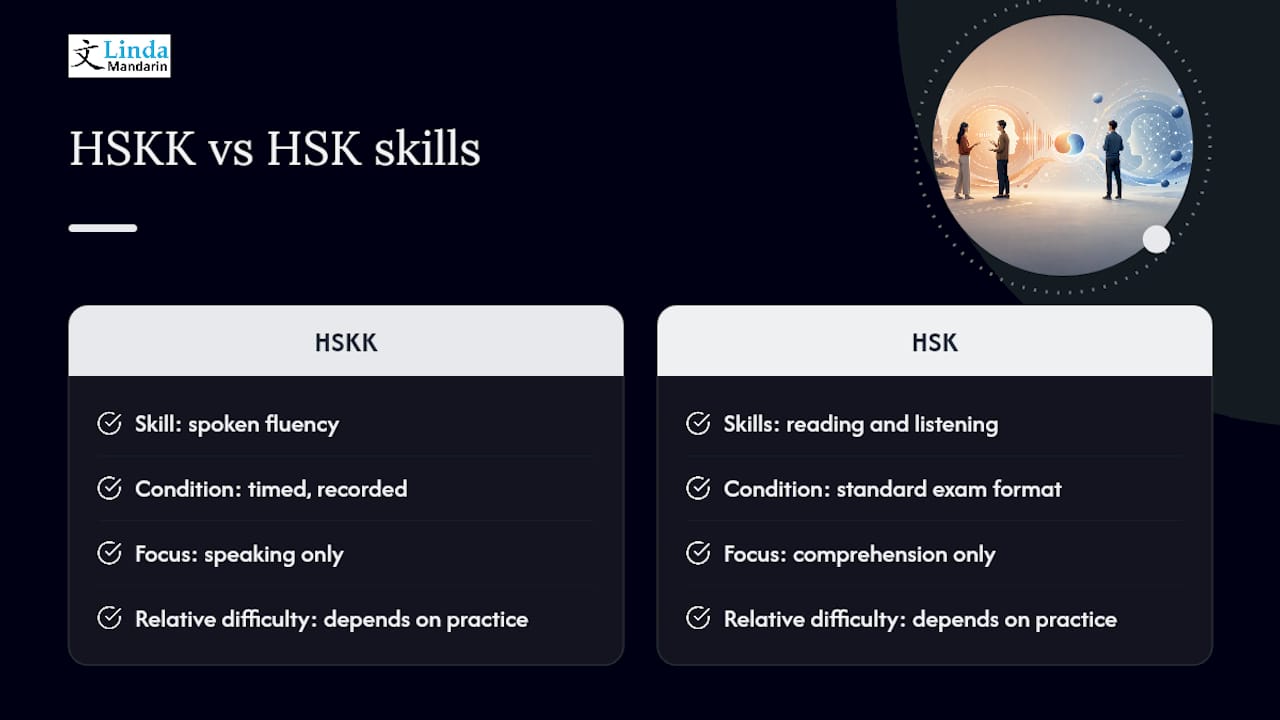
They test different skills entirely. HSK measures reading and listening comprehension, while HSKK measures spoken fluency under timed, recorded conditions, so “harder” depends on which skill you’ve practiced less.
Can I Take HSKK Without Taking HSK First?
Yes. HSKK is a standalone test with its own registration, and you don’t need an HSK result to sign up for any HSKK level.
How Long Are HSKK Results Valid?
Certificates are commonly accepted for two years for university admissions and scholarship applications, though you should confirm the exact requirement with the institution you’re applying to.
What Happens if I Score Below 60 on HSKK?
You receive your numeric score, but no certificate is issued for that sitting. You can register again for the same level at any future test date.
Which HSKK Level Should I Choose First?
Match your level to your active spoken vocabulary: roughly 200 words for Beginner, 900 for Intermediate, and 3,000 for Advanced, rather than the HSK level you’ve studied on paper.