Mandarin measure words (量词, liàngcí) are the small words you must place between a number or demonstrative and a noun, following the pattern Number + Measure Word + Noun. In “三本书” (sān běn shū), “three books,” 本 (běn) is the measure word that makes the phrase grammatical. When you’re unsure which one to use, 个 (gè) works as a safe general-purpose default, though picking the specific classifier makes your Mandarin sound far more natural.
TL;DR:
- Learning the most common classifiers like 个, 本, 张, 条, 只, and 辆 covers over 90% of everyday Mandarin conversations.
- Classifiers are chosen based on physical or functional properties, such as shape, size, or container type, which guides correct pairing.
- Mistakes like omitting measure words or using the wrong classifier happen frequently but follow predictable patterns, making targeted practice effective.
- Memorizing noun-classifier collocations instead of isolated words improves recall and natural use during real conversations.
- Focused, short daily practice with real objects and spontaneous speaking accelerates confidence and helps internalize measure word patterns faster.
Table of Contents
- What Are Mandarin Measure Words and Why Does the Structure Matter?
- The Most Common Chinese Measure Words Beginners Should Learn First
- How to Match a Noun to the Right Measure Word
- Grammar Rules That Trip Up Even Careful Learners
- Eight Mistakes Learners Make With Chinese Measure Words
- How to Practice Measure Words So They Actually Stick
- How Linda Mandarin Teaches Measure Words in Adult Classes
- Where Measure Words Actually Came From
- Do Measure Words Change Across Chinese Dialects?
- How Mandarin Classifiers Compare to Japanese and Korean Counters
- Why Culture Shapes Which Measure Word Gets Used
- Measure Words Beyond Basic Counting
- Spotting Measure Words in Real Mandarin Conversations and Text
- The Fastest Path From Zero to Confident Classifier Use
- Practice Measure Words With Real Feedback, Not Just Flashcards
- Sources
- FAQ
What Are Mandarin Measure Words and Why Does the Structure Matter?
Every language counts things differently, and Mandarin does it through classifiers instead of plurals. English speakers say “three books” and move on. Mandarin speakers need a connector word between the number and the noun, and that connector isn’t optional the way an article like “the” sometimes is in English. Skip it, and the sentence sounds broken to a native ear, not just informal.
Linguists split these words into two camps: count-classifiers and mass-classifiers. Count-classifiers pair with nouns that are naturally discrete, things you can point at and count one by one, like 本 for books or 张 for flat sheets. Mass-classifiers work more like English measure phrases such as “a cup of” or “a slice of,” and they show up with 杯 (bēi, cup) or 片 (piàn, slice). Both types slot into the exact same grammatical position, right between the number and the noun, even though the reasoning behind each differs. Linguistic research on classifiers confirms this shared syntactic behavior despite the semantic split.
Here’s the core pattern spelled out with real examples:
- Number + Measure Word + Noun: 一张纸 (yī zhāng zhǐ) — “one sheet of paper”
- Demonstrative + Measure Word + Noun: 这本书 (zhè běn shū) — “this book”
- Number + Measure Word + Adjective + Noun: 三只可爱的猫 (sān zhī ke’ài de māo) — “three cute cats”
- Demonstrative + Number + Measure Word + Noun: 那两个人 (nà liǎng gè rén) — “those two people”
Notice that the adjective slides in after the measure word, not before it. That order trips up a lot of English speakers who instinctively want to say “cute three cats.”
There’s also a set of situations where you drop the measure word entirely. Bare nouns show up in general statements, proverbs, and some fixed expressions: “我喜欢书” (WO xǐhuān shū, “I like books”) needs no classifier because you’re not counting anything specific. The moment you attach a number, though, the measure word comes back. And when a speaker genuinely doesn’t know or doesn’t care which specific classifier fits, 个 (gè) fills the gap. Native speakers do this constantly in casual conversation, a habit called classifier neutralization, and it’s one reason gè shows up more often in speech than any dictionary count would suggest.
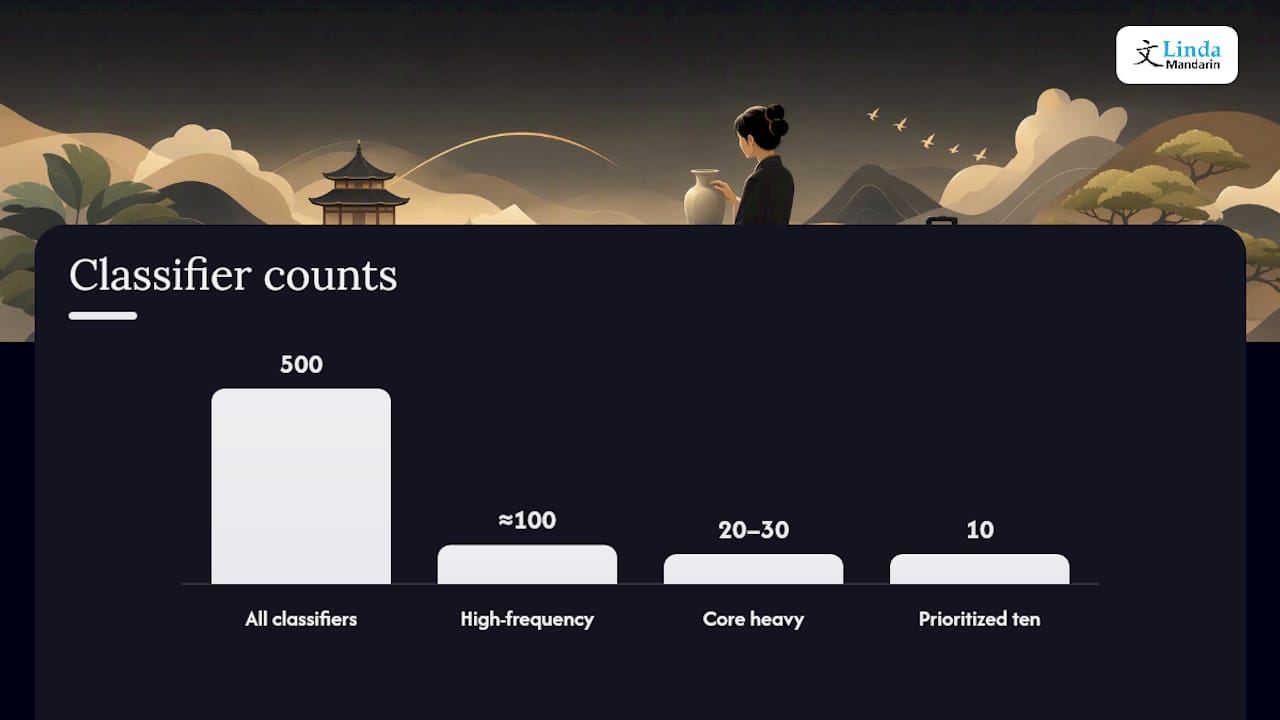
Linguists estimate Mandarin has somewhere between 420 and 500 or more classifiers in total, though a beginner realistically only needs a fraction of that to sound competent. That’s the good news buried in an intimidating number: you’re not memorizing 500 words, you’re memorizing maybe 20 to start.
The Most Common Chinese Measure Words Beginners Should Learn First
You don’t need all 500 classifiers to hold a real conversation. A core set of roughly 100 high-frequency measure words covers the overwhelming majority of daily speech, and within that set, about 20 to 30 do the heaviest lifting. Below is a working list organized by how often you’ll actually reach for each one.
| Character | Pinyin | Used For | Example Phrase |
|---|---|---|---|
| 个 | gè | general/people/objects | 一个人 (yī gè rén) — one person |
| 本 | běn | bound books, magazines | 两本书 (liǎng běn shū) — two books |
| 张 | zhāng | flat objects, paper, tickets, tables | 三张纸 (sān zhāng zhǐ) — three sheets of paper |
| 条 | tiáo | long, flexible objects, rivers, roads | 一条鱼 (yī tiáo you) — one fish |
| 只 | zhī | small animals, one of a pair | 一只猫 (yī zhī māo) — one cat |
| 头 | tóu | large livestock | 一头牛 (yī tóu NIU) — one cow |
| 辆 | liàng | vehicles with wheels | 一辆车 (yī liàng Che) — one car |
| 台 | tái | machines, appliances, electronics | 一台电脑 (yī tái diànnǎo) — one computer |
| 件 | jiàn | clothing (upper body), items, matters | 一件衣服 (yī jiàn yīfu) — one piece of clothing |
| 双 | shuāng | pairs (shoes, chopsticks) | 一双鞋 (yī shuāng xié) — one pair of shoes |
| 把 | bǎ | objects with handles | 一把伞 (yī bǎ San) — one umbrella |
| 支 | zhī | slender objects, pens | 一支笔 (yī zhī Bi) — one pen |
| 杯 | bēi | cups of liquid | 一杯茶 (yī bēi cha) — one cup of tea |
| 瓶 | píng | bottles | 一瓶水 (yī píng shuǐ) — one bottle of water |
| 碗 | wǎn | bowls of food | 一碗面 (yī wǎn miàn) — one bowl of noodles |
| 份 | fèn | portions, copies, sets | 一份报纸 (yī fèn bàozhǐ) — one copy of a newspaper |
| 位 | wèi | people (polite/respectful) | 三位老师 (sān wèi lǎoshī) — three teachers |
| 家 | jiā | families, businesses, shops | 一家公司 (yī jiā gōngsī) — one company |
| 间 | jiān | rooms | 一间房 (yī jiān fáng) — one room |
| 座 | zuò | large, fixed structures (buildings, mountains) | 一座山 (yī zuò shān) — one mountain |
| 幅 | fú | paintings, scrolls | 一幅画 (yī fú huà) — one painting |
| 篇 | piān | articles, essays | 一篇文章 (yī piān wénzhāng) — one article |
| 场 | chǎng | events, performances, matches | 一场电影 (yī chǎng diànyǐng) — one movie showing |
| 群 | qún | groups, crowds | 一群人 (yī qún rén) — a group of people |
| 套 | tào | sets, suites | 一套房子 (yī tào fángzi) — one apartment |
| 片 | piàn | slices, flat thin pieces | 一片面包 (yī piàn miànbāo) — one slice of bread |
| 颗 | kē | small round objects, seeds | 一颗糖 (yī kē táng) — one piece of candy |
| 朵 | duǒ | flowers, clouds | 一朵花 (yī duǒ huā) — one flower |
If you’re starting from zero, prioritize the first ten rows: 个, 本, 张, 条, 只, 辆, 台, 件, 双, and 把. These cover people, books, flat objects, animals, vehicles, machines, clothing, and tools, which means they’ll come up in nearly every conversation about daily life or work. Learner reference guides that group classifiers by everyday use consistently point to this same core cluster as the highest return on study time.
One practical shortcut worth knowing: in relaxed conversation, native speakers often substitute 个 for a more specific classifier when they’re speaking quickly or the correct word slips their mind. You’ll hear “一个车” instead of “一辆车” in casual speech, even though it’s technically imprecise. That’s a safety net for you as a learner too, not a rule to lean on permanently, but a way to keep talking instead of freezing mid-sentence.
How to Match a Noun to the Right Measure Word
Once you get past memorizing individual pairs, a pattern emerges. Chinese classifiers aren’t random. They track a physical or functional property of the noun: shape, rigidity, whether it comes in a pair, or how it’s packaged. Learning to see that logic turns classifier selection from rote memorization into an educated guess, even for words you’ve never seen before.
Here’s the mapping logic broken into the categories that matter most:
- Flat objects use 张 (zhāng). Paper, tickets, tables, beds, maps, anything with a broad, flat surface.
- Long, flexible objects use 条 (tiáo). Fish, snakes, rivers, roads, pants, anything that’s linear and can bend or stretch.
- Bound printed materials use 本 (běn). Books, magazines, dictionaries, notebooks, basically anything with pages bound together.
- Small animals use 只 (zhī); large livestock use 头 (tóu). Cats, dogs, and birds take 只; cows and pigs take 头 because of their size and traditional farming context.
- Vehicles with wheels use 辆 (liàng). Cars, bicycles, trucks. Anything that rolls.
- Machines and appliances use 台 (tái). Computers, televisions, washing machines, printers.
- Containers borrow the container’s name. A cup of tea is 一杯茶; a bottle of water is 一瓶水. The classifier literally is the container.
- Items that come in twos use 双 (shuāng). Shoes, chopsticks, gloves, anything sold or used as a matched pair.
- Clothing for the upper body uses 件 (jiàn). Shirts, jackets, coats.
- Groups and collections use 群 (qún) or 套 (tào). A crowd of people, a flock of birds, or a matched set like furniture or dishware.
Try this quick exercise before moving on: without checking the table above, guess the classifier for 桌子 (table), 狗 (dog), 电视 (television), 裤子 (pants), and 报纸 (newspaper). If you guessed 张, 只, 台, 条, and 份, you’re already thinking in the right categories.
Some nouns resist a single answer because they can be described by more than one property. A newspaper can take 份 (as a set or issue) or 张 (if you’re referring to a single physical sheet). A word like 花 (flower) usually pairs with 朵 for an individual bloom but could shift with context. This isn’t the language being inconsistent. It’s the same noun being viewed through a different lens depending on what the speaker wants to emphasize.

Pro Tip: Don’t try to memorize classifiers as an isolated list. Learn them attached to their most common noun, like “本书” instead of just “本,” because your brain retains the pairing far better than the abstract rule. This collocation approach is one of the most consistently recommended methods in classifier study guides, and it mirrors how native speakers actually acquired the system as children.
Grammar Rules That Trip Up Even Careful Learners
A handful of rules account for most of the confusion learners run into once they’ve got the basic pattern down. None of them are complicated on their own, but they interact in ways that catch people off guard.
- 两 (liǎng) replaces 二 (èr) before a measure word. You say 两本书 (liǎng běn shū, “two books”), never 二本书. 二 is used for counting in sequence (二, 三, 四…) or in numbers like 十二 (twelve), but the moment you’re modifying a noun with a classifier, 两 takes over for the number two specifically.
- Demonstratives come before the number and measure word. The order is Demonstrative + Number + Measure Word + Noun, as in 这两本书 (zhè liǎng běn shū, “these two books”). Reversing this order sounds foreign even if every individual word is correct.
- Adjectives slot in after the measure word, with 的 attached for multi-syllable adjectives. 一个大苹果 (yī gè DA píngguǒ, “one big apple”) works without 的 because 大 is a single syllable, but longer descriptive phrases typically need it: 一个漂亮的女孩 (yī gè piàoliang de Thai, “one beautiful girl”).
- Dropping the classifier for gè happens in fast, casual speech, but it’s not standard. You’ll hear “一人” instead of “一个人” among close friends or in rapid speech, but this isn’t something to imitate as a beginner. It reads as shortcut speech, not correct grammar, and using it inconsistently can sound more confusing than helpful.
- Time and money use their own built-in measure words. 小时 (xiǎoshí, hour) and 块/元 (kuài/yuán, the basic currency unit) function as measure words themselves, so you say 两个小时 (liǎng gè xiǎoshí, “two hours”) or 十块钱 (shí kuài qián, “ten dollars”) without needing an additional classifier layered on top.
The liǎng versus èr distinction alone probably causes more early-stage errors than any other single rule in this list. The fix is mechanical: if a measure word or classifier-like unit (个, 本, 天, 年) directly follows the number, default to 两 for “two.” If you’re counting in sequence or stating a multi-digit number, use 二.
Eight Mistakes Learners Make With Chinese Measure Words
Certain errors show up so consistently across learners that you can predict them before they happen. Here’s what to watch for and how to fix each one on the spot.
- Omitting the classifier entirely. Saying “三书” instead of “三本书” is one of the most common beginner slips. Drill fix: practice saying the number, classifier, and noun as a single memorized chunk, never as separate words.
- Using 个 for vehicles out of habit. “一个车” is understandable but imprecise. Drill fix: attach 辆 to every vehicle noun you learn from day one so it becomes automatic.
- Confusing 两 and 二 before a measure word. Saying “二本书” instead of “两本书” reads as a clear beginner marker. Drill fix: whenever a number touches a classifier, mentally check if it’s “two,” and swap in 两 immediately.
- Picking a classifier by guesswork instead of shape or category. Calling a snake 一个蛇 instead of 一条蛇 ignores the shape-based logic the whole system runs on. Drill fix: run through the shape categories (flat, long, bound, animal, vehicle) before defaulting to gè.
- Placing the adjective in the wrong position. Saying “大一个苹果” instead of “一个大苹果” scrambles the required order. Drill fix: always build the phrase in the fixed sequence, number, then classifier, then adjective, then noun.
- Mixing classifiers from other Chinese varieties into standard Mandarin. A learner who picked up some vocabulary from Cantonese media might import a classifier that doesn’t match standard Mandarin usage. Drill fix: cross-check any classifier you learn outside a Mandarin-specific resource before using it in a Mandarin conversation.
- Translating English quantity phrases literally. English speakers sometimes try to force “a piece of” or “a bit of” word-for-word instead of using the correct Mandarin classifier. Drill fix: learn the Chinese phrase as a complete unit rather than translating from English in your head.
- Applying the wrong classifier for animal size. Using 只 for a cow or 头 for a cat mixes up the size-based distinction. Drill fix: remember 头 is reserved for larger livestock, and 只 covers smaller animals, which covers the vast majority of pets you’ll actually talk about.
Each of these mistakes is common enough that learner guides consistently flag the same top offenders, which is reassuring in its own way. You’re not making an unusual error. You’re making the exact error nearly everyone makes at this stage, and that means the fix is well tested.
How to Practice Measure Words So They Actually Stick
Flashcard apps and vocabulary lists only get you partway with classifiers, because the real skill is retrieving the right pairing under conversational pressure, not just recognizing it on a card. Here’s a practice structure that closes that gap.
- Learn noun and classifier together, never separately. Instead of memorizing “本 = classifier for books” as an abstract fact, memorize “一本书” as a single retrievable phrase. This collocation approach is backed by practical classifier study methods that show paired learning outperforms isolated vocabulary drills.
- Run a fill-in-the-blank drill daily. Write ten sentences with the classifier blanked out, then fill them in from memory. Check against a reference list only after you’ve committed to an answer.
- Do timed recall rounds. Set a 60-second timer and name as many noun-classifier pairs as you can out loud. Speed forces your brain to skip the translation step and pull the pairing directly.
- Try speaking-only rounds with no writing. Describe five objects in the room around you using full number-classifier-noun phrases, out loud, without looking anything up.
- Label real objects in your space. Sticky notes with the full phrase (一把伞, 一台电脑) on household items build passive recognition every time you glance at them.
Mnemonic techniques help here too, particularly for classifiers whose logic isn’t obvious at a glance. Associating 条 with something long and wavy, like a river or a snake, gives your memory a visual hook beyond rote repetition. General mnemonic strategies for vocabulary retention apply directly to classifier learning, since the challenge is fundamentally the same: pairing an abstract label with a concrete category.
For scheduling, aim for short, frequent sessions rather than occasional long ones. Ten focused minutes a day beats one 90-minute session on a Sunday, mostly because classifier recall depends on repetition spaced across days, not volume crammed into a single sitting. Track progress by testing yourself on the same 20 nouns weekly and timing how fast you can produce the correct classifier for each.
How Linda Mandarin Teaches Measure Words in Adult Classes
Adult learners don’t need a 500-word classifier list on day one. They need the 20 that will actually come up at work, at a hawker center, or in a meeting, and they need to use them out loud before they’re memorized in isolation. That’s the sequence Linda Mandarin’s instructors follow: start with 个 as the safety net, then layer in category-specific classifiers tied to nouns students will use immediately, whether that’s business vocabulary or everyday conversation.
In practice, this looks like pair work where one student describes objects and the other corrects the classifier in real time, followed by rapid-fire drills where the instructor calls out a noun and students race to produce the right number-classifier-noun phrase without pausing to translate. A typical lesson block spends the first ten minutes on new noun-classifier pairs, the middle stretch on paired speaking practice, and the final segment on unscripted use, asking students to describe their own belongings or workday using whatever classifiers they’ve learned so far.
This spoken-first, scaffolded approach mirrors what adult communication training generally recommends: start broad, narrow toward precision, and prioritize the classifiers students will actually reach for outside the classroom.
Where Measure Words Actually Came From
Classifiers didn’t appear as an arbitrary grammatical hurdle. They trace back to Old Chinese, where nouns needed a way to be individuated for counting since Chinese has no plural markers the way English does with “s.” Instead of pluralizing, the language developed a system of words that specify what “one unit” of a given noun looks like, whether that’s a flat sheet, a bound volume, or a long, flexible object.
The logic mirrors something English speakers already do without thinking twice: “two loaves of bread,” “three sheets of paper,” “a herd of cattle.” English uses measure words selectively, mostly for mass nouns that don’t have an obvious individual unit. Chinese generalized that same instinct across nearly its entire noun inventory. That’s the real difference. Not that Chinese invented some foreign concept, but that it applied a pattern English keeps in reserve as the default rule for how nouns get counted.
Over centuries, many classifiers picked up specialized meanings tied to trade, agriculture, and craft, which is why you still see distinctions like 头 for livestock (rooted in farming) or 幅 for scrolls and paintings (rooted in textile and art traditions). The system has shrunk somewhat compared to its historical peak, but the underlying logic, describing shape, function, or container before naming the thing itself, remains intact today.
Do Measure Words Change Across Chinese Dialects?
Standard Mandarin’s classifier system is what most learners encounter, but Chinese has several major spoken varieties, including Cantonese, Hokkien, and Shanghainese, and each handles classifiers with its own vocabulary and sometimes different grammatical habits.
Cantonese, for instance, uses a distinct set of classifier characters and pronunciations, and some Cantonese classifiers double as general-purpose words in contexts where Mandarin would require a more specific choice. Hokkien speakers, common across parts of Southeast Asia, also carry their own classifier inventory shaped by regional history and trade contact.
For a Mandarin learner, the practical takeaway is simple: don’t assume a classifier picked up from a Cantonese drama or a Tolkien-speaking relative will transfer directly into Mandarin. The categories often overlap, since all Chinese varieties share the same conceptual root, but the specific character and pronunciation can differ enough to sound off in formal Mandarin conversation. If your goal is standard spoken and written Mandarin, particularly for professional or academic use, stick to Mandarin-specific classifier resources rather than mixing in vocabulary absorbed from other varieties, even when those varieties feel closely related.
How Mandarin Classifiers Compare to Japanese and Korean Counters
If you’ve studied Japanese or Korean, classifiers won’t feel like a totally new concept, both languages use their own counter systems that function similarly to Mandarin’s. Japanese counters like 枚 (mai, for flat objects) or 冊 (satsu, for bound books) map onto categories that look almost identical to Mandarin’s 张 and 本. That’s not a coincidence. Japanese absorbed a significant portion of its counter system from Chinese during centuries of linguistic and cultural exchange.
Korean similarly uses counters (like 개 for general objects or 권 for books) that echo the same shape-and-function logic. The overlap is close enough that a learner who already knows Japanese or Korean counters often picks up Mandarin classifiers faster than someone starting from a language with no classifier system at all, like English or Spanish.
The differences show up mostly in pronunciation and the exact boundaries of each category. A classifier that covers a broad category in Mandarin might split into two narrower counters in Japanese, or vice versa. But the underlying instinct, that nouns need to be paired with a word describing their shape or type before they can be counted, is shared architecture across all three languages, not a uniquely Mandarin complication.
Why Culture Shapes Which Measure Word Gets Used
Classifier choice isn’t purely mechanical. Some selections carry social weight. 位 (wèi), for example, is a respectful classifier reserved for people, typically used when referring to teachers, elders, guests, or anyone you’d address with courtesy. Using 位 instead of the more neutral 个 signals respect, and choosing the wrong one in a formal setting, like introducing a client or addressing a senior colleague, can land as subtly rude even if the grammar is technically fine.
Business and family contexts carry similar undertones. 家 (jiā), the classifier for businesses and families, doubles as the word for “home,” which reflects how closely commercial and domestic life have historically been linked in Chinese culture; a shop was traditionally a family enterprise, and the language never fully separated the two concepts.
Numbers themselves carry cultural weight that interacts with classifier choice in specific set phrases, particularly around gift-giving and celebration, where certain quantities are favored or avoided for reasons tied to pronunciation and tradition. A deeper look at number culture in Chinese shows how deeply these associations run, especially around events like weddings and business openings. None of this changes the grammar of measure words, but it explains why native speakers sometimes make choices that go beyond the literal shape-and-function logic you’d learn from a textbook.
Measure Words Beyond Basic Counting
Once you’re comfortable with the basic Number + Measure Word + Noun pattern, classifiers start showing up in more layered constructions that go beyond simple counting. Approximate quantities use the same classifier slot: 几本书 (jǐ běn shū, “a few books”) replaces the number with 几 (jǐ, “how many/a few”) but keeps the classifier in place exactly where it belongs.
Ordinal numbers work the same way. 第三本书 (dì sān běn shū, “the third book”) adds 第 (dì) before the number to mark sequence, without disturbing the classifier’s position after the number. Measure words also interact with quantifiers like 每 (měi, “every”) and 多 (duō, “many, more than”): 每个人 (měi gè rén, “every person”) and 三个多小时 (sān gè duō xiǎoshí, “more than three hours”) both keep the classifier locked in its usual spot even as the surrounding quantifier logic shifts.
This consistency is actually reassuring for learners. Once you’ve internalized where the classifier goes in a basic counting sentence, that position doesn’t move around as sentences get more complex. You’re adding vocabulary around a fixed structural anchor, not learning a new grammar rule each time.
Spotting Measure Words in Real Mandarin Conversations and Text
Once you know what to listen for, measure words become one of the easiest grammatical features to catch in real speech, mostly because they sit in such a predictable spot. Any time you hear a number, listen for the syllable immediately after it before the noun arrives. That syllable is almost always your classifier.
In written Mandarin, the same logic applies visually. Scan for a number character or 这/那 (this/that) followed by a single character before the noun. News articles, menus, and signage are good low-pressure places to practice this because the sentences tend to be short and the classifiers are usually the high-frequency ones you’ve already studied.
Podcasts and dramas move faster, which is exactly why they’re useful practice once you’ve got the core list down. Try picking one scene and counting how many number-classifier-noun phrases you can catch on a single listen, then replay it once more to check what you missed. You’ll notice quickly that a small handful of classifiers, 个, 些 (die, “some”), 件, and 张, cover the majority of what comes up in casual dialogue, which lines up with how concentrated real-world classifier frequency actually is despite the hundreds that technically exist in the language.
The Fastest Path From Zero to Confident Classifier Use
If you’re starting from nothing, the roadmap is straightforward: learn 个 plus the top ten classifiers this week, run daily ten-minute recall drills for two to three weeks, then push yourself into real conversation practice where you’re forced to produce classifiers under time pressure instead of recognizing them on a card. Correction comes last, and it should come from listening closely when a native speaker rephrases what you said. That’s usually a bigger opportunity for progress than any workbook. Expect rough, hesitant use for the first month, noticeably smoother recall by week six, and near-automatic pairing for your top 20 classifiers within two to three months of consistent practice. The system feels overwhelming for about two weeks. Then it clicks, and it clicks fast.
— Paul
Practice Measure Words With Real Feedback, Not Just Flashcards
Reading about classifiers gets you halfway there. The other half comes from saying them out loud, getting corrected in real time, and repeating the fix until it becomes automatic, which is exactly the gap self-study apps struggle to close. Linda Mandarin’s adult courses build classifier practice directly into spoken drills from the first lesson, whether you’re joining an in-person class or an online Zoom session, so the correction happens the moment the mistake does, not weeks later when the habit has already set in.

If your priority is workplace Mandarin, the business communication track focuses on the collocations professionals actually need, from meeting vocabulary to client conversations. If you want structured progress from the ground up, the full course level guide breaks down what each stage covers, including where measure words fit into the broader grammar sequence. Corporate teams looking for group training can also explore corporate Mandarin programs built around practical, job-relevant scenarios.
Classes run both in person at 10 Anson Road, Level 22, International Plaza, Singapore 079903 (right above Tanjong Pagar MRT), and live online for learners who prefer studying from home or the office. Check the course details page to find a class level and format that fits your schedule and start speaking with confidence sooner than a textbook alone would get you there.
Sources
For readers who want to go deeper, these sources cover the linguistic background and practical vocabulary lists referenced throughout this guide:
- Chinese classifier — Wikipedia
- Classifiers and measure words — PMC article
- 115 frequently used Chinese measure words — DigMandarin
FAQ
What is a measure word in Mandarin?
A measure word (量词, liàngcí) is a required word placed between a number or demonstrative and a noun, such as 本 in 三本书 (“three books”). Mandarin needs one in nearly every counting phrase, unlike English, which only uses measure words for mass nouns like “a slice of bread.”
What is 家 a measure word for?
家 (jiā) classifies families and businesses, as in 一家公司 (yī jiā gōngsī, “one company”) or 一家人 (yī jiā rén, “one family”). It shares its character with the word for “home,” reflecting how closely commercial and domestic life have historically overlapped in Chinese.
Is there a song to help learn Chinese measure words?
Several Mandarin teachers and language YouTube channels have created songs and chants pairing common nouns with their classifiers to help with memorization, though no single definitive version is standard. Searching for “Chinese measure word song” on platforms like YouTube turns up multiple learner-created options worth trying alongside spoken drills.
Is “zhāng” a measure word in Chinese?
Yes, 张 (zhāng) is a measure word used for flat objects, including paper, tickets, tables, and photographs, as in 一张纸 (yī zhāng zhǐ, “one sheet of paper”). It’s one of the ten highest-priority classifiers for beginners to learn early.
Do I need to memorize all 500 Chinese classifiers?
No. A core set of roughly 100 high-frequency classifiers covers the vast majority of daily Mandarin, and beginners can function well after learning around 20 to 30 of the most common ones alongside the general classifier 个.