Working adults can reach functional workplace Mandarin, the kind that handles meetings, client small talk, and basic written messages, in a few months of focused study. The fastest path is a structured adult course built around real workplace scenarios rather than academic grammar drills. Whether that means private lessons, group classes, corporate training, or online Zoom sessions depends mostly on your schedule and how quickly you need results.
TL;DR:
- Most professionals achieve functional workplace Mandarin in three to six months through consistent daily practice and regular class attendance.
- Private lessons deliver faster progress due to personalized pacing, while group classes provide cost-effective peer practice and social learning.
- Online Zoom classes suit busy schedules and remote workers by offering short, frequent sessions without commute time.
- Courses emphasizing workplace scenarios, pronunciation correction, and cultural context are more effective for real-world communication.
- Certificates confirm course completion and skill level but are less important than practical speaking ability for career advancement.
Table of Contents
- What Chinese Teaching in Singapore Looks Like for Adult Learners
- Why Learning Mandarin Actually Helps Your Career
- How to Choose the Right Mandarin Course
- Online vs In-Person Classes: What Actually Fits Your Week
- Your Realistic Study Plan for Functional Mandarin
- What a Quality Adult Program Should Deliver
- Mandarin vs Other Chinese Dialects: What’s Actually Taught
- Cultural Context and Business Etiquette Woven Into Lessons
- Certificates and Recognition After Completing a Course
- Keeping Your Mandarin Sharp Between Classes
- Staying Consistent When Work Takes Over
- Where to Start: Linda Mandarin’s Adult Programs
- Sources
- FAQ
What Chinese Teaching in Singapore Looks Like for Adult Learners
Adult Chinese teaching in Singapore isn’t one product. It splits into distinct course types, and picking the wrong one wastes months.
Conversational Mandarin classes suit beginners who need to speak, not analyze. These focus on greetings, ordering food, small talk, and everyday transactions. Business Mandarin modules go further, covering meeting vocabulary, email phrasing, presentations, and industry-specific terms, built as workplace content rather than exam preparation.
Format matters as much as content:
- Private lessons move fast because the instructor adapts entirely to your pace and job context.
- Group classes cost less and give you peers to practice dialogue with, which some learners need more than one-on-one drilling.
- Corporate training brings the instructor to your office, often scheduled around team availability.
- Online Zoom classes cuts commute time entirely, which matters if you’re already stretched thin during the workweek.
Most professionals mix formats. A structured Business Chinese course aimed at workplace use tends to move faster than generic conversational study for anyone whose goal is client-facing Mandarin.
Why Learning Mandarin Actually Helps Your Career
You don’t need fluency to see returns. Functional Mandarin, being able to greet a client, follow a meeting, or send a short professional message, is enough to build trust and rapport in most bilingual workplaces.
The number that matters: professionals who reach conversational competence in three to six months of consistent daily study often see workplace benefits before they’d call themselves “fluent.”
That’s because the value shows up in unscripted moments, not formal negotiations:
- Side conversations before a meeting starts
- Client small talk over lunch
- Messaging apps where colleagues default to Mandarin
- Drawing quieter bilingual team members into discussions they’d otherwise sit out
Second-language skills also widen your regional opportunities and make you more competitive when companies weigh who gets client-facing roles.
How to Choose the Right Mandarin Course
Most people pick a course based on price alone, then quit three weeks in because the content doesn’t match what they actually need. Work through these questions first.
- What’s your actual goal? Conversational fluency for daily life is a different course than business communication for meetings and emails. Naming this before you enroll saves months.
- Who’s teaching, and how? Native Mandarin instructors who are also fluent in English tend to explain grammar and tone shifts more clearly to adult learners than instructors working in Mandarin-only immersion.
- Does the schedule fit your week? Confirm evening, weekend, and Zoom options before committing. A course you can’t attend consistently is worse than no course.
- What does the syllabus emphasize? Ask to see how much class time goes to role-plays, workplace documents, and practical scenarios versus textbook drills.
- Is there proof it works? Sample lessons, student testimonials, and a clear leveling structure tell you more than a glossy brochure.
- How is pricing structured? Compare hours per module, group versus private rates, and whether corporate packages exist if your employer might subsidize training.
Pro Tip: Ask to sit in on a trial lesson before paying for a full module. You’ll learn more about instructor quality in 30 minutes than any course description will tell you.
Online vs In-Person Classes: What Actually Fits Your Week
Neither format is objectively better. The right one depends on what’s stealing your time.
Online Zoom classes works best when your schedule is the obstacle, not your motivation. You get frequent short sessions without commute time, which matters if you’re managing back-to-back meetings or travel. Remote employees and expatriates juggling multiple time zones tend to lean this way.
In-person classes earn their place when pronunciation and spontaneous conversation are your weak spots. Tone correction happens faster face to face, and peer practice in a physical room builds confidence that’s harder to replicate over a screen.
Some professionals split the difference:
- Hybrid models mix Zoom sessions with occasional in-person practice
- Corporate on-site training brings instructors to the workplace for teams
- Either format should give you real speaking time, not just listening. If a trial lesson is mostly the instructor talking, that’s a signal to look elsewhere.
Your Realistic Study Plan for Functional Mandarin
Skip the fantasy of fluency in six weeks. Here’s what actually moves the needle.
- Daily practice, 30 to 60 minutes. Consistency beats marathon weekend sessions. Short, regular practice builds retention that occasional cramming can’t.
- Attend class 1 to 3 times weekly, depending on format, and treat homework between sessions as non-negotiable.
- Track milestones, not just hours: basic greetings first, then short client exchanges, then participating in a few minutes of an actual meeting in Mandarin.
- Layer in real practice: record voice notes to yourself, use two or three phrases at work each day, or find a language partner for casual conversation outside class.
Most learners following this pace reach functional workplace Mandarin within three to six months, though your starting point and available time shift that window.
What a Quality Adult Program Should Deliver
Not every course delivers what it promises. Here’s what separates a program worth your money from one that wastes it.
- Instructor experience matters more than credentials on paper. Look for native Mandarin instructors who’ve specifically taught adult professionals, not just general language classes, and who explain concepts in clear English when needed.
- The syllabus should build progressively, moving from basic structures to workplace-specific scenarios like negotiations, presentations, and written correspondence, not jumping around topics.
- Delivery should flex to your life: group classes for cost efficiency, private lessons for speed, corporate training for teams, and online Zoom for flexibility, ideally all available from the same provider so you can switch as your needs change.
- Ask for evidence. Student testimonials and outcome examples tell you more about real classroom quality than marketing copy ever will.
Mandarin vs Other Chinese Dialects: What’s Actually Taught
Mandarin dominates adult Chinese teaching, and there’s a practical reason: it’s the standard used in business, government, and media across mainland China, Taiwan, and much of the broader Chinese-speaking world. If your goal is workplace communication, Mandarin is almost always the correct target.
Other Chinese dialects, Hokkien, Cantonese, Teochew, and Hakka among them, still circulate informally in Singapore, particularly among older generations and in specific community or hawker-center contexts. You’ll hear them, but professional courses rarely teach them because the return on workplace investment is far lower. A client meeting, a supplier negotiation, or a regional business call will happen in Mandarin, not dialect.
That said, recognizing a few dialect terms can help socially. Some instructors mention common Hokkien or Cantonese phrases in passing, especially in cultural-context sessions, but this stays supplementary. The structured curriculum, the grammar progression, the vocabulary building, the pronunciation drilling, centers on Mandarin because that’s what actually gets used in emails, meetings, and cross-border calls.
If you’re choosing a course, confirm this upfront. A program advertised as “Chinese lessons” without specifying Mandarin might be vaguer about dialect focus than you’d expect. Ask directly whether the syllabus is Mandarin-based, and whether Pinyin (the standard romanization system) or character reading is emphasized, since that shapes how you’ll practice outside class.
Cultural Context and Business Etiquette Woven Into Lessons
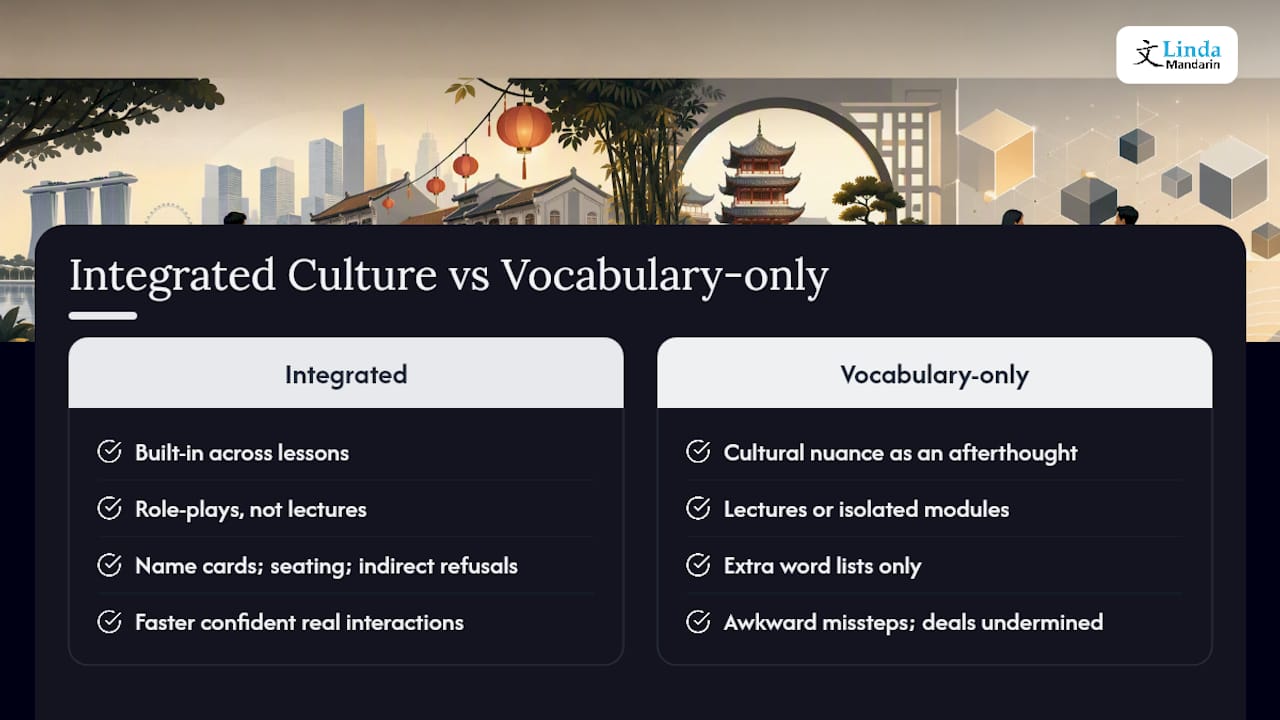
Language without context creates awkward moments. A well-built adult course treats cultural nuance as part of the curriculum, not an afterthought squeezed into one lesson near the end.
Business etiquette specifics show up constantly in professional interactions: how to exchange name cards properly, appropriate ways to address senior colleagues or clients, the role of face-saving language in disagreements, and when directness is acceptable versus when it reads as rude. These aren’t abstract cultural trivia. They’re the difference between a smooth client dinner and an accidental misstep that undermines a deal.
Good instructors weave this into role-plays rather than lecturing about it separately. A lesson on ordering a business lunch might include how seating order signals hierarchy. A negotiation exercise might cover how indirect refusals work in Mandarin business speech, where an outright “no” is rare and reading between the lines matters more than in typical English-language negotiation.
For expatriates especially, this context often matters more than vocabulary size. Knowing fifty extra words won’t help if you don’t understand why a Chinese client hedges instead of giving a direct answer. Courses that build in Chinese culture training alongside language instruction tend to produce learners who navigate real interactions more confidently, faster, than those studying vocabulary lists in isolation.
Ask about this specifically when evaluating a program. If cultural and etiquette content is listed as a separate module or clearly integrated into role-play scenarios, that’s a sign the course was built with working professionals in mind rather than adapted from a generic language template.
Certificates and Recognition After Completing a Course
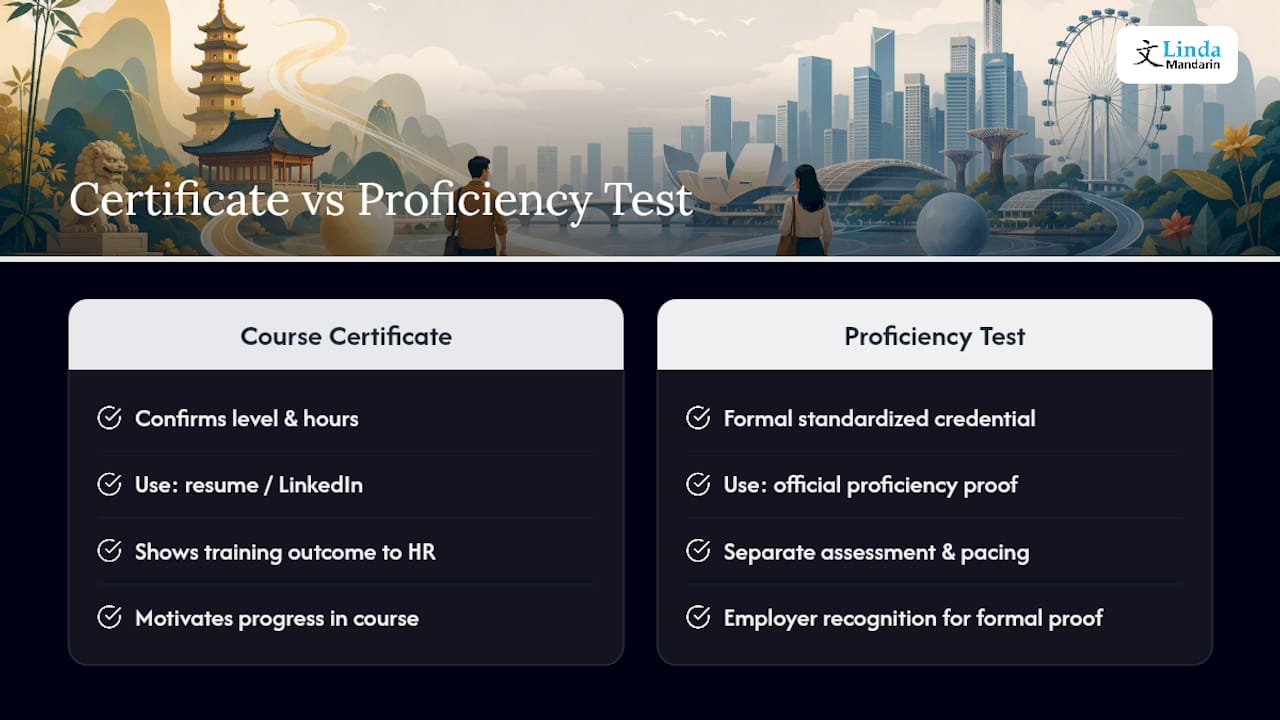
Completion certificates from adult Mandarin programs typically confirm the level and hours completed rather than function as a government-issued qualification. For most working professionals, that’s exactly what’s needed: a record showing you completed a structured business or conversational Mandarin program at a specific proficiency level.
These certificates carry real value in a few practical contexts. They demonstrate initiative to employers when included on a resume or LinkedIn profile, particularly for roles involving regional client work or cross-border coordination. Some professionals use them to show HR departments that a training investment, whether personally funded or employer-supported, produced a measurable outcome. Others simply want proof of progress to stay motivated across a multi-month course.
What these certificates are not is a substitute for standardized international proficiency testing, which follows its own separate track and assessment structure entirely distinct from a workplace-focused adult course. If your specific goal is a formal proficiency credential rather than functional workplace ability, that’s a different course track with different content and pacing.
For the vast majority of professionals and expatriates learning Mandarin for career use, though, the practical skill matters more than the paper. A client who trusts you enough to switch into Mandarin mid-meeting doesn’t ask to see your certificate first. Choose a course based on whether it builds usable skill, then treat any completion documentation as a nice-to-have rather than the main goal.
Keeping Your Mandarin Sharp Between Classes
Class time alone won’t get you to functional fluency. What happens between sessions determines whether skills stick or fade.
Language apps fill useful gaps for vocabulary review and spaced repetition, particularly for character recognition and tone practice during commutes or downtime. They work best as supplements to structured class content, not replacements for it, since apps generally can’t correct your pronunciation or push you through a real conversation the way a live instructor can.
Language exchange groups, often organized through community meetups or professional networking circles in Singapore, pair you with native Mandarin speakers looking to practice English. These sessions cost nothing beyond your time and expose you to natural speech patterns and slang that textbooks skip entirely. Some learners find a weekly exchange session does more for conversational confidence than an extra class would.
Pronunciation remains one of the biggest sticking points for English-speaking learners, particularly around tones, which don’t exist in the same way in English. If tone accuracy is holding back your speaking confidence, resources addressing pronunciation challenges specific to Asian language learners can help target the exact mechanics that trip people up.
Voice recording yourself, then comparing against native audio, remains one of the simplest self-correction tools available. Combine that with two or three workplace phrases practiced daily, and progress between formal lessons compounds faster than most learners expect.
Staying Consistent When Work Takes Over
The biggest obstacle to functional Mandarin isn’t difficulty, it’s inconsistency. Set milestones tied to your actual job: handling a five-minute client call, reading a short internal memo, following ten minutes of a meeting. Vague goals like “get better at Mandarin” don’t survive a busy quarter.
Use the workplace itself as practice ground. Greet Mandarin-speaking colleagues in Mandarin. Try two sentences in a WeChat message instead of English. Protect one weekly review session even when everything else gets cut.
If progress stalls after a few months of group classes, that’s usually the signal to shift into private lessons or corporate training, where pacing bends around your specific gaps instead of the average of a classroom.
— Paul
Where to Start: Linda Mandarin’s Adult Programs
If you’ve read this far, you already know what a good course needs: real instructors, flexible scheduling, and content built around actual workplace use instead of textbook filler. That’s the exact gap Linda Mandarin has worked to close for adult learners since 2003.
The school runs in-person and online Zoom classes from its center at 10 Anson Road, Level 22, International Plaza, right above Tanjong Pagar MRT, so getting to class doesn’t eat into your evening. Courses run as private lessons, group classes, and corporate training, with native Mandarin instructors fluent in English who build lessons around practical, progressive syllabuses rather than generic drills. That combination, structured content plus instructors who can explain grammar clearly in English, is precisely what the checklist above recommends looking for.
If you’re an individual learner, review the available course levels to find your starting point, or request a trial lesson to see the teaching style firsthand. HR teams and business owners exploring team-wide training can look into corporate Mandarin training options built around workplace scheduling. Either way, the next step is simple: pick a format, book a trial, and start building Mandarin you’ll actually use at work.
Sources
FAQ
How long does it take to learn functional Mandarin for work?
Most professionals reach functional workplace Mandarin within three to six months of consistent daily study combined with regular class attendance, though your starting level affects the timeline.
Do I need to be fluent to see career benefits from Mandarin?
No. Functional Mandarin, the ability to greet clients, follow basic conversation, and send simple written messages, is enough to build trust and improve workplace rapport.
Is online Zoom learning as effective as in-person classes?
Zoom classes work well for flexibility and frequent short practice, especially for remote or time-pressed professionals, while in-person classes tend to give faster pronunciation correction and more spontaneous conversation practice.
Should I choose group classes or private lessons?
Group classes cost less and offer peer practice, while private lessons move faster because the instructor adapts entirely to your pace and specific workplace needs, so private fits better if you’re on a tighter timeline.
Does Linda Mandarin offer corporate training for teams?
Yes, Linda Mandarin runs corporate Mandarin training programs for teams and businesses, structured around workplace scheduling and practical communication needs.