The fastest path to real progress combines scheduled live practice, private Zoom tutoring, or targeted corporate coaching, with focused self-study and on-demand interpreting, explained in detail in How Muqabala works, for anything accuracy-critical. Apps and platforms build vocabulary well but rarely produce speaking confidence on their own. A provider structuring private and corporate online lessons around this exact mix can be a solid starting point for busy professionals.
TL;DR:
- Private tutoring and corporate coaching provide targeted speaking practice that apps alone cannot develop, especially for high-stakes professional interactions.
- Building real conversation skills requires consistent, task-oriented practice over months, with lesson frequency having a larger impact than session length.
- Evaluating providers with experience in adult learning, clear curricula, flexible scheduling, and measurable outcomes helps avoid wasting time and money.
- Self-study tools excel at vocabulary retention but fall short on developing speaking fluency, which benefits from native speaker interactions or live feedback.
- Learning Simplified or Traditional characters depends on your target market, and specifying this upfront prevents costly rework later.
Table of Contents
- Types of Mandarin Online Support and Who Each Fits
- What to Expect: Timeframes, Pricing, and Realistic Outcomes
- How to Choose Online Support: Criteria, Questions, and Red Flags
- Practical Platforms and On-Demand Tools That Speed Learning
- How Linda Mandarin Maps to These Needs
- Script Choice: Simplified vs Traditional, and Why It Matters Early
- Author Perspective: A Prioritized Plan for Busy Professionals
- Ready to Start? Book a Demo Lesson with Linda Mandarin
- Sources
- FAQ
Types of Mandarin Online Support and Who Each Fits
Not every learner needs the same setup, and picking the wrong format wastes months. Match the tool to the job you’re actually trying to do.
- Private tutoring over Zoom: one-to-one sessions built for speaking practice and immediate correction. Best for professionals prepping for a specific meeting, negotiation, or presentation.
- Group classes: slower per-person speaking time, but steady structure and peer accountability keep motivation up over months.
- Self-paced platforms and apps: strong for vocabulary drilling and spaced repetition, weak for actual conversation skill. Structured beginner modules on Coursera can teach phonetics and daily expressions efficiently, but speaking fluency still depends on live back-and-forth practice.
- Corporate training: built around your company’s actual vocabulary. Sales teams learn negotiation phrases; HR teams learn onboarding language. Role-play replaces generic textbook dialogue.
- Interpreting and concierge services: immediate, accuracy-first help for a single high-stakes moment. This is not a substitute for learning Mandarin. It’s a separate service for when you need the words right, right now.
The mistake most adults make is picking one format and expecting it to cover every need. A translator hotline won’t teach you grammar, and an app won’t get you through a client call next Tuesday.
What to Expect: Timeframes, Pricing, and Realistic Outcomes
Timelines vary more than most course marketing admits. A learner doing 30 minutes a day with weekly tutoring might reach basic conversational ability in a few months. Someone doing intensive, daily lessons with deliberate speaking drills can move faster. “Conversational” and “professional” competence are different finish lines: one lets you order food and make small talk, the other lets you run a client call in Mandarin without a translator standing by.
Introductory courses typically cover phonetics and core expressions across a handful of modules, but building toward genuine workplace fluency takes sustained, structured practice over months, sometimes longer depending on how often you actually speak the language out loud.
Pricing usually falls into a few shapes:
- Subscriptions: flat monthly fee for app access or platform content, cheapest per hour but weakest for speaking skill.
- Hourly tutoring: pay per session, flexible but costs add up with frequency.
- Packaged courses: bundled sessions at a set price, often with a defined curriculum and progress checkpoints.
- Corporate quotes: custom pricing based on group size, hours, and specialized vocabulary needs.
Pro Tip: Measure progress by task, not by vague fluency labels. “I can handle a five-minute intro in Mandarin” is a real milestone. “I’m getting better” is not.
Lesson frequency matters more than lesson length. Three 30-minute sessions a week beat one two-hour session, because speaking Mandarin is a motor skill as much as a memory one.
How to Choose Online Support: Criteria, Questions, and Red Flags
Evaluating a tutor, platform, or corporate provider gets easier once you know exactly what to ask.
Look for these criteria first:
- Teaching experience specifically with adult professionals, not just casual learners.
- A clear lesson format: how much of each session is you speaking versus listening.
- A curriculum you can actually see before you commit.
- Scheduling flexibility that matches your work hours, not the provider’s.
- Evidence of real outcomes from past learners, not just marketing claims.
Before signing up, ask these questions directly:
- Can I take a trial lesson or demo class first?
- How do you assess my current level and track progress afterward?
- What’s the typical class size for group sessions?
- What’s the cancellation and rescheduling policy?
- Do you teach Simplified or Traditional characters, and can I choose?
Red flags are easy to spot once you’re looking. No demo lesson offered. Pricing that’s vague or only revealed after a sales call. No way to measure whether you’re actually improving. Any of these should make you pause before paying for a package.
Practical Platforms and On-Demand Tools That Speed Learning
Self-study apps and spaced-repetition tools are excellent at one specific job: getting vocabulary and characters into long-term memory. They fall short at teaching you to actually produce sentences under real-time pressure, which is a different skill entirely.
Conversation exchange platforms and video-practice tools fill that gap by pairing you with native speakers for informal speaking practice. They’re free or cheap, and they build the reflexes that structured lessons alone often miss.
On-demand interpreting sits in a different category altogether. Certified interpreting services provide industry-specific terminology and 24/7 availability precisely because they’re built for accuracy under pressure, not gradual learning. Similarly, phone and video interpreter services can connect you to a qualified interpreter quickly, typically billed per minute or per hour. On the ground, concierge-style Mandarin assistants can resolve a language problem in 5 to 15 minutes for a flat per-request fee, useful when you need a fast answer, not a lesson.
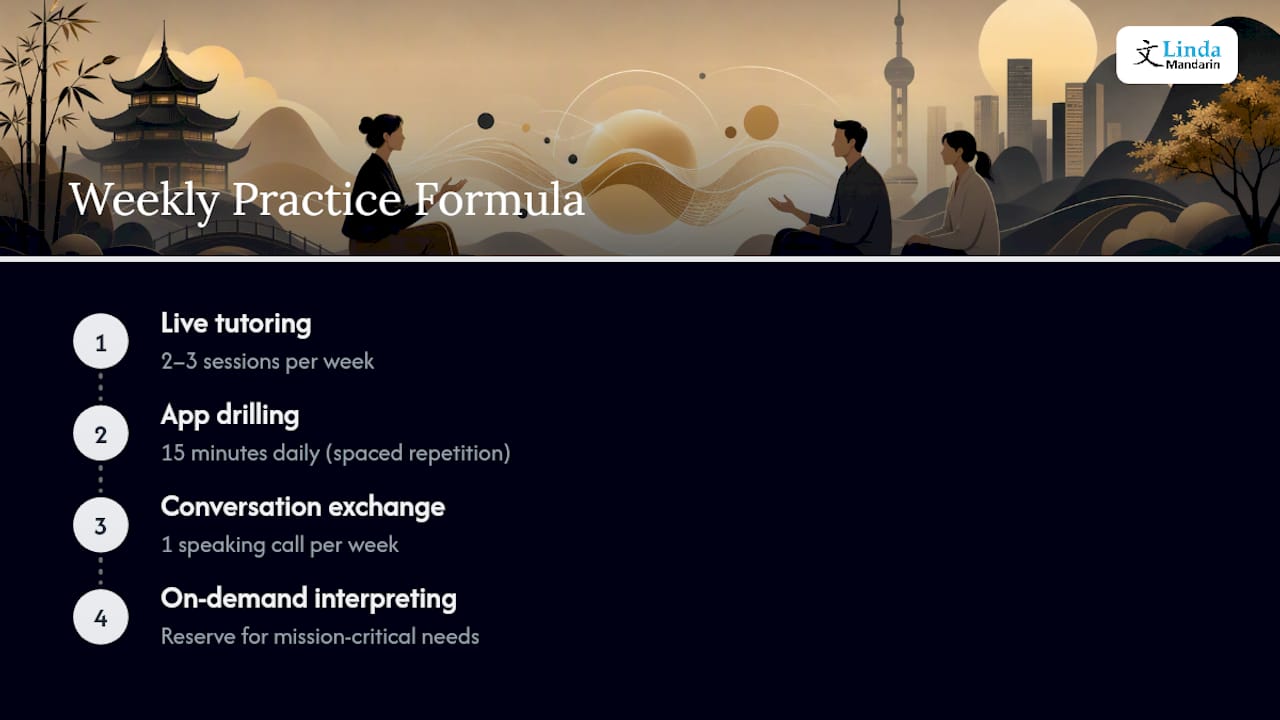
A workable weekly formula: two or three live tutoring sessions, 15 minutes of daily app drilling, and one conversation-exchange call, with interpreting kept in reserve for anything mission-critical.
How Linda Mandarin Maps to These Needs
Some Mandarin programs for adults and professionals offer instruction by native Mandarin speakers fluent in English, capable of explaining grammar and workplace phrasing clearly.
- Private online Zoom lessons for learners who need fast, targeted speaking gains before a specific deadline.
- Corporate Mandarin training built around a company’s actual vocabulary, from client calls to internal meetings.
- Group classes for steady, budget-conscious progress with peer accountability.
- Adult program options spanning beginner through advanced business Mandarin, all delivered with a structured syllabus.
The school operates out of 10 Anson Road, Level 22, International Plaza, Singapore 079903, directly, above Tanjong Pagar MRT, for learners who want an in-person option alongside online classes.
Script Choice: Simplified vs Traditional, and Why It Matters Early
Simplified characters are standard across Mainland China and Singapore. Traditional characters remain the norm in Taiwan and Hong Kong. Picking the wrong one isn’t a minor inconvenience. It means relearning characters, reformatting documents, and potentially confusing business contacts who expect one script and receive the other.
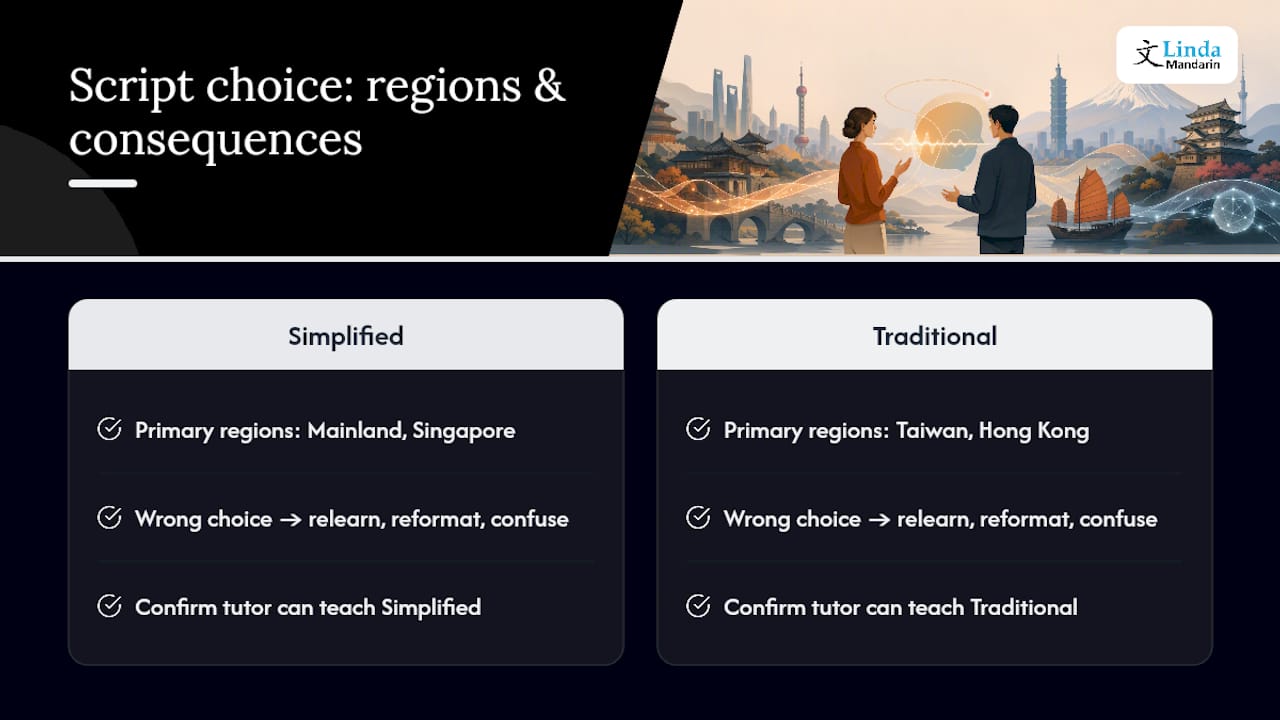
Professionals often skip this decision because it feels like a technical detail that can wait. It can’t. If your work involves clients or offices in Taiwan or Hong Kong, learning Simplified characters first means redoing a chunk of your character study later. If your work is centered on Mainland China or Singapore, Simplified is the practical default from day one.
The fix is simple: decide your target market before your first lesson, not after your third month. Tell your tutor or course provider which script you need, and confirm they can actually teach it. Some programs default to Simplified without asking. Others offer both but only mention it if you ask directly. This is exactly the kind of detail worth raising during a trial lesson, alongside questions about curriculum and class size, so you’re not stuck redoing foundational work because nobody asked upfront.
Author Perspective: A Prioritized Plan for Busy Professionals
Start with 30 days of scheduled live practice, add 60 days of daily micro-practice on top of that, and keep on-demand interpreting on standby for high-stakes weeks. Measure success by tasks, not confidence: can you handle a short client call, present for five minutes, or write a brief email in Mandarin.
— Paul
Ready to Start? Book a Demo Lesson with Linda Mandarin
Most Mandarin apps get you vocabulary. What actually moves the needle for busy professionals is scheduled speaking practice with real feedback, which is exactly what a private Zoom lesson or corporate coaching session delivers that self-study alone can’t.
Linda Mandarin offers online Zoom classes, private lessons, and corporate Mandarin training built specifically for adults and working professionals, with native instructors who teach in English when needed and structure lessons around real workplace tasks. If you’re weighing tutors, platforms, or corporate quotes, the simplest next step is booking a trial lesson to see how a structured, speaking-focused format actually fits your schedule. Check course levels and book a demo to get started this week.
Sources
- Professional Mandarin Interpreting Services
- Mandarin Chinese Interpreter Services | 24/7 Phone, Video & On-Site | Interpreter Services
- Chinese for Beginners | Coursera
- Travel Communication Assistant for China – Real-Time Help
FAQ
How Can I Learn Mandarin Online for Free?
Free options include language exchange apps, YouTube channels, and podcast-based lessons, but they work best paired with at least some paid, structured practice for speaking feedback. Free tools build vocabulary well; they rarely correct your pronunciation or grammar in real time.
How Long Does It Take to Become Fluent in Mandarin?
Basic conversational ability can take a few months of consistent part-time study, while professional-level fluency typically requires sustained, structured practice over a longer stretch, often a year or more depending on lesson frequency and how much you actually speak aloud between sessions.
Is Duolingo Actually Good for Learning Mandarin?
Duolingo and similar apps are useful for building vocabulary and character recognition through repetition, but they don’t replace live speaking practice. Pairing an app with a tutor or corporate coaching session covers the gap apps leave in real conversation skill.
How Do You Say “How Can I Help You?” in Mandarin?
A common phrase is “我能帮你什么?” (Wǒ néng bāng nǐ shénme?), which translates roughly to “What can I help you with?” Tone and phrasing can shift slightly depending on formality and regional context, which is exactly the kind of detail a native-speaking tutor corrects quickly.