TL;DR:
- Proper placement tests ensure learners join classes matching their actual Mandarin level.
- Different class formats cater to various needs, from group lessons to private coaching.
- Consistent practice outside class and correct placement significantly improve language learning outcomes.
Not all Mandarin classes in Singapore are built the same, and picking the wrong one can cost you months of progress. Learners who jump into a class without proper assessment often find themselves either bored because the material is too easy or lost because the pace is too fast. Heritage speakers, working professionals, expatriates, and absolute beginners each need something different from a language program. This guide walks you through how placement works, what class formats exist, how courses are structured, and what practical steps you can take to get real results from your Mandarin learning journey in Singapore.
Table of Contents
- Understanding placement and learning needs
- Types of Mandarin Chinese classes available in Singapore
- How courses are organized and progression works
- Tips, pitfalls, and maximizing learning outcomes
- A practical perspective: Placement matters more than you think
- Explore tailored Mandarin courses for adults
- Frequently asked questions
Key Takeaways
| Point | Details |
|---|---|
| Placement matters most | Accurate placement ensures you learn at the right level and avoid wasted effort or frustration. |
| Choose the right class type | Select group, intensive, corporate, or private lessons based on your goals and schedule. |
| Course progression is structured | Mandarin classes are organized by levels, with advancement driven by placement and performance. |
| Avoid common pitfalls | Heritage or restarting learners must use placement to fill gaps; active practice accelerates progress. |
| Explore tailored options | Singapore offers Mandarin courses for every adult’s needs, including expats and corporate professionals. |
Understanding placement and learning needs
The first thing any serious language school in Singapore does is assess where you actually stand. A Mandarin placement test guide will tell you exactly what to expect: tests that cover listening, speaking, reading, and writing so that you land in a class that matches your real ability, not your self-estimated one. Placement tests are standard to assess all four language domains and place learners accurately, preventing both under-placement (where you waste time on material you already know) and over-placement (where you struggle without the foundation to keep up).
Why does this matter so much? Because language learning is sequential. Missing one rung on the ladder means every step above it becomes harder. A learner placed two levels too high may technically attend class but absorb very little, while a learner placed too low will disengage quickly from boredom.
Some learners present unique challenges at the placement stage:
- Heritage speakers: Grew up hearing Mandarin at home but may have never learned to read or write characters properly. They often test at a conversational level but have significant literacy gaps.
- Restarting learners: Adults who studied Mandarin years ago and stopped. They may remember fragments but have uneven skills across the four domains.
- Complete beginners: The most straightforward case. No prior knowledge means starting at the foundation level.
- Professionals with specific goals: May have basic conversational ability but need technical or business Mandarin, which requires a different assessment lens.
| Learner type | Common placement challenge | Key domain to watch |
|---|---|---|
| Heritage speaker | High speaking, low literacy | Reading and writing |
| Restarting learner | Uneven skill gaps | All four domains |
| Complete beginner | No baseline | Listening and speaking |
| Business professional | Functional but informal | Writing and vocabulary |
One area many learners underestimate is listening comprehension. If you want to boost listening skills before your placement test, spending a week with Mandarin podcasts or audio content at a comfortable speed can help you get a more accurate read on your level. Avoiding common Mandarin learning mistakes during the placement phase also sets a stronger foundation for everything that follows.
Pro Tip: Before your placement test, make a short list of topics you can discuss comfortably in Mandarin and topics where you struggle. Sharing this with your assessor gives them richer context and leads to a more precise class assignment.
Types of Mandarin Chinese classes available in Singapore
Once you know your level, the next decision is about format. Singapore’s Mandarin schools offer several distinct class types, and each is designed for a different kind of learner and lifestyle.
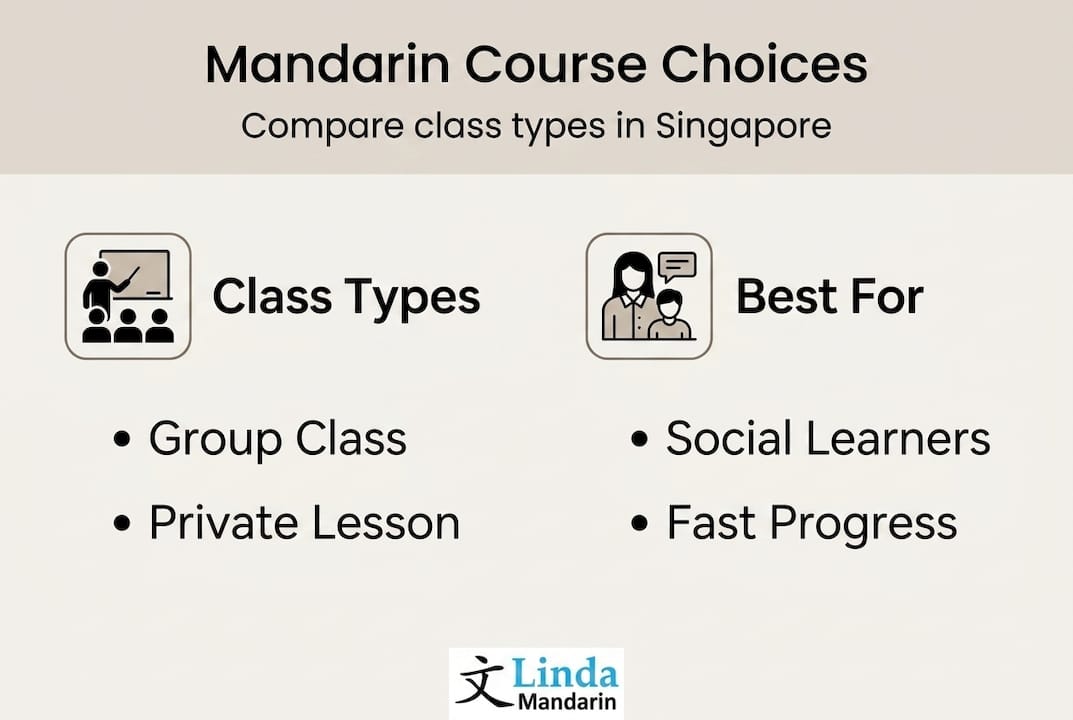
Group classes are the most common format. They work well for learners who benefit from peer interaction and enjoy a social classroom dynamic. Class sizes are typically small enough that instructors can give individual attention while still creating conversational opportunities with other students.
Intensive courses are designed for learners who want to move fast. These are ideal for expatriates who need functional Mandarin within a specific timeframe, or professionals preparing for a role that requires Mandarin communication skills quickly. The pace is demanding, but the results are faster.
Corporate and custom programs are built for organizations whose teams need Mandarin for client communication, internal collaboration, or business negotiations. These programs are often tailored to industry-specific vocabulary. Learning Mandarin for business communication in this format means the content is directly applicable to your workplace.
Private lessons offer the most personalized experience. Your instructor focuses entirely on your needs, your pace, and your goals. This is the highest-cost option but also the most flexible.
| Class type | Best for | Pace | Class size |
|---|---|---|---|
| Group class | Social learners, budget-conscious | Moderate | 6 to 12 students |
| Intensive course | Fast-track learners, expats | Fast | Small group or private |
| Corporate program | Professionals, teams | Customized | Team-based |
| Private lesson | Individual needs, flexible goals | Self-directed | 1-on-1 |
| Online class | Remote learners, busy schedules | Flexible | Varies |
You can review the full range of Mandarin course levels to cross-reference your placement result with the class type that best fits your schedule and goals.
It is worth noting that heritage speakers may test higher but lack literacy, while restarting learners need placement to identify gaps. This makes the class type decision even more important for these two groups, since a standard group class may not address their specific skill imbalances.
Pro Tip: Match your class format to your daily routine first, then your learning style. A class that fits your schedule is one you will actually attend consistently, and consistency matters more than any other variable in language learning.
How courses are organized and progression works
Understanding how a Mandarin course is structured helps you plan your learning journey realistically. Most schools in Singapore follow a leveled progression system, typically moving from beginner through elementary, intermediate, upper-intermediate, and advanced levels. Each level builds directly on the one before it.
Here is how course progression typically works:
- Placement determines your entry point. Your test results, covering listening, speaking, reading, and writing, assign you to the most appropriate starting level.
- Each level has defined outcomes. Beginner courses focus on tones, basic vocabulary, and simple sentence structures. Intermediate levels introduce more complex grammar patterns and expanded topic fluency.
- Advancement is performance-based. You move to the next level when you demonstrate consistent competency, not just attendance.
- Assessments are built in. Regular reviews and end-of-term evaluations help instructors and learners track progress.
- Curriculum is mapped to HSK standards. The international HSK (Hanyu Shuiping Kaoshi) framework is widely used as a benchmark, giving your qualification real-world recognition.
You can explore course levels in detail to understand exactly what skills each stage develops and what the advancement criteria look like. Looking into effective Mandarin learning methods also gives you a sense of how to engage with curriculum content between sessions.
The placement process ensures that learners join the right level from the start, which means no wasted time recapping content you already know or feeling overwhelmed by material you are not ready for.

| Course level | Focus areas | Typical learner |
|---|---|---|
| Beginner | Tones, greetings, basic vocabulary | Zero prior experience |
| Elementary | Simple sentences, daily communication | Some exposure |
| Intermediate | Grammar patterns, topic fluency | 6 to 12 months of study |
| Upper-intermediate | Complex structures, reading | 1 to 2 years of study |
| Advanced | Nuanced expression, professional use | Extensive prior learning |
One important point: advancement is not automatic. Showing up is necessary but not sufficient. Learners who actively engage with coursework, practice outside class, and communicate with their instructors about challenges advance meaningfully and consistently.
Tips, pitfalls, and maximizing learning outcomes
Now that you understand how courses and advancement work, the focus shifts to what you can do to make the most of the class you choose. Many adult learners in Singapore come in with genuine motivation but fall into avoidable traps.
Common mistakes to watch for:
- Overestimating your current ability and requesting a higher level than your placement suggests
- Treating class time as the only place where learning happens
- Skipping practice between sessions and expecting steady progress
- Ignoring feedback from instructors about weak areas
- Choosing a class format that does not match your lifestyle, leading to poor attendance
Familiarizing yourself with Mandarin learning mistakes before you enroll can save you significant frustration. One of the fastest ways to accelerate your vocabulary and reading ability is to build Mandarin vocabulary through daily micro-practice, even 10 to 15 minutes of deliberate review between classes creates compounding results over weeks.
“Placement tests accurately assess all four language domains and place learners where they can grow, not just where they feel comfortable.”
For heritage speakers, the pitfall is usually assuming conversational fluency means literacy readiness. For restarting learners, it is assuming muscle memory from years ago will return quickly without structured review. Both groups need honest self-assessment backed by a proper placement advice process.
Measuring your own progress matters too. Track how well you can handle real conversations, whether you understand more of what you hear in daily life, and how your reading speed changes over weeks. These are better indicators than test scores alone.
Pro Tip: Commit to using Mandarin outside class at least three times per week. Label objects at home, talk to yourself through daily tasks, or watch a short Mandarin video. These habits build fluency faster than extra class hours alone.
A practical perspective: Placement matters more than you think
Most guides on choosing Mandarin classes focus on cost, location, and teacher credentials. Those factors matter, but they are not the primary driver of whether you succeed. The real determining factor is whether your starting level is correctly matched to your actual skills.
We have seen learners at Linda Mandarin who spent months in the wrong class at other schools before joining us. They were frustrated, not because the school was bad or the teacher was unqualified, but because their placement was off from day one. When they took a proper placement test and moved to the right level, their confidence and progress shifted dramatically within weeks.
The uncomfortable truth is that most adults overestimate their Mandarin ability and underestimate the value of starting at the right place. Taking a deep dive on placement tests before committing to any program is the single most impactful step you can take. Honest assessment is not a setback. It is the foundation everything else is built on.
Explore tailored Mandarin courses for adults
If you are ready to move from research to action, Linda Mandarin offers structured, placement-based programs designed for exactly the kind of learners reading this guide: working professionals, expatriates, corporate teams, and adults seeking personal growth through Mandarin.
You can browse all adult Mandarin programs to find the format and level that fits your life. If speed is your priority, the intensive Mandarin course is designed to get you communicating fast. For organizations looking to upskill their teams, corporate Mandarin courses offer customized content aligned to real business needs. Start with your placement, and the right class will follow naturally.
Frequently asked questions
How do Mandarin placement tests work in Singapore?
Placement tests assess listening, speaking, reading, and writing skills so learners are placed in classes that match their actual ability, avoiding both under- and over-placement.
What class formats are available for Mandarin learning?
You can choose from group lessons, intensive programs, corporate courses, private lessons, and online or face-to-face formats depending on your goals and schedule.
Can heritage speakers or restarting learners skip placement tests?
No. Heritage speakers may test higher conversationally but often have literacy gaps, and restarting learners need placement to identify where their knowledge has faded.
How do I maximize my learning outcome in Mandarin classes?
Actively use Mandarin outside class at least three times a week, seek regular feedback from your instructor, and monitor your own progress through real-world communication benchmarks rather than test scores alone.