TL;DR:
- Choosing the right Mandarin school in Singapore requires considering instructor credentials, curriculum focus, and schedule flexibility.
- Professional and business-focused programs enhance workplace communication and negotiation skills essential for career growth.
- Active practice outside the classroom and clear goal setting are crucial for real language mastery beyond school selection.
Many adults in Singapore assume that picking any Mandarin language school will deliver roughly the same results. That assumption is costly. Teaching methods, curriculum design, instructor qualifications, and program focus vary widely across schools, and those differences directly shape how fast you progress and how well you actually use the language. Whether you are a business professional navigating multicultural teams, an expatriate settling into Singapore life, or someone pursuing personal growth, the school you choose matters far more than most people realize. This guide cuts through the noise and gives you a practical framework for making the right call.
Table of Contents
- Why adults in Singapore are learning Mandarin
- Types of Mandarin language programs offered
- What to look for in a Mandarin language school
- Comparing top Mandarin schools in Singapore
- Our perspective: The real keys to success in learning Mandarin as an adult
- Ready to level up your Mandarin? Explore top programs in Singapore
- Frequently asked questions
Key Takeaways
| Point | Details |
|---|---|
| Assess your goals | Choose a program that matches your professional or personal objectives with Mandarin. |
| Compare school offerings | Carefully review each school’s curriculum, teaching style, and value for adults. |
| Prioritize program fit | Select based on class flexibility, specialization, and proven outcomes, not just price. |
| Daily practice matters | Real progress happens when you actively use Mandarin beyond the classroom. |
Why adults in Singapore are learning Mandarin
Singapore is one of the few places in the world where learning Mandarin in Singapore carries both cultural and commercial weight at the same time. Mandarin is one of the country’s four official languages, spoken by roughly 30% of the resident population. But its importance extends well beyond local conversations. As Singapore deepens its trade and investment ties with China, Mandarin proficiency has become a genuine career differentiator.
The reasons to learn Mandarin are stacking up fast for working adults. Here is what is driving demand in 2026:
- Career advancement: Roles in finance, logistics, real estate, and tech increasingly require Mandarin for client-facing work with Chinese-speaking counterparts.
- Team communication: Managers leading multicultural teams find Mandarin skills reduce friction and build trust with colleagues.
- Expatriate integration: Foreign professionals relocating to Singapore use Mandarin to connect with local communities and navigate daily life.
- Family motivation: Parents want to speak the same language their children are learning in school.
- Personal enrichment: Many adults simply want to engage more deeply with Chinese culture, media, and history.
Mandarin proficiency is increasingly required for professional roles in Singapore, particularly in industries with strong China-linked business flows. This is not a soft trend. Employers in sectors like banking, manufacturing, and professional services are actively listing Mandarin as a preferred or required skill in job postings.
Statistic to note: Mandarin is spoken by over 1.1 billion people globally, making it the most widely spoken first language in the world. For Singapore-based professionals, that reach translates directly into business opportunity.
The result is a surge in adult enrollment at language schools across the island. Unlike younger learners who pick up languages through school curricula, adults need programs specifically designed for their pace, schedule, and professional context. That is where school selection becomes critical.
Types of Mandarin language programs offered
Not all Mandarin programs are built the same, and choosing the wrong format can slow your progress significantly. Understanding what each type offers helps you match a program to your actual goals.
| Program type | Duration | Best for | Key focus | Typical outcome |
|---|---|---|---|---|
| Conversational Mandarin | 8-16 weeks | Beginners, expatriates | Speaking and listening | Daily communication |
| Business Mandarin | 2-4 months | Professionals | Workplace language, negotiations | Professional fluency |
| Intensive Mandarin courses | 4-8 weeks | Fast learners, pre-assignment | Immersive daily practice | Rapid foundational skills |
| HSK exam prep | 6-12 weeks | Students, credential seekers | Standardized test readiness | HSK certification |
| Corporate Mandarin training | Custom | Teams, organizations | Industry-specific language | Workplace communication |
| Mandarin writing classes | Ongoing | Intermediate learners | Characters, reading, writing | Literacy skills |
Business Mandarin deserves special attention for professionals. Structured programs for business professionals cover focused negotiation and writing skills, which go well beyond basic vocabulary. Real-life scenarios where business Mandarin pays off include:
- Leading or participating in client negotiations with Chinese-speaking partners
- Delivering presentations to Mandarin-speaking stakeholders
- Writing formal emails or proposals in Chinese
- Reading contracts, reports, or business documents in Mandarin
- Building rapport during business dinners or networking events
Pro Tip: Before enrolling, be honest about your weekly availability. Intensive programs can accelerate results dramatically, but only if you can commit the time. A 20-hour-per-week intensive course taken half-heartedly will underperform a steady twice-weekly class attended consistently.
Specialized courses deliver better return on investment when your goals are specific. A logistics manager who needs to read shipping documents in Chinese has different needs from a sales director preparing for client meetings in Shanghai. Matching the program type to your actual use case is the single most efficient decision you can make before spending a dollar.
What to look for in a Mandarin language school
Choosing a school based on price alone is one of the most common mistakes adult learners make. Here is a numbered checklist of what actually predicts good outcomes:
- Instructor credentials: Look for native Mandarin speakers who are also fluent in English and hold recognized teaching certifications. Bilingual instructors are especially valuable for adult learners who need explanations in English during early stages.
- Adult-focused curriculum: Schools that primarily serve children often lack the professional context and pacing that adults need. Ask specifically whether the curriculum is designed for adult learners.
- Teaching method: Structured, progressive syllabuses aligned with HSK standards provide measurable milestones. Pure immersion without structure can feel chaotic for busy professionals.
- Schedule flexibility: Working adults need evening, weekend, or online options. Confirm class formats, including group, private, and Zoom sessions, before committing.
- Class size: Smaller groups mean more speaking time per student. For conversational development, class sizes above 12 students can limit your practice opportunities.
- Trial lessons and testimonials: Reputable schools offer trial classes or consultation sessions. Read reviews from adult learners specifically, not just general student feedback.
- Progress tracking: Ask how the school measures your improvement. Regular assessments tied to Mandarin course levels give you clear benchmarks and keep motivation high.
Pro Tip: Before signing up, ask the school to walk you through a sample lesson plan and explain how they assess progress at each stage. A school that cannot answer this clearly is worth skipping.
Reference point for cost and structure: Course structures for working professionals typically span 12 lessons over 2 months, with programs priced around $773.90. Use this as a baseline when comparing schools to understand whether you are getting fair value for the format offered.
After-class support also matters more than most learners expect. Schools that provide supplementary materials, online practice tools, or access to instructors between lessons help you maintain momentum outside the classroom.

Comparing top Mandarin schools in Singapore
To make a smart choice, it helps to see how leading providers stack up side by side. Here is a practical comparison based on publicly available information and program positioning:
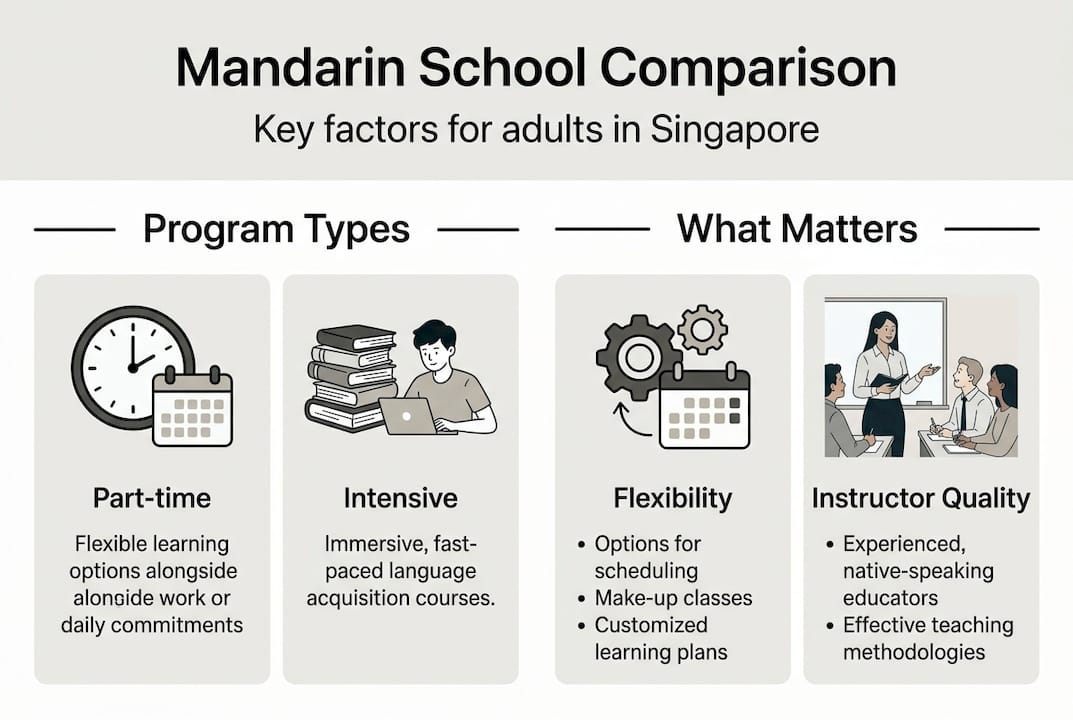
| School | Specialization | Class formats | Standout feature | Target learner |
|---|---|---|---|---|
| Linda Mandarin | Adult and business Mandarin | Group, private, online, corporate | HSK-aligned curriculum, CBD location | Adults, professionals, corporates |
| Acuity Learning | Business Chinese | Group | Negotiation and writing focus | Corporate professionals |
| Berlitz Singapore | Conversational and business | Private, group | Global brand, flexible scheduling | Expatriates, multinationals |
| New Concept Mandarin | General Mandarin | Group, private | Affordable group classes | General adult learners |
Acuity Learning’s business Mandarin course details serve as a useful benchmark for corporate learners evaluating structured programs. Key differentiators to watch across providers include:
- Whether the school offers native Mandarin instructors who can also explain concepts in English
- Availability of corporate packages for team training with customized content
- Access to business Chinese writing workshops for professionals who need written communication skills
- Transparency around pricing, including whether materials and assessments are included
- Location and commute convenience, which affects long-term attendance consistency
The truth about Mandarin classes in Singapore is that the best school for you depends heavily on your specific goals, not on rankings alone. A school with strong corporate programs may not be the right fit for a beginner expatriate, and vice versa. For professionals who need written skills alongside spoken fluency, a business Chinese writing workshop can close a gap that purely conversational courses leave open.
In 2026, the market trend is moving toward more flexible, modular learning. Schools that offer both in-person and online formats, combined with clear level progression, are pulling ahead for adult and professional learners.
Our perspective: The real keys to success in learning Mandarin as an adult
Here is something most school comparison articles will not tell you: the school you pick matters less than what you do between lessons. Adult learners consistently over-index on price comparisons and school reputation while under-investing in daily practice and clear goal setting.
Passive classroom attendance produces passive language skills. You can sit through 50 hours of excellent instruction and still struggle to hold a basic conversation if you are not actively using Mandarin outside class. The professionals who make the fastest gains are those who integrate the language into real interactions, reading a Chinese menu, responding to a Mandarin message at work, or listening to a Chinese podcast during their commute.
Business Mandarin for real results requires treating the language as a living tool, not a subject to study. Feedback from peers, a committed mindset, and small daily habits consistently outperform expensive courses attended without intention. Choose a school that supports this kind of active learning, but remember that the school is only the starting point.
Pro Tip: Commit to one Mandarin interaction per day outside class, even a short one. That single habit compounds faster than any curriculum.
Ready to level up your Mandarin? Explore top programs in Singapore
If you are serious about building Mandarin skills that actually work in professional and everyday settings, Linda Mandarin offers programs built specifically for adult learners in Singapore. With over two decades of experience since 2003, the school combines HSK-aligned curriculum, certified native instructors, and flexible formats to fit working schedules.
Whether you need corporate Mandarin training for your team, an intensive Mandarin course to accelerate your progress, or a structured path through clearly defined Mandarin course levels, Linda Mandarin has a format that fits. Located above Tanjong Pagar MRT in Singapore’s central business district, with online Zoom options available, getting started has never been more convenient.
Frequently asked questions
How long does it take for an adult to become conversational in Mandarin?
Structured programs of 12 lessons over two months can yield basic conversational ability for motivated adults, though reaching natural fluency typically requires continued study and regular real-world practice beyond the classroom.
Are there Mandarin programs for working professionals in Singapore?
Yes, business-focused Mandarin programs are specifically designed around workplace scenarios, covering negotiations, presentations, and professional writing so that learners can apply skills directly in their roles.
How can I compare Mandarin schools for adults?
Focus on curriculum design, instructor qualifications, schedule flexibility, and measurable outcomes. Differences in curriculum and cost among leading schools are significant, so request a sample lesson and ask how progress is tracked before enrolling.
Are intensive Mandarin courses available for expatriates or fast learners?
Intensive Mandarin programs cater to learners who want to progress quickly, making them a strong fit for expatriates preparing for relocation or professionals with a specific deadline for language readiness.