TL;DR:
- Immersion focuses on using Mandarin as the medium for thinking and learning, not just studying language rules.
- Reaching 1,500 high-frequency words enables about 80% comprehension of everyday conversations and content.
- Consistent daily engagement with native material, real conversations, and cultural activities accelerates fluency development.
Learning Mandarin on your own, with flashcard apps and grammar drills, often feels like filling a bucket that never quite gets full. You memorize vocabulary one week and it vanishes the next. The mandarin immersion process takes a fundamentally different approach. Instead of studying the language about life, you study life through the language. This guide breaks down exactly how that works for adults and teens, from the tools you need on day one to the habits that separate learners who plateau from those who actually start thinking in Mandarin.
Table of Contents
- Key takeaways
- What you need before starting the Mandarin immersion process
- The step-by-step immersion learning process
- Overcoming common immersion challenges
- Measuring your progress through immersion
- My honest take on immersion vs. traditional learning
- Accelerate your Mandarin with Linda Mandarin
- FAQ
Key takeaways
| Point | Details |
|---|---|
| Immersion is the medium, not the subject | You use Mandarin to learn other things, not just language rules, for faster fluency. |
| 1,500 words is your first real milestone | Reaching this vocabulary threshold unlocks roughly 80% of everyday conversational comprehension. |
| Daily routine integration matters most | Replacing English habits with Mandarin inputs throughout your day drives faster acquisition than extra study sessions. |
| Motivation requires cultural fuel | Pairing language practice with genuine cultural engagement keeps progress consistent over months. |
| Progress needs regular reality checks | Measuring comprehension against native content and native speakers prevents false confidence and stalled growth. |
What you need before starting the Mandarin immersion process
Most people underestimate the preparation phase. They jump straight into an app or a class without building the environment that makes immersion actually work. Setting up that environment, both digitally and physically, is where real progress begins.
The vocabulary foundation
Before anything else, get honest about where your vocabulary stands. Mastering 1,500 core words enables roughly 80% comprehension of native-level Mandarin content. That number sounds daunting, but it is your anchor. Everything else in the immersion process is built around reaching and then surpassing that threshold. Use a structured vocabulary building approach from the start rather than learning random words out of context.
Tools and technology that support immersion
You do not need to live in Beijing to immerse yourself in Mandarin. Your phone, streaming subscriptions, and a few well-chosen apps can create a genuinely rich input environment anywhere. Here is what actually works:
- Flashcard tools with native content integration: Apps like Migaku can convert shows and videos into interactive vocabulary cards, so you learn words as they appear in real conversations, not isolated lists.
- Mandarin-language podcasts and YouTube channels: Swap your usual commute content for Mandarin audio. Even passive listening builds phonetic familiarity faster than most people expect.
- Phone and device language settings: Change your phone’s display language to Mandarin. The friction of navigating familiar menus in an unfamiliar language is exactly the low-stakes challenge immersion thrives on.
- Mandarin content streaming: Chinese drama series, variety shows, and documentaries are available on platforms like iQIYI and YouTube. Watch with Chinese subtitles, not English ones.
| Tool type | Example | Primary benefit |
|---|---|---|
| Vocabulary app | Migaku, Anki | Builds high-frequency word recall |
| Audio content | Mandarin Corner podcast | Trains listening and pronunciation |
| Video streaming | Chinese drama with Chinese subs | Connects vocabulary to natural context |
| Device settings | Phone set to Simplified Chinese | Creates constant, low-pressure exposure |
Pro Tip: Set one hour per day as your “Mandarin only” window, where every digital interaction — search, social media, music — happens in Mandarin. Consistency in this window compounds faster than longer, irregular study sessions.
Critically, quality immersion requires more than consuming content. Structured immersion programs deliver at least 50% of instruction through Mandarin with qualified native-speaking teachers, which gives adult learners a benchmark for what genuine immersion looks like compared to casual exposure.
The step-by-step immersion learning process
This is where the mandarin language immersion approach separates itself from every other method. The goal is not to study Mandarin. The goal is to use Mandarin to do other things. That shift in framing changes everything about how you practice.
-
Start your day in Mandarin. Before you check English news or social media, spend 15 minutes reading a Mandarin news source or watching a short Mandarin video. This primes your brain to operate in the language before English crowds it out.
-
Use Mandarin for at least one non-language task daily. This is the core of true immersion. Effective immersion integrates Mandarin as the instruction medium for academic subjects, not just vocabulary practice. For adults, this might mean reading a Mandarin article about your professional field, watching a cooking tutorial in Mandarin, or following a fitness program with a Chinese-speaking instructor.
-
Speak out loud, even to yourself. Narrate what you are doing in Mandarin while you cook, commute, or exercise. This habit builds spontaneous speech faster than any drilling exercise because it forces you to retrieve vocabulary under natural conditions.
-
Engage with native drama and music daily. Authentic media exposes you to tones, rhythm, and colloquial expressions that textbooks never cover. Mandarin pop music is particularly useful because repeated listening locks tonal patterns into your phonological memory.
-
Write one paragraph in Mandarin every evening. It does not need to be perfect. The act of composing sentences in characters forces you to think in structures, not translate from English, which is the cognitive shift immersion is designed to trigger.
-
Seek real conversations weekly. Language exchange platforms connect you with native speakers who want to practice English while you practice Mandarin. One 30-minute real conversation weekly is worth more than five hours of solo study.
-
Review with a structured curriculum. Self-directed immersion works better when anchored to a progression framework. Exploring effective Mandarin learning methods alongside your immersion practice fills structural gaps you might not notice on your own.
Pro Tip: Avoid translating mentally from English to Mandarin. Instead, describe what you see or think directly in Mandarin, even if the sentences are simple. This builds the neural pathways that characterize genuine fluency rather than translation speed.
Adult learners benefit most from high-frequency input loops, which means returning to the same types of native content repeatedly until comprehension feels automatic rather than effortful.

Overcoming common immersion challenges
Even with the right tools and a clear plan, most learners hit the same walls. Knowing what those walls look like before you reach them makes all the difference.
The most common mistake is falling back on translation. When you encounter an unfamiliar word, the instinct is to look it up in English and move on. But this habit short-circuits the immersion process. Train yourself to look up the Mandarin definition first, then use the word in a sentence before closing the app. Meaning absorbed in Mandarin sticks far longer than meaning absorbed through English.
Relying too heavily on memorization is a close second. Vocabulary lists give you the illusion of progress without the comprehension to back it up. Words learned without context disappear within days. Every new word should be encountered first in a sentence or a scene, never in isolation.
Motivation dips are real and predictable. Research shows that blending speaking practice with cultural exploration helps learners sustain momentum through difficult stretches. This might mean attending a Mandarin film screening, cooking a dish while following a Chinese-language recipe, or connecting with a Mandarin-speaking community in your city.
“The learners who reach conversational fluency are rarely the ones who studied hardest. They are the ones who kept showing up to use the language, even badly, long after it stopped feeling like progress.”
Social interaction and cultural connection sustain motivation for immersion learners in ways that solo practice simply cannot. If your immersion process feels purely academic, you are missing the element that makes the language actually stick.
Measuring your progress through immersion
Feeling like you are improving and actually improving are two different things. Adults and teens need concrete checkpoints to verify that their Mandarin language acquisition is moving in the right direction.
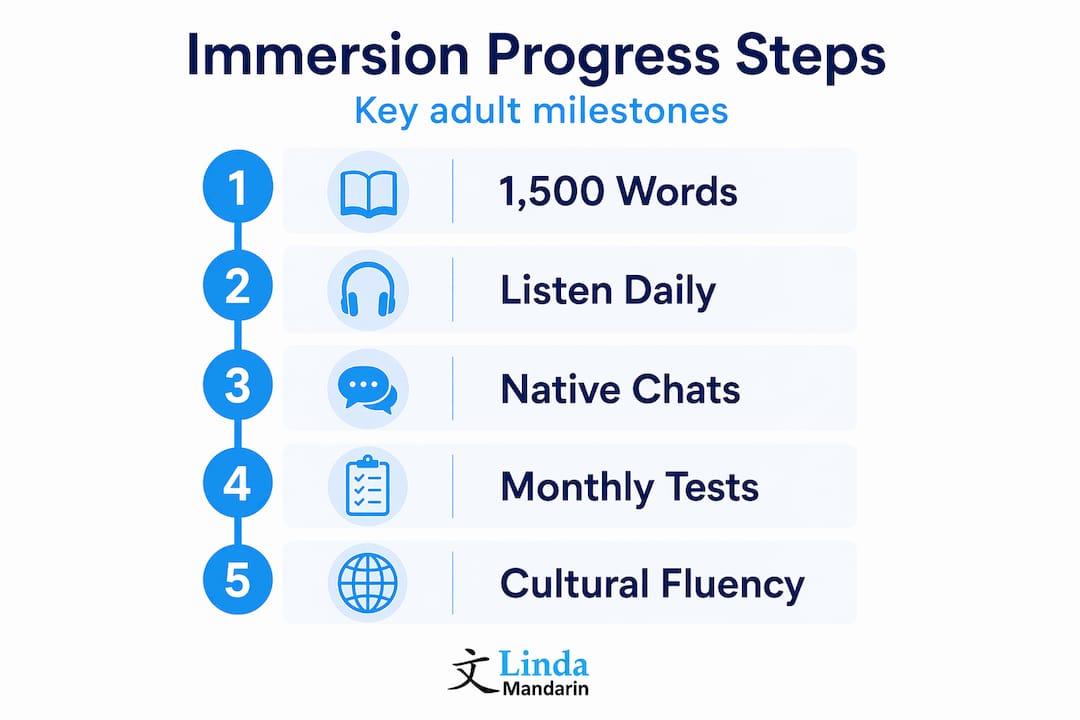
| Milestone | How to test it | What it signals |
|---|---|---|
| 1,500 core words acquired | Watch a native video without subtitles; note comprehension rate | Ready for intermediate immersion content |
| Following a native conversation | Join a language exchange and hold 5 minutes without switching languages | Listening comprehension is functional |
| Reading short articles without lookup | Read a Mandarin news brief; track how often you stop | Reading fluency is developing |
| Thinking in Mandarin spontaneously | Notice when you form a thought in Mandarin without translating | A major cognitive milestone |
Informal assessments work better than you might think. Recording yourself speaking for two minutes every month and then listening back gives you an honest picture of tonal accuracy and vocabulary range that no app score can replicate.
Native speakers and experienced tutors are your most valuable feedback sources. Even a single session with a qualified instructor every few weeks can identify pronunciation habits or tonal errors you have been reinforcing through practice. Catching those early prevents months of correcting ingrained mistakes later.
Pro Tip: Set a monthly “comprehension benchmark” using the same native video or audio clip. Track how much more you understand each month compared to the last. Concrete improvement data is more motivating than any streak counter.
Early, sustained immersion supports cognitive flexibility and cultural adaptability, which boosts long-term retention. The goal is not just to pass a benchmark. It is to build the kind of flexible, context-sensitive comprehension that holds up in real conversations.
My honest take on immersion vs. traditional learning
I have worked closely with adult Mandarin learners long enough to say this plainly: traditional classroom methods alone rarely produce fluency. They produce test-takers. Students who can conjugate grammar rules but freeze the moment a native speaker uses slang or talks at natural speed.
What I have seen work, consistently, is when learners stop treating Mandarin as a subject and start treating it as the medium. One professional I worked with made faster progress in three months of deliberate immersion than in two years of textbook classes. The shift was simple. She stopped studying Mandarin and started living parts of her day in it. Reading industry news in Mandarin. Watching her favorite cooking shows in Chinese. Having weekly calls with a Mandarin-speaking colleague just to practice.
The distinction between immersion and enrichment is not a technicality. Only immersion leads to native-like fluency because only immersion trains your brain to process meaning without going through English first. That cognitive shift takes time, and it requires real commitment to building Mandarin into your daily life. But when it clicks, the acceleration is remarkable.
The readers who get the most from this approach are not necessarily the most talented linguists. They are the most consistent ones.
— Paul
Accelerate your Mandarin with Linda Mandarin
If you are ready to move beyond self-study and want immersion-quality instruction built for adults, Linda Mandarin has been delivering exactly that in Singapore since 2003.

Linda Mandarin’s courses are structured around real-world communication from the first lesson. Whether you are working toward conversational confidence, professional-level business Mandarin, or need corporate training for your team, the school’s certified native instructors tailor instruction to your pace and goals. Classes are available in group, private, and live online Zoom formats, so your schedule does not have to change to fit your learning. The school is located at 10 Anson Road, Level 22, International Plaza, Singapore 079903, right above Tanjong Pagar MRT. Explore the adult Mandarin course levels or check out the intensive Mandarin program if you want faster results through structured immersion.
FAQ
What is the Mandarin immersion process?
The Mandarin immersion process is a language learning approach where Mandarin becomes the medium for daily thinking, communication, and content consumption rather than a subject studied in isolation. It combines consistent input through native content, real conversations, and structured instruction.
How long does Mandarin immersion take to show results?
Most adult learners notice measurable comprehension gains within two to three months of consistent daily immersion. Reaching conversational fluency typically takes one to two years depending on input volume and practice quality.
What is the most important vocabulary milestone in Mandarin immersion?
Acquiring 1,500 high-frequency words is the key early milestone, unlocking approximately 80% comprehension of everyday Mandarin conversations and making native content genuinely accessible.
Can adults learn Mandarin fast through immersion?
Yes. Adults who structure their immersion around high-frequency input loops and regular native speaker interaction typically progress faster than those using traditional study methods alone. Consistency and cultural engagement accelerate the process significantly.
How is immersion different from a regular Mandarin class?
A regular class teaches Mandarin as a subject. True immersion uses Mandarin as the instruction medium for other content, which trains the brain to process meaning directly in the language rather than translating from English.