TL;DR:
- Business Mandarin uses industry-specific vocabulary, formal tone, and cultural etiquette, unlike conversational Mandarin. Transitioning requires deliberate practice, focusing on formality, respect, and adapting to communication channels like email, meetings, and messaging apps. Regular targeted study and cultural awareness are essential for professional fluency.
Business Mandarin and conversational Mandarin are two distinct language styles that serve completely different communication goals. Conversational Mandarin is the everyday spoken language used for general daily interactions, while business Mandarin requires industry-specific vocabulary, formal written communication, and cultural etiquette that go well beyond general conversational skills. The differences between business and conversational Mandarin affect everything from the words you choose to the way you structure an email or open a meeting. Understanding these distinctions is the first step toward communicating with real confidence in professional settings. Linda Mandarin, based in Singapore’s central business district, has been training adult learners in both styles since 2003.
What are the key vocabulary differences between business and conversational Mandarin?
The most immediate gap between business Mandarin vs conversational Mandarin shows up in vocabulary. Everyday Mandarin relies on simple, high-frequency words that get the point across in context. Business Mandarin demands precise terminology for negotiations, contracts, financial reporting, and formal correspondence.

A conversational learner might say a general phrase meaning “let’s talk about it later.” A business speaker uses specific terms for scheduling a follow-up meeting, referencing agenda items, or proposing a formal review. The gap is not just about formality. It is about having the right word for the right professional situation.
| Conversational Mandarin | Business Mandarin |
|---|---|
| General greeting (hello, how are you) | Formal opening address (respected colleague) |
| “Let’s discuss this” | “I would like to schedule a formal review” |
| “I think…” | “Our company’s position is…” |
| Casual agreement (“okay, sure”) | Formal confirmation (“We confirm our agreement”) |
| “Call me later” | “Please contact me at your earliest convenience” |
Business Mandarin also incorporates modern industry terms drawn from finance, technology, and law. Words like “supply chain,” “quarterly earnings,” and “due diligence” each have specific Mandarin equivalents used in professional contexts. Learners who only study conversational Mandarin will not encounter these terms naturally. Structured business Mandarin vocabulary training closes this gap directly.
- Negotiation language includes polite softening phrases alongside direct requests.
- Formal email phrasing follows structured conventions not found in casual texting.
- Industry jargon varies by sector: finance, tech, and legal Mandarin each have distinct term sets.
- Modern business Mandarin blends Chinese vocabulary with adapted English loan terms in multinational settings.
Pro Tip: Build a personal glossary of 10 to 15 business Mandarin terms specific to your industry. Review them weekly. Targeted vocabulary practice outperforms general study for professional communication.
How does tone and formality differ between business and conversational Mandarin?
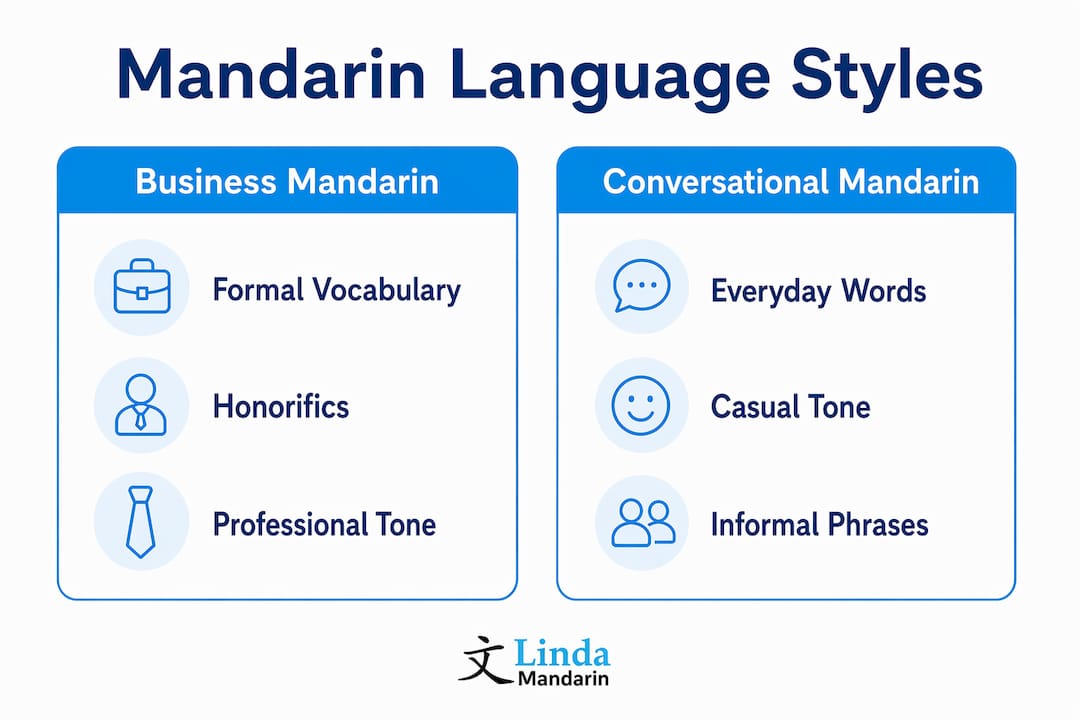
Tone is where formal vs informal Mandarin diverges most sharply, and where mistakes cause the most damage. Conversational Mandarin prioritizes being understood in daily life, while business Mandarin prioritizes professional credibility and relationship maintenance. That shift in priority changes every sentence you speak or write.
The most visible marker is the pronoun you use. In casual speech, “你” (nǐ) is the standard word for “you.” In business settings, using “您” (nín) signals respect and establishes the right professional tone immediately. Skipping this distinction reads as careless or even disrespectful to a Chinese business counterpart.
Hierarchy is linguistically embedded in business Mandarin. Failing to use honorifics or professional titles in introductions and communication undermines your credibility before the conversation even begins. Chinese business culture places significant weight on proper address, and your language choices signal whether you understand that culture.
Key formality markers in business Mandarin include:
- Using professional titles before names (Director Wang, Manager Li) rather than first names alone.
- Opening meetings with structured small talk before moving to business topics.
- Employing indirect language to soften requests or disagreements.
- Avoiding blunt refusals. A polite “we will consider this carefully” carries more weight than a direct “no.”
- Closing formal correspondence with set phrases that signal respect and professionalism.
“Effective negotiators balance direct requests with polite modifiers to maintain harmony.” — ChineseForWork
The concept of “mianzi” (face) drives much of this formality. Causing someone to lose face in a meeting, even unintentionally, damages the relationship. Softening language and indirect expressions are preferred in business Mandarin precisely to protect everyone’s dignity in the room. This is not vagueness. It is a deliberate communication strategy.
Pro Tip: Before your next business meeting in Mandarin, confirm the correct title and surname for each person you will address. Using the right title from the first introduction sets a professional tone that lasts the entire meeting.
How do context and communication channels shape Mandarin language choices?
The setting and medium of communication directly determine which Mandarin style is appropriate. Effective business Mandarin communication blends language skill, cultural awareness, and medium adaptation across emails, meetings, and chat platforms. Each channel carries its own rules.
-
Face-to-face meetings. Spoken business Mandarin requires clear pronunciation and correct tones. Mispronounced numbers or technical terms in business Mandarin generate confusion that casual conversation can absorb through context. In a contract discussion, a tonal error on a number is not a minor slip.
-
Formal emails. Business Mandarin emails open with structured greetings like “尊敬的” (zūnjìng de, meaning “respected”) and close with formal phrases like “此致敬礼” (cǐ zhì jìng lǐ, meaning “with highest respects”). These formal email conventions are standard professional practice and their absence signals inexperience.
-
Messaging apps (WeChat, DingTalk). Internal team chats on platforms like WeChat often blend casual and semi-formal Mandarin. The tone is lighter than email but still more structured than personal conversation. Knowing when to shift registers on these platforms is a skill in itself.
-
Multinational team environments. In multinational companies in China, language blends Chinese and English with mixed communication styles. This hybrid environment demands adaptability between direct Western business communication and Chinese indirectness. A learner who only knows one style will struggle in these settings.
-
Presentations and reports. Written business Mandarin for presentations follows strict structural conventions. Clarity is the priority. Ambiguous phrasing that works in conversation creates real misunderstandings in a board report or client proposal.
Understanding Chinese business culture and etiquette is not separate from language learning. It is part of it. The channel you use and the relationship you have with the other person both determine which Mandarin style is correct.
How can learners transition from conversational to business Mandarin?
Moving from conversational Chinese skills to professional fluency requires a deliberate shift in focus, not just more vocabulary. The core conversational skills you already have are a real foundation. The transition is about building new layers on top of them.
Two focused lessons per week plus regular review outperform sporadic study for mastering business Mandarin. Consistency matters more than intensity. Short, regular practice sessions with real correction build lasting professional habits.
Practical strategies for making the transition:
- Focus on tones in professional contexts. Tonal accuracy matters more in business than in casual speech. Practice business vocabulary with a certified instructor who can correct errors before they become habits.
- Study real business documents. Read actual Mandarin business emails, contracts, and meeting minutes. Exposure to authentic professional language accelerates vocabulary acquisition faster than textbook exercises.
- Role-play professional scenarios. Simulate meetings, negotiations, and client calls in Mandarin. Scenario practice builds the automatic responses you need under real professional pressure.
- Build cultural competence alongside language skills. Learning Mandarin for business means understanding why certain phrases are used, not just what they mean. Cultural context makes the language stick.
- Seek structured feedback. Self-study builds vocabulary but rarely corrects the subtle formality errors that undermine professional credibility. A qualified instructor catches these gaps early.
Pro Tip: Record yourself speaking business Mandarin phrases and play them back. Hearing your own tonal errors is one of the fastest ways to identify and fix pronunciation habits that classroom practice alone might miss.
The learners who progress fastest are those who treat business Mandarin as a separate skill set from conversational Mandarin, not just a harder version of the same thing. That mindset shift changes how you study and how quickly you improve.
Key Takeaways
Business Mandarin and conversational Mandarin require different vocabulary, tone, and cultural knowledge, and treating them as the same skill set is the most common mistake adult learners make.
| Point | Details |
|---|---|
| Vocabulary gap is real | Business Mandarin uses industry-specific terms and formal phrasing not found in everyday conversation. |
| Tone and honorifics matter | Using “您” instead of “你” and proper titles signals respect and professional credibility. |
| Channel shapes language | Emails, meetings, and chat apps each require a different level of formality in business Mandarin. |
| Consistency beats intensity | Two focused practice sessions per week with review outperform irregular study for professional fluency. |
| Culture is part of the language | Understanding mianzi and indirect communication is as important as vocabulary for business success. |
What I’ve learned watching learners make the same mistake twice
Most adult learners who come to business Mandarin with a conversational base make the same error. They assume formal Mandarin is just conversational Mandarin with harder words. It is not. The structure, the intent, and the cultural logic are different.
I have watched confident conversational speakers stumble badly in their first business meeting because they used casual pronouns with a senior executive or skipped the formal opening in an email. The language was technically correct. The register was completely wrong. The damage to the relationship was immediate and real.
The other mistake I see constantly is overcorrecting. Learners who know formality matters sometimes load every sentence with complex vocabulary and stiff phrasing. That reads as unnatural and creates distance rather than trust. Mastering business Mandarin is about using polite softening phrases and indirect language, not just formal or complex terms. The goal is warmth within structure.
Cultural adaptability is the skill that separates good business Mandarin speakers from great ones. You need to read the room, adjust your register mid-conversation, and know when a direct statement serves better than an indirect one. That only comes from practice in real professional settings, not from a textbook alone. Personalized coaching with scenario-based practice is the fastest path I have seen to genuine professional fluency.
— Paul
Build the professional Mandarin skills your career needs
Linda Mandarin has trained adult professionals in Singapore since 2003, with courses that cover both conversational and business communication in Mandarin from the ground up.

The school’s corporate Mandarin training program is built specifically for professionals who need to communicate in formal business settings, covering vocabulary, tone, email writing, and cultural etiquette. Flexible online Zoom classes and group or private formats make it practical for working adults. Classes are held at 10 Anson Road, Level 22, International Plaza, Singapore 079903, right above Tanjong Pagar MRT. For professionals ready to close the gap between casual and professional Mandarin, Linda Mandarin’s business Chinese courses offer a structured, instructor-led path to real workplace fluency.
FAQ
What is the main difference between business and conversational Mandarin?
Conversational Mandarin focuses on being understood in everyday situations, while business Mandarin requires formal vocabulary, honorifics, and cultural etiquette to maintain professional credibility and relationships.
Why do honorifics matter so much in business Mandarin?
Using “您” (nín) instead of “你” (nǐ) and addressing people by their professional titles signals respect and establishes trust. Skipping these conventions undermines your credibility in Chinese professional settings.
How long does it take to transition from conversational to business Mandarin?
The timeline depends on your current level and study consistency. Two focused lessons per week with regular review and real-world practice is the most effective approach for building professional fluency.
Do I need to learn business Mandarin if I already speak conversational Mandarin?
Yes. The vocabulary, tone, and communication norms in business Mandarin are distinct enough that conversational fluency does not transfer automatically to professional settings without targeted study.
How does communication channel affect business Mandarin usage?
Formal emails use structured greetings and closings not used in chat or casual speech. Meetings require clear tonal pronunciation, and messaging apps like WeChat use a semi-formal register that sits between the two styles.