Start with pinyin and tones, add daily spaced-repetition vocabulary review, and get two live speaking sessions into your week from day one. That combination beats any single app or textbook because it forces your ear, mouth, and memory to work together instead of in isolation. Chinese language learning rewards consistency over intensity, and adults who treat it like a habit rather than a project tend to stick with it past the three-month wall where most beginners quit.
Here is where to start today:
- Learn the full pinyin chart and all four tones before touching characters seriously.
- Set a 15 to 30 minute daily session using a Spaced Repetition System (SRS) for vocabulary.
- Book at least two speaking sessions a week with a partner or tutor.
- Pick a structured course or teacher rather than piecing together random content.
- Aim for a rough CEFR A1 equivalent (basic greetings, simple questions, everyday phrases) as your first milestone.
For most working adults, an online Zoom group class with a small cohort, backed up by daily solo SRS practice, is the easiest format to sustain. A program like Linda Mandarin’s course pathway builds exactly around that starter sequence.
Key Takeaways
Consistent daily practice built around pinyin, tones, and active speaking outperforms sporadic, character-heavy study for adult Chinese language learning.
| Point | Details |
|---|---|
| Start with pinyin and tones | Master the sound system before heavy character study to speed up intelligibility. |
| Use SRS daily | Short spaced repetition review sessions consistently beat occasional long cramming sessions. |
| Speak twice weekly minimum | Live speaking practice with a partner or tutor converts recognition into real production. |
| Choose Mandarin unless family ties say otherwise | Mandarin gives the widest practical reach across business, travel, and media. |
| Consider a structured program | Providers like Linda Mandarin offer syllabus-based online Zoom, private, and corporate tracks for adult learners. |
Table of Contents
- Core Building Blocks Every Beginner Must Learn First
- Practical Study Methods and a Weekly Routine That Works
- Where to Learn: Formats, Pros and Cons
- How to Choose the Right Course or Provider
- Linda Mandarin’s Structured Pathway From Zero to Practical Fluency
- Overview of Chinese Dialects and Deciding Which One to Learn
- Cultural Aspects Important for Language Learning Motivation and Context
- Resources for Advanced Learners: Literature, Media, and Writing Practice
- Assessment and Certification Options
- If You Prefer Guided Classes: How Linda Mandarin Helps
- Sources
- FAQ
Core Building Blocks Every Beginner Must Learn First
Pinyin is not optional homework, it is the operating system for everything else. Pay attention to the four tones and a word like “mā” (mother) can turn into “mǎ” (horse) mid sentence, which is why courses such as Beginning Chinese 1 at Carnegie Mellon put tone drills before vocabulary lists. Nail pinyin and tones in the first few weeks, and reading, typing, and speaking all get faster later.
Listening and speaking need to happen together, not listening first and speaking “someday.” Passive listening (podcasts in the background) helps your ear adjust to rhythm, but active production, actually saying sentences out loud and getting corrected, is what moves words from recognition to recall.
Basic characters come next, and recognition beats handwriting early on. You do not need to write 汉字 by hand to read a menu or a text message. Focus on learning the most frequent characters in context, not isolation.
- Recognition and typing (pinyin input) before stroke-order handwriting.
- Sentence frames (“我想要…” / “I would like…”) instead of memorizing isolated words.
Loecsen’s beginner approach recommends layering characters this way: recognize the shape, attach pinyin and tone, then attach meaning, then reuse it in a new sentence. That layered approach avoids the trap of memorizing 500 characters you can recognize but never actually use in speech.
Pro Tip: Don’t chase perfect tones before you can hold a 30-second conversation. Beginners who obsess over tone perfection often freeze up mid-sentence. Speak first, refine tones as you go.
Practical Study Methods and a Weekly Routine That Works
Spaced Repetition Systems work because they show you a word right before you would naturally forget it, which is far more efficient than rereading a vocabulary list ten times in one sitting. Ten to fifteen minutes a day on an SRS deck, done consistently, will outperform a single two-hour cramming session every time.
Pair that with active speaking drills. Shadowing (repeating audio in real time, matching rhythm and tone) and sentence mining (pulling full sentences from shows or conversations instead of single words) both force your brain to produce language, not just recognize it. If you don’t have a regular speaking partner, a structured class gives you built-in accountability for this.
A realistic weekly plan for a working adult looks like this:
- Monday, Wednesday, Friday: 15 to 20 minutes SRS vocabulary review.
- Tuesday: 30-minute focused listening session (short native-audio clips, repeated twice).
- Thursday: 30 to 45 minute live speaking session with a tutor or partner.
- Saturday: reading and light writing practice (messages, short sentences).
- Sunday: light review, no new material, just consolidation.
A few habits keep this sustainable long term:
- Set micro-goals (“order food in Mandarin” beats “become fluent”).
- Stack the SRS session onto an existing habit, like right after coffee.
- Track weekly minutes, not just vocabulary count, since consistency matters more than volume.
Pro Tip: Combine your SRS deck with full sentences instead of single words. A card that says “这个多少钱?” (How much is this?) trains tone, grammar, and vocabulary in one repetition, instead of three separate drills.
Where to Learn: Formats, Pros and Cons
Different formats solve different problems, and picking the wrong one for your schedule is the most common reason adults quit within two months.
- Self-study apps and SRS decks: cheap, flexible, good for daily vocabulary maintenance. Weak on real speaking feedback and easy to abandon without accountability, a limitation even popular apps acknowledge as supplementary rather than a full replacement for guided instruction.
- MOOCs and structured online courses: clear progression, often built around cultural context, as seen in Coursera’s Mandarin Chinese 1. Limited live speaking correction unless paired with a tutor.
- Instructor-led group classes (online Zoom): built-in speaking practice, structured syllabus, peer accountability. Less individualized pacing than one-on-one.
- Private tutoring: maximum speaking time, custom pacing for business or travel goals. Costs more per hour than group formats.
- Corporate and intensive in-person training: fast progress for workplace deadlines, structured around real business scenarios.
A busy professional usually does best with a Zoom group class plus daily SRS. A self-directed learner with strong discipline can lean on structured MOOCs and graded readers. Anyone with a workplace deadline should look straight at corporate or private formats.
How to Choose the Right Course or Provider
A flashy website means nothing if the syllabus is vague. Before enrolling anywhere, check:
- A clear syllabus with stated learning outcomes for each level.
- Teacher qualifications, native or highly experienced instructors who teach comfortably in English and Mandarin.
- Class size small enough that you actually get speaking time each session.
- Format fit: Zoom for flexibility, in-person if you learn better with face-to-face correction.
- Schedule flexibility, especially evening or weekend slots for working adults.
- Transparent pricing and a trial class option before you commit.
Red flags include no visible syllabus, classes built entirely around copying characters with no speaking component, and vague claims about “experienced teachers” with no actual credentials listed. Programs like the University of Sheffield’s Confucius Institute show what a clear, modular structure with level outcomes should look like.
If you’re comparing options, weigh syllabus clarity and speaking opportunities far more heavily than marketing polish. During a trial class, ask:
- What will I be able to say or understand after this level?
- How much of each class is spent speaking versus listening to the teacher?
- What happens if I miss a session, can I reschedule or join another group?
Linda Mandarin’s Structured Pathway From Zero to Practical Fluency
A well-built adult program moves in stages, not straight into random topics. Linda Mandarin’s course structure starts with pinyin and tone fundamentals, moves into conversational modules for everyday situations, then layers in workplace and business-specific language once the basics hold.
A learner who starts with pinyin and structured speaking practice reaches functional conversation faster than one who jumps straight into memorizing characters, according to Loecsen’s beginner-course framework and echoed in most modular university programs.
What a solid provider should offer at each stage:
- A visible syllabus with outcomes stated per level, not vague promises.
- Bilingual, experienced instructors who can explain grammar in English when needed.
- Flexible formats: online Zoom group classes, private one-on-one sessions, and corporate blocks.
- Scheduling that fits real adult lives, evening classes and weekend intensives included.
By the later modules, learners are typically handling short meetings, drafting simple business emails, and holding real conversations rather than reciting memorized phrases. The schedule and fee details outline how these levels connect.
Overview of Chinese Dialects and Deciding Which One to Learn
Mandarin is not “the” Chinese language, it is the most widely spoken variety among several distinct spoken forms, including Cantonese, Hokkien, Shanghainese, and others. These are not simply accents of one language; a Cantonese speaker and a Mandarin speaker often cannot understand each other’s spoken conversation at all, even though the written characters largely overlap.
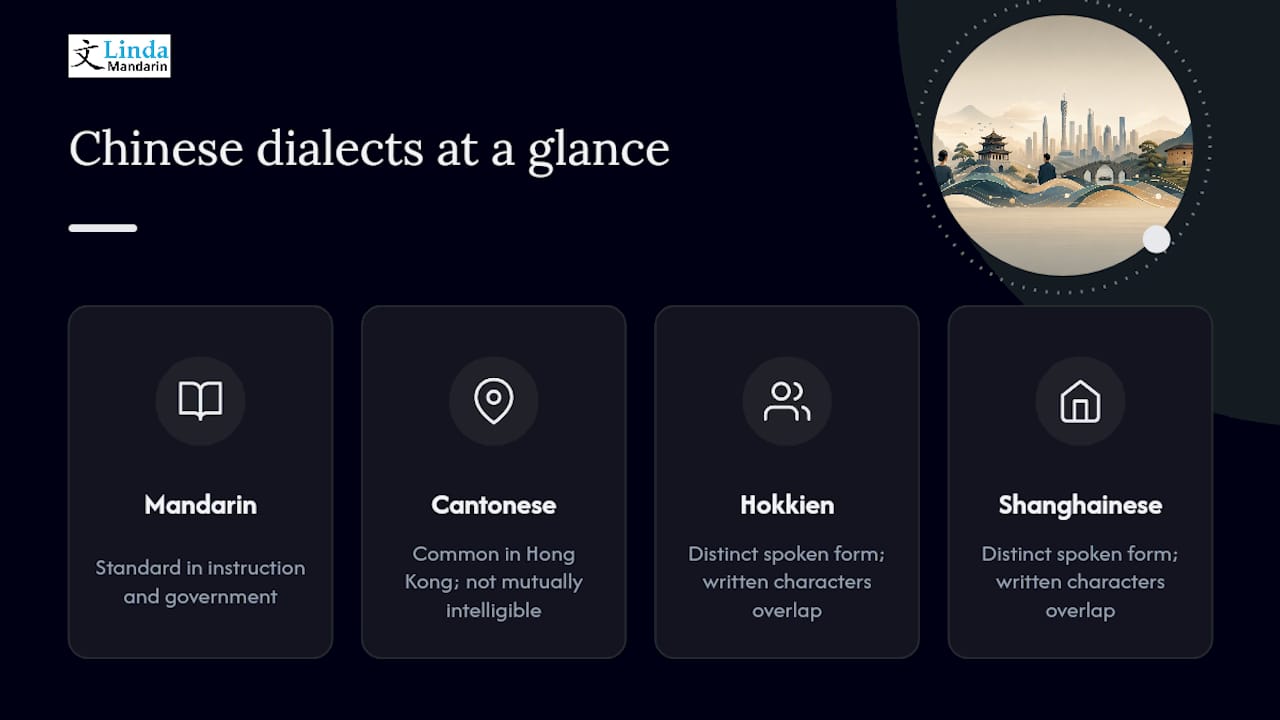
For most adult learners outside of a specific family or regional connection, Mandarin is the practical default. It is the standard language of instruction and government across mainland China and Taiwan, and it dominates business, diplomacy, and media production. If your goal is workplace communication, travel flexibility, or general conversational ability, Mandarin gives you the widest reach for the effort invested.
The exception is personal: if your family speaks Cantonese, or your business dealings are concentrated in Hong Kong or a Cantonese-speaking community, learning that dialect directly makes more sense than routing through Mandarin first. Written Chinese characters offer a partial bridge between dialects since simplified characters used in Mandarin contexts are largely shared with other varieties, but pronunciation and even vocabulary can diverge sharply.
One clarifying point: within Mandarin itself, “Standard Mandarin” (based on the Beijing dialect) is what nearly every course, textbook, and structured program teaches, so you don’t need to worry about regional Mandarin variation as a beginner. Pick Mandarin unless you have a specific reason not to, and move on to actually studying it.
Cultural Aspects Important for Language Learning Motivation and Context
Language and culture are not separable in Chinese the way they sometimes feel in other languages you may have studied. Idioms, business etiquette, and even basic politeness markers carry cultural weight that a vocabulary list alone won’t teach you. Knowing when to use 您 (the formal “you”) instead of 你 in a business meeting, for instance, signals respect in a way that changes how a conversation lands.

Understanding cultural context also keeps motivation alive during the inevitable plateau every learner hits around month two or three. Learning why certain phrases exist, like the layered greetings used before getting to business, or the significance of specific festivals and food traditions, gives your studying a reason beyond passing a test.
Business Mandarin in particular leans on cultural fluency as much as vocabulary. Meeting etiquette, gift-giving customs, and indirect communication styles often matter more to a successful interaction than grammatical precision. A program built around business communication training typically folds these cultural cues directly into the language lessons rather than treating them as an afterthought.
If you’re learning for personal reasons, exploring Chinese cinema, music, or literature in the original language turns study time into genuine enjoyment rather than a chore, and that shift is often what separates learners who quit at month three from those still going at month twelve.
Resources for Advanced Learners: Literature, Media, and Writing Practice
Once you clear the beginner and intermediate plateau, the challenge shifts from acquiring basic vocabulary to handling nuance, idiom, and longer written text. Graded readers remain useful here longer than most learners expect. Collections like Yale University Press’s Chinese Dialogues use repeated, realistic conversation patterns that build fluency through volume rather than isolated grammar drills.
For media, shift from short clips to unedited native content: news broadcasts, drama series without English subtitles, and podcasts aimed at native speakers rather than learners. The jump feels uncomfortable at first, but it trains your ear for natural speed and colloquial phrasing that textbooks rarely cover.
Writing practice at the advanced level should move beyond single sentences into short paragraphs, emails, or journal entries. Keeping a simple weekly journal in Chinese, even five sentences about your day, builds the kind of production skill that passive reading never will. Pairing that with a native speaker or tutor who corrects your writing regularly closes the gap between what you can read and what you can actually produce.
Literature is the long-term goal for many advanced learners, and short stories tend to be a better entry point than novels. Contemporary short fiction uses more everyday vocabulary than classical or heavily literary texts, making it a realistic stretch goal for someone one or two years into consistent study.
Assessment and Certification Options
Formal proficiency testing gives you an external benchmark instead of relying purely on how confident you feel, which is notoriously unreliable in language learning. The internationally recognized standardized test for Mandarin proficiency assesses listening, reading, and (at higher levels) writing across six graded levels, from basic survival phrases up to near-native academic and professional fluency.
For adult learners, testing serves two purposes. First, it’s a concrete milestone that breaks the abstract goal of “learning Chinese” into measurable stages, which helps combat the motivation dip that hits most learners by month three. Second, for professionals, a recognized certification level can matter for job applications or internal company requirements involving China-based operations or clients.
Not every learner needs to test formally. If your goal is purely conversational or workplace communication without a specific certification requirement, you can track progress through practical benchmarks instead, holding a five-minute unscripted conversation, reading a simple news headline, or handling a business email without a dictionary. These informal checkpoints matter just as much as a test score for measuring real progress.
A structured test preparation course can help if you do need formal certification, since exam-specific vocabulary and question formats differ meaningfully from general conversational study.
Author’s Practical Note: Encouragement and Realistic Expectations
Tone perfection and character literacy come later. Intelligibility comes first. Most frustration in the early months comes from expecting fluency on a timeline that doesn’t match how language actually sinks in.
At three months of consistent study (roughly 4 to 6 hours a week), expect basic conversations, ordering food, introducing yourself, handling simple directions. At six months, expect to participate in short meetings and handle everyday situations without translating in your head first.
Set small, measurable wins early: order coffee entirely in Mandarin, introduce yourself at a networking event, get through a five-minute call without switching to English. Those wins compound faster than most learners expect.
If You Prefer Guided Classes: How Linda Mandarin Helps
Self-study gets you vocabulary. It rarely gets you a real conversation partner who corrects your tones in real time, which is exactly where a structured class earns its keep for busy adults.

Linda Mandarin runs adult programs built around online Zoom group classes, private one-on-one lessons, and corporate training blocks, all designed for people juggling a full-time job alongside language study. Three things make it worth a look: a syllabus with clear outcomes at every level, bilingual instructors experienced in teaching working professionals rather than classroom kids, and flexible scheduling from a central location right above Tanjong Pagar MRT for anyone who prefers occasional in-person sessions. If your goal involves workplace Mandarin specifically, the corporate training track folds business vocabulary and meeting etiquette directly into the curriculum. Check the course levels page to see where your current ability fits, or book a trial consultation to get a realistic read on your starting point before committing to a full term.
Sources
- Chinese 1 for Independent Learners — OLI Carnegie Mellon University
- Chinese for Everyone — 12-Week Mandarin Chinese Course | Confucius Institute, University of Sheffield
- Mandarin Chinese 1: Chinese for Beginners | Coursera
- Learn Chinese online: a free course for complete beginners — Loecsen
FAQ
How Can I Learn Chinese Easily?
Focus on pinyin and tones first, use short daily spaced-repetition sessions for vocabulary, and get real speaking practice at least twice a week rather than relying on passive listening alone.
How Do You Say 1 Through 10 in Mandarin?
The numbers one through ten in Mandarin are: 一 (yī), 二 (èr), 三 (sān), 四 (sì), 五 (wǔ), 六 (liù), 七 (qī), 八 (bā), 九 (jiǔ), and 十 (shí).
Can I Learn Mandarin in Three Months?
In three months of consistent study, around 4 to 6 hours a week, most adults can handle basic conversations like ordering food, introducing themselves, and asking simple directions, but full conversational fluency typically takes longer.
How Do I Teach Myself Mandarin?
Combine a structured beginner resource like Beginning Chinese 1 or Coursera’s Mandarin Chinese 1 with daily SRS vocabulary review, but plan for a live speaking partner or tutor since self-study alone rarely builds strong spoken skills.
Is It Better to Learn Mandarin Online or In Person?
Both work if the course has a clear syllabus and real speaking time; online Zoom classes tend to fit busy adult schedules better, while in-person sessions can suit learners who want more direct face-to-face correction.