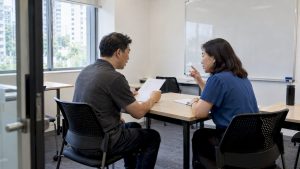
The fastest way to learn Chinese in Singapore is to join a structured Mandarin course with a native instructor, practise speaking every week, and then use the language in a real setting, whether that is a client call or a hawker centre. For adults, the real decisions are format (small group, private or online Zoom), goal (everyday conversation or business Mandarin) and budget. This guide walks through each one, with the course fees we publish and the market ranges you should compare them against.
TL;DR
- Pick your goal first: conversational Mandarin for daily life and travel, or business Mandarin for meetings, negotiations and emails.
- Group classes are the most economical route. Our group classes cost S$500 to S$600 per student, while private lessons start at S$1,730.
- Online Zoom classes suit busy professionals. Our online Conversational Mandarin course is S$1,580 and the Business Mandarin course is S$1,880.
- Speaking practice outside class matters as much as the lessons. Singapore gives you plenty of chances to use Mandarin at work and in the neighborhood.
- Visit a school, sit in on the teaching style and ask about class size, level placement and the schedule before you pay.
Table of Contents
- Why Singapore is a good place to learn Mandarin
- Decide what you want Mandarin for
- Group, private or online: how the formats compare
- What learning Chinese in Singapore costs
- A realistic learning path, level by level
- How to choose a Mandarin school
- Our perspective: why adults stall, and how we teach around it
- Make the most of your lessons
- Where our classes run
- Start learning with Linda Mandarin
- FAQ
- Sources
Why Singapore is a good place to learn Mandarin
Mandarin is not a foreign curiosity here. Since the 1960s, almost everyone who went to school in Singapore has learnt English plus a Mother Tongue, and for most Chinese Singaporeans that Mother Tongue is Mandarin. That means colleagues, clients, taxi drivers and neighbors can all become practice partners.
The numbers show how much the language still matters. According to a survey by the Institute of Policy Studies, English is the most frequently spoken home language for 48.3% of residents, and 54.9% of respondents reported using Mandarin at work in 2024, making it the second most used workplace language after English. For an adult who deals with Chinese-speaking suppliers, customers or leadership, that is a practical reason to study.
There is also a caution. Because English dominates daily life, it is easy to live in Singapore for years and never speak a full sentence of Mandarin. People often switch to English the moment they hear a learner hesitate. A class with a fixed schedule, a teacher who corrects you and classmates at your level is what turns good intentions into progress.
Decide what you want Mandarin for
Before you compare schools, write down one sentence: “In six months I want to be able to …” The answer shapes everything else.
Everyday conversation
If you want to chat with a spouse’s family, order food, make friends or travel in China and Taiwan, you need listening and speaking first. Reading and writing can follow. A conversational course builds pinyin (the romanized sound system), tones, and the most common sentence patterns so that you can start talking within the first few lessons.
Business and professional use
If your goal is work, you need a different vocabulary: introducing your company, scheduling meetings, discussing price and delivery, handling small talk at a dinner with partners. Business Mandarin also teaches the etiquette around titles and politeness that textbooks for tourists skip. Many professionals combine this with a short writing workshop so they can draft emails and messages with confidence.
Reading and writing characters
Some adults want to read menus, signs, messages and documents. Characters take longer than speaking, so it helps to treat them as a separate track that runs alongside your conversation lessons rather than waiting until you are “fluent”.
Group, private or online: how the formats compare
All three formats work. The right one depends on your schedule, your budget and how you like to learn.
| Format | Best for | Strengths | Trade-offs |
|---|---|---|---|
| Small group class in person | Beginners and anyone who enjoys learning with others | Lower cost, classmates to practise with, steady weekly rhythm | Fixed timetable, pace set by the group |
| Private one-to-one class | Executives, travelers with a deadline, specific work goals | Content built around you, flexible scheduling, maximum speaking time | Highest cost |
| Online Zoom class | Busy professionals, people who travel or live far from the city | No commute, learn from home or the office | Needs a quiet space and good connection |
| Corporate training | Teams that need Mandarin together | Content tailored to the company’s industry and situations | Arranged for the company, not for individuals |
A small group is usually the sweet spot for a first course. You speak often enough to improve but pay a fraction of the private rate. Private lessons make sense when time is tight, when your needs are unusual (a negotiation next quarter, a posting to China) or when you feel shy in a group. Online lessons give you the same teaching without the travel, which in a city of long workdays is a bigger advantage than it sounds. If you are weighing online specifically, our guide to online Mandarin courses for professionals in Singapore goes through what to check.
What learning Chinese in Singapore costs
Fees vary a lot, so it helps to know the market range. A recent KakiList price guide puts adult group Mandarin classes at roughly S$180 to S$650 per month and private tutoring at S$40 to S$100 per hour in 2026. Intensive programs run longer and cost more.
Here are our own published course fees, per student:
| Course | Format | Fee |
|---|---|---|
| Beginner 1 Group Class | In person, group | S$500-600 |
| Conversational Group Mandarin Class | In person, group | S$600 |
| Business Mandarin Group Class | In person, group | S$500-600 |
| Conversational Private Mandarin Class | In person, private | S$1,730 |
| Business Chinese Private class | In person, private | S$1,980 |
| Online Chinese Course (Conversational Mandarin) | Online Zoom | S$1,580 |
| Online Chinese Course (Business Mandarin) | Online Zoom | S$1,880 |
Each fee is a one-off payment for the course. For a fuller breakdown of what adults tend to pay and what affects the price, see what adults pay for Mandarin classes in Singapore, and for current timings check the class schedule and fees page.
When you compare quotes, do not look at the headline number alone. Ask how many lessons the fee covers, how many students sit in a group, how long each lesson lasts, whether materials are included and what happens if you miss a class.

A realistic learning path, level by level
Progress in Mandarin is easier to plan when you break it into stages.
- Sounds and basics. Pinyin, the four tones and the neutral tone, greetings, numbers, time, simple questions. Tones are the hardest part for English speakers, so this stage needs a teacher who listens closely.
- Daily conversation. Shopping, transport, food, directions, talking about family and work. You start building sentences instead of repeating phrases.
- Intermediate fluency. Longer exchanges, opinions, describing past events and plans, understanding fast speech. This is where many self-learners stall without a class.
- Advanced and business Mandarin. Meetings, presentations, negotiations, formal and informal registers, and written communication.
Our course levels page shows how these stages map onto our classes. If you have studied before, a short placement conversation puts you in the right level so you do not repeat what you know or struggle to keep up.
How to choose a Mandarin school
A short checklist saves you from a poor fit:
- Native instructors who speak good English. You need someone who can explain grammar clearly when you are lost, then switch to Mandarin for practice.
- A clear syllabus. You should be able to see what you will be able to do at the end of each level.
- Speaking time. Ask how many minutes each student actually talks in a lesson.
- Small classes. The fewer the students, the more corrections you get.
- Location and schedule. A school you can reach after work, or one that offers Zoom, is a school you will keep attending.
- Business relevance. If work is your goal, look for content built on workplace situations, not only travel phrases.
Our longer guide to choosing Mandarin classes in Singapore covers these questions in more detail, and our instructors page explains who teaches.
Our perspective: why adults stall, and how we teach around it
We have taught Mandarin to adults in Singapore since 2003, and the same patterns come up year after year.
The first is the fluency-by-osmosis myth. Many expatriates assume that living here will make them speak Mandarin. It rarely does, because Singapore is so comfortable in English. Learners who improve fastest set a weekly class, do a little homework and then deliberately use a few new sentences with colleagues or in shops.
The second is starting with too much. Adults who try to learn characters, grammar and vocabulary all at once get discouraged. We prefer a progressive path: sounds first, then useful sentences, then reading and writing as confidence grows. Our syllabus follows international standards for Chinese proficiency levels, so each step builds on the last.

The third is ignoring the work context. A manager who needs to sit through a supplier meeting in Mandarin gains little from a course about ordering dumplings. That is why we run business Mandarin as its own course and tailor corporate training to the company’s industry, and we have trained teams from Fortune 500 companies.
Our advice: choose the smallest class that fits your budget, commit to at least one full course before judging your progress, and ask your teacher to focus on the situations you will actually face next month.
— Paul
Make the most of your lessons
Class is only a few hours a week. These habits turn it into progress:
- Review within 24 hours. Ten minutes the next day on new words and sentences beats an hour of cramming before the next lesson.
- Say it out loud. Record yourself on your phone and compare it with your teacher’s tones.
- Use the language in small doses. Order your coffee in Mandarin, greet the security guard, send a short message to a Chinese-speaking colleague.
- Read what interests you. Saving articles, annotating the words you do not know and coming back to them later is a good habit. A reading tool such as Omphalis, which lets you save and annotate articles, can help you keep your notes and source passages together.
- Be patient with tones. Everybody sounds wrong at first. Teachers expect it and will correct you gently.
Where our classes run
Our training centre is at 10 Anson Road, Level 22, International Plaza, Singapore 079903, right above Tanjong Pagar MRT. That makes it easy to join a lesson before work, at lunchtime or on your way home from the central business district. If you would rather stay at your desk or at home, our Zoom classes use the same syllabus and teaching approach.
Start learning with Linda Mandarin
If you want a structured route, begin with the format that suits you:
- New to Mandarin and happy to learn alongside others: our Beginner 1 Group Class.
- Want to talk comfortably in daily life: our Conversational Chinese course, in group or private format.
- Learning from home or the office: our online Zoom Chinese courses.
- Need Mandarin for work: our Business Chinese course.
- Training a team: our corporate Mandarin training. Fees for corporate training are arranged with us directly, so please get in touch through our website.
Not sure where to start? Tell us your goal and current level, and we will suggest the class that fits.
FAQ
What is the best way to learn Chinese in Singapore?
The most reliable way is a structured course with a native instructor, a fixed weekly schedule and plenty of speaking practice. Add short daily review and use Mandarin in real situations, such as at work or with neighbors. Self-study apps help with vocabulary, but they rarely fix tones or speaking confidence on their own.
Do people speak Mandarin in Singapore?
Yes. Mandarin is one of the four official languages, and 54.9% of respondents in a 2024 survey said they use it at work. English is still the most common home language, so you will often need to ask people to speak Mandarin with you.
How much do Mandarin classes for adults cost in Singapore?
It depends on format and intensity. A 2026 price guide lists group classes at about S$180 to S$650 per month and private tutoring at S$40 to S$100 per hour. Our own group classes are S$500 to S$600 per student, and our private conversational class is S$1,730.
Can I learn Mandarin online instead of attending a class?
Yes. Live Zoom lessons with a teacher give you the same correction and interaction as a classroom, without the commute. Our online Conversational Mandarin course is S$1,580 and the Business Mandarin course is S$1,880. Choose a quiet spot and test your audio before the first lesson.
Should I choose conversational or business Mandarin?
Choose conversational if your goal is daily life, family or travel. Choose business Mandarin if you need to handle meetings, negotiations or professional email. If you are a complete beginner heading into a Chinese-speaking workplace, many learners start with conversational basics and then move to the business course.
Sources
- Institute of Policy Studies: Language identity and management in Singapore
- KakiList: Language schools cost in Singapore (2026)
- Ministry of Education: Speech at the 9th Mother Tongue Languages Symposium