If you need practical spoken Mandarin, not exam scores, pick a speaking-first beginner course that runs on Zoom or in small groups and gives you a trial lesson before you commit. That combination gets adult beginners talking fastest, and it separates a real conversational program from a literacy-heavy one dressed up as “beginner Mandarin.”
- Who it fits: working adults, expatriates, and professionals with zero to minimal Mandarin
- Expected outcome: confident handling of daily errands and simple workplace exchanges
- Trust signals to look for: native-speaking instructors, small class or 1:1 options, a trial class before enrollment
Timeframe to expect: most adult learners reach basic conversational ability within roughly 6 to 12 months of consistent part-time study, faster with daily speaking practice built in.
Key Takeaways
Conversational fluency in Mandarin comes from consistent speaking practice paired with a structured, speaking-first course, not from vocabulary memorization alone.
| Point | Details |
|---|---|
| Course scope | Beginner conversational courses focus on pinyin, tones, and everyday phrases, not character writing. |
| Realistic timeline | Expect 6 to 12 months of part-time study for basic daily conversational ability. |
| Format choice | Group classes suit budget and consistency; private or online Zoom lessons suit flexible, fast-paced schedules. |
| Outside-class practice | Daily 15 to 30 minute speaking drills and real conversation partners speed up recall significantly. |
| Recommended option | Linda Mandarin offers speaking-first adult courses online and in person, with a trial class before enrollment. |
Table of Contents
- What Does a Conversational Mandarin Course Actually Teach?
- What Do You Practice Week to Week?
- Group, Private, or Online: Which Format Fits You?
- How Long Does It Take and What Does It Cost?
- How Do You Choose a Course You Can Trust?
- How Can You Practice Outside Class to Get Fluent Faster?
- Why Linda Mandarin Stands Out for Adult Beginners
- Ready to Start Speaking Mandarin With Confidence?
- Sources
- FAQ
What Does a Conversational Mandarin Course Actually Teach?
A beginner conversational Mandarin course is built around one goal: getting you talking, not getting you reading. That’s the core distinction between “conversational” and the exam-prep or literacy-first programs many people picture when they hear “Chinese class.”
The curriculum usually opens with survival vocabulary, pinyin, and the four tones, because tone errors are the single fastest way to say the wrong word by accident. From there it moves into basic sentence patterns and everyday phrases you’ll actually use, at a hawker stall, in a lift with a colleague, or on a client call.
Course listings for community-level conversational classes consistently emphasize everyday vocabulary and practical dialogues over grammar drills or character writing. Expect class time built around:
- Guided role-plays (ordering food, greeting coworkers, asking for directions)
- Response drills that force quick, unscripted replies instead of memorized scripts
- Listening practice using natural speech pace, not slowed-down textbook audio
- One-on-one pronunciation correction, especially on tone pairs that trip up English speakers
If a “beginner” course spends its first month on character stroke order, it’s not a conversational program. It’s a literacy program wearing a conversational label.
What Do You Practice Week to Week?
A well-sequenced beginner course follows a predictable arc, and knowing it helps you judge whether a syllabus is actually structured or just a loose collection of topics.
- Weeks 1 to 2: pinyin, the four tones, and basic greetings, drilled until pronunciation becomes automatic
- Weeks 3 to 5: core survival phrases, numbers, and question patterns for shopping, transport, and small talk
- Weeks 6 to 8: short dialogues combining what you’ve learned, with instructor feedback on flow, not just accuracy
- Weeks 9 and beyond: workplace-specific phrases, longer exchanges, and unscripted conversation practice
Every session, regardless of week, should include listening, repeating, and free speaking with correction. That mix matters more than the topic itself.
Pro Tip: Speak the new phrase out loud within the same session you learn it. Waiting until “you know it better” is the most common reason learners freeze up when a real conversation moves faster than they expect.
Group, Private, or Online: Which Format Fits You?
Format matters as much as content when you’re balancing Mandarin study against a full-time job. Here’s how the main options stack up:
- Group classes: lower cost per session, built-in speaking partners, but less individual correction time
- Private or 1:1 lessons: faster pacing tailored to your pronunciation gaps, at a higher per-hour rate
- Online Zoom classes: no commute, flexible evening slots, ideal if your schedule shifts week to week
- Hybrid formats: mix live in-person sessions with Zoom makeups when travel or work gets in the way
Busy professionals often lean toward evening or weekend group classes for consistency, then add private sessions closer to a big trip or presentation. A trial class and a flexible make-up policy matter here too: they let you test an instructor’s teaching style and pacing before paying for a full course, which lowers the risk of enrolling in the wrong format.
How Long Does It Take and What Does It Cost?
Realistic budgeting starts with timeframes, not price tags. Learners studying part-time, a few hours a week, generally need 6 to 12 months to hold basic daily conversations comfortably. Intensive, immersive study compresses that considerably, since a speaking-focused daily routine shortens the timeline far more than sporadic weekly classes ever will.
Pricing shapes vary by format:
- Group course packages: priced per term or per block of sessions, the most economical entry point
- Private lessons: charged per hour, reflecting one-on-one instructor time
- Intensive or full-time blocks: higher total cost but compressed timelines for people who need speed
What moves the price up or down: class size, instructor experience, and total course length. A 1:1 course with a senior instructor costs more per hour than a group class, but often gets you conversational faster, which can offset the difference over a full course.
How Do You Choose a Course You Can Trust?
Before you hand over payment, ask a few direct questions. The answers separate a course built for speaking outcomes from one built to fill seats.
- Is the instructor a native Mandarin speaker with real experience teaching adults, not just fluency?
- What’s the actual class size, and is a 1:1 option available if group pacing doesn’t suit you?
- Does the syllabus prioritize speaking and listening, or does it lean heavily on reading and writing?
- Can you sit in on a trial lesson before committing to a full course?
- Does the school publish clear learning outcomes, or does the marketing stay vague about what you’ll be able to do?
Watch for red flags: a syllabus dominated by character writing in the first few weeks, no visible student outcomes or testimonials, or vague promises like “learn Chinese fast” with no timeline attached. A checklist for evaluating Mandarin schools helps if you’re comparing multiple options side by side.
Strong programs share a few things in common: a syllabus you can actually read before enrolling, small classes or 1:1 availability, a trial lesson, and instructors with a track record teaching working adults rather than school-age students.
How Can You Practice Outside Class to Get Fluent Faster?
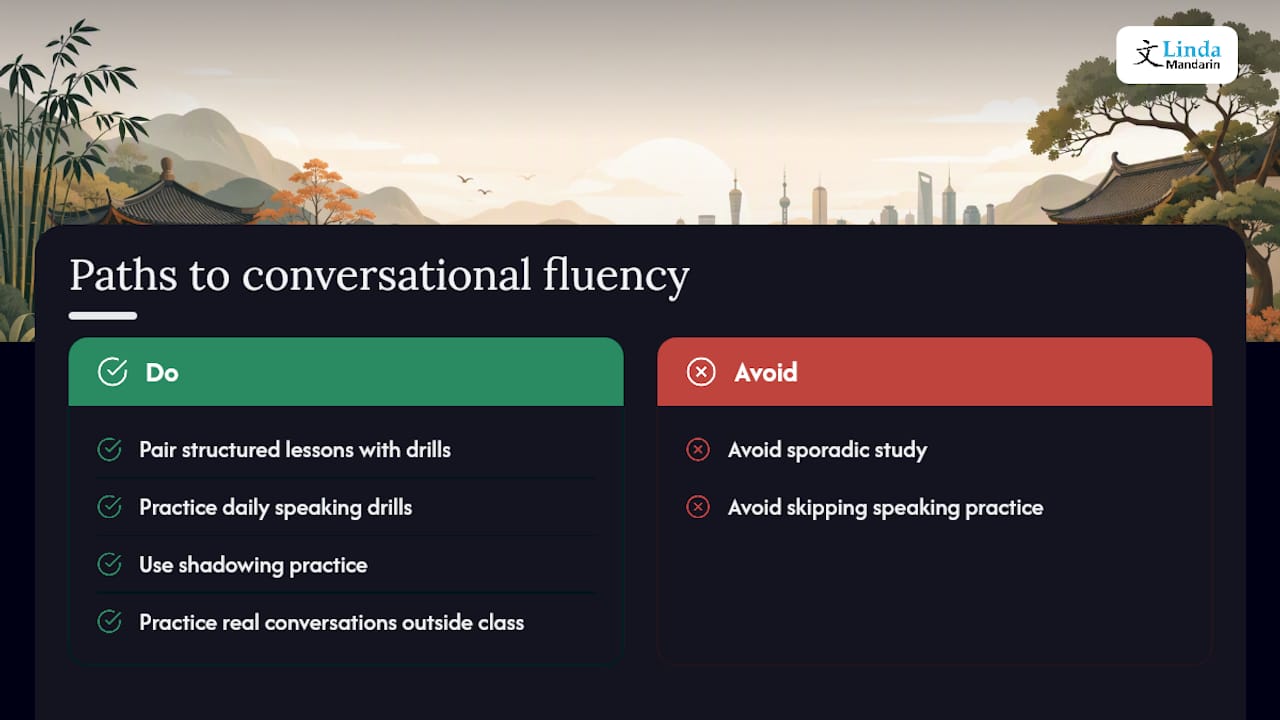
Tuition gives you structure, but conversational fluency depends on what you do between classes as much as what happens during them. Learners who pair lessons with daily speaking practice progress noticeably faster than those who only show up once a week.
- Daily micro-practice: 15 to 30 minutes of speaking drills or shadowing native audio, done consistently beats occasional long sessions
- Spaced repetition: review high-frequency vocabulary in short bursts rather than cramming word lists
- Real conversation partners: trade language practice with a native speaker, or use AI conversation tools to rehearse real-life speaking situations before trying them with a live person
- Weekly speaking targets: set a concrete goal, like holding a two-minute unscripted conversation by week 8, and track it
Pairing classroom patterns with real-world practice, language partners, role-play, and AI tools, converts memorized phrases into automatic speech far faster than vocabulary study alone.
Pro Tip: Set a weekly “unscripted conversation” goal, even five minutes with no notes. It forces recall speed, which matters more for real fluency than how many words you’ve memorized.

Why Linda Mandarin Stands Out for Adult Beginners
Linda Mandarin has run adult-focused Mandarin programs in Singapore since 2003, with conversational and business courses delivered online via Zoom and in person. The school also runs corporate training for teams that need workplace-ready Mandarin, not textbook Chinese.
- Native-speaking instructors experienced with adult learners, not school-age students
- Speaking-first curriculum built around real workplace and social scenarios
- Flexible formats: group, private, and online Zoom classes
- Central location above Tanjong Pagar MRT, easy for a lunch-break or after-work class
- Trial class available before you commit to a full course
If you’re weighing formats, the adult conversational and business Mandarin programs page lays out current course options and how to book an assessment.
A Note on Realistic Expectations
Progress in Mandarin isn’t linear, most learners plateau around week six before tones “click.” That’s normal, not a sign the course isn’t working. Stick with regular speaking practice and a trial lesson to see if the pacing suits you.
Ready to Start Speaking Mandarin With Confidence?
Choosing between a traditional weekly class and a self-study app leaves most adult beginners stuck somewhere in the middle, progressing too slowly with an app, or losing motivation without live feedback. Linda Mandarin closes that gap with structured, speaking-first courses taught by native instructors who actually correct your tones in real time, whether you’re in the room or on Zoom.
Getting started is simple: book a short assessment to gauge your current level, choose between a group class or private 1:1 sessions based on your schedule and budget, then confirm a time slot that works, evenings, weekends, or flexible online sessions. Classes run both online via Zoom and in person at 10 Anson Road, Level 22, International Plaza, right above Tanjong Pagar MRT. Teams looking for corporate Mandarin training can also arrange bespoke schedules for staff groups. If you’re not sure which format fits, the adult programs page lists current course options, or you can reach out directly to book a trial lesson and see the teaching style firsthand.
Sources
- Can You Become Conversationally Fluent With Mandarin Tuition? – FC Euro College
- How long to reach conversational Mandarin for English speakers | Comprenders Docs
- How long to become fluent in Mandarin
FAQ
How Long Does It Take to Become Conversational in Mandarin?
Most adult learners reach basic conversational ability in roughly 6 to 12 months of consistent part-time study, faster with intensive, daily speaking practice.
How Do You Become Conversational in Mandarin Faster?
Pair structured lessons with daily speaking drills, shadowing, and real conversation practice outside class; immersive, speaking-focused routines shorten the timeline considerably compared with sporadic study.
Is Mark Zuckerberg Fluent in Mandarin?
Zuckerberg has given public speeches in Mandarin and can hold conversations, though independent assessments generally describe his level as intermediate rather than fully fluent.
Can Lee Kuan Yew Speak Mandarin?
Yes, Singapore’s founding prime minister famously learned Mandarin as an adult later in life and became a public advocate for bilingualism in Singapore.
What’s the Best Course Format for a Busy Working Adult?
Online Zoom classes or evening group sessions tend to fit working schedules best, and a trial class lets you confirm the pacing works before committing to a full course, an option Linda Mandarin offers for adult beginners.