For adult learners and working professionals, small-group Mandarin classes tend to be the most practical way to build real conversational confidence. The format forces more speaking turns per hour, exposes you to a wider range of listening input than a private lesson ever could, and the peer accountability keeps people showing up week after week. The trade-off: if you need fast, targeted pronunciation coaching or you’re discussing confidential business material, private tuition still wins.
TL;DR:
- Small-group Mandarin classes are best with three to eight learners at similar levels to maintain active participation and personalized speaking practice.
- Classes with more than six students often reduce each learner’s speaking time, which diminishes the core benefits of the format.
- For business Mandarin, role-plays and peer feedback on real workplace scenarios are essential to simulate authentic interactions.
- Private lessons excel when quick, targeted correction or confidential discussion is needed, and a hybrid approach can maximize both speed and practice.
- Online classes require strong moderation and recordings, while in-person courses benefit from nonverbal cues and spontaneous partner work for better engagement.
Table of Contents
- What Small-Group Mandarin Classes Are and Who They Suit
- Core Pedagogical Benefits of Small-Group Mandarin Classes
- How Small Groups Advance Workplace and Business Mandarin
- When Private Lessons Are the Better Choice
- How to Evaluate and Choose a Small-Group Mandarin Class
- Online vs In-Person Small-Group Classes: Trade-Offs
- Evidence and Research Behind Small-Group Benefits
- Author Perspective: Designing Small Groups for Adult Learners
- Start With a Small-Group Trial Class
- Sources
- FAQ
What Small-Group Mandarin Classes Are and Who They Suit
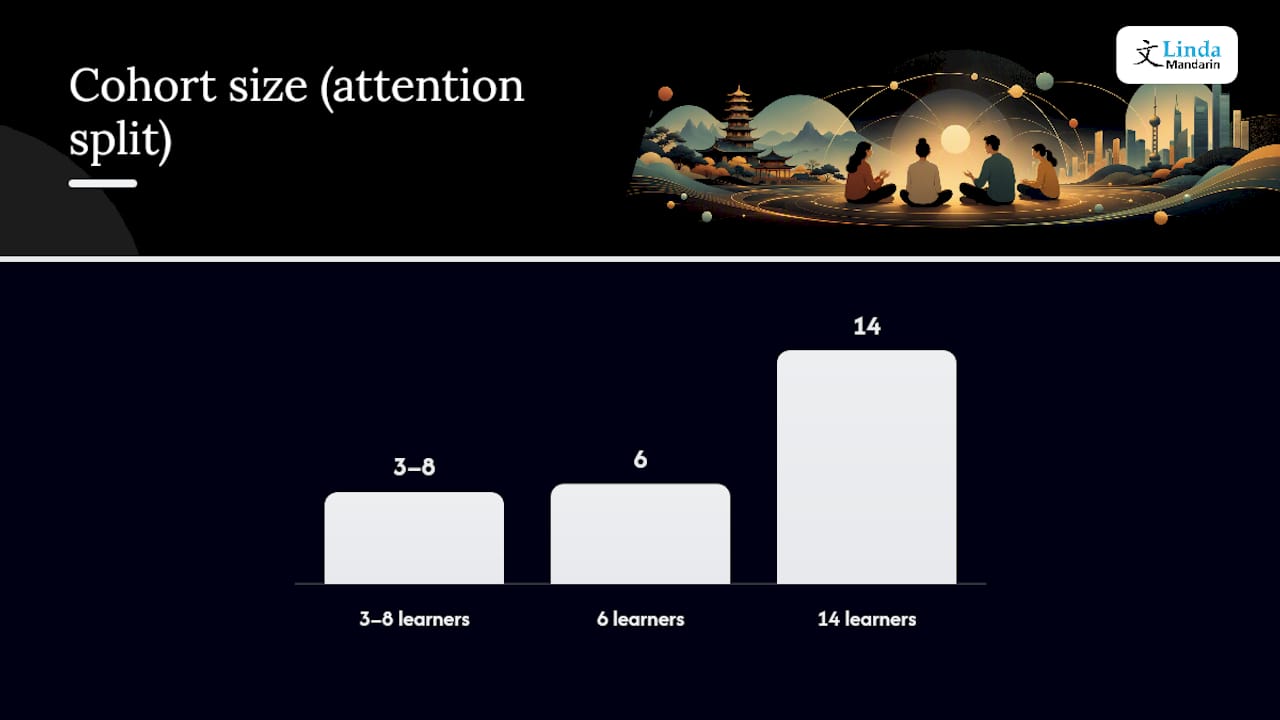
A small group typically means three to eight learners at a similar proficiency level, not a lecture hall and not a one-on-one tutorial. Size alone doesn’t guarantee results. Practical guidance from language schools points to keeping cohorts in the low single digits when the goal is maximizing each student’s speaking time, since a group of six splits attention very differently than a group of fourteen.
Level matching matters just as much as headcount. A beginner dropped into an intermediate group either shuts down or slows everyone else’s progress, and both outcomes defeat the purpose of learning alongside peers.
The format tends to suit:
- Working adults who want steady conversational progress without the schedule demands of daily private lessons
- Professionals preparing for client calls, meetings, or travel who benefit from rehearsing real dialogue with others
- Budget-conscious learners who need a sustainable, long-term study plan rather than a short intensive burst
- Beginners and intermediate speakers who need repetition and correction more than they need highly specialized vocabulary
Poorly matched groups, or classes that swell past eight or nine people, erode most of these benefits fast.
Core Pedagogical Benefits of Small-Group Mandarin Classes
The biggest advantage is volume of speaking practice. In a well-run group, everyone gets multiple speaking turns per session through pair work and short role-plays, rather than sitting through a lecture and speaking twice in an hour.
Listening exposure improves too, and not just from the teacher. Hearing classmates attempt tones, stumble on a measure word, or mispronounce a sentence pattern gives you more raw language input to calibrate against than a single instructor’s voice repeated back to you.
Retention benefits from context. Vocabulary introduced through a role-play about ordering food or negotiating a deadline sticks better than a vocabulary list, because you used it in a situation resembling real life. Peer accountability plays a quieter but significant role: research and expert commentary consistently point to consistency, not instructional format, as the biggest barrier to adult fluency, and a scheduled group with familiar classmates gives people a reason to show up on a tired Tuesday evening.
Group classes are also simply more cost-effective per hour than private lessons, which lets learners commit to a longer runway of study instead of burning through a budget in eight weeks.
- More speaking turns through pair work and role-play
- Wider listening exposure from multiple peer voices
- Better retention through contextual, repeated use
- Built-in accountability that supports attendance
- Lower cost per hour, supporting longer study commitments
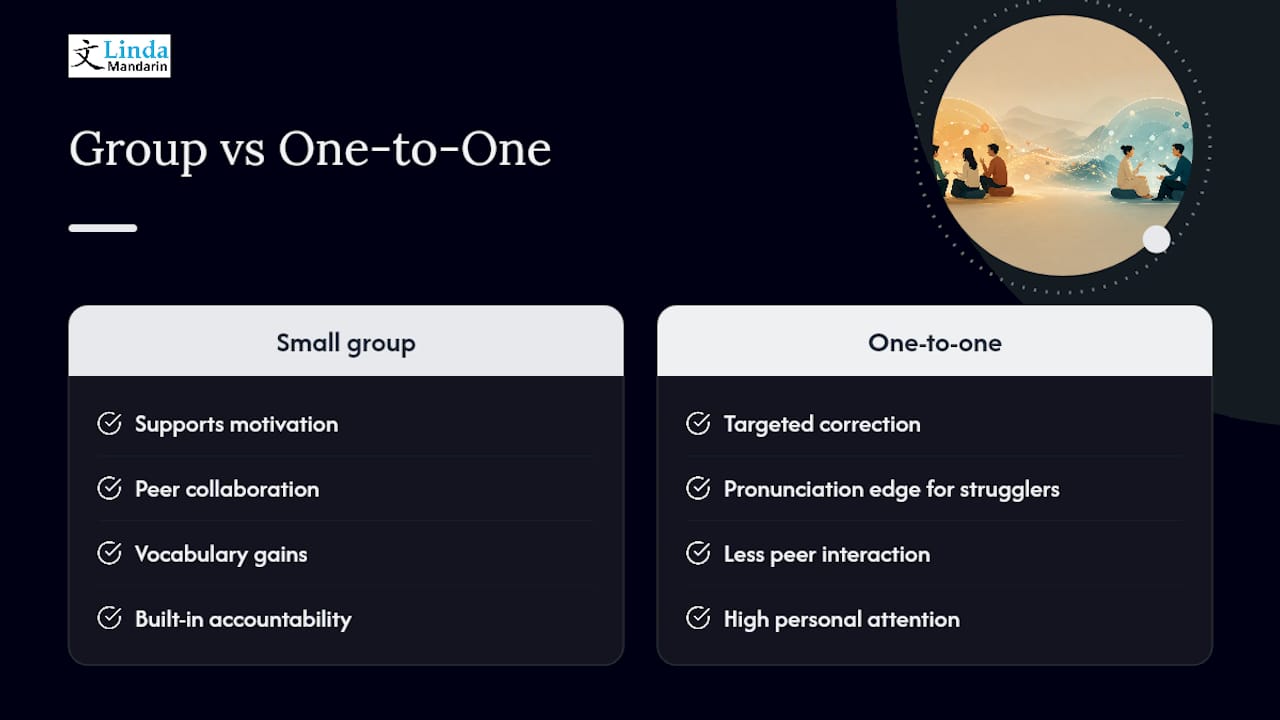
A 2025 comparative study on Mandarin instruction found that group-based teaching specifically fosters motivation, peer collaboration, and vocabulary mastery, while one-on-one instruction showed its strength in pronunciation accuracy for learners who were struggling the most.
Pro Tip: Count your actual speaking minutes in a trial class. If you’re not talking for at least a third of the session, the group is too large or too passive to move your fluency forward.
How Small Groups Advance Workplace and Business Mandarin
Business Mandarin benefits from group dynamics in a specific way: negotiations, presentations, and client meetings are inherently social, and rehearsing them solo with a tutor never quite replicates the pressure of responding to someone else in real time. Small groups let you simulate those scenarios directly.
Effective business-focused sessions typically include:
- Role-plays built around common workplace situations, like introducing a proposal or handling a scheduling conflict
- Simulated negotiations where each learner takes a different position
- Short presentations followed by peer feedback, not just teacher correction
- Structured feedback cycles where classmates flag phrasing that sounded unnatural
Linda Mandarin runs adult group classes and business Mandarin programs, including online Zoom delivery, built around exactly this kind of active practice rather than passive listening. Before enrolling anywhere, verify the instructor’s teaching experience, ask how the syllabus progresses across levels, confirm there’s an actual placement process rather than a guess, and ask directly how much class time is speaking versus listening.
When Private Lessons Are the Better Choice
Group classes aren’t the right fit for every situation, and pretending otherwise does readers a disservice. Private tuition tends to win when you need fast turnaround before a specific deadline, detailed one-on-one correction of a persistent pronunciation issue, or you’re discussing material that’s confidential to your work and can’t be rehearsed in front of classmates.
Many learners don’t have to choose one exclusively. A common and effective pattern combines a weekly small-group class for conversational range with a monthly private check-in focused purely on pronunciation or trouble spots. This hybrid approach lets group dynamics handle motivation and volume while private time handles precision.
Watch for these red flags when evaluating a group program:
- No level test or placement process before you join
- Class sizes above eight or nine learners
- Little to no pair work built into the lesson plan
- Minimal or vague teacher correction during speaking activities
How to Evaluate and Choose a Small-Group Mandarin Class
Before committing to a program, ask direct questions rather than trusting a brochure description.
- Ask about class size and level testing. A real placement process, not a self-reported guess, is the baseline for a group that will actually match your level.
- Request a sample lesson plan. You want to see pair work and role-play built in, not a single teacher lecturing for the full hour.
- Ask how often each student speaks per session. If the school can’t answer this specifically, that’s telling.
- Check teacher qualifications and continuity. Rotating instructors every few weeks disrupts the rapport that makes group learning work.
- Commit to a minimum trial period. Judge progress over six to eight classes, not one, since first sessions rarely reflect the real rhythm of a course.
Match the format to your actual goal: conversational fluency and workplace confidence lean toward group classes, while highly specialized vocabulary for a niche technical field may need supplementary private time.
Pro Tip: During a trial class, watch how the teacher handles mistakes. Quick, non-disruptive correction that lets the conversation keep moving is a much stronger signal than a teacher who stops the entire class to fix one student’s tone.
Online vs In-Person Small-Group Classes: Trade-Offs
Online small-group classes offer session recordings for review and obvious convenience for a packed work schedule. In-person classes offer nonverbal cues and more natural, spontaneous pair work that’s harder to replicate through a screen.
Quality online delivery depends on tight moderation: clear turn-taking, decent audio, and a teacher who actively manages who speaks when. Guidance on small-class teaching design notes that online sessions can match in-person clarity when structured with explicit turn-taking and recordings built into the routine.
In-person quality depends on clear pair tasks and a low-distraction room. Busy professionals who travel frequently often do better sticking with online Zoom-based courses for consistency, while those working near a physical campus may prefer the in-person energy.
- Online: recordings, flexible location, needs strong moderation
- In-person: nonverbal cues, spontaneous pair work, needs a focused room
Evidence and Research Behind Small-Group Benefits
The strongest data point comes from a comparative study of individualized and group-based Mandarin instruction, which found group formats specifically support motivation, peer collaboration, and vocabulary gains, while one-to-one instruction showed an edge in pronunciation accuracy among learners who were falling behind.
Group interaction and repeated spoken exposure appear to drive the motivation and vocabulary gains that isolated study struggles to replicate, though individualized attention still has a distinct role for learners needing targeted correction.
The mechanism behind this isn’t mysterious: peer interaction, built-in accountability, and repeated spoken exposure combine to keep learners engaged over time. Educational commentary on why small groups suit Chinese learning makes a similar case, arguing the format balances personal attention with live interaction in a way large classes and solo study both struggle to match.
The caveat worth naming honestly: much of this research comes from single-site or small-sample studies, so treat the findings as indicative rather than definitive, and lean toward a hybrid approach when your situation calls for it.
Author Perspective: Designing Small Groups for Adult Learners
Years spent building adult language programs teaches you one thing fast: motivation dies in isolation and gets rebuilt in a room with other tired professionals trying the same tones. Good group design means grouping by real level, not sign-up date, and building in speaking practice every single session, not just when time allows. Business-focused modules work because they mirror what learners actually face at work. The learners who benefit most aren’t the most talented ones. They’re the ones who show up consistently because their classmates expect them to.
— Paul
Start With a Small-Group Trial Class
This school is a practical option for adults who want conversational or business Mandarin without committing to the higher cost of private tuition or the isolation of a self-study app. The school offers adult group classes, business Mandarin programs, corporate training, and online Zoom delivery, all built around speaking practice and level-matched cohorts.

If you’ve read this far, the next step is simple: book a trial session, ask for a level placement, or browse the group classes program page to see how the cohorts are structured. The school’s training center sits at 10 Anson Road, Level 22, International Plaza, Singapore 079903, right above Tanjong Pagar MRT for anyone who prefers checking out the in-person option before deciding between formats.
Sources
- A comparative study of individualized and group-based instruction in mandarin learning for beginner students
- Why small group classes are ideal for learning Chinese – The Reporter Desk
- How teachers shape small class learning in Singapore
FAQ
What Are the Benefits of Learning Mandarin?
Mandarin opens direct communication with more than a billion speakers, strengthens professional standing across trade and business roles in Asia, and improves cognitive flexibility through tonal and character-based learning. Learning it in a small group adds faster conversational gains through peer practice and consistent accountability.
Why Is Mandarin So Important for Professionals?
Mandarin is the most widely spoken first language in the world, and fluency gives professionals a real advantage in client relationships, negotiations, and regional business roles. Business Mandarin training built around workplace scenarios speeds up that practical payoff.
Is It Better to Learn Mandarin in a Group or Privately?
Private lessons are stronger for fast, targeted pronunciation correction or handling confidential material.
What Jobs Benefit From Knowing Chinese Mandarin?
Roles in international trade, finance, client relations, hospitality, and regional business development frequently value Mandarin fluency, especially for professionals working with clients or partners across Greater China and Southeast Asia. Business-focused Mandarin study, rather than general conversational study alone, tends to serve these roles best.
How Many People Should Be in a Small Mandarin Group?
Most language schools recommend three to eight learners per group, matched by proficiency level, to keep speaking time high for every student. Groups larger than eight or nine tend to dilute the speaking practice that makes the format effective.