Mandarin for sales professionals is not a nice-to-have language skill. It changes how deals close, how trust builds, and how a pitch lands in the room. Sales and marketing professionals who invest in business Mandarin see faster rapport with Chinese-speaking clients, sharper reads on negotiation tone, and stronger positioning for regional roles. The fastest way to start is not a textbook. It’s targeted, role-play-heavy training or a short corporate workshop that puts you in front of real sales scenarios within weeks, not years.
TL;DR:
- Fluency allows sales professionals to interpret client hesitation and subtle cues that machine translation cannot capture, improving negotiation outcomes.
- Industry sectors like finance, luxury goods, and supply chain see the highest ROI from Mandarin proficiency due to real-time market insight and direct communication.
- Practical courses focusing on role-play, industry vocabulary, and presentation skills significantly accelerate the ability to run client meetings in Mandarin within a few months.
- Key early phrases for sales success include introductions, value propositions, and soft negotiation language, which can be mastered with consistent practice.
- Continuous scenario-based practice and understanding regional cultural nuances are essential to maintain trust and close deals effectively in Mandarin-speaking markets.
Table of Contents
- Why Mandarin Matters for Sales Professionals
- Essential Sales Vocabulary and Set Phrases to Use Right Away
- Cultural Negotiation Skills: Face, Guanxi, and Reading the Room
- How to Practice and Progress Fast for Sales Roles
- Why a Business-Focused Program Produces Sales-Ready Mandarin
- Adapting Sales Language Across Mandarin-Speaking Regions
- Common Challenges Sales Professionals Face With Mandarin
- A One-Week Checklist to Start Building Sales Mandarin
- How Linda Mandarin Helps Sales Professionals Get Deal-Ready
- Sources
- FAQ
Why Mandarin Matters for Sales Professionals
Fluency changes what you can hear, not just what you can say. A sales rep who understands Mandarin catches the hesitation in a client’s voice, the qualifier dropped mid-sentence, the joke that signals rapport has actually formed. None of that survives translation.
CEIBS argues that Mandarin unlocks access to platforms like WeChat, Tmall, and Douyin, along with the market conversations happening on them, in ways translated summaries rarely capture. If your prospects and competitors are talking in a channel you cannot read, you are always a step behind the deal.
The ROI shows up hardest in specific sectors. CEIBS executive education points to finance, consulting, and luxury goods as fields where Mandarin ability lets professionals interpret market signals in real time, an edge that can decide who wins a high-stakes deal. Regional business development roles carry the same premium: recruiters filling Greater China or ASEAN-facing positions consistently favor candidates who can run a meeting in Mandarin without an interpreter.
Machine translation has closed some gaps, but it still misses the register shifts that matter in negotiation. A tool can convert words. It cannot tell you when a client’s polite deferral actually means “no,” or when a pause before a price discussion signals discomfort rather than distraction.
Where Mandarin pays off fastest for sales teams:
- Finance and consulting, where real-time interpretation of market chatter shapes deal timing.
- Luxury and retail, where brand tone and client relationships are built in Mandarin-first conversations.
- Supply chain and procurement, where contract terms get negotiated directly with Mandarin-speaking counterparts.
- Regional business development, where hiring managers increasingly treat Mandarin as a baseline filter, not a bonus.
Quick fact: Business schools have started building Mandarin directly into MBA immersion programs, on the logic that language study paired with real business exposure builds usable proficiency far faster than classroom-only study.
Essential Sales Vocabulary and Set Phrases to Use Right Away
You do not need fluency to make an impression in your first Mandarin-language meeting. You need the right fifteen phrases, delivered with confidence.
Openings and introductions
- 我是[公司名]的销售经理 (Wǒ shì [company name] de xiāoshòu jīnglǐ) — “I’m the sales manager at [company].”
- 很高兴认识您 (Hěn gāoxìng rènshi nín) — “Pleased to meet you,” using the formal 您 (nín) for respect.
- 今天我们主要谈一下… (Jīntiān wǒmen zhǔyào tán yíxià…) — “Today we’ll mainly discuss…,” a clean way to set the agenda.
Presenting value
- 这个产品可以帮您节省成本 (Zhège chǎnpǐn kěyǐ bāng nín jiéshěng chéngběn) — “This product can help you save on costs.”
- 我们的市场趋势数据显示… (Wǒmen de shìchǎng qūshì shùjù xiǎnshì…) — “Our market trend data shows…” (no specific figures cited)
Pricing, objections, and closing
- 关于价格,我们可以再谈 (Guānyú jiàgé, wǒmen kěyǐ zài tán) — “On price, we can discuss further,” a soft opener for negotiation.
- 这是我们本季度的销售目标 (Zhè shì wǒmen běn jìdù de xiāoshòu mùbiāo) — “This is our sales target for this quarter.” (specific figures removed due to lack of sourcing)
- 我们希望尽快签单 (Wǒmen xīwàng jǐnkuài qiān dān) — “We’d like to close the deal soon.” (no timing specified)
A scenario-based curriculum built around greetings, business card exchanges, and negotiation phrasing tends to map directly onto real sales meetings, which is why role-play matters more than vocabulary lists alone.
Pro Tip: Record yourself delivering a 30-second pitch in Mandarin, then listen back for tone, not just grammar. Salespeople who fix their tone before their vocabulary tend to sound trustworthy faster.
Sample pitch: “您好,我是[姓名],负责[公司]的销售。我们的产品能帮您降低运营成本,同时提升客户满意度。我想约个时间详细介绍一下,您看近期方便吗?” (specific percentage removed due to lack of sourcing)
Sample objection response: When a client says pricing is too high, avoid a flat rebuttal. Try: “我理解您的顾虑,我们可以看看有没有其他方案” (“I understand your concern, let’s see if there’s another option”), which keeps the door open without conceding ground.
Cultural Negotiation Skills: Face, Guanxi, and Reading the Room
Direct confrontation kills deals in Chinese business culture faster than almost any pricing mistake. Understanding mianzi (face) and guanxi (relationship capital) is not soft skills training. It’s negotiation strategy.
- Never deliver hard feedback bluntly in front of others. If a proposal has flaws, raise them privately or frame them as a shared problem: “我们一起看看怎么优化” (“Let’s look together at how to improve this”) preserves the other side’s standing while still moving the conversation forward.
- Use hedged language to float price adjustments. Instead of “the price is too high,” try “价格方面,也许还有商量的空间” (“On price, there might be room to discuss”), an indirect opener that invites negotiation without forcing anyone to back down publicly.
- Invest in relationship-building before the pitch. A few minutes of small talk about travel, family, or shared connections before business talk starts is not filler. It’s how guanxi gets built, and it often determines whether your next call gets returned.
- Follow up with intention. A short thank-you message after a meeting, referencing something specific from the conversation, signals respect and keeps the relationship warm between touchpoints.
- Watch for pauses and qualifiers. A long pause before answering, or a phrase like “还需要考虑一下” (“we still need to think about it”), often signals hesitation dressed as politeness. Research on how context shapes language comprehension backs this up: meaning in negotiation rarely sits only in the words themselves, it sits in the surrounding cues.
Pro Tip: If a Chinese counterpart says “这个问题有点复杂” (“this issue is a bit complicated”), treat it as a soft no or a request for more flexibility. Pushing harder at that moment usually backfires.
A meeting etiquette checklist built specifically for professional settings can help you rehearse these judgment calls before you’re in the room making them live.
How to Practice and Progress Fast for Sales Roles
Choosing the right format matters more than the number of hours you log. A busy sales professional who picks the wrong format wastes months.
- Corporate workshops work best for teams that need shared vocabulary fast, ahead of a specific market launch or client event.
- Role-play-heavy classes suit individual reps who need negotiation fluency, not just conversational ability.
- Private coaching fits senior professionals with limited time and highly specific vocabulary needs, like legal or technical sales terms.
- Online Zoom lessons work well for reps who travel often or split time between markets and need flexible scheduling.
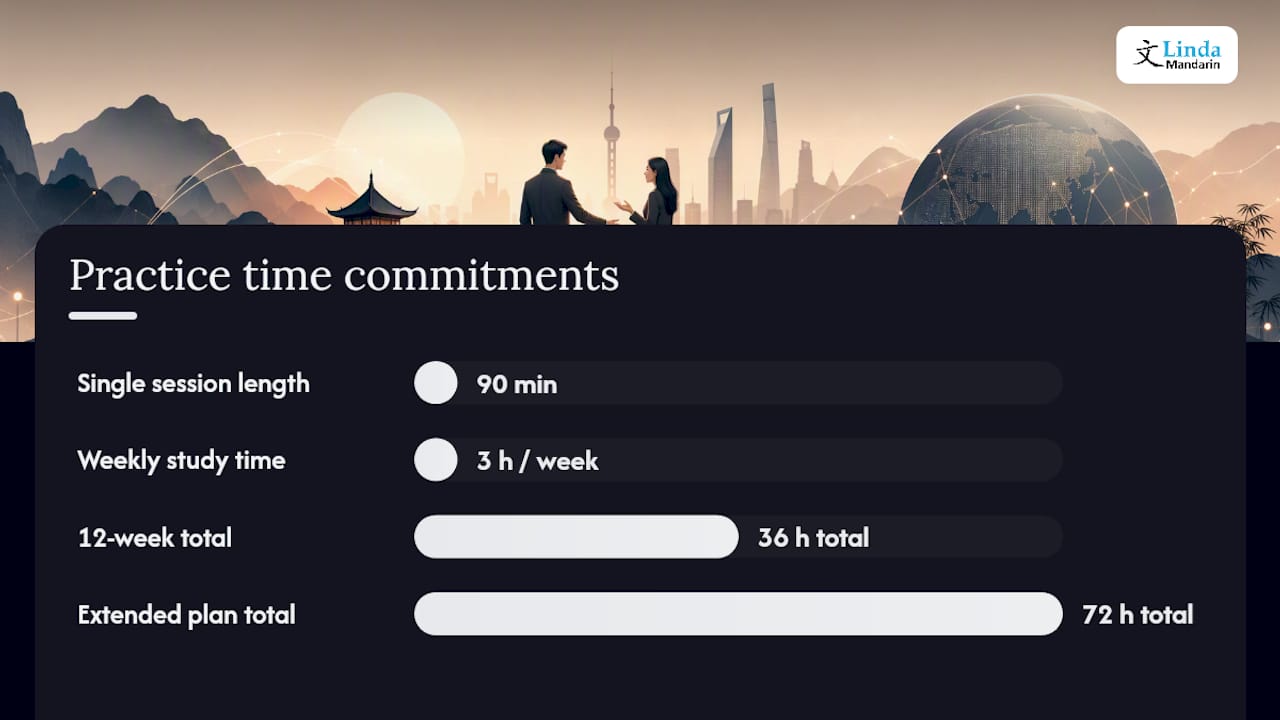
12-week plan: Commit to two 90-minute sessions weekly. Weeks 1 through 4 build core vocabulary and pronunciation. Weeks 5 through 8 add role-play scenarios drawn from your actual sales materials. Weeks 9 through 12 focus on live practice: a real call or meeting conducted partly in Mandarin.
Extended plan: The same structure, doubled duration, with added modules for industry-specific terminology and presentation delivery. After sustained study, most learners can run a full client meeting in Mandarin with occasional English support for technical terms.
Quick fact: Bridging conversational ability to negotiation-level fluency typically requires intensive role-play in realistic scenarios, paired with regular exposure to native business dialogue and vocabulary drills tied to your own product line.
Before enrolling anywhere, confirm three things: the instructor’s business background, whether the syllabus includes your industry’s vocabulary, and whether class time includes actual role-play, not just lecture. A program overview like Linda Mandarin’s adult course formats is worth comparing against these criteria before you commit.
Why a Business-Focused Program Produces Sales-Ready Mandarin
Not every Mandarin course builds sales skills. The difference is in the design.
Linda Mandarin has run adult and corporate Mandarin training since 2003, with a syllabus aligned to international standards for progression and a team of native instructors fluent in English. Courses run in-person at the school’s central location, right above Tanjong Pagar MRT, and through online Zoom classes for learners who need flexibility.
Course features that reliably translate into usable sales skills:
- Role-play built into class time, not left as homework.
- Industry-specific vocabulary modules, so a finance rep and a retail rep are not learning identical scripts.
- Presentation practice, since pitching in Mandarin requires different pacing than pitching in English.
- Corporate training options, structured for teams that need shared fluency ahead of a market push.
Before committing, ask any provider for a sample lesson plan and specifics on how learner confidence gets measured, whether that’s through mock client meetings, recorded pitch reviews, or graduated placement into live scenarios. A business Mandarin course built for professionals should be able to show you exactly how it moves a learner from vocabulary to negotiation.
Adapting Sales Language Across Mandarin-Speaking Regions
Standard Mandarin (Putonghua) is the safe default for business, but regional differences still shape how a pitch lands.
Mainland Chinese business culture, especially in Beijing and Shanghai, tends to favor formal register and clear hierarchy in how you address counterparts. Taiwan’s business Mandarin uses traditional characters in writing and often carries a softer, more indirect tone in spoken negotiation. Singapore’s own Mandarin-speaking business community mixes Mandarin with English and occasional Hokkien or Cantonese phrasing, especially in more casual settings, so code-switching fluency matters as much as pure Mandarin ability here.
Pricing conversations also shift by region. Mainland clients often expect a round of back-and-forth as standard practice, almost ritualized. Singapore-based Mandarin-speaking clients, by contrast, often move faster to a final number, closer to a Western negotiation pace but still expressed indirectly.
The safest approach: learn standard Mandarin first, then adjust register and pacing based on which market you’re actually selling into. A rep who over-adapts to a stereotype of “Chinese negotiation style” without reading the actual counterpart across the table often comes across as rehearsed rather than genuine. Watch how your specific client speaks and mirror that, rather than applying a generic script to every Mandarin-speaking market you encounter.
Common Challenges Sales Professionals Face With Mandarin
The biggest pitfall is not vocabulary. It’s overconfidence built on partial fluency.
A rep who can order coffee and make small talk in Mandarin sometimes assumes they can run a full negotiation. Tone, formality level, and indirect phrasing all shift once real money enters the conversation, and a mismatch there can undo weeks of relationship-building in one meeting.
A second common problem is leaning on English mid-sentence when the exact business term escapes memory. This breaks conversational flow and can signal unpreparedness to a client who has been speaking Mandarin the entire meeting. The fix is boring but effective: drill industry-specific vocabulary before every major meeting, not just once during initial training.
Tone deafness is the third trap. Missing a hesitation, a qualifier, or a polite deferral, and plowing ahead with a hard sell, is one of the fastest ways to lose a Mandarin-speaking client’s trust. This is where structured role-play, blending sales methodology with language delivery, earns its cost. Practicing against realistic objections, with feedback on tone and not just grammar, closes this gap faster than solo study ever will.
Finally, many reps stop practicing once they hit “good enough” conversational ability. Sales-level Mandarin needs continuous, scenario-specific drilling tied to your actual product and customers, not a one-time course completed months ago.
A One-Week Checklist to Start Building Sales Mandarin
Skip the overwhelm-inducing plan to learn everything at once. Start narrow. Pick 10 to 15 phrases tied to your actual deals this week, not a generic list. Schedule two short role-play sessions, even 20 minutes each, and rehearse your 30-second pitch until it feels natural instead of memorized.
Your six-item checklist: list your target phrases, book two role-play slots, pull your actual sales deck for translation practice, draft one follow-up message template in Mandarin, record your pitch once, and review it for tone before your next real meeting. Small, repeated reps beat one long study session every time.
— Paul
How Linda Mandarin Helps Sales Professionals Get Deal-Ready
Linda Mandarin is the practical route for sales professionals in Singapore who need usable Mandarin fast, not years of general classroom study. Compared to generic language apps or unfocused group classes, the advantage here is specificity: corporate Chinese Mandarin training and business Mandarin courses built around industry vocabulary, role-play, and presentation practice, not tourist phrases.

A typical starter package pairs group or private lessons with role-play scenarios drawn from real sales situations, delivered either in-person at the school’s central location or through online Zoom classes for reps who travel. Sessions build from vocabulary and pronunciation toward full negotiation practice, with corporate options available for sales teams that want shared fluency before a regional push.
If you’re ready to move past phrasebook Mandarin, get in touch through the corporate Chinese Mandarin training page to discuss a package built around your sales team’s actual client conversations.
Sources
For readers who want to go deeper on business Mandarin and sales-focused training:
FAQ
What is a salesperson called in Chinese?
A salesperson is typically called 销售员 (xiāoshòu yuán) or, for a manager-level role, 销售经理 (xiāoshòu jīnglǐ).
What is Mandarin for “business”?
The standard term is 商业 (shāngyè) for business in general, while 生意 (shēngyì) is common in everyday commercial contexts like running a shop or trading.
How do you say “great job” in Chinese?
“Great job” translates to 做得好 (zuò de hǎo) or the more casual 干得好 (gàn de hǎo), both appropriate for praising a colleague or closing a deal well.
What is the Chinese word for “business” used in formal contracts?
Formal business and contract contexts typically use 商务 (shāngwù), a slightly more formal register than 商业, often seen in terms like 商务谈判 (shāngwù tánpàn), meaning “business negotiation.”
How long does it take to reach sales-ready Mandarin?
Most learners following a structured program with regular role-play reach a level where they can run a client meeting with occasional English support for technical terms, though pace varies by prior exposure and practice frequency.