In this article, “Chinese dialects in Singapore” refers to Standard Mandarin, the language adult professionals actually need for work. The right move is enrolling in a focused conversational or business Mandarin course matched to your role, not chasing native-level fluency. Providers like Linda Mandarin offer exactly this kind of targeted, workplace-oriented training in Singapore.
TL;DR:
- Focused conversational or business Mandarin courses in Singapore can prepare professionals to function effectively at work within three to six months.
- Small classes with native instructors fluent in English help optimize speaking practice, especially for courses tailored to workplace communication.
- Daily practice involving vocabulary review, listening, and speaking, combined with weekly classes and role-playing, accelerates progress toward basic work conversations.
- Dialect use persists mainly in cultural, familial, and traditional contexts, but not in professional settings where Standard Mandarin and English dominate.
- Self-study suits casual learners, but structured courses are essential for meeting pressing career deadlines or gaining confidence in business interactions.
Table of Contents
- Why Standard Mandarin Is the Right Target for Singapore Professionals
- Which Course Types Fit Different Professional Goals
- How to Choose a Mandarin Course in Singapore
- A Realistic Study Plan for Busy Professionals
- How Linda Mandarin Supports Adult Professionals in Singapore
- Overview of Major Chinese Dialects Spoken in Singapore
- Historical and Cultural Significance of Chinese Dialects in Singapore Society
- Current Usage and Demographics of Chinese Dialect Speakers in Singapore
- Government Policies and Initiatives Regarding Dialects Versus Mandarin
- Challenges Facing Dialect Preservation in Singapore
- Social Contexts Where Different Dialects Still Show Up
- Should You Take a Course or Keep Self-Studying?
- Ready to Start Learning Mandarin for Work?
- Sources
- FAQ
Why Standard Mandarin Is the Right Target for Singapore Professionals
You don’t need fluency to get value from Mandarin at work. Functional or intermediate Mandarin is enough to greet clients properly, follow the gist of a meeting, and handle short written exchanges without waiting on a colleague to translate. That’s the level most working adults in Singapore actually reach, and it’s the level that moves the needle professionally.
Here’s the thing most learners get wrong: they assume workplace Mandarin means textbook perfection. It doesn’t. It means being useful in real situations.
Common scenarios where functional Mandarin pays off:
- Welcoming a client or vendor from mainland China or Taiwan without an interpreter
- Catching the key points in a Mandarin-language meeting or call
- Reading and replying to routine business emails or WeChat messages
- Making small talk with Mandarin-speaking colleagues, building rapport that spills into deal-making
- Presenting a short update or pitch section in Mandarin when the room calls for it
None of these require perfect tones or a 3,000-character vocabulary. They require consistent, targeted practice.
Which Course Types Fit Different Professional Goals
Not every Mandarin course serves the same purpose, and picking the wrong one wastes months.
Conversational Mandarin suits professionals starting from zero or near-zero who want everyday speaking confidence: ordering food, chatting with coworkers, navigating daily life in Singapore before layering on work vocabulary.
Business Chinese targets people who already have some foundation and need workplace-specific language. These courses focus on meetings, emails, presentations, and negotiations, often folding in Chinese business etiquette so you’re not just fluent but appropriate in context.
Intensive courses compress the timeline for people facing a deadline, a transfer, or a client visit in a few months. Online Zoom classes solve the scheduling problem for professionals who travel or can’t commit to a fixed in-person slot, and they work well when the instructor keeps sessions interaction-heavy rather than lecture-style.
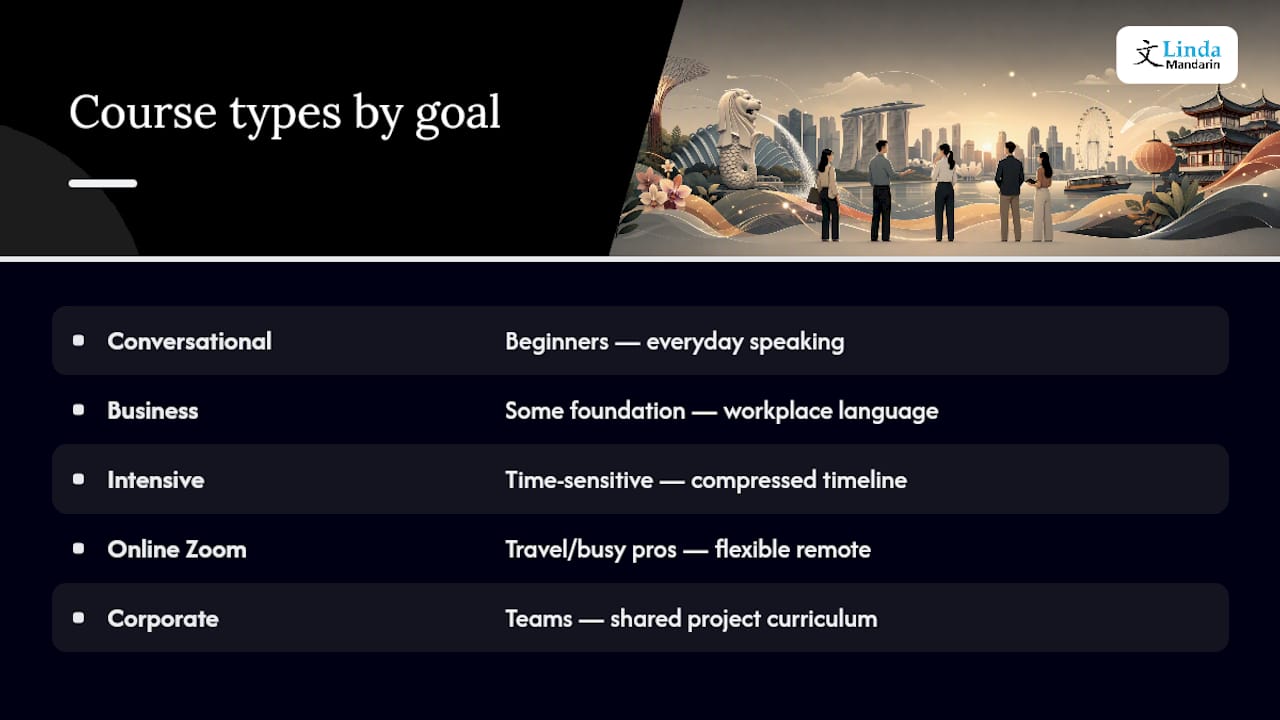
Corporate training fits teams, not individuals. A department heading into a China-facing project often gets more value from a shared curriculum than five people studying separately.
If you’re a true beginner, take a foundation course first. Jumping straight into Business Chinese without basic grammar and tones tends to backfire, since you’ll spend lesson time relearning fundamentals instead of practicing negotiation phrases.
How to Choose a Mandarin Course in Singapore
Course quality varies more than most people expect, and the wrong pick costs you months, not just money. A few criteria separate courses that build real speaking ability from ones that just fill a time slot.
- Class size. Small groups of four to eight students preserve enough speaking time per person. Anything past ten students usually means you’re listening more than talking.
- Teacher profile. Look for native Mandarin instructors who are also fluent in English, so corrections and explanations land clearly without a language barrier slowing things down.
- Syllabus relevance. Ask whether the content maps to your actual work, not just general conversation.
- Scheduling flexibility. Evening, weekend, and online options matter if you’re not cutting into work hours.
- Format fit. Private lessons move faster but cost more per hour; group classes cost less and add peer practice, which some learners need to build confidence.
- Pricing model. Check whether it’s a flat course fee or an open-ended commitment, and what happens if you need to pause.
Red flags: classes larger than 12 to 15 students, no speaking practice built into lessons, and vague promises about “fluency” with no timeline or milestone attached.
Pro Tip: Ask for a sample lesson or trial class before committing. A 45-minute trial tells you more about teaching style, pacing, and class energy than any brochure ever will.
Good discovery questions to ask a provider: What’s the syllabus based on? What’s the average class size? What’s the instructor’s teaching background? Can I sit in on or try a sample lesson? What’s the policy if the course isn’t the right fit?
A Realistic Study Plan for Busy Professionals
Most working adults can reach functional workplace Mandarin within three to six months with structured lessons and consistent daily practice. That’s the honest timeline. Anyone promising fluency in six weeks is selling something.
The weekly commitment that actually works:
- 30 to 60 minutes of daily practice, split between vocabulary review, listening, and speaking aloud. Short, frequent sessions beat occasional marathon study blocks for retention.
- One structured class per week, whether in-person or via online Zoom sessions with a native instructor, to catch mistakes early and stay accountable.
- Shadowing practice, repeating audio clips or dialogue out loud to train pronunciation and rhythm.
- Role-play drills, running through a mock client greeting or meeting scenario with a study partner or tutor.
- Voice notes, recording yourself weekly and comparing to a native speaker to track real progress, not guesswork.
Milestones to expect: by month one, basic greetings, numbers, and simple self-introductions. By month three, you should follow simple work conversations and write short messages. By month six, functional meeting participation and email replies become realistic, assuming you kept the weekly rhythm.
Pro Tip: Pair one weekly Zoom class with two short in-person practice sessions with colleagues or a language partner. The class gives you structure; the practice sessions turn it into habit.
How Linda Mandarin Supports Adult Professionals in Singapore
Linda Mandarin offers Mandarin programs for adult learners, with courses designed for working professionals rather than students. That distinction matters: a curriculum built for exams looks nothing like one built for meetings and client calls.
The relevant program lines include:
- Conversational Mandarin, offered privately, in groups, and online
- Business Mandarin, covering workplace communication and professional vocabulary
- Corporate Chinese Mandarin Training for teams and departments
- Chinese Culture Training for professionals who want the etiquette layer alongside the language
The teaching approach follows a structured syllabus, delivered by native Mandarin instructors fluent in English, with lessons built around interactive, practical use rather than rote memorization.
The training center sits at 10 Anson Road, Level 22, International Plaza, Singapore 079903, right above Tanjong Pagar MRT, making it accessible for a lunch-hour or after-work class. Scheduling covers evenings, weekends, and online Zoom slots for professionals who can’t commit to a fixed weekday time.
Overview of Major Chinese Dialects Spoken in Singapore
Beyond Standard Mandarin, Singapore’s Chinese community historically spoke several regional Chinese languages, often called dialects, brought over by migrants from different parts of southern China. Hokkien, originating from Fujian province, was for decades the most widely spoken variety among Singapore’s Chinese population, especially in trade and hawker culture. Teochew, from the Chaoshan region, has a strong historical presence too, particularly among families with roots in that area.
Cantonese, from Guangdong, carries strong associations with Hong Kong entertainment and cuisine, and remains recognizable to many younger Singaporeans even without fluency. Hainanese, spoken by migrants from Hainan Island, is smaller in number but historically tied to Singapore’s coffee shop and hospitality trades. Hakka, spoken by a dispersed community without one single home region, rounds out the major groups, alongside smaller communities speaking Foochow, Henghua, and Shanghainese.
Each of these languages carries distinct pronunciation, vocabulary, and cultural associations tied to specific clan associations, temples, and neighborhoods. A grandmother from a Teochew household and a grandfather from a Hokkien one might have communicated across their two languages only imperfectly, or leaned on Standard Mandarin or English as a common ground.
These languages remain part of Singapore’s cultural fabric today, even as everyday use has narrowed considerably across generations.
Historical and Cultural Significance of Chinese Dialects in Singapore Society
Singapore’s Chinese community formed largely through 19th and early 20th century migration from southern China, and migrants organized themselves around dialect groups long before national identity took shape. Clan associations, dialect-based schools, and mutual aid societies gave new arrivals a support network in an unfamiliar place, and those structures still exist today, even if their role has shifted from survival network to cultural heritage keeper.
Street names, hawker dish names, and neighborhood identities across Singapore still trace back to specific dialect communities. Certain streets in Chinatown carry Hokkien and Teochew associations dating back over a century, tied to the trades and clan groups that settled there.
Dialect also shaped early Chinese-language media, opera, and street performance in Singapore, forms of entertainment that drew on shared regional identity rather than a single unified Chinese-language culture. Getai performances during the Hungry Ghost Festival, for instance, often featured dialect songs recognizable to specific community groups.
This history explains why dialects still carry emotional weight for many Singaporean Chinese families, even those who no longer speak them fluently. A Teochew funeral rite, a Hokkien wedding toast, or a Cantonese lion dance chant connects a family to ancestry in a way Standard Mandarin, as the newer common language, doesn’t replicate. The cultural layer sits underneath the practical, everyday language question, and it’s part of why the topic carries more sentiment in Singapore than in most other places that adopted Mandarin as a common tongue.
Current Usage and Demographics of Chinese Dialect Speakers in Singapore
Dialect use in Singapore has declined sharply across generations, and the pattern is generational rather than random. Older Singaporeans, particularly those over 60, are far more likely to use a dialect like Hokkien or Teochew at home or with peers, often as their first language learned in childhood. Middle-aged Singaporeans typically understand a dialect passively, picked up from grandparents, without necessarily speaking it fluently themselves.
Younger Singaporeans show the steepest drop-off. Many grow up hearing a grandparent’s dialect at home but communicate primarily in English and Mandarin, with limited or no active dialect ability. This shift didn’t happen by accident. It reflects decades of language policy, changing family structures, and the practical reality that English and Mandarin dominate school, work, and media.
Dialect use today survives mostly in specific pockets: within families where older generations remain the primary caregivers, within certain trades and hawker stalls where a dialect signals a shared regional background, and within religious and cultural practices like temple rites, funeral customs, or wedding traditions that still use dialect phrases even when the rest of the ceremony runs in English or Mandarin.
Community groups, some cultural associations, and a handful of enthusiast projects have made efforts to document and teach dialects informally, largely outside the school system. These efforts tend to frame dialects as heritage and identity rather than a practical everyday communication tool, which lines up with how most Singaporean families actually experience them today: present, meaningful, but not the language they reach for at work or in daily transactions.
Government Policies and Initiatives Regarding Dialects Versus Mandarin
Singapore’s language policy since independence has centered on English as the working language across ethnic groups and Mandarin as the common language uniting Chinese Singaporeans across their different ancestral backgrounds. The reasoning was straightforward: a Chinese population fragmented across Hokkien, Teochew, Cantonese, Hainanese, and Hakka speakers had no single shared Chinese language, and a unified standard made communication, education, and administration far simpler.
This policy direction meant dialects were actively discouraged in schools and broadcast media for decades, particularly from the 1980s onward, as part of a push toward bilingual proficiency in English and Mandarin. Television and radio programming in dialects largely disappeared from mainstream channels during this period, a shift that accelerated the generational decline described earlier.
The policy achieved its core goal. Mandarin became the dominant Chinese language across nearly all Chinese Singaporean households within a couple of generations, and English cemented itself as the language of school, government, and most workplaces. That success came with a tradeoff: the same policy that unified the Chinese community linguistically also sped up the erosion of dialects as living, actively used languages rather than heritage artifacts.
In recent years, there’s been more open acknowledgment of dialects as part of Singapore’s heritage, with some space given to dialect content in cultural and heritage contexts rather than mainstream education or broadcast policy. The overall direction hasn’t reversed. Mandarin and English remain the two languages that matter for school, work, and public life, while dialects occupy a cultural and familial space alongside them.
Challenges Facing Dialect Preservation in Singapore
The core challenge is simple to state and hard to fix: each generation that doesn’t actively use a dialect at home passes less of it forward, and Singapore is several generations into that decline now. A Hokkien speaker in their 70s might have a grandchild who understands maybe a few dozen common phrases and nothing beyond that, with no realistic path back to fluency through casual exposure alone.
Formal education offers essentially no support, since dialects sit outside the school Mandarin and English curriculum entirely. Whatever gets passed down happens at home or nowhere. That puts enormous weight on individual families, and many simply don’t prioritize it when Mandarin and English cover every practical need a child will face in school and work.
Media exposure has thinned dramatically compared to decades past, when dialect programming had a real presence on local television and radio. Younger Singaporeans today have far fewer casual, ambient opportunities to absorb a dialect the way earlier generations did just by growing up around it.
There’s also a documentation gap. Compared to Mandarin, which has extensive teaching materials, standardized romanization, and structured curricula, dialects in Singapore rely heavily on informal community efforts, oral transmission, and a smaller pool of committed enthusiasts and cultural organizations. That’s a much thinner base to sustain a language across future generations, especially without institutional backing at scale.
None of this is unique to Singapore. It’s the same pattern seen wherever a smaller regional language sits next to a dominant national one, but the speed of the shift here, compressed into roughly two generations, has been unusually fast.
Social Contexts Where Different Dialects Still Show Up
Dialects in Singapore today live mostly in specific, recognizable situations rather than general daily conversation. Family gatherings, especially those involving older relatives, are the most common setting. A Cantonese-speaking grandmother might default to Cantonese with her own generation and switch to Mandarin or English with grandchildren, sometimes within the same conversation.
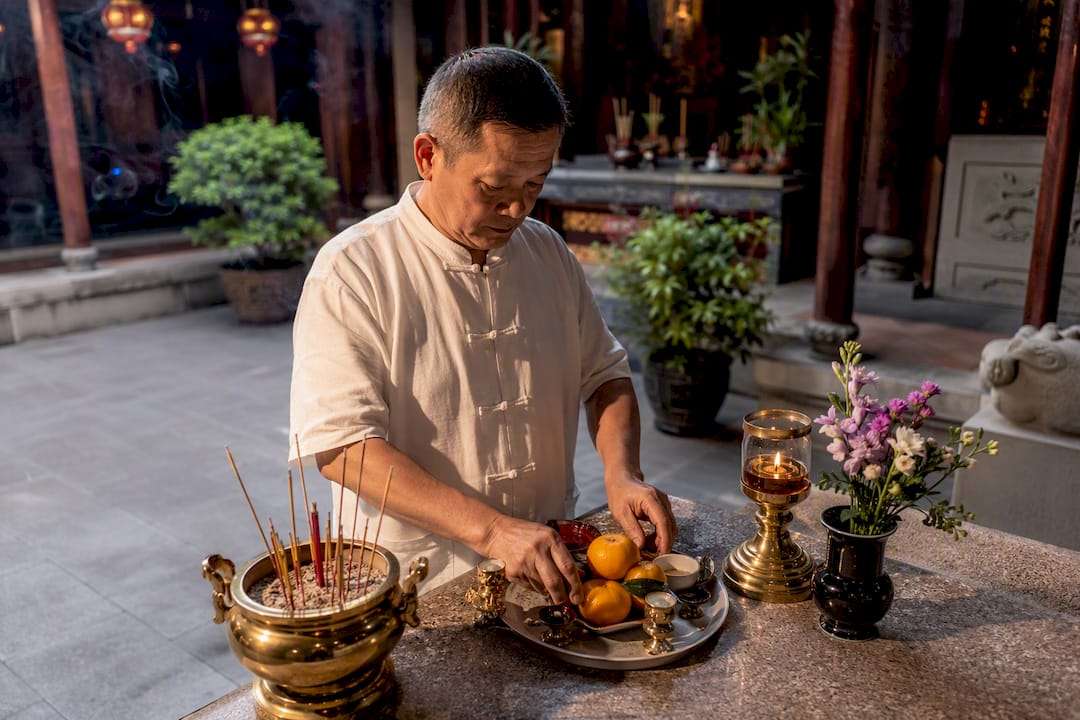
Religious and cultural ceremonies preserve dialect use even among people who don’t speak it elsewhere. Taoist and Buddhist temple rites, funeral wakes, and certain wedding customs often retain specific dialect phrases or chants passed down as ritual language, regardless of what the participants speak day to day.
Hawker centers and traditional trades carry dialect traces too, particularly Hokkien and Teochew, in stall names, ordering terms, and interactions between older vendors and regular customers who share a dialect background. It’s less about full conversations and more about specific words and phrases that signal familiarity and shared identity.
Clan association events, dialect opera performances, and heritage festivals function as intentional preservation spaces, where organizers actively use dialect as part of programming rather than incidentally. These settings tend to draw an older crowd, along with younger Singaporeans specifically interested in cultural heritage.
What’s notably absent is the workplace. Professional settings in Singapore run overwhelmingly on English and Mandarin, which is exactly why building strong Standard Mandarin, rather than any dialect, is the practical move for career purposes.
Should You Take a Course or Keep Self-Studying?
Self-study works fine if you’re casually curious and have no deadline pressing on you. Apps and podcasts build vocabulary slowly, and that’s a reasonable pace for someone with no immediate need.
The calculation changes the moment there’s a real trigger: a promotion that puts you in front of Mandarin-speaking clients, a transfer, or a project where you’ll be expected to hold your own in a meeting within a few months. At that point, structured courses win because they force consistent practice and correct mistakes early, instead of letting bad habits calcify the way solo study often allows.
The honest cost-benefit for busy professionals: a course costs money and a fixed weekly slot, but it buys you a deadline and an instructor keeping you accountable. If you’ve tried self-study before and stalled, that scheduled class is probably the missing piece, not more willpower.
— Paul
Ready to Start Learning Mandarin for Work?
If you’ve read this far, you already know the fastest path isn’t guesswork. It’s picking the course format that actually matches your job, not the one that happens to have an open slot this week. Linda Mandarin runs Conversational Mandarin classes in private and group formats for professionals starting from the ground up, and Business Chinese courses for those who need meeting, email, and negotiation vocabulary specifically.
Traveling often or working odd hours? The online Zoom courses cover both conversational and business tracks with the same native, English-fluent instructors, so you’re not trading quality for convenience. Companies looking to upskill a whole team should look at Corporate Chinese Mandarin Training, which builds a shared curriculum around your industry instead of generic conversation topics.
Not sure which format fits? Book a trial class first. It’s the fastest way to feel out the teaching style, class size, and pacing before committing to a full program, and it costs you one lesson, not a semester.
Sources
- Is Learning Chinese Useful for Your Career in Singapore?
- How to Choose a Chinese Language School in Singapore for Adults-iWorld Learning
- Why Singapore Professionals Gain an Edge by Learning Mandarin – IntelligentHQ
FAQ
Is Mandarin the Same as the Chinese Dialects Spoken in Singapore?
No. Standard Mandarin is the common Chinese language taught in schools and used at work, while dialects like Hokkien, Teochew, and Cantonese are separate regional languages historically spoken by different Chinese community groups in Singapore. For workplace and professional purposes, Standard Mandarin is what you need.
How Long Does It Take to Learn Workplace Mandarin?
Most professionals reach functional workplace Mandarin within three to six months with structured lessons and 30 to 60 minutes of daily practice. Faster progress is possible with intensive formats, but that timeline assumes consistent weekly attendance, not occasional study.
Should I Take a Conversational or Business Mandarin Course?
Start with conversational Mandarin if you have little or no foundation, since it builds the grammar and pronunciation basics you’ll need later. Move to Business Chinese once you can hold a basic conversation, as it focuses specifically on meetings, emails, and presentations.
Are Online Zoom Mandarin Classes Effective for Busy Professionals?
Yes, when the lessons are interaction-focused rather than lecture-style. Online Zoom classes with native instructors work well as a complement to in-person practice, especially for professionals with unpredictable schedules or frequent travel.
How Much Does a Mandarin Course Cost in Singapore With Linda Mandarin?
Pricing depends on the format: a Conversational Group Mandarin Class is 600 $ one-off per student, while a Conversational Private Mandarin Class runs 1730 $ one-off per student. Business Chinese private classes are 1980 $ one-off, and online courses are 1,580 $ or 1,880 $ one-off per student depending on the track.