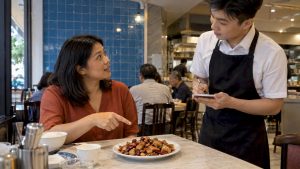
You can order a full meal in Mandarin with about twenty phrases: ask for a table, ask for the menu, say what you want with 我要… (wǒ yào…), flag what you can’t eat, and finish with 买单 (mǎidān). This guide gives you those phrases with pinyin, shows you how to decode a Chinese menu without knowing every character, and covers the Singapore twist: hawker centres, “dabao” and drink orders that mix Mandarin with Hokkien, Malay and English.
TL;DR
- Learn a small core: 有位子吗? (a table?), 可以看一下菜单吗? (the menu?), 我要… (I’d like…), 不要辣 (not spicy), 买单 (the bill).
- Read menus in layers: main ingredient, cut, cooking method, flavor. You don’t need a word-for-word translation.
- State dietary needs plainly: 我吃素 (I’m vegetarian), 我不吃… (I don’t eat…), 我对…过敏 (I’m allergic to…).
- In Singapore, 打包 (dǎbāo) means takeaway, and hawker orders are quick, so decide before you reach the front.
- Practice aloud with a teacher or partner. Pronunciation and tones matter more than a long vocabulary list.
Table of Contents
- Getting a table and asking for the menu
- How to order dishes and drinks
- Reading a Chinese menu without reading every character
- Dietary needs and allergies
- Asking for the bill
- Ordering in Singapore: hawker centres and local lingo
- A short restaurant dialogue to practice
- Pronunciation: where beginners get misunderstood
- Our perspective on learning restaurant Mandarin
- Take it from phrases to real conversation
- FAQ
- Sources
Getting a table and asking for the menu
Start with the part of the meal that happens before you sit down. In a restaurant you can ask whether there is space with 有位子吗? (yǒu wèizi ma?), and if you want to book ahead you say 我想订位 (wǒ xiǎng dìng wèi), meaning “I’d like to make a reservation” (Chinese Learner).
Staff will usually ask how many of you there are. The answer is a number plus 位 (wèi), the polite counter for people:
| English | Mandarin | Pinyin |
|---|---|---|
| Table for two, please | 两位 | liǎng wèi |
| Table for four, please | 四位 | sì wèi |
| Do you have a table? | 有位子吗? | yǒu wèizi ma? |
| Could I see the menu, please? | 可以看一下菜单吗? | kěyǐ kàn yíxià càidān ma? |
| We’re ready to order | 我们要点菜 | wǒmen yào diǎn cài |
The last line is worth noting. 点菜 (diǎn cài) is the everyday verb for “to order dishes”, and 点 alone works for drinks too. You will hear staff ask 可以点菜了吗? (kěyǐ diǎn cài le ma?), “are you ready to order?”, and a simple 我们要点菜 (wǒmen yào diǎn cài) is a natural reply.
A practical tip: if you need more time, say 请等一下 (qǐng děng yíxià), “please wait a moment”. It sounds polite and nobody will rush you.
How to order dishes and drinks
The simplest pattern is 我要 + dish. For example, 我要宫保鸡丁 (wǒ yào gōngbǎo jīdīng) gets you kung pao chicken. To sound a little more natural in a sit-down restaurant, add a quantity with a measure word. A common pattern is 来一份… (lái yí fèn…), “one serving of…” (Chinese Learner).
Quantities and measure words
Chinese needs a measure word between the number and the noun. You don’t need dozens. These cover most tables:
| Measure word | Used for | Example |
|---|---|---|
| 份 (fèn) | a portion or serving of a dish | 一份炒饭 (yí fèn chǎofàn), one fried rice |
| 碗 (wǎn) | bowls of rice, noodles, soup | 两碗面 (liǎng wǎn miàn), two bowls of noodles |
| 杯 (bēi) | cups and glasses | 一杯茶 (yì bēi chá), one cup of tea |
| 瓶 (píng) | bottles | 一瓶水 (yì píng shuǐ), one bottle of water |
| 个 (ge) | the general fallback | 三个包子 (sān ge bāozi), three buns |
Note that for “two” before a measure word you say 两 (liǎng), not 二 (èr).
Asking for recommendations
If the menu is long, ask 有什么推荐的吗? (yǒu shénme tuījiàn de ma?), “what do you recommend?” (Chinese Learner). Two follow-ups help you narrow the answer:
- 哪个比较好吃? (nǎge bǐjiào hǎochī?), which one is tastier?
- 这个辣吗? (zhège là ma?), is this spicy?
When you are sharing dishes, which is how most Chinese meals work, a handy question is 够吃吗? (gòu chī ma?), “is that enough?” Staff will often tell you honestly if you have over- or under-ordered.
Making polite requests
Add 请 (qǐng) and 谢谢 (xièxie) generously. Useful extras at the table:
- 请给我一双筷子 (qǐng gěi wǒ yì shuāng kuàizi), chopsticks, please
- 请给我一把勺子 (qǐng gěi wǒ yì bǎ sháozi), a spoon, please
- 可以加水吗? (kěyǐ jiā shuǐ ma?), can I have more water?
- 请快一点 (qǐng kuài yìdiǎn), a bit faster, please
Reading a Chinese menu without reading every character
Menus look intimidating, but most dish names are built from a few predictable parts. A useful way to approach it is to treat the name as layers: find the main ingredient, the cut, the cooking technique and the flavor, rather than translating each dish literally. Dish names also don’t follow one fixed order, so scan for the pieces you know (Chinese Food Atlas).

Cooking methods to recognize
The character 炒 (chǎo) signals stir-frying, and 辣 (là) signals chili (Chinese Food Atlas). Once you know those two, plenty of menu lines open up. Add these common ones from everyday restaurant menus:
| Character | Pinyin | Meaning |
|---|---|---|
| 炒 | chǎo | stir-fried |
| 蒸 | zhēng | steamed |
| 煮 | zhǔ | boiled or poached |
| 烤 | kǎo | roasted or baked |
| 炸 | zhá | deep-fried |
| 红烧 | hóngshāo | braised in soy sauce |
Ingredients to recognize
| Character | Pinyin | Meaning |
|---|---|---|
| 鸡 | jī | chicken |
| 猪肉 | zhūròu | pork |
| 牛肉 | niúròu | beef |
| 鱼 | yú | fish |
| 虾 | xiā | shrimp |
| 豆腐 | dòufu | tofu |
| 青菜 | qīngcài | green vegetables |
| 蛋 | dàn | egg |
| 饭 | fàn | rice |
| 面 | miàn | noodles |
Put them together and a dish like 青菜炒蛋 reads as “green vegetables, stir-fried, egg”, and 蒸鱼 is steamed fish. That is the decoding habit in action.
Common dishes and what to ask about them
A handful of names come up again and again. 宫保鸡丁 (gōngbǎo jīdīng) is diced chicken stir-fried with peanuts and chili. 麻婆豆腐 (mápó dòufu) is tofu in a spicy sauce. 炒饭 (chǎofàn) is fried rice, 炒面 (chǎomiàn) fried noodles, and 饺子 (jiǎozi) are dumplings. Scallion pancake is 葱油饼 (cōng yóubǐng), and mooncake is 月饼 (yuèbǐng) (The Shortlist).
When a name tells you nothing, ask:
- 这是什么? (zhè shì shénme?), what is this?
- 里面有什么? (lǐmiàn yǒu shénme?), what’s in it?
- 是什么味道的? (shì shénme wèidào de?), what does it taste like?
- 有肉吗? (yǒu ròu ma?), does it have meat?
Spice levels
Spice is the thing most learners want to control. You can say 不要辣 (bú yào là) for no chili, 微辣 (wēilà) for mild, 中辣 (zhōnglà) for medium, and 特辣 (tèlà) for extra hot (Netchai). If you are unsure, start with 微辣. You can always ask for more.
Dietary needs and allergies
Be direct. For vegetarians, 我吃素 (wǒ chī sù) says “I’m vegetarian”. For a specific food, use 我不吃… (wǒ bù chī…), “I don’t eat…”, and for allergies, 我对…过敏 (wǒ duì… guòmǐn), “I’m allergic to…” (Chinese Learner).
Fill the blank with the food:
| Say this | Pinyin | Meaning |
|---|---|---|
| 我不吃猪肉 | wǒ bù chī zhūròu | I don’t eat pork |
| 我不吃牛肉 | wǒ bù chī niúròu | I don’t eat beef |
| 我对花生过敏 | wǒ duì huāshēng guòmǐn | I’m allergic to peanuts |
| 我对虾过敏 | wǒ duì xiā guòmǐn | I’m allergic to shrimp |
One caution from experience: broths and sauces can contain ingredients that never appear in the dish name. If an allergy is serious, say it before ordering, repeat it when the food is confirmed, and ask 里面有…吗? (lǐmiàn yǒu… ma?), “does it contain…?” For medical allergies, your doctor is the right person to advise on what to carry and how to communicate it. A phrase list is not a safety system.
Asking for the bill
At the end of the meal, call for the bill with 买单! (mǎidān!) or the more formal 结账,谢谢 (jiézhàng, xièxie). If you want to confirm the total, ask 多少钱? (duōshao qián?), “how much is it?” (Chinese Learner). In Singapore, many places also take 一起付 (yìqǐ fù), “paying together”, and 分开付 (fēnkāi fù), “paying separately”, when you ask for the check as a group.
A tidy finish: 谢谢,很好吃! (xièxie, hěn hǎochī!), “thank you, it was delicious!”
Ordering in Singapore: hawker centres and local lingo
Singapore is not Beijing or Chengdu, and a textbook phrase doesn’t always match what you hear at the stall. Hawker lingo is a mix of Mandarin, Tamil, Malay, English and local dialects (Wak Wak Hawker). That’s useful to know, because you will hear Mandarin words next to Hokkien and Malay ones in the same sentence.
Words worth knowing
- 打包 (dǎbāo, “dabao”): takeaway. It is the Mandarin term for asking for your food to go (ST Signature).
- Chope: reserving a seat, often with a tissue packet. The word is Singlish, not Mandarin (ST Signature).
- Uncle and Auntie: how vendors are commonly addressed (ST Signature). In Mandarin you can also say 老板 (lǎobǎn) to a stall owner.
- Drink orders: “Siew Dai”, “Teh C”, “Teh O Kosong” and “Teh Peng” are all standard hawker orders (ST Signature). Add “peng” for iced, as in “Kopi C peng” (Neighbourhood Life).
You can blend them in a Mandarin sentence: 老板,一碗鱼丸面,打包 (lǎobǎn, yì wǎn yúwán miàn, dǎbāo), “boss, one bowl of fishball noodles, takeaway.” Short and clear works best.
Hawker etiquette that saves awkward moments
Ordering at a busy stall is fast. Know what you want before you get to the front, and step aside if you need more time (Singapore Travel Guide by a Local). For takeaway, bringing a sturdy bag helps, since the thin plastic bags provided can be flimsy (Neighbourhood Life).
If you are learning Mandarin in Singapore specifically, it also helps to know which varieties you’ll hear around you. Our guide to Mandarin dialects in Singapore explains what to focus on first.
A short restaurant dialogue to practice
Read this aloud, then cover the English and try to rebuild it. Roles: 服务员 (fúwùyuán, server) and 客人 (kèrén, guest).
- 服务员:几位? (jǐ wèi?) How many people?
- 客人:两位。 (liǎng wèi.) Two.
- 客人:可以看一下菜单吗? (kěyǐ kàn yíxià càidān ma?) Could I see the menu?
- 客人:有什么推荐的吗? (yǒu shénme tuījiàn de ma?) What do you recommend?
- 服务员:宫保鸡丁很好吃。 (gōngbǎo jīdīng hěn hǎochī.) The kung pao chicken is very good.
- 客人:好,我要一份宫保鸡丁,一份青菜,两碗饭。不要太辣。 (hǎo, wǒ yào yí fèn gōngbǎo jīdīng, yí fèn qīngcài, liǎng wǎn fàn. bú yào tài là.) Good, I’ll have one kung pao chicken, one green vegetable, two bowls of rice. Not too spicy.
- 客人:买单,谢谢。 (mǎidān, xièxie.) The bill, thank you.
Repeat it three times, changing the dishes each time. This kind of swapping is how a script turns into a skill.
Pronunciation: where beginners get misunderstood
Mandarin has four tones plus a neutral one, and a wrong tone can change a word. The classic restaurant example is 吃 (chī, to eat) and 次 (cì, a time or occasion). You can usually be rescued by context at a restaurant, but numbers and measure words are where mistakes show: 四 (sì, four) and 十 (shí, ten) are easy to mix up when you say “four of these”.
Three habits help:
- Learn each phrase with its pinyin and listen to a native speaker saying it, not just reading it.
- Practice the tones on the short words you’ll say most: 要 (yào), 不 (bù), 辣 (là), 好 (hǎo).
- Get corrected by a person. Apps can’t tell you which tone you actually said.
Our article on the challenges beginners face when learning Chinese in Singapore covers tones and other early hurdles in more depth.
Our perspective on learning restaurant Mandarin
We have taught Mandarin in Singapore since 2003, and ordering food is one of the first real-life goals adult learners bring us. It is a good goal. The language is predictable, the stakes are low, and you get instant feedback: you either get the dish you wanted or you don’t.

Our advice is to resist the phrasebook trap. Memorizing 32 phrases from a list gets you through one script. What carries over is a handful of patterns (我要…, 我不吃…, 有…吗?) that you can swap words into. That is why we teach communication first, with listening, speaking, reading and writing built up step by step, and why our native Mandarin instructors, who are fluent in English, correct tones in the moment instead of leaving you to guess.
Most of our learners find that a few weeks of structured practice with real conversation changes how they feel at a table far more than any word list does. Take what is in this article, say it out loud this week, and then use a real meal as your test.
— Paul
Take it from phrases to real conversation
If you want to go beyond a phrase list, our Conversational Mandarin classes in Singapore focus on exactly this kind of situational speaking. A group class is priced at $600 per student, one-off, and a private class at $1,730 per student, one-off. If you prefer to learn from home or from your office, the online Zoom Conversational Mandarin course is $1,580 per student, one-off.

We teach from 10 Anson Road, Level 22, International Plaza, Singapore 079903, right above Tanjong Pagar MRT. Not sure which format suits you? Book a trial class and try it before you commit. Our broader guide to learning Chinese in Singapore as an adult can also help you plan.
FAQ
What is the easiest way to order food in Mandarin?
Use 我要… (wǒ yào…), “I want…”, followed by the dish name, and add 谢谢 (xièxie). If you don’t know the name, point to the menu and ask 这个多少钱? (zhège duōshao qián?). That one pattern covers most simple orders.
How do I say “no spice” or “less spicy” in Chinese?
Say 不要辣 (bú yào là) for no chili. For a gentler level, 微辣 (wēilà) means mild and 中辣 (zhōnglà) means medium (Netchai). If you are unsure, start mild.
How do I read a Chinese menu if I can’t read characters?
Learn a small set of cooking-method and ingredient characters, such as 炒 for stir-fried and 辣 for chili (Chinese Food Atlas). Then read each name as layers of ingredient, cooking method and flavor. Many restaurants in Singapore also have pictures or English names, so combine all three clues.
What does “dabao” mean in Singapore?
“Dabao” is the pinyin for 打包 (dǎbāo), the word for takeaway at hawker centres (ST Signature). You may also hear “tapau”, which is used in the same way.
How do I tell staff I have a food allergy in Mandarin?
Say 我对…过敏 (wǒ duì… guòmǐn), filling in the food, for example 我对花生过敏 for peanuts (Chinese Learner). For a serious allergy, repeat it when the dish is confirmed and ask whether sauces or broths contain it.
Sources
- Ordering Food in Chinese: 32 Common Phrases with Pinyin (Chinese Learner)
- How to Read a Chinese Menu: Essential Terms and Techniques (Chinese Food Atlas)
- 120 Chinese Travel Phrases by Scene (Netchai)
- Basic Mandarin Chinese Food and Restaurant Vocabulary (The Shortlist)
- Guide to Maxwell Hawker Centre (ST Signature)
- How to Tapau Like a Pro in Singapore’s Hawker Centres (Neighbourhood Life)
- How to Order at a Singapore Hawker Centre: Etiquette (Singapore Travel Guide by a Local)
- How To Order Like A Local: Hawker Centre Lingo (Wak Wak Hawker)