The fastest path to conversational Mandarin as an adult is a structured course that drills tones and speaking from lesson one, backed by daily micro-practice between classes. Prioritize three things when picking a program: instructor quality, small class size (or private lessons), and a delivery mode (in-person, Zoom, or hybrid) that actually fits your calendar. Schools like Linda Mandarin build their adult programs around exactly this combination.
TL;DR:
- Small group classes or private lessons ensure enough speaking practice and real-time correction, which are crucial for rapid progress in Mandarin.
- Courses focused on tones and pinyin are most effective for beginners to prevent bad habits from forming and to accelerate understanding.
- The typical progression from foundation to advanced takes about 8 to 12 weeks, with consistent daily practice boosting fluency and comprehension.
- The best programs offer native or near-native instructors, clear level progression, and trial sessions to verify teaching quality before commitment.
- Regular self-assessment through conversations, milestones such as ordering meals, and tracking retention with apps help measure real language improvement.
Table of Contents
- What Type Of Adult Mandarin Course Fits Your Goal?
- In-Person, Private, Or Online Zoom: Which Delivery Mode Works Best?
- How Do Adult Learners Progress From Beginner To Advanced?
- How Do You Choose The Right Mandarin Course?
- A Weekly Study Routine That Actually Sticks
- How Do You Know If Your Mandarin Is Actually Improving?
- Why Speaking-First Courses Beat Everything Else I’ve Seen
- Get Started With Linda Mandarin’s Adult Programs
- Sources
- FAQ
What Type Of Adult Mandarin Course Fits Your Goal?
Not every Mandarin course is built for the same outcome, and picking the wrong one wastes months. Adult programs generally split into four tracks, and matching yourself to the right one saves both time and money.
Conversational Mandarin targets everyday survival: ordering food, small talk, navigating a taxi ride, chatting with in-laws. It leans heavily on spoken practice over reading and writing, which suits someone who wants results in months, not years.
Business or professional Mandarin goes further. It covers industry vocabulary, meeting etiquette, negotiation phrases, and email conventions. A finance manager who needs to run a call with a Shanghai supplier needs this track, not a beginner conversational class.
Pinyin and pronunciation-focused classes exist because tones make or break comprehension. Getting the sound system right early, before bad habits calcify, is one of the highest-leverage things a beginner course can do.
Intensive or corporate formats compress the timeline. These fit two kinds of learners: someone relocating for work in eight weeks, or a company rolling out corporate Chinese Mandarin training across a department.
- A new expat hire: conversational track, small group
- A regional sales lead: business Mandarin with negotiation vocabulary
- Someone starting from zero: pinyin and tone foundation first
- An HR team upskilling staff: corporate or intensive format
In-Person, Private, Or Online Zoom: Which Delivery Mode Works Best?
Delivery mode decides how much correction and speaking time you actually get, and that matters more than most learners assume. Passive apps are fine for vocabulary drilling, but they typically lack real-time tone correction, which is exactly what a live instructor provides.
Small in-person groups (capped around 6 to 10 students) give you regular speaking turns and a teacher who can catch a mispronounced tone before it becomes a habit. Private lessons go further, offering full class time dedicated to your voice, at a higher price point. Online Zoom classes now match in-person quality for most conversational goals, provided the group stays small and the instructor uses breakout rooms or direct call-outs for speaking practice.
- In-person small group: best balance of cost and speaking practice
- Private lessons: fastest progress, highest cost, ideal for tight deadlines
- Zoom classes: same structure as in-person, better for irregular schedules
- Hybrid: mix weekly Zoom sessions with occasional in-person practice days
Hybrid formats suit people who travel for work but still want consistency. A typical session runs 60 to 90 minutes, once or twice weekly, which is enough for structured input without burning out a working adult.
Pro Tip: Book evening or weekend slots if you’re juggling a day job. Momentum matters more than intensity. Two consistent 90-minute sessions a week beat one exhausting three-hour block.
How Do Adult Learners Progress From Beginner To Advanced?
Progress in Mandarin follows a fairly predictable sequence, and knowing it ahead of time helps you set realistic expectations instead of quitting after week three because you can’t yet read a menu.
- Foundation stage (weeks 1 to 8). Tones and pinyin come first, since training tone accuracy from the start prevents errors that are painful to unlearn later. Speaking and listening lead; characters are introduced gradually rather than front-loaded.
- Elementary conversational stage (weeks 8 to 20). Learners typically handle survival interactions: ordering, directions, basic introductions. Vocabulary expands through spaced repetition and simple dialogues.
- Intermediate stage (months 5 to 9). This is where most adults can hold a 5 to 10 minute conversation on familiar topics and start reading short texts with support.
- Advanced/professional stage (month 9 onward). Business vocabulary, nuanced grammar, and independent reading come into focus, depending on the track chosen.
Many adult programs, including university and language-center offerings, run this progression in 8 to 12 week modules with hybrid attendance, which keeps working adults engaged and gives a natural checkpoint to assess progress before committing to the next stage.
How Do You Choose The Right Mandarin Course?
Pick a course the way you’d vet any long-term commitment: check credentials, ask direct questions, and watch for warning signs before signing up.
Run through this checklist before enrolling:
- Are instructors native or near-native speakers with real teaching experience, not just fluency?
- Is class size small enough that you speak every session, not just listen?
- Does the syllabus show clear level progression, not vague “conversational fluency” promises?
- How much speaking time happens per lesson versus lecture-style instruction?
- Can you try a sample lesson or take a placement assessment first?
- Does the schedule (evenings, weekends, Zoom) actually fit your week?
- What’s the pricing structure, and is there a refund or transfer policy if the pace is wrong?
Red flags include schools that can’t describe what you’ll be able to say or write after each stage, classes where the teacher talks for 50 minutes straight, and providers who won’t offer any trial session before you pay in full. Trial lessons and short modules let you judge teaching style and pace before a longer commitment.
Speaking practice, not passive review, is the lever that moves the needle. Fifteen minutes of genuine conversation often outperforms an hour of flashcard drilling for retention and real-world fluency.
A Weekly Study Routine That Actually Sticks
Classes alone won’t get you fluent. What happens between sessions decides how fast you move. A sustainable weekly routine for a busy adult looks something like this: 10 to 15 minutes of spaced-repetition vocabulary review daily, one 20 minute listening session (podcasts, short videos, graded audio), and short speaking practice, even if it’s just repeating dialogue aloud, every single day.
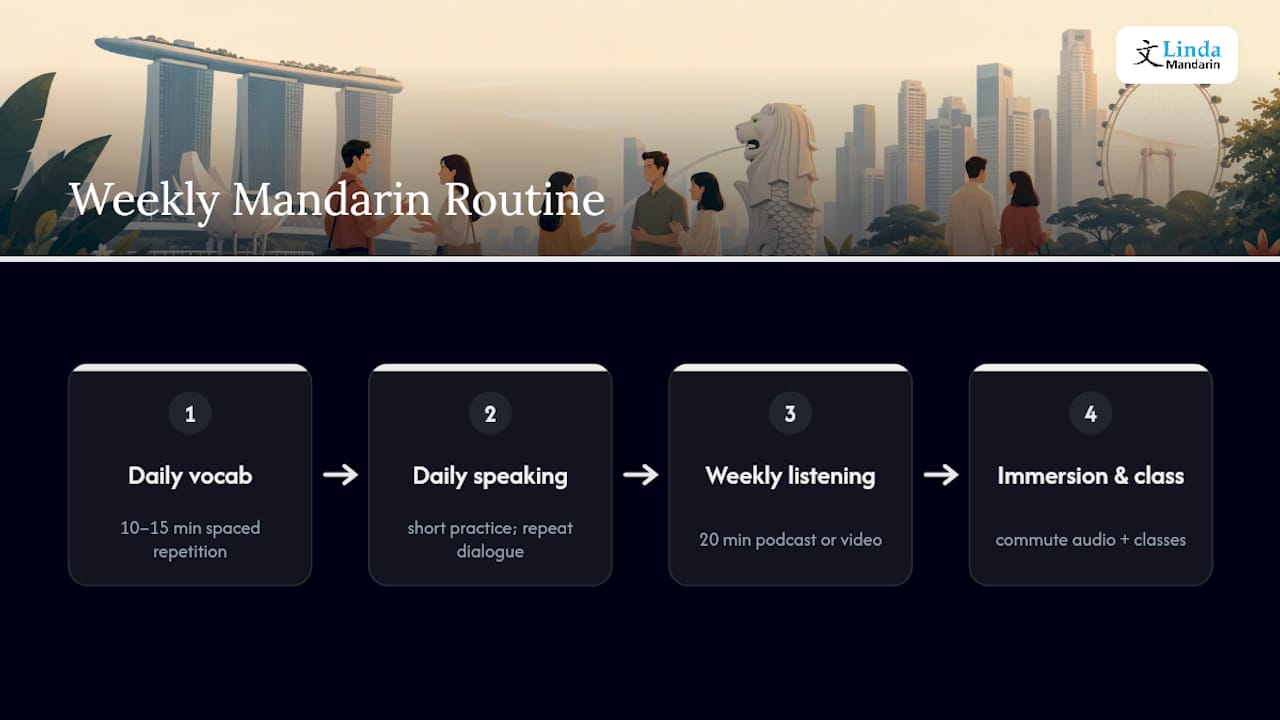
Five to ten new, genuinely useful words a day, reviewed through spaced repetition, is a realistic and sustainable pace, far more effective than cramming forty words once a week and forgetting most of them by Friday.
Early tone work pays off disproportionately because pinyin should function as scaffolding, not the destination — characters get layered in steadily once the sound system is solid.
Pro Tip: Pair your class with immersion outside it. Even five minutes of Mandarin audio during a commute compounds over a semester.
Group classes, private lessons, and online Zoom sessions each reinforce this routine differently. Group formats build accountability through peers; private and corporate training sessions let an instructor tailor drills to your specific gaps.
How Do You Know If Your Mandarin Is Actually Improving?
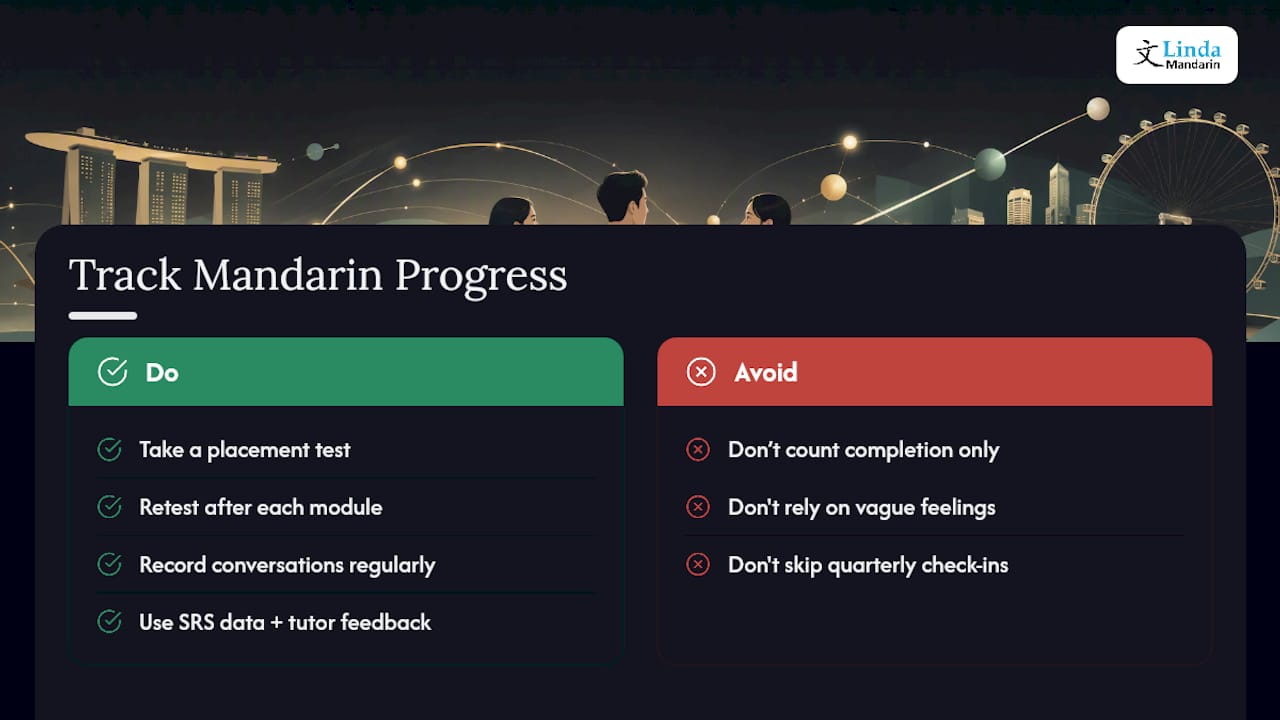
Course completion is not the same as competence, and too many adult learners finish a term without a clear read on what they can actually do. Real progress tracking needs more than a certificate of attendance.
Placement tests at the start of a program give you a baseline, and many schools retest at the end of each module to measure movement, not just attendance. Recording yourself in conversation, then comparing clips a few months apart, reveals fluency gains that are easy to miss in the moment.
Beyond the classroom, track concrete milestones instead of vague feelings of “getting better”: Can you order a full meal without switching to English? Can you follow a five-minute news clip at a slower pace? Can you write a short message to a colleague without a translation app? These functional checkpoints matter more than a vocabulary count.
Spaced-repetition apps also generate useful data on retention, showing which words or grammar patterns keep slipping. Pairing that data with a tutor’s qualitative feedback (pronunciation habits, sentence structure quirks) gives a fuller picture than either source alone.
Some learners set a target, such as passing a standardized proficiency benchmark or being able to conduct a full client meeting in Mandarin, and use that as an external check every few months. Whatever the metric, revisit it regularly. Progress in a tonal language is often invisible week to week but obvious over a quarter, which is exactly why structured check-ins matter more than daily self-assessment.
Why Speaking-First Courses Beat Everything Else I’ve Seen
Most people learning Mandarin as adults over-invest in apps and vocabulary lists and under-invest in the one skill that actually compounds: talking, out loud, with correction. That’s the uncomfortable part. Apps feel productive because they show streaks and progress bars, but they can’t hear you butcher a third tone and fix it on the spot.
The learners who progress fastest treat class time as speaking rehearsal, not lecture attendance, and they show up daily with five minutes of practice rather than weekly with an hour of cramming. If you’re choosing a course right now, weigh speaking time per lesson more heavily than syllabus glossiness or brand name.
Try a sample lesson before committing. Fifteen minutes of daily practice, sustained over months, will do more for you than any app subscription. Explore adult programs built around this exact sequencing.
— Paul
Get Started With Linda Mandarin’s Adult Programs
Linda Mandarin has been teaching working adults and professionals since 2003, from the studio at 10 Anson Road, Level 22, International Plaza, right above Tanjong Pagar MRT. Whether you need survival conversational skills, boardroom-ready business Mandarin, or a corporate rollout for your whole team, the course formats are built around speaking practice, not passive lectures.
Options include small group classes, one-on-one private lessons, flexible online Zoom sessions, and intensive formats for anyone on a tight timeline. Business-focused learners can go straight into professional Mandarin training built around real workplace scenarios, while companies can arrange corporate Chinese Mandarin training for entire teams.
The next step is simple: book a sample lesson or request a placement assessment to find your starting level, then pick the schedule, in-person, Zoom, or hybrid, that actually fits your week. Visit the adult programs page to see current course levels and get started.
Sources
- Best Way to Learn Mandarin in 2026: What Actually Works for English Speakers
- Learn Chinese by Yourself: The Complete Self-Study Method for Beginners (2026) | ChineseSRS
- Chinese for Everyone – 12-Week Mandarin Chinese Course | Confucius Institute
FAQ
Is it possible to learn Chinese as an adult?
Yes. Adults often learn faster than children in structured settings because they can grasp grammar explanations and study strategically, and tone training plus daily speaking practice closes most of the natural disadvantage in pronunciation.
Is 50 too old to learn Chinese, or is there an age limit?
No age limit exists for learning Mandarin effectively. Adult learners in their 50s and beyond regularly reach solid conversational fluency, especially when they combine a structured course with consistent short daily practice rather than relying on age as an excuse to skip speaking practice.
Is 30 too late to start learning Mandarin?
Thirty is nowhere close to too late. Cognitive ability to learn a new language stays strong well into adulthood, and the biggest factor in success is consistency of practice, not the age you started.
How long does it take an adult to hold a basic conversation in Mandarin?
With a structured course and daily micro-practice, many adult learners can hold a 5 to 10 minute conversation on familiar topics within roughly four to six months, following a foundation-to-intermediate progression.
Should I choose group classes or private lessons as a beginner?
Small group classes work well for most beginners because they still guarantee speaking turns at a lower cost, while private lessons suit anyone with a tight deadline or highly specific goals, such as an upcoming client meeting in Mandarin.