Learning Mandarin gives U.S. adults and professionals a genuine edge across Asia’s most important markets. The advantages of Mandarin in Asia span career advancement, economic access, cultural credibility, and cognitive growth. Here is what that means in practice:
- Mandarin connects you with over 1 billion native speakers, plus diaspora communities across Southeast Asia, Taiwan, Singapore, and Malaysia
- Mandarin proficiency is associated with a 15–25% pay premium and 74% faster career advancement in multinational corporations
- Speaking Mandarin gives you direct access to Chinese digital platforms like WeChat, Tmall, and Douyin, where English-only professionals are locked out of critical consumer data
- Cultural fluency in Mandarin signals respect and effort, shifting business relationships from transactional to trusted
- The cognitive challenge of learning a tonal, logographic language trains brain areas that alphabetic languages simply do not reach
These benefits do not operate in isolation. Each one compounds the others, and together they explain why Mandarin has become one of the most sought-after professional skills in Asia-facing careers.
Table of Contents
- 1. How Mandarin connects you with speakers across Asia
- 2. Career opportunities that open with Mandarin proficiency
- 3. Economic advantages of speaking Mandarin in Asia
- 4. Travel and cultural benefits in Mandarin-speaking regions
- 5. Cognitive and creative benefits of learning Mandarin
- 6. Why cultural humility through Mandarin builds professional trust
- 7. Professional Mandarin learning options for U.S. adults
- 8. How regional dialects and variations affect Mandarin communication
- 9. How to integrate Mandarin into daily life in Asian countries
- 10. Why Mandarin outperforms other Asian languages for U.S. professionals
- Key Takeaways
- Why Mandarin is the skill most professionals underestimate
- FAQ
1. How Mandarin connects you with speakers across Asia
Mandarin functions as a lingua franca across Chinese communities throughout Southeast Asia, not just in mainland China. Ethnic Chinese communities in Indonesia, Thailand, Malaysia, Singapore, and the Philippines often use Mandarin as a shared language when their regional dialects differ. That reach is broader than most U.S. professionals realize before their first trip to the region.
The language also carries embedded social values. Mandarin reflects formality, respect, and collectivist norms that shape how people communicate across Asia’s high-context cultures. Knowing how to address a senior colleague correctly, or how to phrase a request with appropriate deference, signals cultural literacy that no business card or credential communicates on its own.
Even basic proficiency flips professional dynamics. A simple greeting in Mandarin at the start of a meeting, or a polite toast at a business dinner, shifts the atmosphere immediately. Locals notice the effort, and that noticing matters more than most Western professionals expect.
- Mandarin bridges communication gaps between different Asian ethnic and linguistic groups
- Respectful titles and greetings signal cultural awareness before a single business point is made
- Diaspora networks across Southeast Asia respond warmly to Mandarin speakers regardless of nationality
2. Career opportunities that open with Mandarin proficiency
Mandarin proficiency is now a listed requirement or strong preference in finance, consulting, supply chain, technology, luxury retail, and international trade roles across Asia. The pay premium is real: Mandarin speakers tend to earn more and advance faster in multinational corporations compared to peers without the language. Job listings requiring Mandarin have grown sharply in technology, finance, and supply chain roles.
Access to Chinese digital ecosystems is a career advantage that rarely gets enough attention. WeChat, Tmall, and Douyin are not just apps. They are the primary channels for consumer insights and marketing in the world’s largest consumer market, and navigating them requires Mandarin literacy. An English-only professional working in Asia-facing marketing or product roles is working with one hand tied behind their back.
Mandarin also changes how you perform in negotiations and cross-border team management. Professionals who can conduct even part of a meeting in Mandarin build rapport faster and retain more of what is actually being communicated. Recruiters and clients read Mandarin proficiency as a signal of genuine regional commitment, not just a line on a resume.
- Finance, consulting, and supply chain roles increasingly list Mandarin as preferred or required
- Career advancement in multinational firms correlates directly with demonstrated language commitment
- Cross-border team leaders who use Mandarin, even imperfectly, report higher trust and better retention
Pro Tip: If you are targeting a promotion into an Asia-Pacific leadership role, even intermediate conversational Mandarin on your profile changes how hiring managers read your application.
3. Economic advantages of speaking Mandarin in Asia
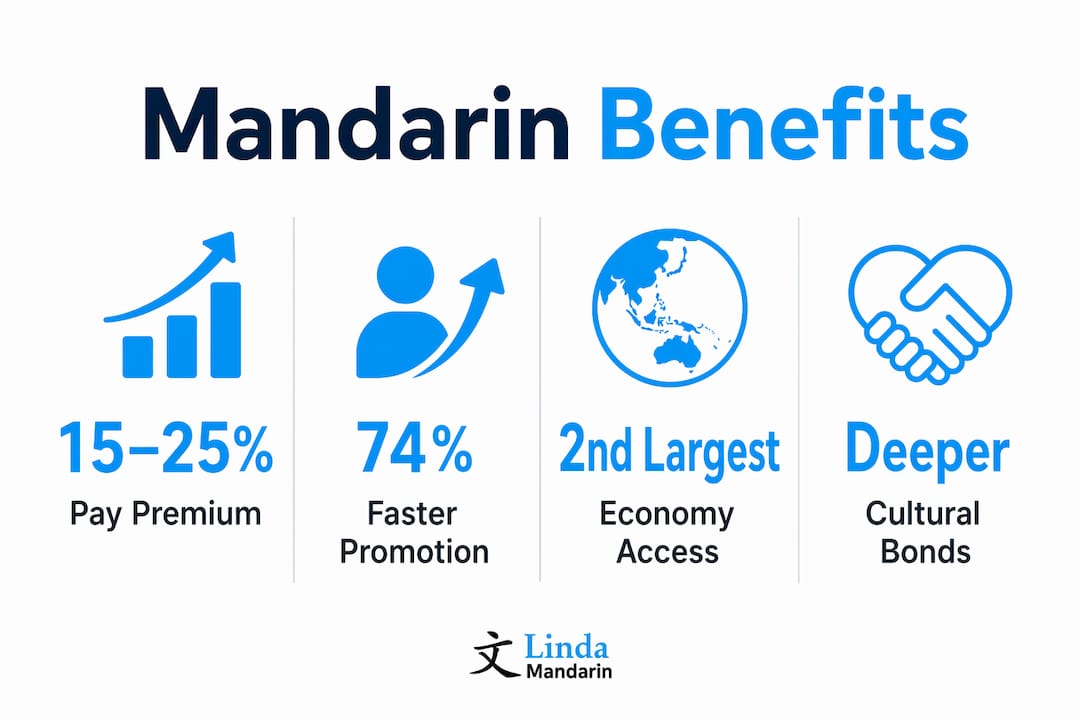
China is the world’s second-largest economy, connecting professionals to a vast amount of economic influence. Mandarin is the primary business and digital language across that economy and extends its reach into major Asian trading partners. For U.S. professionals working in trade, investment, or operations, that scale is not abstract. It shows up in every supplier negotiation, every partnership discussion, and every market entry decision.

The Belt and Road Initiative has deepened Mandarin’s relevance beyond China’s borders. Infrastructure and trade projects linking Central Asia, Southeast Asia, and East Africa increasingly operate in Mandarin at the working level. Professionals who can engage in that language reduce friction in negotiations and build the kind of trust that lowers transaction costs over time.
Mandarin also unlocks market intelligence that simply does not exist in English. Consumer trend data, regulatory updates, and competitive analysis published in Chinese rarely get translated quickly or accurately. Professionals who can read and interpret that content have a genuine information advantage over those who cannot.
- Mandarin proficiency reduces friction and builds trust in supplier and partner negotiations
- Business Mandarin skills give direct access to market data and consumer insights unavailable in English
- Trade and infrastructure projects across Asia increasingly require Mandarin at the working level
4. Travel and cultural benefits in Mandarin-speaking regions
Traveling through China, Taiwan, Singapore, or Malaysia with Mandarin changes the experience completely. Navigation becomes straightforward, menus make sense, and interactions with locals shift from transactional to genuinely conversational. Outside major tourist corridors, English is limited, and Mandarin is the practical tool that gets things done.

The deeper benefit is cultural access. Mandarin opens Chinese literature, film, cuisine culture, and social customs in ways that translation cannot replicate. Understanding why a dish is served at a particular moment in a meal, or what a specific phrase in a toast actually implies, requires the language itself. That kind of access builds real appreciation rather than surface-level tourism.
Friendships and professional connections formed in Mandarin tend to run deeper. When you can participate in a conversation rather than wait for it to be summarized for you, you become part of the social fabric rather than an observer of it. That difference matters whether you are traveling for a week or living in the region for years.
5. Cognitive and creative benefits of learning Mandarin
Mandarin’s tonal and logographic system trains the brain differently than any alphabetic language. Research from the Wellcome Trust found that Mandarin speakers use both temporal lobes to process language, while English speakers rely primarily on the left. That bilateral activation reflects a genuinely different cognitive demand.
Writing Chinese characters adds another layer. The sequential, multi-directional strokes required to form each character activate working memory, spatial reasoning, and fine motor coordination simultaneously. Studies from Indiana University confirmed that handwriting complex characters produces more enhanced neural activity than tracing simpler alphabetic letters. The brain is doing more work, and that work builds transferable cognitive capacity.
For professionals, the practical payoff shows up in multitasking and high-pressure decision-making. The mental discipline required to track tones, characters, and context simultaneously translates into sharper attention control and greater cognitive flexibility. Creativity benefits too, because the logographic system trains visual and associative thinking that linear alphabetic languages do not demand.
- Mandarin’s tonal system requires both brain hemispheres, unlike English which primarily uses the left
- Character writing strengthens spatial memory, motor skills, and visual pattern recognition
- Cognitive flexibility gained from Mandarin learning transfers to professional problem-solving
6. Why cultural humility through Mandarin builds professional trust
Cultural humility is the quality that separates professionals who succeed long-term in Asia from those who plateau. Mandarin is one of the clearest signals of it. Learning the language communicates that you took the time, made the effort, and respect the culture enough to engage on its own terms. Across Asia’s high-context business environments, that signal carries more weight than credentials or titles.
Small gestures in Mandarin shift negotiation dynamics in ways that are hard to quantify but easy to feel. A polite greeting, a correctly used honorific, or a brief toast in Mandarin at a dinner moves the relationship from transactional to trusted faster than any formal presentation. These moments build guanxi, the interpersonal relationship networks that drive business decisions in Chinese contexts, and no AI translation tool can replicate that process.
Mandarin also helps professionals “read the air.” In negotiations where the most important communication is indirect, a Mandarin speaker picks up on tone, pacing, and phrasing cues that a translator simply cannot convey in real time. That situational awareness is a competitive differentiator in any high-stakes deal.
In Asia, language proficiency signals commitment more strongly than credentials alone, affecting promotions and recruitment in multinational firms.
Pro Tip: Even intermediate Mandarin proficiency accelerates relationship-building and leadership credibility in Asia-Pacific roles. You do not need to be fluent to change how colleagues and clients perceive you.
7. Professional Mandarin learning options for U.S. adults
For U.S. adults and professionals serious about building Mandarin skills for Asia, the right learning environment makes a significant difference. Linda Mandarin, based in Singapore since 2003, offers adult conversational and business Mandarin courses designed specifically for professional use, not academic study. The syllabus emphasizes real-life communication from the first lesson.
Flexibility is built into the model. Physical classes run at the school’s central Singapore location at 10 Anson Road, Level 22, International Plaza, right above Tanjong Pagar MRT. Online Zoom sessions cover the same curriculum for professionals based elsewhere or traveling frequently. Both formats use experienced, certified native Mandarin instructors who are fluent in English, so explanations are clear and lessons stay practical.
Corporate Mandarin training programs are available for teams, with customized content that integrates business language and cultural context together. That combination matters because language skills without cultural grounding produce professionals who can speak Mandarin but still misread the room.
- Group classes, private sessions, and online Zoom options accommodate different schedules and locations
- Corporate programs are customized to industry-specific vocabulary and business communication needs
- Native instructors fluent in English deliver lessons tailored to adult learners at every level

8. How regional dialects and variations affect Mandarin communication
Standard Mandarin, known as Putonghua in mainland China and Guoyu in Taiwan, is the official spoken standard across both territories and serves as the common language in Singapore’s formal and professional settings. However, regional accents and vocabulary variations exist across provinces, and they can catch unprepared learners off guard.
In southern China, speakers from Guangdong, Fujian, and surrounding provinces often carry strong regional accents that differ noticeably from the Beijing standard. In Taiwan, the accent and some vocabulary choices differ from mainland usage, though mutual intelligibility is high. Singapore’s Mandarin carries local influences from Hokkien and Cantonese, producing a distinct cadence that sounds different from either mainland or Taiwanese speech.
For professionals, the practical implication is to learn standard Putonghua first and treat regional variations as context you will absorb over time. The core grammar and vocabulary transfer across all variations. Exposure to different accents through media, podcasts, and conversation partners accelerates comprehension faster than any textbook exercise.
9. How to integrate Mandarin into daily life in Asian countries
The fastest way to build Mandarin fluency while living or working in Asia is to stop treating it as a study subject and start treating it as a daily operating tool. That shift in mindset changes everything about how quickly the language sticks.
Practical integration starts with the mundane. Order food in Mandarin. Ask for directions in Mandarin. Read the Chinese-language version of a menu or sign before checking the English translation. Each small interaction builds the neural pathways that classroom study alone cannot create. The discomfort of making mistakes in public fades quickly, and the confidence that replaces it compounds.
For professionals, the most effective daily practice is consuming Chinese-language media relevant to your industry. Business news in Mandarin, industry podcasts, and even social media content on WeChat or Douyin expose you to the vocabulary and communication style you will actually use at work. Pair that with a cross-cultural communication framework and the language starts serving your career rather than just your curiosity.
- Use Mandarin for everyday transactions first: ordering, navigating, and small talk
- Consume Chinese-language media in your professional field to build relevant vocabulary
- Find a conversation partner or language exchange contact to practice outside formal lessons
10. Why Mandarin outperforms other Asian languages for U.S. professionals
For U.S. professionals choosing which Asian language to invest in, Mandarin offers a reach that no other Asian language matches. Japanese and Korean are valuable in their respective markets, but Mandarin connects you to a network that spans mainland China, Taiwan, Singapore, Malaysia, and diaspora communities across Southeast Asia. That geographic and economic breadth is unmatched.
The economic weight behind Mandarin is also distinct. China’s role as the world’s second-largest economy means Mandarin proficiency connects you to supply chains, investment flows, and consumer markets that touch virtually every major industry. Japanese and Korean are important for specific sectors, but Mandarin is relevant across finance, technology, manufacturing, logistics, retail, and professional services simultaneously.
There is also a scarcity argument. Relatively few U.S. professionals reach working proficiency in Mandarin, which means the competitive differentiation is sharper. The Foreign Service Institute classifies Mandarin as a Category IV language requiring approximately 2,200 hours to reach professional working proficiency, which is a genuine barrier. That barrier is also what makes the credential so valuable once you clear it. Conversational fluency, achievable within 18–24 months of consistent study, is enough to change how you are perceived in most professional settings.
Key Takeaways
Mandarin proficiency is one of the highest-return professional investments a U.S. adult can make for Asia-facing careers, combining career, economic, cultural, and cognitive advantages that no other Asian language delivers at the same scale.
| Point | Details |
|---|---|
| Career pay premium | Mandarin speakers earn a 15–25% pay premium and advance 74% faster in multinational corporations. |
| Economic reach | Mandarin connects professionals to the world’s second-largest economy as their economic influence. |
| Cultural trust signal | Mandarin proficiency demonstrates cultural humility, building guanxi and trust that AI translation cannot replicate. |
| Cognitive advantage | Mandarin’s tonal and logographic system activates both brain hemispheres, strengthening cognitive flexibility and working memory. |
| Learning timeline | Conversational fluency is achievable within 18–24 months of consistent study; professional proficiency requires approximately 2,200 hours. |
Why Mandarin is the skill most professionals underestimate
There is a pattern I see repeatedly in how U.S. professionals approach Mandarin. They acknowledge it is valuable, they intend to learn it eventually, and then they do not. The reason is almost always the same: they overestimate how much fluency they need before it starts paying off, and they underestimate how quickly even basic proficiency changes how they are perceived.
The cultural humility argument is not soft or abstract. In high-context Asian business cultures, the effort to learn the language is itself the message. It says you are not expecting the other side to adapt to you. That posture, communicated before you say a single business word, opens doors that credentials and titles cannot. I have seen professionals with modest Mandarin skills outperform fluent translators in relationship-building because they were present in the conversation rather than waiting for it to be relayed.
The cognitive benefits are also more practical than they sound in academic papers. The discipline of tracking tones and characters under pressure builds a kind of mental resilience that transfers directly to high-stakes professional situations. It is not a coincidence that many of the sharpest cross-cultural negotiators I have observed are Mandarin learners, even imperfect ones.
The window for differentiation is still open. Mandarin proficiency among U.S. professionals remains relatively rare, which means the competitive advantage is still sharp. That will not be true indefinitely as more professionals recognize what the data already shows.
FAQ
Is Mandarin useful in Southeast Asia?
Mandarin is widely useful across Southeast Asia, where ethnic Chinese diaspora communities in Indonesia, Thailand, Malaysia, Singapore, and the Philippines use it as a shared language. It functions as a regional lingua franca among Chinese communities regardless of which local dialect they speak at home.
What are the main benefits of speaking Mandarin professionally?
Mandarin speakers earn a 15–25% pay premium and advance 74% faster in multinational corporations, while gaining direct access to Chinese digital platforms and consumer markets unavailable in English. The language also signals cultural commitment, which recruiters and clients in Asia-facing roles consistently value.
Which country is best for learning Mandarin?
Taiwan and mainland China offer full immersion, but Singapore is a practical choice for working professionals because it combines a Mandarin-speaking environment with an English-language business infrastructure. Linda Mandarin’s courses in Singapore’s central business district serve professionals who want structured learning alongside real-world daily practice.
What makes Mandarin uniquely challenging compared to other languages?
Mandarin is a Category IV language by Foreign Service Institute standards, requiring approximately 2,200 hours to reach professional working proficiency. Its tonal system and logographic writing require both brain hemispheres to process, making it cognitively demanding in ways that alphabetic languages are not.
Can you reach useful Mandarin proficiency without years of full-time study?
Conversational fluency is achievable within 18–24 months of consistent daily study, which is enough to shift professional dynamics in most business settings. Full professional working proficiency takes longer, but intermediate Mandarin already accelerates relationship-building and leadership credibility in Asia-Pacific roles.