A Chinese résumé, or 简历 (jiǎnlì), is a one to two page document built around personal information, a job objective, and reverse chronological education and work history, usually topped with a professional headshot. The single most important move is matching your résumé’s language to the job posting’s language: use Chinese for Chinese-language listings and attach a passport-style photo for domestic applications if appropriate. Save the file as a PDF unless the employer’s portal specifies otherwise.
TL;DR:
- Your resume should match the language of the job posting, with Chinese for domestic roles and English for multinational or foreign companies.
- Use a clear, structured format with personal info, a concise job objective, education, work experience, skills, and awards, tailored by experience level.
- Quantify achievements in work experience bullets and prioritize measurable results over vague descriptors to catch recruiters’ attention quickly.
- Including a WeChat ID and a passport-style photo is important for domestic Chinese applications, but may be optional or omitted for international firms or English resumes.
- Maintain culturally appropriate modest language, focus on factual accomplishments, and tailor your resume to distinguish between mainland, Hong Kong, and Taiwan conventions.
Table of Contents
- What Is the Standard Chinese Resume Format Structure?
- What Are the Exact Formatting Specs for a Chinese Resume?
- How Should the Personal Information Block Look?
- How Do You Write Education and Work Experience Entries?
- How Should You List Skills, Languages, and Certificates?
- Should You Send a Chinese or English Resume?
- Copy These Micro-Examples Directly
- What Cultural Expectations Should You Follow?
- How Do Mainland China, Hong Kong, and Taiwan Resumes Differ?
- What Phrases and Keywords Do Local Recruiters Look For?
- Which Western Resume Sections Should You Leave Out?
- How Do You Tailor a Resume for Academic vs. Professional Use?
- Why Presentation Still Decides Who Gets Called Back
- How Language Training Strengthens Your Resume and Your Interview
- Sources
- FAQ
What Is the Standard Chinese Resume Format Structure?
The order of sections follows a fairly rigid convention, and drifting from it signals you don’t know the market. Personal information and photo sit at the top, followed immediately by a one-line job objective (求职意向), then education, followed by work experience, projects or skills, and finally awards or certificates.
Recruiters in Mainland China expect education listed prominently and translated clearly for foreign institutions, often with more space given to schooling than a Western resume would allow, especially for recent graduates. Once you have two or more years of relevant work experience, flip the order so work history comes before education.
Here’s the section-by-section template with sample labels:
- 个人信息 (Personal Info): Name, phone, email, WeChat ID, photo
- 求职意向 (Job Objective): “Seeking a Marketing Specialist role in consumer goods”
- 教育背景 (Education): Degree, institution, graduation year, honors
- 工作经验 (Work Experience): Company, title, dates, 2 to 3 quantified bullets
- 项目经验/技能 (Projects/Skills): Relevant projects, technical or language skills
- 获奖情况 (Awards): Scholarships, competitions, professional certificates
New graduates should keep this to one page. Candidates with several years of experience can use two pages, but rarely more.
What Are the Exact Formatting Specs for a Chinese Resume?
Layout choices carry more weight in China than in many Western hiring markets, where a slightly unconventional resume might read as creative. Here, it usually just reads as careless.
Use A4 paper size with moderate margins on all sides. For fonts, SimSun (宋体) or Microsoft YaHei (微软雅黑) at 10.5 to 12 point size render Chinese characters cleanly, while bilingual documents typically pair those with Arial or Calibri for the English sections. Dates follow year-month or year-month-day order (2024年3月 or 2024.03), always listed in reverse chronological order.
Photos belong in the top right corner, roughly passport-size standard, with a plain background and business attire. Skip colored backgrounds, table borders, and decorative shading. Standardized fonts and clear blank-line spacing between sections matter more for readability than any visual flourish.
For submission, export as PDF to preserve formatting across devices unless a company portal requests a Word document or asks you to paste text directly into an online form.
Pro Tip: Rename your file “LastName_FirstName_Position_Resume.pdf” before sending. Chinese HR staff often manage hundreds of applications by filename alone, and a generic “resume_final.pdf” gets lost or ignored.
How Should the Personal Information Block Look?
This is the section where Chinese resumes diverge most sharply from Western norms, and it’s also where foreign applicants make the most avoidable mistakes.
Essential fields include your name in Chinese characters with pinyin underneath if you’re a foreign applicant, phone number, professional email address, and your WeChat ID. WeChat functions as an important recruiter contact channel in China, and leaving it off puts you at a real disadvantage for domestic roles since many hiring managers will message candidates directly rather than call.
Optional fields worth considering, though not mandatory:
- Date of birth and gender, still commonly requested for domestic state-owned enterprises and traditional companies
- Nationality and visa status, relevant if you’re a foreign applicant
- Marital status, increasingly seen as outdated but still present on some templates
Pro Tip: A photo is conventionally expected for domestic Chinese-language résumés but is often skipped entirely on English versions sent to multinational firms. Match the photo decision to the language of the document, not just the employer’s nationality.
How Do You Write Education and Work Experience Entries?
Each entry needs to answer three questions fast: where, when, and what did you actually accomplish there. Chinese recruiters skim quickly, so dense paragraphs get skipped entirely.
- Education line format: Institution name (translated and annotated with country if outside China), degree and major, graduation year. Example: “Fudan University (China), B.A. Economics, 2022.” For a foreign institution: “University of Melbourne (Australia), M.Sc. Data Science, 2023.”
- Work entry format: Company name, job title, employment dates, followed by 2 to 3 bullets capped at roughly two lines each. More than four bullets per role and recruiters stop reading.
- Bullet structure: Apply STAR (Situation, Task, Action, Result) but compress it into one sentence. Skip the narrative windup and lead with the action and number.
Notice the number does the persuading, not the adjective before it.
Pro Tip: *Quantify everything you can, even loosely. “负责团队管理” (“Responsible for team management”) tells a recruiter nothing.
How Should You List Skills, Languages, and Certificates?
Skills sections work best grouped by category rather than dumped into one long line. Separate technical or software skills from language ability, and list certifications on their own.
For language ability, functional phrasing beats naming a test score alone. “流利读写,可作为工作语言” (“Fluent reading and writing, usable as a working language”) communicates more to a hiring manager than a bare score with no context attached.
- Group skills as: 技术技能 (Technical Skills), 语言能力 (Language Ability), 软件工具 (Software Tools)
- Prioritize measurable or certifiable skills (Excel, Python, project management tools) over vague traits like “team player”
- Place awards, scholarships, and certificates in their own short section near the bottom
- Add a brief self-evaluation (自我评价) only if it adds new information, not a restatement of your job objective
Should You Send a Chinese or English Resume?
The posting language decides this almost every time, and second-guessing it usually backfires.
If the job listing is written in Chinese, send a Chinese resume. If it’s in English, particularly at a multinational company, send English. When you genuinely can’t tell, which happens often with joint ventures and regional offices, send both in a single PDF with the Chinese version first.
- Chinese posting → Chinese resume. Domestic firms, state-owned enterprises, and local startups expect this by default.
- English posting → English resume. Multinational corporations and foreign-owned companies operating in China typically screen in English first.
- Unknown or bilingual posting → both versions, Chinese first. Combining Chinese and English content into one PDF, rather than two separate attachments, signals you understand the market without making the recruiter dig for the right file.
- Portal vs. PDF: if the employer uses an online application system, paste plain text into form fields exactly as instructed. When emailing directly, PDF preserves your formatting; Word documents risk reflowing on the recipient’s machine.
Copy These Micro-Examples Directly
Seeing the format in miniature clears up more confusion than another paragraph of rules ever will.
Header example:
张伟 (Zhang Wei) | +86 138 XXXX XXXX | zhangwei@email.com | WeChat: zw_2024
Job objective example:
求职意向:市场营销专员 (“Objective: Marketing Specialist position”)
Education line example:
上海交通大学,工商管理硕士,2023年毕业 (“Shanghai Jiao Tong University, MBA, graduated 2023”) — for foreign applicants, add the country in parentheses after any non-Chinese institution.
Annotated experience bullet:
This works because it opens with a verb, names the scope (cross-departmental), and closes with a hard number instead of a vague claim of success.
- For structural inspiration outside general business roles, a niche example like this makeup artist CV breakdown shows how industry-specific resumes still follow the same lead-with-action, close-with-result pattern.
- If you want outside feedback on your bullets before sending, a tool like ResumeRoast offers blunt AI critique of resume wording and structure.
What Cultural Expectations Should You Follow?
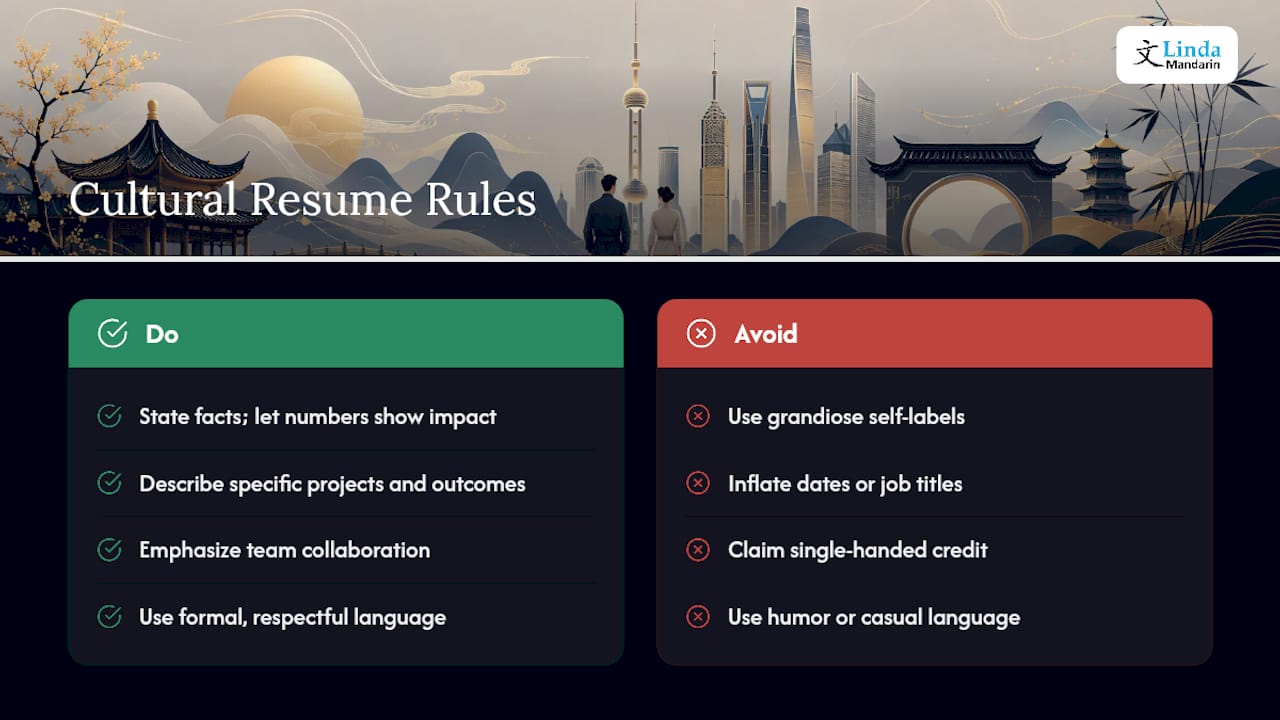
Modesty isn’t just a nice-to-have in Chinese resume writing, it’s a filtering mechanism recruiters use to sort candidates. Overselling yourself the way American resumes often reward (“visionary leader,” “world-class negotiator”) reads as immature or dishonest to a Chinese hiring manager, not confident.
The safer register states facts and lets numbers carry the weight. Instead of “exceptional problem solver,” write what you actually solved and what changed as a result. Instead of “passionate about innovation,” describe the specific project and its outcome. The number does the boasting so you don’t have to.
Exaggeration carries real risk here beyond just tone. Chinese employers, particularly state-owned enterprises and larger private firms, commonly verify education credentials and prior employment dates directly with universities and former employers. A mismatched graduation year or an inflated title doesn’t just cost you the interview, it can flag your entire application as untrustworthy before HR even calls your references.
Group harmony language also matters more than individual heroics. Describing yourself as someone who “coordinated with the team to achieve” a result lands better than “single-handedly drove” the same result, even when your individual contribution was larger. This isn’t false modesty for its own sake, it reflects how collaborative credit is actually valued in most Chinese workplace cultures, and a resume that ignores this can read as tone-deaf regardless of how strong the underlying achievement is.
One more taboo worth flagging: avoid humor, casual language, or anything that reads as overly familiar, even in a cover email accompanying the resume. Formality signals respect for the process, not stiffness.
How Do Mainland China, Hong Kong, and Taiwan Resumes Differ?
Treating “Chinese resume format” as one uniform standard across these three markets is a common mistake, and each has distinct enough conventions that a Mainland-style resume can look out of place in Hong Kong or Taiwan.
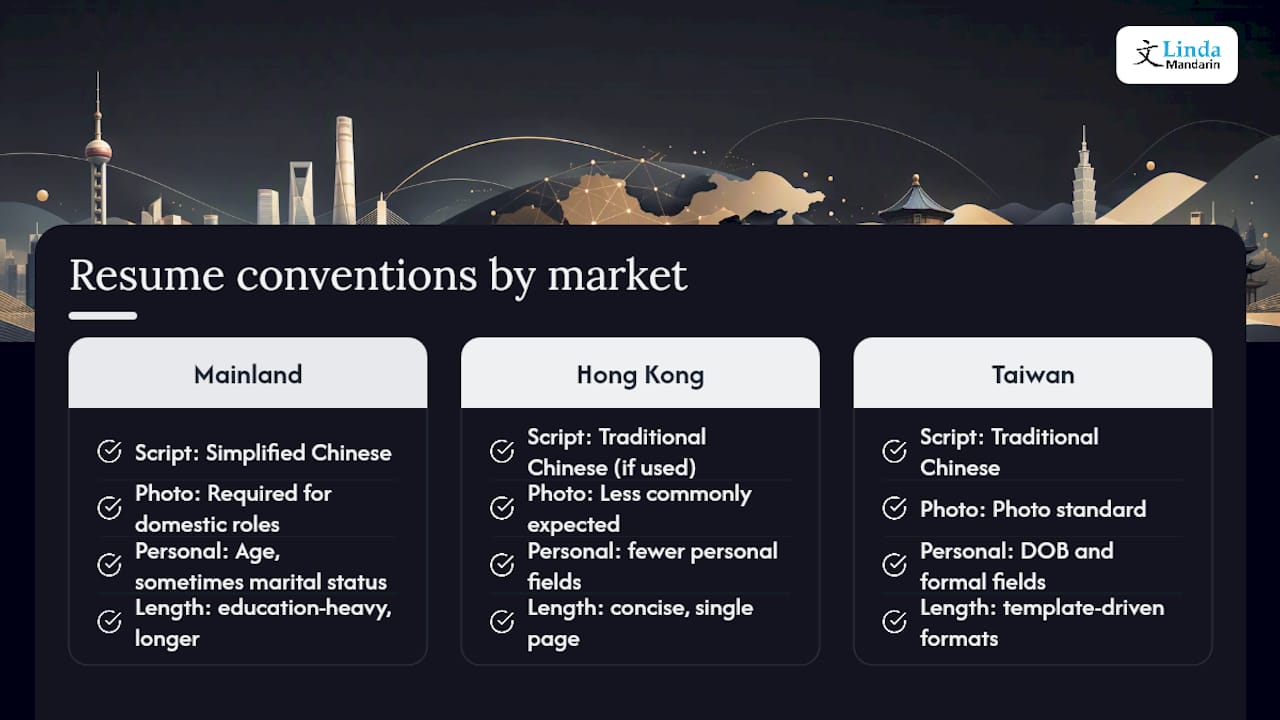
Mainland China leans most heavily on the structure covered throughout this article: photo required for domestic roles, WeChat ID expected, personal details like age and sometimes marital status commonly included, and simplified Chinese characters (简体字) used throughout.
Hong Kong resumes sit closer to a Western format, reflecting the city’s international business environment. English is frequently the primary or sole language even for local companies, photos are less universally expected outside customer-facing roles, and traditional Chinese characters (繁體字) appear when Chinese text is used at all. Hong Kong employers also tend to favor a more concise, achievement-focused single page over the longer education-heavy layout common on the Mainland.
Taiwan resumes typically use traditional Chinese characters as well, but retain more of the Mainland’s formality around personal details. A photo is standard, and many Taiwanese companies still expect fields like date of birth. Taiwan job seekers often submit resumes through standardized government or major job-portal templates (similar to 104 or 1111 job bank formats), which impose their own fixed layout regardless of personal preference.
The practical takeaway: identify which market you’re applying into before choosing your template, not after. A Hong Kong finance resume built on a Mainland state-owned-enterprise template will look overly formal and dated to that audience, and the reverse mismatch looks underprepared.
What Phrases and Keywords Do Local Recruiters Look For?
Certain phrases function almost like keywords in Chinese recruiter screening, whether that screening is done by a human skimming quickly or by simple keyword-matching software layered into a company’s applicant tracking system.
Strong action-oriented openers to build bullets around include 负责 (responsible for), 主导 (led), 优化 (optimized), 提升 (increased), and 建立 (established). Each pairs naturally with a number, which is exactly the format Chinese recruiters expect: verb, object, measurable result.
Recruiters skimming dozens of resumes a day gravitate toward these because they answer “so what happened” instantly.
Industry-specific keywords matter too, and they shift by sector. A marketing candidate benefits from terms like 品牌推广 (brand promotion) and 用户增长 (user growth), while a finance candidate should work in 财务分析 (financial analysis) and 风险控制 (risk control). Matching the exact terminology used in the job posting itself, not just a close synonym, measurably improves how far a resume gets in automated or semi-automated screening.
Avoid vague filler phrases that Chinese recruiters have learned to skip past entirely, things like 工作认真负责 (works diligently and responsibly) with no supporting evidence. Every claim needs a number or a specific example sitting right next to it.
Which Western Resume Sections Should You Leave Out?
Several sections that feel standard on an American or European resume are either unnecessary or actively out of place on a Chinese one, and including them can make a resume look imported rather than locally prepared.
Hobbies and interests rarely appear on Chinese resumes outside of creative or startup roles where cultural fit gets emphasized more heavily. A line about weekend hiking or reading habits reads as padding to a Mainland recruiter focused on credentials and results.
References are essentially never listed by name and contact information the way US resumes often do. Chinese employers who want to verify your background will contact previous employers directly through HR channels, typically after an offer is close, rather than calling a reference you’ve pre-selected. Including a “References available upon request” line isn’t harmful, but it adds nothing either.
A lengthy personal statement or cover letter narrative baked into the resume itself also tends to get cut in favor of the short 求职意向 (job objective) line covered earlier. Chinese hiring managers want the objective stated in one sentence, not explored across a paragraph.
What replaces these Western staples is more space given to education detail, a photo, and personal information fields, sections that Western resumes have largely phased out over the last two decades for privacy reasons but that remain standard practice across most of Mainland China’s hiring processes today.
How Do You Tailor a Resume for Academic vs. Professional Use?
Academic and professional applications in China pull in genuinely different directions, and using one resume for both is a common and avoidable error.
Academic applications, whether for graduate programs, research positions, or teaching roles, put much heavier weight on publications, research experience, and academic honors. University-facing CV templates typically expand the education section significantly, listing thesis topics, advisor names, relevant coursework, and any conference presentations or published papers. Work experience, if present at all, is compressed into a brief supporting section rather than the centerpiece.
Professional applications flip that emphasis entirely. Work experience and quantified achievements move to the top of the reader’s attention even when education is listed first structurally, and research experience only matters if it’s directly relevant to the role, such as an R&D position at a technology company. A hiring manager screening for a sales role has no interest in your undergraduate thesis abstract.
Length norms differ too. Academic CVs in China commonly run longer than the one to two page professional norm, especially for applicants with multiple publications or teaching assistant roles to document, since completeness matters more than brevity in that context. A professional resume that runs three pages, by contrast, reads as unfocused regardless of how strong the individual entries are.
The safest approach if you’re applying to both academic programs and jobs simultaneously is maintaining two separate documents rather than one hybrid version, since trying to satisfy both audiences at once usually satisfies neither.
Why Presentation Still Decides Who Gets Called Back
Format gets treated as an afterthought by a lot of job seekers, but recruiters in China use it as a proxy for how seriously you understand the market you’re applying into. A resume with the wrong section order, missing WeChat ID, or English-only content for a Chinese-language posting doesn’t just look sloppy, it signals you didn’t do the basic homework.
The bottleneck for most applicants, especially foreign professionals, isn’t the template. It’s finding the right business vocabulary to write bullets that sound natural in Chinese rather than translated. That’s usually where structured Mandarin writing practice closes the gap templates alone can’t.
— Paul
How Language Training Strengthens Your Resume and Your Interview
A perfectly formatted résumé still falls flat in an interview if your spoken or written Mandarin can’t back it up, and that gap shows up fast once a recruiter starts asking follow-up questions about those quantified bullets you wrote.
Linda Mandarin offers Mandarin courses designed to improve practical business vocabulary and writing precision, helping learners make résumé bullets and interview answers sound native rather than translated. Courses range from conversational levels through advanced business Mandarin, plus corporate training programs for teams that need this at scale.
The training center sits at 10 Anson Road, Level 22, International Plaza, Singapore 079903, right above Tanjong Pagar MRT, with flexible group, private, and online formats. If your next application depends on writing and speaking Mandarin with real confidence, check the adult program levels and find the class that fits your schedule.
Sources
For deeper formatting guidance, the LTL School Chinese CV guide, TailorCV’s format breakdown, and ResumeStudio’s university templates cover structure, wording, and downloadable samples in detail.
- Chinese resume format guide 2026 | TailorCV blog
- China resume template — Tsinghua, Peking, Fudan format | ResumeStudio
- Chinese – Sample resume templates | Michigan State University Career Network
FAQ
Do I Need a Photo on My Chinese Resume?
Yes, for domestic Chinese-language applications a professional headshot is standard practice, though it’s commonly omitted on English-language resumes sent to multinational firms.
What File Format Should I Use to Submit a Chinese Resume?
PDF is the safest default since it preserves formatting across devices, unless the employer’s application portal specifically requests a Word document or plain text entry.
How Long Should a Chinese Resume Be?
One page for new graduates and early-career applicants, extending to two pages once you have three or more years of relevant work experience.
Should I Include My WeChat ID on My Resume?
Yes, for any domestic Chinese application, since WeChat functions as a primary contact channel many recruiters use to reach candidates directly.
Can Learning Mandarin Actually Improve My Resume?
Improving your business Mandarin helps you write more natural, precise achievement bullets instead of stiff translations, and it prepares you for the interview questions those bullets inevitably invite.