Start with Growing Up with Chinese for absolute beginners, then move to slice-of-life dramas like A Love So Beautiful once you can follow basic dialogue. The method matters more than the title: watch with Chinese subtitles on, decode unfamiliar words with a click-to-translate tool that shows pinyin and tones, save five to ten words per episode into a spaced-repetition app, then shadow a few lines out loud before moving on.
TL;DR:
- Choosing shows with slow, clear dialogue and everyday vocabulary helps beginners build practical skills without frustration.
- Using Chinese subtitles and click-to-translate tools enables effective vocabulary extraction, with five to ten words per episode being optimal.
- Short episodes of 20 to 30 minutes are easier to study consistently than longer formats, which often lead to burnout or abandonment.
- Watching in standard Mandarin ensures better comprehension, while accents from regional productions can create additional listening challenges.
- Supplementing TV watching with structured speaking practice closes the gap between passive understanding and active conversation skills.
Table of Contents
- Top Picks: 8 Starter Shows for Chinese TV Learners
- Matching Shows to Your Level (and Avoiding the Traps)
- How to Watch Chinese TV So You Actually Learn Something
- Best Platforms and Tools for Watching Chinese TV Shows
- A Concrete 30 to 45 Minute Episode Study Session
- Why Structured Courses Still Matter for TV-Based Learners
- How Dialects and Accents Shape What You Actually Understand
- An Editorial Take: What Actually Moves the Needle
- Turn Comprehension Into Conversation With Linda Mandarin
- Sources
- FAQ
Top Picks: 8 Starter Shows for Chinese TV Learners
Not every popular Chinese show teaches well. Some are too dense, too regional, or simply lack usable Chinese subtitles. The eight below were picked because they pair watchability with a manageable vocabulary load, and each one shows up repeatedly across learner communities and study guides for good reason.
- Growing Up with Chinese (成长汉语), beginner: 100 fifteen-minute episodes built around roughly three short phrases each, using dramatized skits that replay key lines for reinforcement. It teaches survival vocabulary. Directions, greetings, shopping. Available on CGTN’s learning platform.
- Home with Kids (家有儿女), beginner to lower intermediate: A family sitcom with clear Beijing Mandarin and everyday household vocabulary. Widely available on Chinese streaming sites and sometimes on YouTube in clips.
- A Love So Beautiful, beginner to lower intermediate: A high school romance with slow, clean dialogue and vocabulary centered on school life and friendship. Streams on Netflix in several regions.
- Put Your Head on My Shoulder, lower intermediate: Campus romance with natural pacing and a manageable vocabulary curve, good for learners past the absolute-beginner stage. Available on Viki with community subtitle notes.
- Nothing But Thirty, intermediate: Follows three women navigating careers and relationships in Shanghai, with workplace and family vocabulary that pushes past textbook phrasing.
- Ode to Joy, intermediate: An ensemble drama about young professionals sharing an apartment complex, useful for picking up modern colloquial speech and social register shifts.
- Nirvana in Fire, advanced: A political and military drama with elevated vocabulary and formal registers. Rewarding once you’re comfortable with faster speech and idiom.
- The Untamed, advanced: A historical fantasy drama with dense, sometimes archaic phrasing. Treat it as a listening challenge, not a vocabulary source, until your level catches up.
Matching Shows to Your Level (and Avoiding the Traps)
Choosing a show by popularity alone is how most learners end up frustrated within twenty minutes. The right pick depends on your comprehension level, not your interest in the plot, and level-appropriate selection makes the difference between a productive session and a discouraging one.
Beginner criteria: Look for slow, clearly enunciated dialogue, contemporary settings, and vocabulary tied to daily routines. School dramas and family sitcoms are reliable because the situations repeat. Ordering food, asking directions, talking about homework. That repetition is what makes new words stick.
- Growing Up with Chinese for structured, lesson-style input
- Home with Kids for household and family vocabulary
- A Love So Beautiful for school-life dialogue at a manageable pace
- Short clips from children’s educational programming (viewed for vocabulary only, not as a course)
Lower-intermediate criteria: You can follow slower dramas but still need Chinese subtitles to catch fast exchanges. Campus romances and light workplace comedies work well because the vocabulary expands without jumping into technical or historical registers.
- Put Your Head on My Shoulder for natural youth dialogue
- Nothing But Thirty for entry-level workplace and adult-life vocabulary
Upper-intermediate and advanced criteria: This is where most learners hit a wall. Period dramas and historical fiction use vocabulary, honorifics, and grammatical structures that barely appear in modern conversation. The Untamed and Nirvana in Fire are excellent listening practice, but don’t expect the phrases you learn there to transfer directly into ordering coffee or negotiating a contract. Treat historical dramas as immersion for tone and rhythm, and save your active vocabulary-building for shows set in the present day.
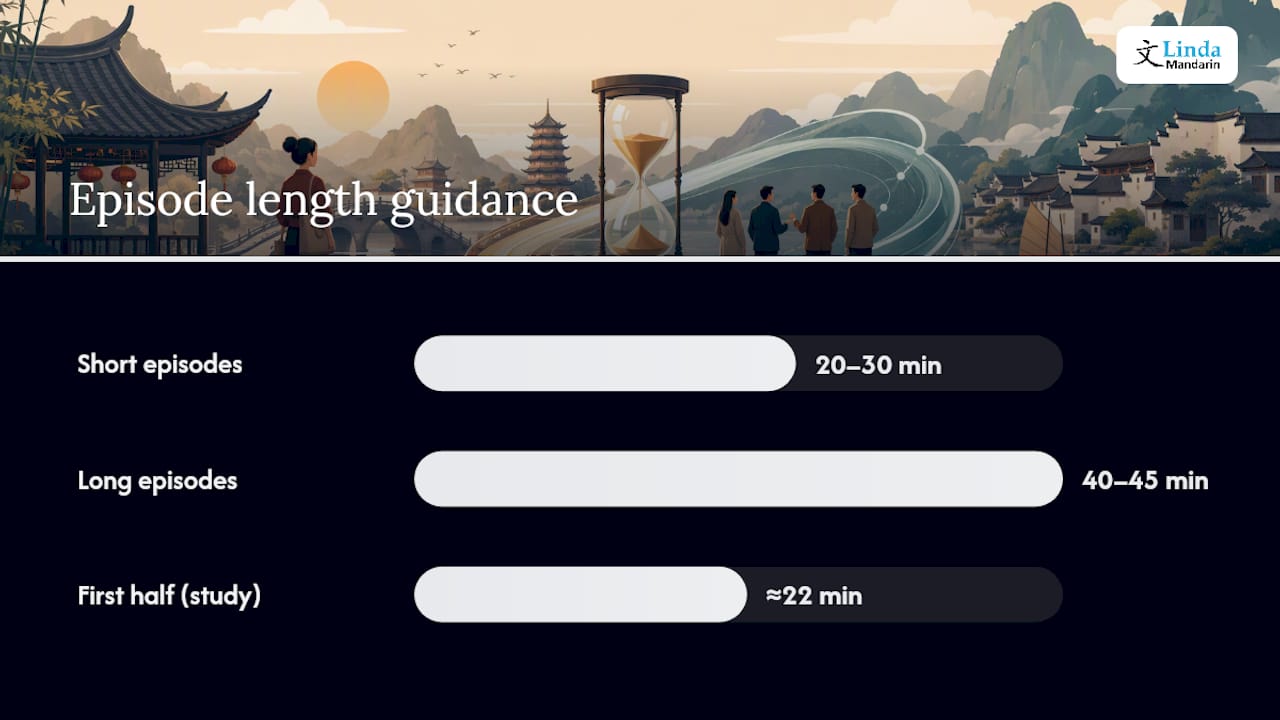
One practical note on episode length: shows with 40 to 45 minute episodes are harder to sustain as a study tool than shorter formats. If you’re new to this method, favor shows with 20 to 30 minute episodes, or plan to study only the first half of a longer one. Trying to decode an entire 45-minute episode in one sitting is how most people abandon the habit within a week.
How to Watch Chinese TV So You Actually Learn Something
Passive watching with English subtitles trains your ear a little, but it doesn’t build vocabulary you can retrieve on demand. A structured workflow converts screen time into something closer to flashcard drilling, minus the boredom.
- Watch once for the story. If your comprehension is low, use English subtitles for a first pass through a scene or two, just enough to understand who’s talking and why. This step is optional once your listening improves.
- Rewatch with Chinese subtitles on. Switch to Chinese text and pause whenever you hit an unfamiliar word or phrase. Use a click-to-translate tool to pull up the pinyin, tone marks, and meaning instantly instead of pausing to look words up manually.
- Save five to ten items per episode. More than that and review becomes a chore you’ll skip. Fewer, and you’re not extracting enough value from the episode.
- Shadow three to five short lines aloud. Pick lines with natural rhythm, not the hardest sentence in the scene. Recording yourself and comparing against the original, even just once, exposes tone errors your ear alone will miss.
- Review daily for five to ten minutes. Spaced repetition only works if you actually open the app. Short, daily reviews beat long, occasional ones.
- Rewatch key scenes after one to two weeks. Returning to a scene you’ve already decoded is where the real payoff shows up. Comprehension speed jumps noticeably because the vocabulary is now familiar rather than new.
Pro Tip: When saving new words, always capture the tone-marked pinyin, not just the character and English meaning. Tones are the first thing that disappears from memory, and retaining pronunciation alongside meaning from the start prevents you from having to relearn a word’s sound months later.
Best Platforms and Tools for Watching Chinese TV Shows
The show doesn’t matter if the platform doesn’t give you usable subtitles. This is where most learners waste time picking a title only to discover there’s no Chinese subtitle track available in their region.
- Netflix: Carries a solid Mandarin drama library, but availability and subtitle tracks vary by region, so check the subtitle menu on the specific title before committing to it.
- Viki: Often has more community-contributed subtitles and cultural notes than mainstream platforms, which helps with idioms and cultural references that a straight translation misses.
- YouTube: Free, and good for short clips, trailers, and some full series, though official Chinese subtitle tracks are inconsistent across uploads.
- CGTN/CCTV: The home for structured educational programming like Growing Up with Chinese, built specifically as bite-sized lessons rather than pure entertainment.
On the tool side, browser extensions and standalone apps have changed how much work this actually takes. LangPanda integrates with Netflix, YouTube, and Viki to add instant pinyin, tone marks, and click-to-translate directly inside the subtitle track, and it can export saved words straight to flashcards.
Before you settle on a show, spend two minutes checking its subtitle options rather than five hours watching an episode you can’t actually study from. Subtitle accuracy also varies. Fan-translated tracks sometimes simplify or skip lines, so if a sentence feels off, cross-check it against the audio rather than trusting the text blindly.
A Concrete 30 to 45 Minute Episode Study Session
Here’s a session you can run today with almost any show on your list, structured around a single episode.
- Minutes 0 to 10: Orientation watch. Follow the scene with English subtitles only if you’re lost, otherwise skip straight to Chinese.
- Minutes 10 to 25: Focused replay. Go back through the same stretch of dialogue, pause on unfamiliar words, pull pinyin and tone marks, and add five to ten items to your spaced-repetition deck.
- Minutes 25 to 35: Shadowing. Pick three lines, say them aloud, and if you can, record yourself and compare the tones against the original audio.
- Minutes 35 to 45: Quick review and scheduling. Set your spaced-repetition reminders for the next day, and jot down one phrase from the episode to try out loud with a tutor or conversation partner this week.
Run this four to six times and you’ll usually notice two things shift: your listening speed improves, meaning you need fewer pauses to catch dialogue, and your recognition of recurring vocabulary (the words that show up in nearly every episode of a genre) starts happening in real time instead of after a rewind.
Why Structured Courses Still Matter for TV-Based Learners
TV gets you exposure and vocabulary, but it can’t correct your grammar or tell you why a sentence sounds off. That kind of feedback loop, someone actually listening to you speak and flagging the error in real time, is the piece dramas can’t replace no matter how disciplined your workflow is.
- Corrective feedback on pronunciation and tone requires a live listener, not a subtitle track.
- Targeted grammar practice fills gaps that immersion alone leaves inconsistent.
- Guided speaking practice converts passive comprehension into active, confident output.
This is the gap that structured lessons close. Linda Mandarin has been teaching adult learners in Singapore since 2003, with native Mandarin instructors fluent in English who build lessons around real conversation rather than rote drilling. For learners coming from a TV-heavy study routine, adult conversational classes and business Mandarin courses tend to fit best, since they take the vocabulary you’ve absorbed passively and put it to work in live dialogue. Online Zoom classes make this pairing easy even if you’re studying dramas on your own schedule.
How Dialects and Accents Shape What You Actually Understand
Standard Mandarin, the register used in news broadcasts and most mainland productions, is what nearly every show on this list is filmed in. That’s good news for learners, because it means your listening practice transfers cleanly across most contemporary dramas.
Regional accents still show up, though. Mainland productions set in the north tend to have crisper, more standard pronunciation, while shows filmed with Taiwanese casts sometimes carry a softer accent with different tone contours and vocabulary choices (Taiwanese Mandarin often drops certain retroflex sounds that mainland speakers pronounce clearly). Hong Kong productions dubbed into Mandarin can sound noticeably different again, since the original dialogue was often Cantonese before dubbing.
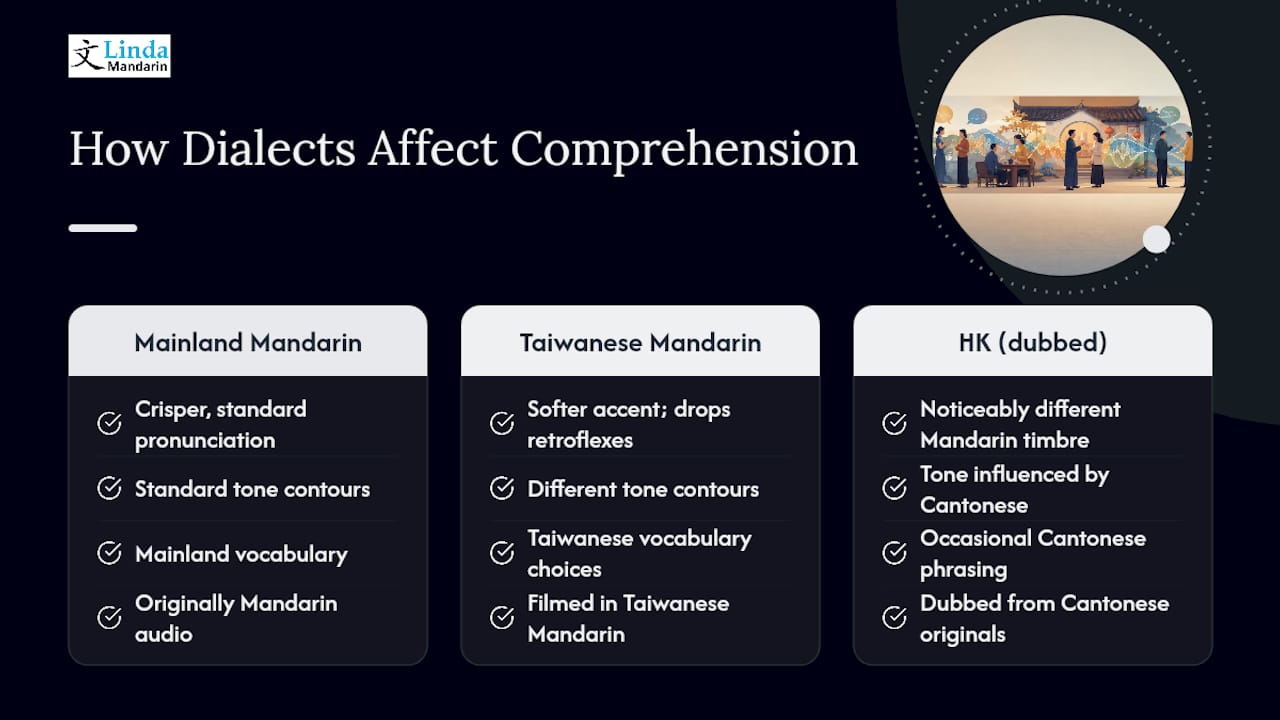
None of this should stop you from watching a show you enjoy, but it explains why a drama that felt easy to follow one week can suddenly feel harder the next if the cast or setting shifts. If you notice a show’s accent is throwing you off consistently, that’s a signal to switch to something filmed in standard Mandarin until your ear adjusts, rather than assuming your comprehension has gotten worse.
An Editorial Take: What Actually Moves the Needle
Most advice about learning Chinese from TV focuses on finding the “right” show, as if the perfect drama exists somewhere and will unlock fluency. It won’t. The workflow does more work than the title ever will, and learners who treat show selection as the main decision usually quit within a month because they never built a repeatable habit.
The bigger issue is pacing. Adults with jobs and families don’t need a two-hour nightly commitment, they need fifteen minutes they’ll actually show up for. Pick shows you genuinely enjoy, keep sessions short enough to repeat daily, and pair every week of watching with at least one output activity, a conversation, a voice note, a sentence you force yourself to say out loud. Comprehension without production plateaus fast.
— Paul
Turn Comprehension Into Conversation With Linda Mandarin
Watching dramas builds your ear and your vocabulary, but it won’t correct a mispronounced tone or push you to actually say a sentence out loud under pressure. That’s the gap Linda Mandarin closes for adult learners who’ve already put in the screen time and want a structured way to speak with confidence.
Linda Mandarin runs adult conversational classes, business Mandarin courses, and corporate training programs, all available in-person or through online Zoom sessions, so your drama-watching habit can stay in the background while your speaking catches up. Instructors are native Mandarin speakers fluent in English, and lessons are built around real-life communication rather than rote memorization. Whether you’re aiming for smoother small talk or need Mandarin for client meetings, the adult program pages walk through course levels and formats so you can find the right fit. Classes run out of Linda Mandarin’s training center at 10 Anson Road, Level 22, International Plaza, Singapore 079903, right above Tanjong Pagar MRT. Visit the adult programs page to check current class schedules and get started.
Sources
A few sources are worth bookmarking if you want to go deeper into the workflow or find more shows to add to your list.
- Growing Up with Chinese – Wikipedia
- Learn Chinese with C-Dramas: Best Beginner Shows + Workflow | Linglass
- Best Chinese TV Shows for Language Learners (2026 Guide) | Migaku
- Learn Chinese from Dramas, Movies & Netflix — LangPanda
FAQ
What are the best Chinese TV shows on Netflix for learning Mandarin?
A Love So Beautiful and similar slice-of-life dramas tend to work best on Netflix for beginners, but availability and Chinese subtitle tracks vary by region, so always check the subtitle menu on the specific title before starting.
Are there good Chinese shows appropriate for younger viewers learning the language?
Educational programming like Growing Up with Chinese is designed as structured, lesson-style content rather than entertainment, which makes it a reasonable starting point for very young or absolute-beginner viewers under adult guidance.
What are some good Chinese dramas for beginners?
Growing Up with Chinese, Home with Kids, and A Love So Beautiful are strong beginner picks because they use slower, clearer dialogue and everyday vocabulary tied to school and family life.
What is the best version of Chinese to learn?
Standard Mandarin, the register used in most mainland productions and news broadcasts, is the most widely useful choice for learners and is what nearly every show recommended in this guide uses.
How do I choose a Chinese show that’s actually good for studying, not just entertainment?
Check for clear pronunciation, contemporary settings, and confirmed Chinese subtitles before watching, and avoid period dramas until you’re comfortable with formal registers and faster speech. Structured classes, like the adult courses at Linda Mandarin, can help you build the foundation that makes those shows easier to follow in the first place.