TL;DR:
- No single platform fully covers all Mandarin learning needs, so combining tools tailored to specific goals yields the best results.
- Self-study apps are effective for building listening skills and vocabulary, while live tutors improve speaking confidence and real-world communication.
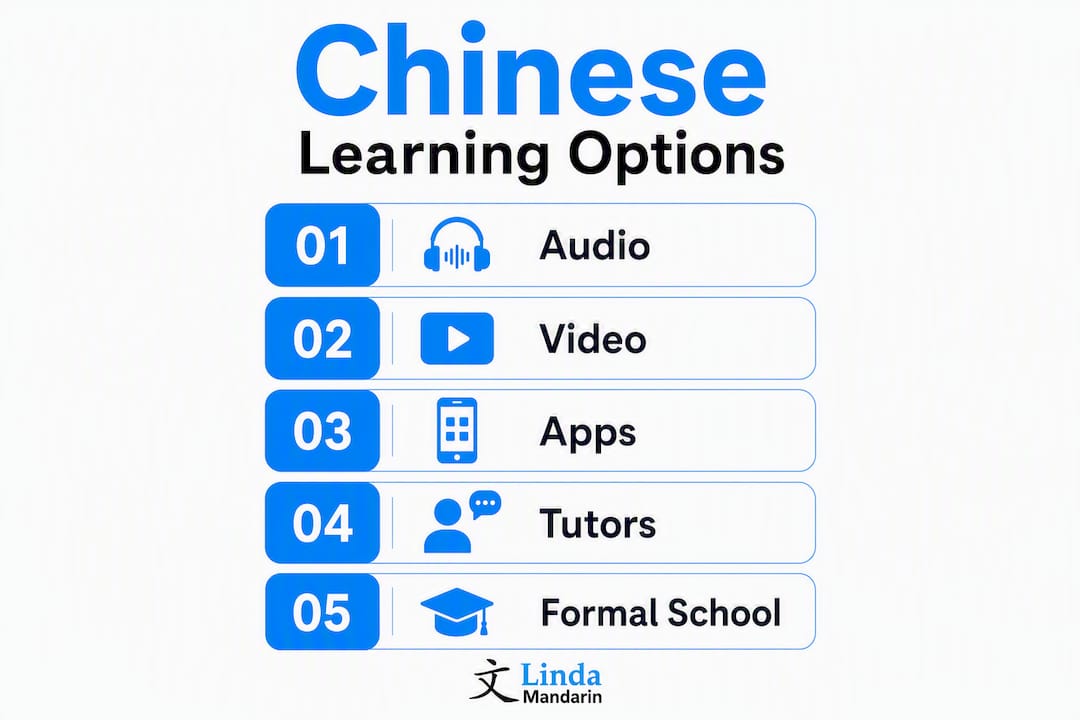
If you’re searching for ChineseClass101.com alternatives, the short answer is this: no single platform does everything well, and the best results come from matching the right tool to your actual goal. For tone training and listening, audio-first lesson libraries like ChinesePod lead. For structured video grammar, Yoyo Chinese is hard to beat. For live speaking practice, one-on-one tutor marketplaces like iTalki give you real conversation time. For character writing, dedicated apps like Skritter fill the gap most audio platforms leave open. And for adult learners who want a structured syllabus with live instructors, a formal school like Linda Mandarin delivers what self-study apps cannot.
Here’s a quick-scan verdict by category:
- Audio-first lesson library (e.g., ChinesePod): Best for tone training, listening, and vocabulary building on the go.
- Structured video course (e.g., Yoyo Chinese): Best for grammar-focused learners who want a clear progression path.
- Gamified beginner app (e.g., HelloChinese, Duolingo): Best for absolute beginners building daily habits at zero cost.
- One-on-one tutor marketplace (e.g., iTalki): Best for speaking confidence and real conversation practice.
- Immersive video platform (e.g., FluentU): Best for learners who want to absorb Mandarin through authentic media.
- Character-writing app (e.g., Skritter): Best for handwriting, stroke order, and character retention.
- Formal school with live instructors (Linda Mandarin): Best for adult conversational and business Mandarin learners who want a structured syllabus, certified teachers, and measurable progress.
Table of Contents
- How do the top ChineseClass101 alternatives compare at a glance?
- What does each alternative actually deliver?
- How do you choose the right alternative for your goals?
- Why combining resources beats relying on one platform
- Key Takeaways
- What most learners get wrong when picking a Mandarin platform
- Linda Mandarin: a structured alternative for adult and business learners
- Useful sources and further reading
- FAQ
How do the top ChineseClass101 alternatives compare at a glance?
| Option | Price / Free Tier | Best For | Primary Format | Character Support | Speaking Practice | Curriculum Structure | Mobile / Offline | US Availability |
|---|---|---|---|---|---|---|---|---|
| ChinesePod | Free tier; paid from ~$15/mo | Listening, tones, vocabulary | Audio/podcast library | Minimal | Limited | Loose library | App + offline audio | Full access |
| Yoyo Chinese | Free YouTube content; paid course ~$10/mo | Grammar, structured video | Video lessons | Pinyin focus | None built-in | Structured path | Mobile-friendly | Full access |
| HelloChinese | Free core app; Premium ~$10/mo | Beginners, daily habit | Gamified app | Basic stroke order | Pronunciation drills | Structured path | Strong mobile, offline | Full access |
| Duolingo | Free; Super ~$7/mo | Absolute beginners, habit | Gamified app | Very limited | Minimal | Loose gamified path | Excellent mobile | Full access |
| iTalki | Free to browse; lessons from ~$10/hr | Speaking, conversation | One-on-one tutors | Tutor-dependent | Core feature | Tutor-set | App available | Full access, global tutors |
| FluentU | Free trial; from ~$15/mo | Immersive listening, vocab | Authentic video + quizzes | Subtitle-based | Limited | Loose by topic | Mobile app | Full access |
| Skritter | Free trial; ~$15/mo | Characters, handwriting | Writing app | Core feature | None | Structured by deck | Strong mobile | Full access |
| Linda Mandarin | Contact for pricing; online Zoom available | Adult conversational & business Mandarin | Live instructor-led (Zoom + in-person) | Covered in curriculum | Core feature | Fully structured syllabus | Online Zoom sessions | Remote US learners via Zoom |
A few things to note when reading this table:
- Prices listed are approximate and based on standard billing. Always check checkout screens for actual monthly costs, since many platforms advertise rates based on their longest billing cycle.
- “Curriculum structure” matters more than it looks. A loose library gives you flexibility but no accountability. A structured syllabus tells you exactly where you are and what comes next.
- US-based learners using Linda Mandarin’s online Zoom option will need to account for the Singapore time zone (SGT is UTC+8), but flexible scheduling is available for remote learners.
What does each alternative actually deliver?
Audio-first lesson library: ChinesePod
ChinesePod has been around since 2005 and built its reputation on short, dialogue-driven audio lessons organized by level. The format works well for commuters and people who learn by ear. Tone training and vocabulary exposure are genuine strengths. What it does not do well: there is almost no handwriting feedback, and grammar explanations stay thin past the intermediate stage. Think of it as a listening engine, not a complete course.
Pros: Large back-catalog of audio content; real conversational dialogues; strong tone and pronunciation focus.
Cons: Light on writing and grammar depth; library size can feel disorganized without a plan.
Pricing: Free tier available; paid plans start around $15/month.
Time commitment: 20–30 minutes per lesson; works well at 3–5 sessions per week.
US availability: Full access; app and web-based.
Structured video course: Yoyo Chinese
Yoyo Chinese is built around Yangyang Cheng’s video explanations, which are unusually clear for a non-classroom format. The grammar breakdowns are the best available in a self-study video course, and the progression from pinyin through intermediate grammar is logical. The trade-off: there is no live speaking component, and advanced learners will outgrow the library.

Pros: Clear grammar explanations; structured progression; free YouTube content to sample before buying.
Cons: No speaking practice or tutor access; limited advanced content.
Pricing: Free YouTube content; paid course around $10/month.
Time commitment: 2–4 hours per week for steady progress.
US availability: Full access.
Gamified beginner apps: HelloChinese and Duolingo
HelloChinese is the stronger of the two for Mandarin specifically. It covers pinyin, basic characters, and tone drills in a structured path that Duolingo’s Mandarin course does not match for depth. Duolingo wins on habit-building and daily streaks, but its character coverage is minimal and its grammar explanations are nearly absent. Both are free to start, which makes them useful for testing whether you’ll stick with daily practice before spending money.
HelloChinese pros: Structured path; basic stroke-order practice; solid for beginners.
HelloChinese cons: Plateaus at intermediate; limited speaking feedback.
Duolingo pros: Free; excellent for habit formation; widely available.
Duolingo cons: Very light on characters and grammar; not suited past survival-level Mandarin.
Pricing: Both free; premium tiers around $7–10/month.
US availability: Full access; strong mobile apps.
One-on-one tutor marketplace: iTalki
iTalki connects learners with community tutors and professional teachers for live video sessions. For speaking confidence, nothing in the self-study category competes with actual conversation time. Lesson quality varies by tutor, so reading reviews and booking a trial lesson before committing to a package matters. The platform itself does not provide a curriculum; you bring the structure or ask your tutor to build one.

Pros: Real conversation practice; large global tutor pool; flexible scheduling.
Cons: No built-in curriculum; quality varies by tutor; requires self-direction.
Pricing: Lessons from around $10/hour; no subscription required.
Time commitment: Even one session per week produces measurable speaking gains over 6–8 weeks.
US availability: Full access; tutors across time zones.
Pro Tip: Book a 30-minute trial lesson with two or three different tutors before committing to a package. Teaching styles vary enormously, and chemistry matters more than credentials on a marketplace platform.
Immersive video platform: FluentU
FluentU uses real-world video clips (news segments, music videos, ads) with interactive subtitles and vocabulary quizzes. The immersion approach works well for learners who have basic grammar in place and want to build listening comprehension through authentic content. It is not a structured course and does not teach grammar from scratch. Pair it with a grammar reference for best results.
Pros: Authentic media exposure; vocabulary in context; engaging format.
Cons: Not a standalone course; limited grammar instruction; can feel scattered without a plan.
Pricing: Free trial; paid plans from around $15/month.
US availability: Full access; mobile app available.
Character-writing app: Skritter
Skritter is the most focused tool on this list. It does one thing: teach you to write Chinese characters correctly, with stroke-order feedback and spaced-repetition scheduling. Pairing an audio-driven course with a dedicated character-writing app is one of the most consistently recommended moves for learners who want to read and write, not just speak. Ten to fifteen minutes of Skritter daily compounds quickly.
Pros: Genuine stroke-order feedback; spaced repetition; works alongside any other resource.
Cons: Writing only; no listening, grammar, or speaking components.
Pricing: Free trial; around $15/month.
US availability: Full access; strong mobile app with offline support.
Formal school with live instructors: Linda Mandarin
Linda Mandarin is a different category from everything above. It is a structured Mandarin school, not a self-study app, and that distinction matters for adult learners with real goals. The school has been running adult conversational and business Mandarin programs since 2003, with certified native instructors who are fluent in English. Lessons follow a progressive syllabus aligned with international proficiency standards, covering speaking, listening, reading, and writing in a sequence that builds on itself.
For US-based learners, the online Zoom option makes Linda Mandarin accessible remotely. Corporate training programs are also available for teams. The format is instructor-led, which means you get real-time correction, structured feedback, and accountability that no app provides. Explore adult Mandarin programs and course levels to see how the curriculum maps to your current level.
Pros: Fully structured syllabus; live speaking and listening practice; certified native instructors; corporate and business Mandarin options; online Zoom availability.
Cons: Higher investment than self-study apps; requires scheduling; best suited to learners who want instructor-led accountability.
Time commitment: Flexible; group and private class formats available.
US availability: Online Zoom sessions available for remote learners; time-zone coordination required.
How do you choose the right alternative for your goals?
The decision comes down to four questions. Answer them honestly before you spend money or time on a trial.
- What is your primary goal? Survival travel phrases, business conversation, reading characters, or full professional fluency each point to a different tool.
- How many hours per week can you realistically commit? Less than two hours favors a gamified app. Four or more hours opens up structured courses and tutor sessions.
- Do you need live speaking practice? If yes, a tutor marketplace or instructor-led school is non-negotiable. No app substitutes for real conversation.
- What is your budget? Free apps work for habit-building. Structured courses and live tutors cost more but produce faster, more measurable results.
Before signing up for any paid platform, ask:
- Is there a free trial or sample lesson? If not, that is a red flag.
- What is the refund policy? Look for at least a 7-day window.
- Are instructor credentials listed? For tutor marketplaces, check individual reviews.
- Is the curriculum mapped to a proficiency framework, or is it just a content library?
- When was the content last updated? Stale material is a real problem on older platforms.
Red flags to avoid:
- Pricing shown only on a 24-month billing basis with no monthly option clearly displayed.
- No free trial or sample content before purchase.
- Tutor pool under a few hundred teachers (limits scheduling flexibility for US time zones).
- No community forum or student support channel.
Step-by-step decision flow:
- Assess your goal, weekly time, and budget using the four questions above.
- Shortlist two or three options from the comparison table that match your answers.
- Trial each shortlisted option for 7–14 days using free tiers or trial periods.
- Evaluate after the trial: Did you use it consistently? Did you make measurable progress? Did the teaching style hold your attention?
Understanding different teaching methods before you commit helps you recognize which approach fits how you actually learn.
Why combining resources beats relying on one platform
The most common mistake adult Mandarin learners make is treating one platform as a complete solution. Audio-based platforms excel at tone and listening work but are best treated as one component in a broader learning stack rather than an all-in-one answer. The gaps are predictable: audio libraries skip handwriting, apps skip grammar depth, and self-study skips real speaking feedback.
Asia Society recommends connecting with language communities, using authentic media, and aligning study with proficiency frameworks. That is not abstract advice. It maps directly to a four-component stack that covers the gaps:
“Learners who combine structured materials with community interaction and authentic media exposure retain more than those who rely on solitary app use alone.” — Asia Society
The Chinese Grammar Wiki by AllSet Learning offers over 2,000 practical grammar articles mapped to proficiency levels, and it is free. Pair it with an audio library and you have listening plus structure. Add a character-writing app for handwriting, and one live tutor session per week for speaking, and you have covered every major skill area.
A sample study week for an intermediate adult learner:
- Monday / Wednesday / Friday: 25 minutes of audio lesson library (listening, tones, new vocabulary).
- Tuesday / Thursday: 20 minutes of grammar wiki reading and practice exercises.
- Daily (10–15 minutes): Character-writing app for stroke-order and spaced-repetition review.
- Once per week: 45–60 minute live tutor session focused on conversation and pronunciation correction.
One pricing trap worth flagging: many platforms advertise low monthly rates calculated on a 24-month commitment. Always click through to the checkout screen and compare the actual monthly cost for 1-month, 3-month, and 12-month billing before entering payment details. The headline price and the real price are often very different.
For practical study strategies and tools that work alongside any of the platforms above, Linda Mandarin’s resource guides are worth bookmarking.
Community-driven approaches also accelerate progress. Examples of community-driven language learning show how group accountability and peer interaction improve retention in ways that solo app use rarely matches.
Key Takeaways
No single ChineseClass101 alternative covers every skill. The fastest path to Mandarin fluency combines a listening-first library, a grammar reference, a character-writing tool, and live speaking practice with a qualified instructor.
| Point | Details |
|---|---|
| Match tool to goal | Audio libraries build listening; tutor marketplaces build speaking; writing apps build characters. Pick by skill gap, not by popularity. |
| Check real pricing | Advertised monthly rates are often based on 24-month billing; always check the checkout screen for the actual cost at your preferred billing period. |
| Trial before committing | Use free tiers or 7–14 day trials to test whether a platform’s style fits how you learn before paying. |
| Combine resources | Pair an audio library with a grammar reference and a character-writing app for faster, more complete progress than any single platform delivers. |
| Linda Mandarin for structured learning | Adult and business learners who want a certified instructor, live speaking practice, and a structured syllabus should explore Linda Mandarin’s adult programs. |
Quick red flags to avoid during trials:
- No refund policy or trial period stated upfront.
- Grammar explanations absent or surface-level past beginner content.
- No measurable progress after two weeks of consistent use.
- Pricing that changes significantly at checkout versus the advertised rate.
What most learners get wrong when picking a Mandarin platform
The conventional wisdom says to find one great app and stick with it. That advice works for habit formation, but it breaks down fast once you move past survival-level Mandarin. Every platform has a structural blind spot: audio libraries skip writing, apps skip grammar, and self-study skips the correction loop you only get from a real teacher.
What actually moves the needle for adult learners, especially those with a professional goal, is deciding what the platform cannot do and filling that gap deliberately. An adult preparing for a job in China needs more than vocabulary drills. They need to hold a business meeting, read a contract, and navigate small talk with colleagues. That requires live practice, structured feedback, and a curriculum that builds toward real-world use. No app on this list does all three.
Linda Mandarin sits in a different category for exactly this reason. The school’s business Mandarin programs are built around practical communication, not test prep or gamified streaks. For a professional who needs to function in Mandarin within six to twelve months, that structure and accountability is worth more than the flexibility of a self-paced library. Use the trials on the self-study tools to build vocabulary and listening habits. Then invest in instructor-led sessions to close the gap between passive understanding and active fluency.
Linda Mandarin: a structured alternative for adult and business learners
Self-study apps and tutor marketplaces are useful tools. But if your goal is professional Mandarin fluency, the fastest path runs through a structured school with certified instructors and a curriculum built for adults.
Linda Mandarin has been training adult and professional Mandarin learners since 2003. The school offers online Zoom classes, corporate training programs, and flexible group or private formats, all taught by experienced native Mandarin instructors who are fluent in English. The syllabus is progressive and practical, covering real-world conversation, business communication, and workplace Mandarin from beginner through advanced levels.
For US-based learners, the online Zoom option makes it possible to attend live sessions remotely. Corporate teams can arrange tailored programs aligned to their industry and communication goals. Whether you need business Mandarin for professional settings or a structured conversational course to build confidence from scratch, Linda Mandarin’s programs are designed for exactly that.
Browse adult course details and levels to find the right starting point, or contact the school directly to discuss online Zoom scheduling and corporate training options.
Useful sources and further reading
The sources below were used in researching this article. Each is worth bookmarking if you want to go deeper on any of the topics covered.
| Source | What it covers |
|---|---|
| Asia Society: Chinese Learning Resources | Proficiency frameworks, authentic media, and community-based learning strategies |
| AllSet Learning: Chinese Grammar Wiki | 2,000+ grammar articles mapped to proficiency levels; free structured reference |
| Fluent in 3 Months: ChineseClass101 Review | Detailed review covering pricing traps, audio library strengths, and handwriting gaps |
| LearnChinese.ai: Free HSK and Character Courses | Free structured curriculum with spaced-repetition character practice |
| UNCG: Online Resources for Chinese Language Learners | University-curated list of dictionaries, apps, and authentic media for self-study |
| Mezzo Guild: ChineseClass101 Review | User-focused review covering content library size, motivation challenges, and structured challenge formats |
FAQ
Is ChineseClass101 a legitimate platform?
Yes, ChineseClass101 is a real, long-running language learning platform with a large audio and video lesson library for Mandarin learners at all levels. Its main limitations are thin grammar depth past the beginner stage and minimal handwriting support.
How much does ChineseClass101 cost?
Pricing varies by billing period. Advertised monthly rates are typically based on a 24-month commitment; shorter billing cycles cost more per month. Always check the checkout screen for the actual rate at your preferred billing length.
Is ChineseClass101 free?
ChineseClass101 offers a free trial and limited free access, but full lesson access requires a paid subscription.
are available and worth using before committing to a plan.
What is the best free app to learn Chinese?
HelloChinese is the strongest free option for structured beginner Mandarin, covering pinyin, basic characters, and tones. LearnChinese.ai also offers a free curriculum with spaced-repetition character practice at no cost.
Can Linda Mandarin work for US-based learners?
Yes. Linda Mandarin’s online Zoom classes are available to remote learners worldwide, including those based in the United States. Time-zone coordination with Singapore (UTC+8) is required, and the school offers flexible scheduling to accommodate different time zones.