For adult learners who want more than grammar videos, the strongest ChineseFor.Us alternatives split into three categories: structured instructor-led programs like Linda Mandarin for business and conversational goals, tutor marketplaces like iTalki for live speaking practice, and SRS tools like Anki paired with Skritter for character retention. Those three tracks cover the gaps ChineseFor.Us leaves most exposed: limited live interaction, no handwriting practice, and no corporate-focused curriculum.
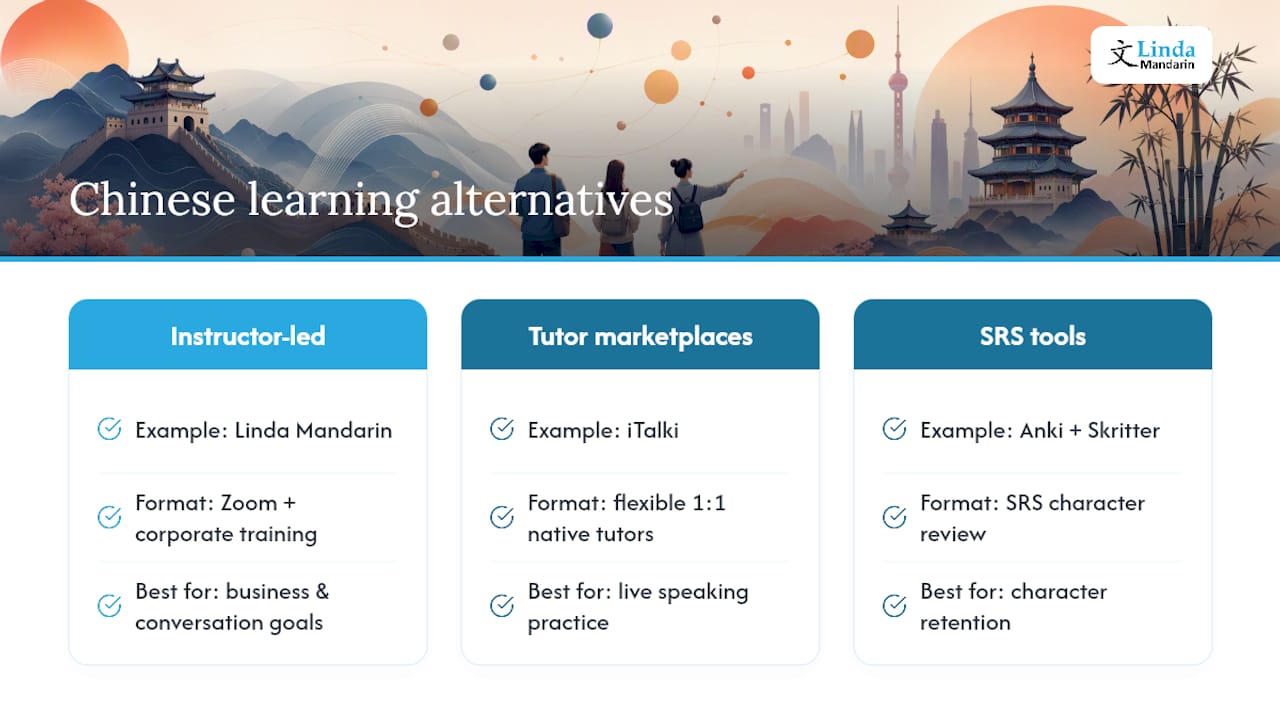
If you are a professional or adult learner in the United States comparing Chinese learning platforms, the short picks are: Linda Mandarin (instructor-led Zoom and corporate training), iTalki (flexible 1:1 native tutors), and Anki + Skritter (SRS character review). Each solves a different problem. Read on to match the right one to your actual goal.
Table of Contents
- How do ChineseFor.Us alternatives compare at a glance?
- What does ChineseFor.Us offer, and why do learners look elsewhere?
- Short reviews of the best alternatives to ChineseFor.Us
- How do you pick the right alternative for your goals?
- How we compared these options
- Key Takeaways
- When I’d choose each type of alternative
- Linda Mandarin is built for adult learners who need real results
- Useful sources and where to try demos
- FAQ
How do ChineseFor.Us alternatives compare at a glance?
| Platform | Best for | Format | Price & trial | Content depth / syllabus | Character / SRS | Native tutors | Platforms | Standout feature |
|---|---|---|---|---|---|---|---|---|
| Linda Mandarin | Adult conversational & business Mandarin; corporate teams | Instructor-led Zoom; group & private | Paid enrollment; contact for quote | Structured syllabus aligned with international standards | Covered in lessons | Yes — certified native instructors | Web / Zoom | Tailored corporate packages and live instructor accountability |
| ChineseFor.Us | Grammar-focused self-study | Self-paced video | Free tier + premium membership | Strong grammar focus; character writing included | Character writing in curriculum | No live tutors | Web | Classroom-style video curriculum |
| Yoyo Chinese | Structured video learners | Self-paced video | Subscription; free sample lessons | Solid grammar explanations; practical conversation | Limited | No | Web / mobile | Clear English grammar breakdowns |
| ChineseClass101 | Audio/topic-based study | Audio + video on-demand | Free tier + subscription | Large lesson library; topic-based | Limited | No | iOS / Android / web | Massive on-demand library |
| iTalki | Rapid speaking practice | Live 1:1 tutor marketplace | Pay-per-lesson (varies by tutor) | Tutor-dependent | Tutor-dependent | Yes — wide tutor pool | Web / app | Flexible scheduling; tutor choice |
| HelloChinese | Casual mobile learners | App / gamified | Free tier + subscription | Beginner-intermediate; structured app path | Basic character practice | No | iOS / Android | Speech recognition drills |
| Duolingo | Absolute beginners | App / gamified | Free tier + Super subscription | Beginner only; light structure | Minimal | No | iOS / Android / web | Completely free entry point |
| Skritter | Character handwriting & retention | SRS app | Subscription; 7-day free trial | Character and vocabulary focused | Handwriting SRS — core feature | No | iOS / Android / web | Stroke-order handwriting with SRS |
| Anki | Vocabulary & character SRS | Flashcard app | Free (desktop); small iOS fee | Customizable; community decks | SRS — core feature | No | iOS / Android / web / desktop | Fully customizable SRS decks |
| Pleco | Dictionary & reading support | Reference app | Free + paid add-ons | Dictionary depth; example sentences | Flashcard add-on available | No | iOS / Android | OCR lookup and authoritative dictionary |
| TouchChinese | Mobile speaking + character mix | App / interactive | Subscription | Beginner-intermediate | Character drills included | No | iOS / Android | Interactive pronunciation and character exercises |
Three trade-offs stand out from this table:
- Characters vs. conversation: Skritter and Anki win on retention; iTalki and Linda Mandarin win on speaking output. Combining them covers both.
- Free vs. structured: Duolingo and ChineseFor.Us offer free entry, but neither gives you a live instructor or a corporate-ready curriculum.
- Self-paced vs. accountable: Apps let you study at midnight. Instructor-led Zoom lessons with Linda Mandarin give you a teacher who notices when your tones slip.
What does ChineseFor.Us offer, and why do learners look elsewhere?
ChineseFor.Us is a video-based platform built around classroom-style lessons with a strong grammar emphasis. According to Lunoo’s language review, it scores well for curriculum structure and includes pronunciation guides and character-writing work. FluentU’s 28-course roundup labels it “Best for Grammar” — a fair tag that also signals its limits.
What ChineseFor.Us does well:
- Structured, classroom-style video lessons that progress logically
- Clear grammar explanations with character-writing components
- A genuine free tier with a library of free video lessons before any paywall
- Good for self-disciplined learners who prefer a teacher-on-screen format
Where learners commonly hit a wall:
- No live speaking practice or real-time feedback from an instructor
- No SRS-driven character retention system built into the platform
- Limited appeal for mobile-first or gamified-learning preferences
- No corporate or business Mandarin track
- Premium content requires a paid membership, which some learners find steep relative to competitors
Pro Tip: If grammar and reading are already your strengths, ChineseFor.Us may actually slow you down. Pair it with iTalki for speaking or swap to Linda Mandarin if you need a business-focused curriculum with live instruction.
The pattern is consistent across 2026 roundups: learners who outgrow ChineseFor.Us are usually chasing one of three things — live conversation, character mastery, or a professional Mandarin track. The alternatives below are organized around exactly those goals.
Short reviews of the best alternatives to ChineseFor.Us
Linda Mandarin
Linda Mandarin is the strongest pick for adults who need Mandarin that actually works in a professional context. The school has been running instructor-led programs since 2003, with a structured syllabus and certified native instructors who explain grammar in English. Online Zoom lessons mean U.S.-based learners can access the same curriculum as in-person students in Singapore. Corporate training packages are available for teams, making it one of the few options on this list that can scale from a solo professional to a company-wide program.
No free tier, but the structured enrollment process includes a consultation to place you at the right level. For anyone who has bounced between apps and still can’t hold a business conversation, that placement matters.
Yoyo Chinese
Yoyo Chinese takes a video-first approach with unusually clear English explanations of Mandarin grammar. The founder, Yangyang Cheng, built the course around the confusion points that trip up English speakers specifically — tones, sentence structure, measure words. Lessons are practical and conversation-focused rather than academic. A free sample is available before committing to a subscription. It works best for intermediate beginners who want to understand why the language works the way it does, not just memorize phrases.
ChineseClass101
The library here is enormous: thousands of short audio and video lessons organized by topic and level. ChineseClass101 suits learners who like variety and want to study in 10–15 minute bursts. The free tier is real but limited; the paid subscription unlocks the full archive. One honest caveat: the sheer volume can feel directionless without a clear study plan. Pair it with Anki decks to retain vocabulary from each lesson.
iTalki
iTalki is a tutor marketplace, not a course. You browse profiles, read reviews, and book a 1:1 lesson with a native Mandarin speaker at a price the tutor sets. That flexibility is the whole point. Rates vary widely depending on the tutor’s experience and location. For speaking practice, it is hard to beat: you get real-time correction, a human conversation partner, and the ability to steer lessons toward your specific needs — business vocabulary, travel phrases, or exam prep. The gap is that without a structured curriculum alongside it, progress can plateau.
Recommended combo: iTalki for weekly speaking sessions + Anki for vocabulary review between lessons. Many learners also use regular tutoring services to supplement structured course work with consistent 1:1 practice.
HelloChinese
HelloChinese is a well-built app for beginners who want a structured path without the commitment of a subscription course. The gamified drills include speech recognition, so you get immediate feedback on pronunciation. It covers reading, writing, listening, and speaking in a single interface. The free tier goes surprisingly far. Where it falls short is depth: once you hit intermediate level, the content thins out and you will need to move on.
Duolingo
Duolingo’s Chinese course is the lowest-friction entry point on this list. It is free, it is on every device, and it will teach you basic vocabulary and sentence patterns through repetition and game mechanics. For absolute beginners who want to test whether Mandarin is for them before spending money, it makes sense. For anyone with a serious goal — business fluency, professional communication, passing a language benchmark — Duolingo alone will not get you there.
Skritter
Skritter does one thing and does it better than anything else: it teaches you to write Chinese characters by hand, using spaced repetition to schedule reviews at the exact moment you are about to forget. Stroke order, tone marks, and meaning are all drilled together. A 7-day free trial lets you test it before subscribing. If character retention is your weak point, Skritter is not optional — it is the fix.
Anki
Anki is free on desktop (a small fee applies on iOS) and runs on a spaced-repetition algorithm that schedules flashcard reviews based on how well you know each card. The community has built thousands of Chinese decks covering vocabulary, characters, sentences, and even audio. The learning curve for setup is real, but once your deck is running, 20 minutes a day of Anki review compounds faster than most learners expect. It pairs with any course or tutor on this list.
Pleco
Pleco is the dictionary every serious Mandarin learner eventually installs. The free version covers most needs: character lookup, pinyin, example sentences, stroke order diagrams, and audio pronunciation. Paid add-ons include a flashcard system and OCR lookup (point your camera at text and get an instant translation). It is not a course, but as a reading and reference tool it is authoritative and constantly updated.
TouchChinese
TouchChinese is a mobile-first app that mixes speaking drills with character practice in interactive exercises. It sits between HelloChinese and a full structured course in terms of depth. The pronunciation practice is a genuine strength. For learners who want a mobile option that goes beyond pure gamification, it is worth a look, though the content library is smaller than ChineseClass101’s.
Price and trial summary:
| Platform | Free tier / trial | Paid pricing shape |
|---|---|---|
| Linda Mandarin | Consultation / placement | Paid enrollment; contact for quote |
| ChineseFor.Us | Free video library | Premium membership |
| Yoyo Chinese | Free sample lessons | Subscription |
| ChineseClass101 | Limited free tier | Subscription |
| iTalki | Browse free; pay per lesson | Pay-per-lesson |
| HelloChinese | Generous free tier | Subscription |
| Duolingo | Full free tier | Super subscription |
| Skritter | 7-day free trial | Subscription |
| Anki | Free (desktop) | Small iOS fee |
| Pleco | Free core app | Paid add-ons |
| TouchChinese | Free tier | Subscription |
How do you pick the right alternative for your goals?
The decision comes down to four variables: your goal, your available time, your budget, and how you learn best. Work through these steps before committing to anything.
- Define your goal precisely. “Learn Chinese” is not a goal. “Hold a 10-minute business meeting in Mandarin within six months” is. Conversation goals point toward iTalki or Linda Mandarin. Character mastery points toward Skritter and Anki. Grammar foundations point toward Yoyo Chinese or ChineseFor.Us.
- Assess your weekly time budget. Less than 30 minutes a day? An app like HelloChinese or Duolingo fits. An hour or more, consistently? A structured course or weekly tutor sessions will compound faster.
- Set a realistic spending limit. Free tools (Anki, Duolingo, Pleco) cover vocabulary and basics. Live instruction costs more and delivers more. Know which you actually need before you pay.
- Decide on format. Self-paced video suits independent learners with irregular schedules. Live Zoom lessons suit learners who need accountability and real-time correction. Apps suit commuters and mobile-first learners. Read more on virtual vs. physical Chinese learning to weigh those trade-offs.
- Check the trial and refund policy before paying. Any platform worth your money offers a trial lesson, a free tier, or a clear refund window.
Questions to ask before enrolling:
- Are the instructors native Mandarin speakers who can explain grammar in English?
- Is there a trial lesson or free sample before full payment?
- What is the refund policy if the course does not fit?
- Does the syllabus align with a recognized framework?
- Can lessons be rescheduled without penalty?
Red flags: no trial option, opaque pricing with no published rates, no information about instructor qualifications, and no community or support channel. A platform that hides these details is usually hiding something about quality.
For a practical checklist on vetting online language providers, this guide on pinpointing the best online language courses covers the key questions in detail.

How we compared these options
The comparison above draws on official product pages, third-party roundups including FluentU’s 28-course review and the Mezzoguild 2026 roundup, independent review aggregators like Lunoo, and community recommendations across learner forums.
Rating criteria used:
- Content scope and depth (beginner through advanced; business Mandarin coverage)
- Format and teaching model (self-paced, app, live 1:1, tutor marketplace)
- Character practice and SRS support (Skritter, Anki, Pleco integration)
- Teacher availability and qualifications (native speakers, English-medium instruction)
- Device and platform compatibility (iOS, Android, web, offline access)
- Price transparency and trial / refund policy
- Community support and learner resources
Linda Mandarin appears in this comparison as a recommended, enrollment-ready option for adult and professional learners. Its instructor-led Zoom model, certified native teachers, and structured syllabus place it in a different category from self-paced apps — it is the option for learners who want a real teacher, not an algorithm.
Combining short, focused 1:1 Zoom lessons with 20–30 minutes per day of SRS review yields better speaking and retention outcomes for adult business learners than doubling weekly lesson time without any SRS practice.
Key Takeaways
The most effective approach to finding a ChineseFor.Us alternative is matching your specific goal — conversation, business Mandarin, or character mastery — to the format that delivers it, rather than defaulting to the most popular app.
| Point | Details |
|---|---|
| Match format to goal | Conversation goals need live instruction or a tutor; character goals need SRS tools like Skritter and Anki. |
| Combine tools for faster progress | Pairing a structured course or tutor with daily SRS review compounds retention faster than any single platform alone. |
| Trial before you pay | Every strong platform offers a free tier, trial lesson, or sample content — skip any that do not. |
| Business Mandarin needs a specialist | Apps and grammar videos do not build professional fluency; instructor-led programs like Linda Mandarin are built for that outcome. |
| Linda Mandarin for adult and corporate learners | Linda Mandarin’s online Zoom and corporate training programs serve adults and professionals who need structured, instructor-led Mandarin. |
When I’d choose each type of alternative
The hardest thing to say honestly about language apps is that most of them are fine for the first month and then quietly stop working. Not because the content runs out, but because motivation does. A busy manager who downloads Duolingo in January has usually stopped by March. That is not a character flaw — it is a format mismatch.
For a professional who needs business Mandarin within a defined timeframe, the only format that consistently delivers is instructor-led: a real teacher, a fixed schedule, and someone who notices when your tones are wrong. Linda Mandarin’s online Zoom model is built for exactly that learner. The corporate training track goes further, covering industry vocabulary and professional communication scenarios that no app has bothered to build.
For a hobbyist who wants to read characters and enjoy Chinese media, the combination of Skritter for handwriting and Anki for vocabulary is genuinely powerful. Neither requires a subscription to a course. Both reward daily 20-minute sessions more than occasional marathon study sessions.
For someone who is not sure yet, HelloChinese or Duolingo is the right starting point. Low cost, low commitment, real feedback on whether Mandarin is something you want to pursue seriously.
Pro Tip: If you are using a tutor through iTalki, bring your Anki deck to every session. Ask your tutor to review the sentences you are struggling with and add new vocabulary from the lesson to your deck the same day. That single habit closes the gap between lesson time and retention.
The mistake most learners make is treating these tools as alternatives to each other when they are actually complements. A structured course handles grammar and progression. SRS handles retention. A live tutor handles speaking. Use all three and you are not choosing between ChineseFor.Us alternatives — you are building a system.
Linda Mandarin is built for adult learners who need real results
Self-study apps and grammar videos have their place, but they share one limit: no one is watching. For adults and professionals who need Mandarin that works in a meeting room or a client dinner, Linda Mandarin’s online Zoom classes and corporate Mandarin training deliver something apps cannot — a certified native instructor who adapts to your pace, corrects your tones in real time, and keeps the curriculum moving toward your actual goal.
Linda Mandarin has been running structured adult programs since 2003, with a syllabus built around practical communication and a teaching team of experienced native Mandarin speakers fluent in English. Whether you need conversational Mandarin for personal growth or business Mandarin for professional communication, the program is designed to get you speaking, not just studying. Corporate teams can enroll in group training packages tailored to industry-specific vocabulary and cross-cultural communication.
Contact Linda Mandarin to discuss your goals and find the right program for your schedule.
Useful sources and where to try demos
Structured courses and instructor-led programs:
- Linda Mandarin official site — adult conversational and business Mandarin programs, online Zoom and corporate training; contact for enrollment and course details.
- Linda Mandarin learning resources — curated tools, apps, and study paths for adult learners exploring alternatives and SRS combos.
- ChineseFor.Us free lessons — free video library to sample the grammar-focused curriculum before deciding on premium.
- Yoyo Chinese — free sample lessons available on the site before subscribing.
Apps and gamified platforms:
- Duolingo Chinese course — fully free entry point; no account required to start.
- HelloChinese — available on iOS and Android; free tier covers beginner content.
- TouchChinese — iOS and Android; free tier available to test the interactive exercises.
SRS and character tools:
- Skritter — 7-day free trial on iOS, Android, and web; best starting point for character handwriting practice.
- Anki — free on desktop at ankiweb.net; small fee on iOS. Search “Chinese” in the shared deck library for community-built vocabulary and character decks.
- Pleco — free core app on iOS and Android; download and test the dictionary before considering paid add-ons.
Tutor marketplaces:
- iTalki — browse tutor profiles and rates for free at italki.com; book a trial lesson before committing to a regular schedule.
- Regular tutoring services — an option for learners who prefer booking structured tutoring packages outside the major marketplace platforms.
Third-party roundups for further research:
- FluentU’s 28 best online Chinese courses — categorizes options by learning goal; useful for cross-checking recommendations.
- Mezzoguild 2026 online Chinese course roundup — independent ratings and comparisons across a wide field of platforms.
Try the free tier or trial lesson of any platform before paying. No course is worth full price without a sample.
FAQ
Is ChineseFor.Us free?
ChineseFor.Us offers a genuine free tier with a library of video lessons available without payment. Some lessons require a premium membership to unlock, so the free content covers the basics but not the full curriculum.
What is the best Chinese learning app?
For absolute beginners, HelloChinese and Duolingo are the strongest free-entry apps. For character retention, Skritter leads on handwriting practice and Anki on vocabulary SRS. No single app covers all goals, which is why most serious learners combine two or three tools.
What is the best online Mandarin course for adults?
For adults who need structured, instructor-led learning with real speaking practice, Linda Mandarin’s online Zoom classes and corporate training programs are built specifically for that outcome. For self-paced grammar study, Yoyo Chinese is consistently rated among the clearest video-based options.
How do SRS tools like Anki and Skritter fit into a course?
Anki and Skritter work best as daily supplements to a structured course or tutor sessions, not as standalone replacements. Twenty to thirty minutes of SRS review per day between lessons significantly improves character retention and vocabulary recall compared to lesson time alone.
Do I need a live tutor, or can I learn Mandarin from apps alone?
Apps build vocabulary and reading recognition effectively. Speaking fluency — especially for business or professional contexts — requires real-time feedback from a native speaker. A tutor through iTalki or an instructor-led program like Linda Mandarin closes that gap in a way no app currently replicates.