TL;DR:
- Assess your personal goals and practical constraints before choosing a Mandarin course.
- Match course formats like group, private, or online to your learning style and schedule.
- Consistent practice, a positive mindset, and realistic goals are key to mastering Mandarin as an adult.
Finding the right Chinese course in Singapore can feel overwhelming. You scroll through options online, see dozens of schools promising fluency, and still can’t tell which one fits your schedule, budget, or career goals. Whether you’re an expat trying to connect with colleagues, a professional chasing a promotion, or someone who simply wants to order dim sum without pointing at the menu, the path forward is the same: clarity first, then commitment. This guide breaks down exactly how to assess your goals, compare course formats, evaluate curriculum quality, and build habits that make your Mandarin stick.
Table of Contents
- Assess your Mandarin learning goals and needs
- Compare available Chinese course formats in Singapore
- Evaluate course curriculum, levels, and certification pathways
- How to make progress and avoid common pitfalls in learning Mandarin
- What most guides miss about mastering Mandarin as an adult
- Find the right Mandarin course for your goals
- Frequently asked questions
Key Takeaways
| Point | Details |
|---|---|
| Clarify your objectives | Define your core motivation and skill targets before choosing a course for better results. |
| Match the right format | Select a course structure and schedule that fits your lifestyle and learning style. |
| Review curriculum and levels | Check for recognized certification paths and a stepwise curriculum that matches your needs. |
| Implement effective habits | Adopt productive study strategies and avoid common pitfalls for steady progress. |
| Success is about mindset | Consistency and practical application, not perfection, are keys to mastering Mandarin. |
Assess your Mandarin learning goals and needs
Before you compare schools or pricing, spend ten minutes getting honest about why you’re doing this. Adults who skip this step often end up in the wrong course and quit within three months. Your motivation shapes every decision that follows.
Start by identifying your primary driver. Are you learning Mandarin for career advancement, business communication, daily conversation in Singapore, or personal fulfillment? Each of these calls for a different course focus. A finance professional preparing to manage a team in Shanghai needs something very different from a retiree who wants to chat with neighbors.
Next, set a proficiency target. Singapore’s Mandarin schools often align their programs with the HSK framework, which runs from HSK 1 (basic phrases) to HSK 6 (near-native fluency). Knowing where you want to land helps you choose a school that offers a clear pathway. There are many reasons for learning Mandarin that go beyond work, including sharper cognitive skills and richer cultural experiences.
Also think through your practical constraints:
- Time availability: Can you commit to two evenings a week, or do you need weekend-only options?
- Learning style: Do you thrive in group discussions, or do you need one-on-one attention to stay on track?
- Budget: Group classes are typically more affordable; private or corporate sessions cost more but move faster.
- Starting point: Are you a complete beginner, or do you have some childhood Mandarin that needs refreshing?
As course fit depends on your goals, being specific about business communication, daily conversation, or exam preparation will save you time and money. Reviewing the available Mandarin course levels before you enroll gives you a realistic sense of how long the journey will take.
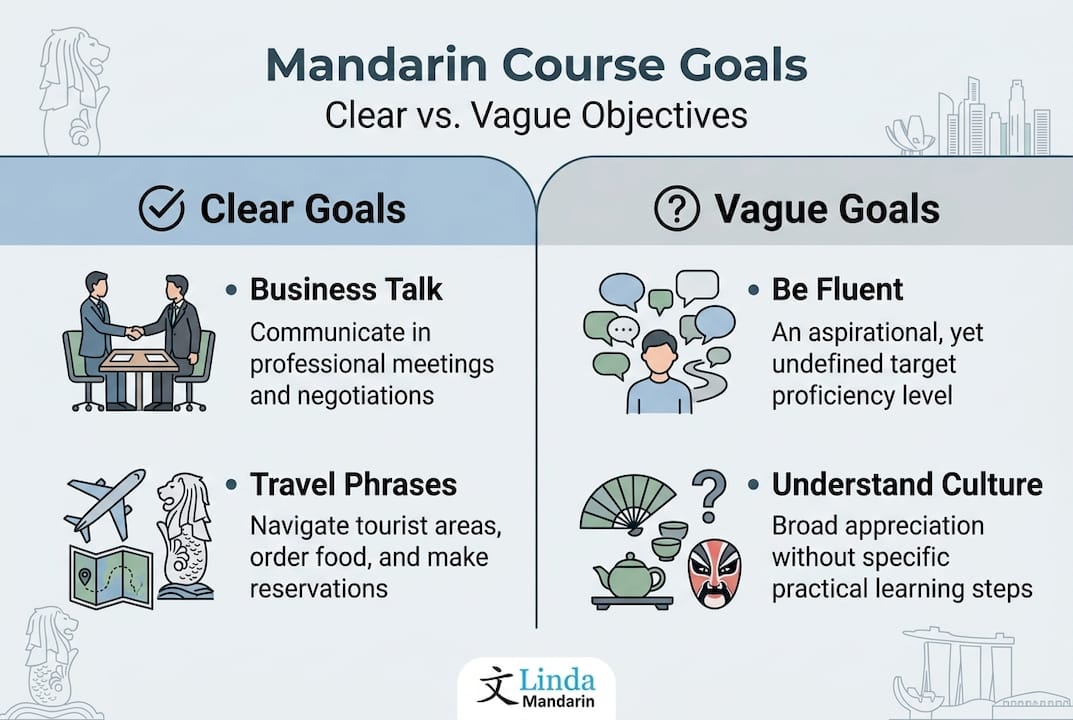
Pro Tip: Write down your goal in one sentence. “I want to hold a basic business conversation in Mandarin within six months.” That single sentence will help you filter out courses that don’t serve you.
Common pitfalls at this stage include setting vague goals like “become fluent” or overcommitting to intensive schedules that collapse within weeks. Realistic, specific goals beat ambitious, unsustainable ones every time.
Compare available Chinese course formats in Singapore
With your goals clear, you can now match them to the right course structure. Singapore’s Mandarin learning market offers several formats, and each has genuine advantages depending on your lifestyle and learning preferences.
Here’s a quick comparison of the most common formats:
| Format | Best for | Typical duration | Relative cost |
|---|---|---|---|
| Group classes | Social learners, budget-conscious adults | 10-15 weeks per level | Low to moderate |
| Private lessons | Fast-track learners, custom focus | Flexible | High |
| Intensive courses | Career transitions, urgent timelines | 2-4 weeks | Moderate to high |
| Corporate training | Teams, workplace Mandarin | Custom | High |
| Online (Zoom) classes | Busy professionals, remote learners | Flexible | Low to moderate |
| Blended learning | Those wanting flexibility plus structure | Varies | Moderate |
Online and classroom-based Mandarin classes each have their strengths: online is more flexible and often more affordable, while in-person provides stronger immersion and real-time feedback from instructors.
Here’s what each format does well:
- Group classes create natural conversation opportunities and let you learn from classmates’ mistakes, not just your own.
- Private lessons let you set the agenda. If you need to master boardroom Mandarin in eight weeks, a private tutor can build that exact program.
- Online classes via Zoom eliminate commute time and let you join from your office or home, which matters when your schedule is unpredictable.
- Corporate programs are tailored for teams and often include role-play scenarios relevant to specific industries.
When evaluating online Chinese course factors such as class size, instructor interaction, and practice frequency, pay close attention to whether sessions are live or pre-recorded. Live classes with real interaction produce far better results for adult learners.
A statistic worth noting: adult language learners who practice speaking at least three times per week are significantly more likely to retain vocabulary and grammar compared to those who study only through reading or apps. Format selection directly affects how often you actually speak.
Evaluate course curriculum, levels, and certification pathways
Not all Mandarin courses are built the same. A good curriculum doesn’t just teach vocabulary. It builds skills across speaking, listening, reading, and writing in a logical sequence that compounds over time.
Most reputable schools in Singapore map their Mandarin course structure to either the HSK framework or the Common European Framework of Reference (CEFR) scale, which runs from A1 (beginner) to C2 (mastery). Here’s a practical breakdown of what to expect at each stage:
- Beginner (HSK 1-2 / A1-A2): Basic greetings, numbers, directions, everyday phrases. Duration: 3-6 months.
- Elementary (HSK 3 / B1): Simple conversations, workplace small talk, short written messages. Duration: 3-4 months.
- Intermediate (HSK 4 / B2): Fluent discussion of familiar topics, reading Chinese news snippets, professional emails. Duration: 4-6 months.
- Upper intermediate (HSK 5 / C1): Nuanced business conversation, presentations, understanding regional accents. Duration: 4-6 months.
- Advanced (HSK 6 / C2): Near-native communication, negotiation, complex written Chinese. Duration: 6-12 months.
Mandarin courses in Singapore follow standardized proficiency levels and prepare students for recognized certifications, which matters if you want to document your skills for an employer or graduate school.
When evaluating a course, check for these quality markers:
| Curriculum feature | Why it matters |
|---|---|
| Skill balance | Speaking and listening must be prioritized alongside reading/writing |
| Native instructors | Accurate pronunciation modeling from day one |
| HSK alignment | Ensures internationally recognized progress benchmarks |
| Business Mandarin modules | Critical for professionals in finance, trade, or management |
| Regular assessments | Tracks progress and highlights gaps early |
There are also meaningful benefits of learning Chinese that go beyond career use, including access to one of the richest literary and cultural traditions in the world.
Pro Tip: Ask any school for a sample lesson plan before signing up. A quality curriculum will show you exactly what skills you’ll develop each week, not just a list of topics.
How to make progress and avoid common pitfalls in learning Mandarin
Enrolling is the easy part. Showing up consistently and making it stick is where most adults struggle. The good news is that a few strategic habits make a disproportionate difference.
Here’s a proven framework for busy professionals:
- Study in short, frequent sessions. Twenty minutes daily beats two hours on Sunday. Your brain consolidates language during sleep, so smaller daily inputs build stronger retention.
- Prioritize speaking from day one. Many adult learners wait until they feel “ready” to speak. That day never comes. Speaking imperfectly is how you improve.
- Use Mandarin in your real life. Label objects around your home in Chinese characters. Switch your phone to Mandarin. Watch one episode of a Chinese drama per week with subtitles.
- Set milestone-based goals. Instead of “study every day,” aim for “order coffee in Mandarin by the end of week two.”
- Find a language partner. Practicing with a native speaker or fellow learner outside of class accelerates your progress faster than any app.
Adults can fit Mandarin learning into even busy schedules by applying targeted strategies that work within real-world constraints rather than fighting them.
“The goal isn’t to memorize Mandarin. The goal is to use it. Even one imperfect conversation a day moves you further than an hour of silent review.”
The most common mistakes adults make include relying too heavily on apps without live conversation practice, skipping tones because they feel awkward, and treating every setback as proof they’re “not a language person.” Tones are actually systematic once you study them, and Mandarin learning myths about difficulty dissolve quickly once you start using a structured method.
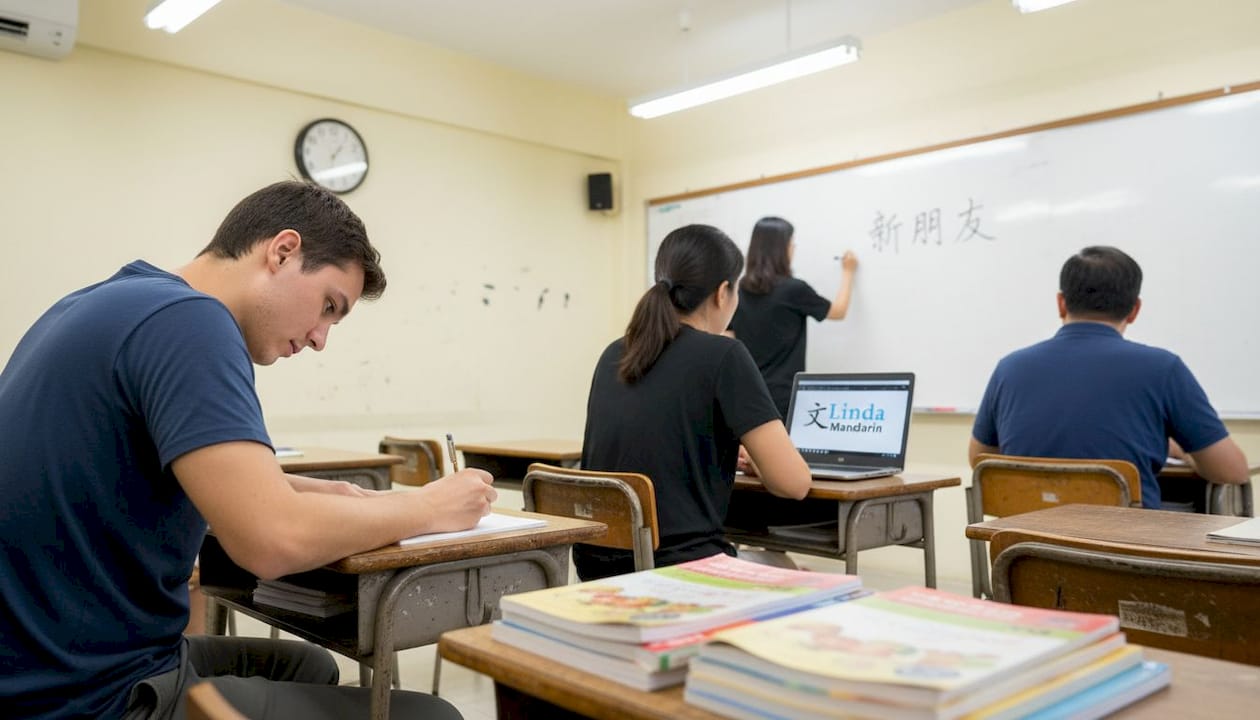
Also avoid the trap of switching courses every few months in search of the “perfect” program. Consistency with a good course beats perfection-seeking every time.
What most guides miss about mastering Mandarin as an adult
Most Mandarin guides focus on methods: which app, which textbook, which class schedule. What they rarely address is the mindset that separates adults who succeed from those who give up after six weeks.
In our experience working with adult learners in Singapore, the biggest predictor of success isn’t prior exposure to Chinese or natural aptitude for languages. It’s adaptability. The learners who progress fastest are the ones who treat mistakes as data, not failure. They don’t catastrophize a mispronounced tone. They note it, correct it, and move on.
Another truth: progress in Mandarin is not linear. Most adults hit a plateau around the intermediate stage where grammar becomes more complex and the initial excitement wears off. This is normal. Learners who understand this in advance push through it. Those who don’t often interpret the plateau as a sign they’ve maxed out.
The real value of learning Mandarin isn’t the certificate at the end. It’s the professional doors that open, the relationships that deepen, and the confidence that comes from communicating across a cultural divide. A practical mindset about Mandarin is the single most underrated asset in this process.
Find the right Mandarin course for your goals
If you’ve worked through the steps in this guide, you’re already ahead of most adult learners who walk into a school without a clear sense of what they need. Putting that clarity into action is the next move.
Linda Mandarin offers Mandarin courses for adults at every level, from first-time beginners to advanced business communicators. Whether you need a flexible online schedule, a fast-track intensive Mandarin course, or structured corporate Mandarin classes for your team, there’s a program built around your actual goals. Located above Tanjong Pagar MRT and offering Zoom-based sessions, Linda Mandarin makes it easy to start regardless of where you work or live. Reach out for a placement consultation and get matched to the right level and format from day one.
Frequently asked questions
How long does it take for an adult to speak conversational Mandarin?
With consistent study, most adults reach conversational level in 6-12 months. Course timelines vary based on class frequency and program intensity.
Can I learn Mandarin in Singapore without prior knowledge?
Yes. Most schools offer beginner-friendly classes designed for adults starting from zero. Mandarin courses range from beginner to advanced in Singapore, so there’s always an appropriate entry point.
What certification can I obtain from a Mandarin course in Singapore?
You can earn HSK certification, which is globally recognized for Mandarin proficiency. Some schools also offer business or corporate certificates. Courses follow proficiency levels that align with standardized international benchmarks.
Are online Mandarin courses as effective as in-person classes?
Online courses can be highly effective when they include live interaction, structured practice, and regular instructor feedback. Flexible learning formats, whether online or in-person, cater to different learning styles and schedules.
Is Mandarin hard to learn for adults?
Mandarin is challenging but absolutely achievable with the right method, consistent practice, and a realistic mindset. With the right approach, most adults find it far more accessible than they initially expected.