Corporate Mandarin training pays off in three measurable ways: stronger client trust, faster deal cycles, and better retention of the employees you invest in. Companies that pair language instruction with real business scenarios see the clearest gains, and providers like Linda Mandarin build programs around exactly that mix. The next step for most HR teams is a short, KPI-driven pilot rather than a company-wide rollout.
TL;DR:
- Effective Mandarin training can significantly improve client trust and shorten deal cycles by enabling direct negotiation and communication in real business scenarios.
- Companies should focus on measurable outcomes such as response times, deal cycle duration, and employee confidence during pilots to justify full program investment.
- A three- to six-month pilot targeting one team with two to three KPIs is advisable before expanding, ensuring the training directly impacts real workplace tasks.
- Training programs combining online and in-person methods with scenario-based instruction outperform generic courses and reinforce practical skills through daily practice.
- Vendors should provide case studies, structured assessments, and customized content aligned with specific business needs to validate the program’s ROI.
Table of Contents
- Which Business Gains Should HR Expect From Mandarin Training?
- Where Does Mandarin Ability Actually Change Business Outcomes?
- How Do You Measure ROI From Corporate Language Training?
- What Delivery Formats and Timelines Actually Work?
- What Proof Should HR Look for Before Signing a Contract?
- How Do You Choose the Right Corporate Mandarin Program?
- Why Business-Aligned Mandarin Training Beats Generic Language Courses
- Ready to Pilot Corporate Mandarin Training for Your Team?
- Sources
- FAQ
Which Business Gains Should HR Expect From Mandarin Training?
Budget conversations need specifics, not vague promises about “cultural competence.” Here is what actually shows up on the balance sheet when employees gain working Mandarin skills.
- Stronger client and partner relationships. Speaking even conversational Mandarin during a client dinner or site visit signals respect, and that trust often outlasts the meeting itself.
- New sales and business development openings. Teams that can pitch, follow up, and negotiate directly in Mandarin skip the delay and distortion of relying on a third-party interpreter.
- Fewer cross-cultural misunderstandings internally. Regional offices and joint ventures run smoother when staff can read tone and intent instead of guessing at a translated email.
- Higher employee engagement and retention. Workers notice when a company funds their professional growth, and that investment shows up in how long they stay.
- A stronger employer brand for recruitment. Candidates weighing offers factor in whether a company actually develops language and market skills, not just job titles.
The hidden ROI of corporate language training extends well past fluency scores. It touches retention, market reach, and how much risk a company carries from miscommunication with Chinese-speaking clients or partners. Given China’s outsized trade footprint, that risk reduction alone often justifies the training budget for firms doing business with Chinese-speaking markets.
Where Does Mandarin Ability Actually Change Business Outcomes?
Language skill only matters where it touches revenue or risk. A few scenarios keep showing up across corporate programs:
- Live negotiations and client meetings. Tone, pacing, and indirect phrasing carry meaning in Mandarin that a translation app tends to flatten out, especially in high-stakes deal conversations.
- Sales and account management. Direct communication with a prospect, without routing every message through a translator, shortens the back-and-forth that slows deal cycles.
- Customer service and after-sales support. Mandarin-speaking customers resolve issues faster when they are not stuck explaining a problem twice.
- Reading Chinese platforms and marketplaces. Understanding local social media and e-commerce sites directly gives account teams and marketers a read on sentiment that a scraped translation misses.
- Managing and mentoring Mandarin-speaking staff. Managers who can communicate directly build trust faster with regional hires than those working through an intermediary.
AI translation tools handle routine tasks well, but they struggle with the nuance that high-stakes negotiations and relationship-building demand. That gap is where trained employees earn their keep, and it is the same limitation you will see if you compare AI voice tools to human voice talent for anything requiring genuine rapport rather than raw information transfer.
How Do You Measure ROI From Corporate Language Training?
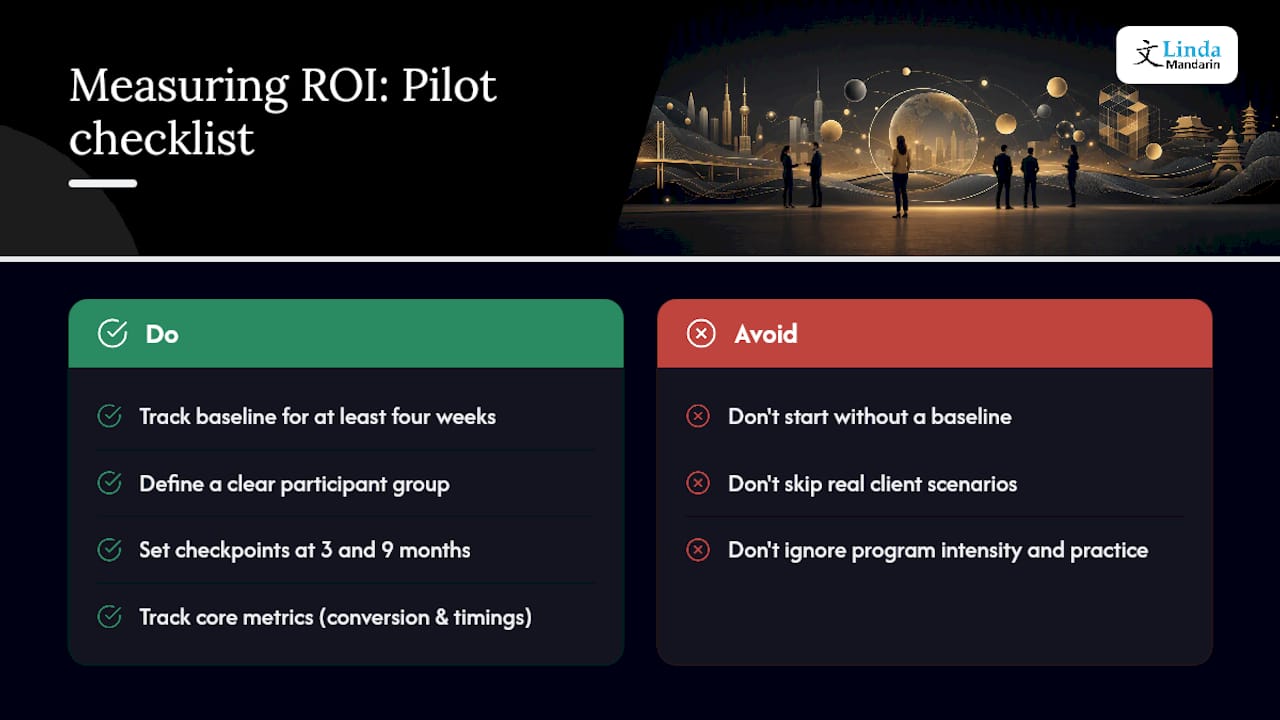
The metrics HR should track are concrete: conversion rate on Mandarin-speaking accounts, deal cycle time, client response time, interpreter hours eliminated, and retention among employees enrolled in training.
Pro Tip: Track your baseline numbers for at least four weeks before training starts. Without a “before” snapshot, you cannot prove the “after” improvement to finance.
Enterprise data backs the productivity case directly: 83% of learners who need language skills on the job report saving time on at least one critical business task after training, and many also report higher willingness to keep training. That is a strong signal for any HR leader building a case to finance.
A measurement-ready pilot needs a baseline, a defined group of participants, and short and medium-term checkpoints, ideally at the three-month and nine-month marks. Keep the caveats honest: ROI depends heavily on how intensive the program is, how directly employees apply Mandarin at work, and whether they keep practicing after the course ends. A program that never touches real client scenarios will underperform no matter how many hours employees log.
What Delivery Formats and Timelines Actually Work?
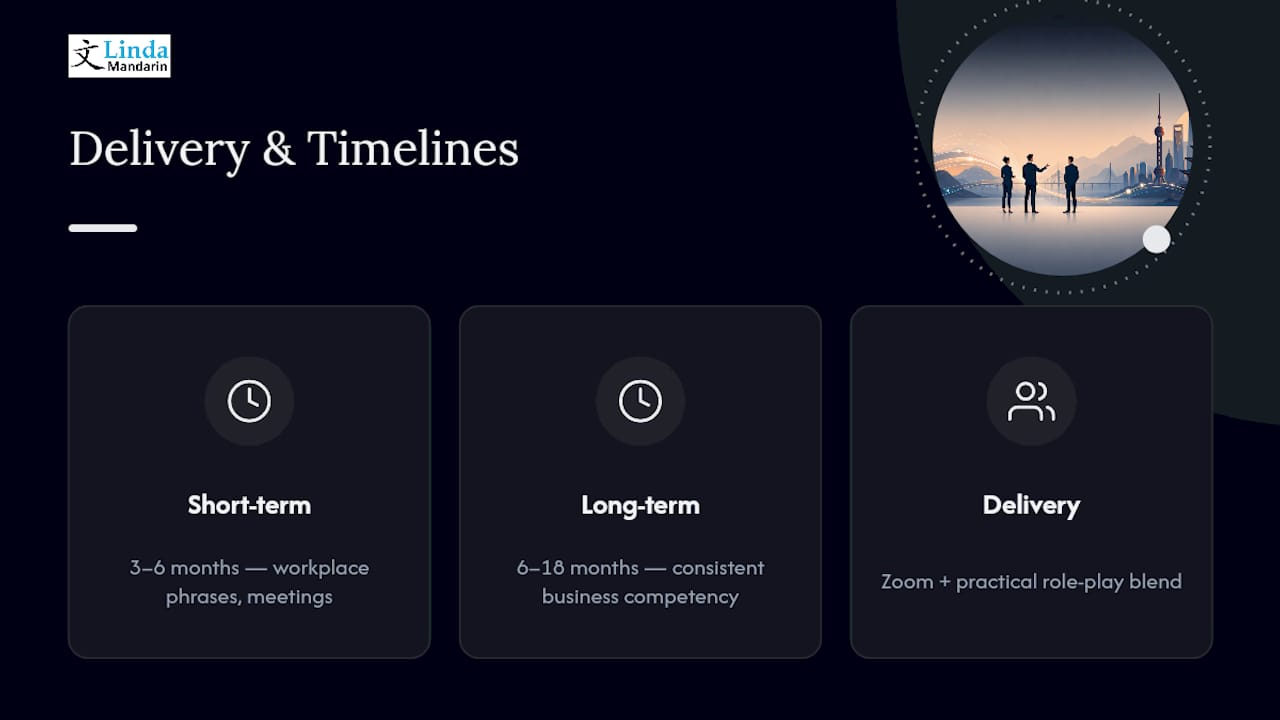
Corporate schedules rarely tolerate a rigid classroom model, so most successful programs blend formats. In-person cohorts work well for teams based at one office; online Zoom sessions suit distributed teams or executives who travel often; private coaching and role-play sessions fit leaders who need targeted negotiation or presentation practice.
Timelines vary by goal. Expect three to six months to build workplace phrases and handle basic meetings confidently. Consistent business competency, the kind that supports unscripted negotiation, typically takes six to eighteen months of steady practice. Blended delivery that mixes Zoom instruction with practical role-play tends to balance cost against business relevance better than either format alone.
Embedding practice into daily work matters more than classroom hours. Mock client calls, language buddy pairings, and supervised shadowing during real client interactions all move learning from theoretical to usable. Budget for a scoped pilot before committing to a scaled, company-wide rollout; it is easier to expand a program that already has proof points than to walk back one that overpromised.
What Proof Should HR Look for Before Signing a Contract?
Linda Mandarin has delivered adult and professional Mandarin instruction since 2003, including corporate training built around business scenarios rather than generic conversation drills. Its instructors are native Mandarin speakers, fluent in English, with syllabi structured around progressive, real-world communication rather than abstract grammar drills.
Ask any provider for:
- Case examples or outcome summaries from past corporate clients in comparable industries.
- A sample syllabus showing business scenarios (client calls, negotiation role-play, meeting etiquette), not just vocabulary lists.
- Instructor backgrounds that include actual business or corporate training experience.
Pro Tip: Structure your first pilot around one sales or client-facing team, run it for three months, and track two KPIs only: response time to Mandarin-speaking clients and self-reported confidence in meetings. Two clean metrics beat ten vague ones when you report back to leadership.
The school’s central location, right above Tanjong Pagar MRT, keeps logistics simple for teams squeezing lessons around work hours, and Zoom options remove the commute question entirely for distributed teams.
How Do You Choose the Right Corporate Mandarin Program?
Vet a provider the same way you would vet any vendor tied to a measurable business outcome, not by how polished the sales deck looks.
- Confirm the curriculum is business-relevant. Ask for a sample syllabus and check that it includes meetings, negotiations, and client service scenarios, not just travel phrases.
- Check instructor experience. Instructors should have real exposure to corporate contexts, not just classroom teaching credentials.
- Ask how the provider measures progress. Look for structured assessment and reporting, not a vague “you’ll improve” promise.
- Request a pilot design. A provider confident in results will happily scope a short pilot with defined KPIs.
- Ask for customization options. Your finance team’s Mandarin needs differ from your sales team’s; the program should reflect that.
Red flags include vendors with no measurement plan, generic textbook materials with no business application, and no clear guidance on post-course practice. Start with a time-boxed pilot, require measurable outcomes, and scale only once you have proof it works for your teams.
Why Business-Aligned Mandarin Training Beats Generic Language Courses
Generic conversational courses teach people to order coffee. Business outcomes require negotiation vocabulary, meeting etiquette, and role-play under realistic pressure, and that gap is exactly where most corporate training budgets get wasted on the wrong curriculum.
Structured pilots with clear KPIs give HR something concrete to bring to finance, and they cut the risk of committing to a year-long program that never proves its worth. Combining language instruction with actual business education accelerates results far more than generic conversation classes ever will. Any HR team weighing this investment should ask a provider to design a small, measurable pilot before signing anything larger.
— Paul
Ready to Pilot Corporate Mandarin Training for Your Team?
Linda Mandarin builds its corporate Chinese Mandarin training around the exact business scenarios this article covers: client meetings, negotiation practice, and after-sales communication, delivered by native instructors fluent in English. Programs run in-person at 10 Anson Road, Level 22, International Plaza, right above Tanjong Pagar MRT, or online via Zoom for distributed teams.
A practical starting point is a scoped pilot: one team, three months, two or three KPIs like client response time and meeting confidence. The school’s business Mandarin programs are built to plug into exactly that kind of measurement-ready structure, with instructors experienced in tailoring lessons to real workplace scenarios rather than generic textbook chapters. If your team is weighing whether a pilot makes sense, reach out through the corporate training page to scope a program around your specific business needs and timeline.
Sources
- The hidden ROI of corporate language training – English Online
- Why learn Mandarin for business – CEIBS
FAQ
What are the benefits of learning Mandarin for business?
Mandarin fluency strengthens client trust, speeds up negotiations, improves internal communication with regional teams, and supports employer branding when companies invest in employee development.
Does Mark Zuckerberg speak Mandarin or Cantonese?
Mark Zuckerberg speaks Mandarin, which he has demonstrated in public interviews and university speeches in China, not Cantonese.
Is Jackie Chan fluent in Mandarin?
Yes, Jackie Chan is fluent in Mandarin, along with Cantonese and English, reflecting his background in Hong Kong film and mainland Chinese productions.
How long does it take employees to become business-ready in Mandarin?
Most employees can handle basic workplace phrases and simple meetings within three to six months, while consistent business competency for negotiation typically takes six to eighteen months of regular practice.
What should a corporate Mandarin pilot include?
A strong pilot defines a baseline, targets one team, sets two or three measurable KPIs like response time or deal cycle speed, and runs for about three months before a scale decision.